After CoreWeave, another publicly traded company signs a $3.2 billion deal with Neocloud.
During the highly anticipated global Nvidia earnings call, in addition to upgrades to their own technology, Jensen Huang mentioned Neocloud once again.
Jensen Huang's fondness for Neocloud is well known. During the earnings call, he continued to believe that Neocloud is an indispensable computing infrastructure for the AI era. Nvidia's investment and capital allocation spoke volumes.
The Neocloud sector has indeed shown great strength, with the two industry leaders, Nebius and CoreWeave, experiencing explosive growth around their respective earnings days, proving to the market that Neocloud is a race that cannot be ignored in this year's tech stocks.
Over the past year, the market has been constantly discussing who can create the next large-scale model. Now, more and more funds are beginning to ask a more practical question: If models continue to grow in size, who will have the capability to run them?
The answer is not just Nvidia. For a GPU to truly become sellable computing power, it needs to be backed by data centers, power supply, cooling systems, network infrastructure, operations and maintenance, and a pre-paid customer order. While the GPUs are still in transit, transformers may have been on backorder for six months; model companies are eager to scale up, yet data center space is becoming increasingly scarce.
As a result, a group of new companies specializing in building AI infrastructure for clients are gaining more attention in the capital markets. They are not selling just a regular cloud account but a complete environment capable of running large-scale models. Customers don't need to buy machines themselves, compete for power supply, or build and maintain their own data center teams from scratch. These companies have a new name: Neocloud providers.
In addition to the more familiar names like CoreWeave and Nebius, there is a company on Nasdaq that has just rebranded and is emerging from the track.
It's called Axe Compute, with the stock ticker symbol AGPU.
On August 14, Axe Compute released its second-quarter earnings report. The report disclosed that the cumulative contracted value for 2026 has exceeded $3.2 billion. If all these projects are fully deployed, the projected annualized revenue run rate is expected to exceed $696 million.
It's clearly not a company on the same scale as CoreWeave. However, for a company that only changed its name at the end of last year and truly began selling computing power this year, these disclosed figures are worth investigating.
What kind of new company is Axe Compute?
Axe Compute is the new brand and strategy following the renaming of Predictive Oncology.
This company used to focus on oncology drug discovery. By the end of 2025, it shifted its focus to AI computing infrastructure, officially rebranded on December 11, 2025, and started trading on the Nasdaq as AGPU the next day. In February 2026, the management team underwent a major change, with Christopher Miglino appointed as CEO, Kyle Okamoto joining as President in April, and Jeremy Yaukey-Witter promoted to CFO in May.
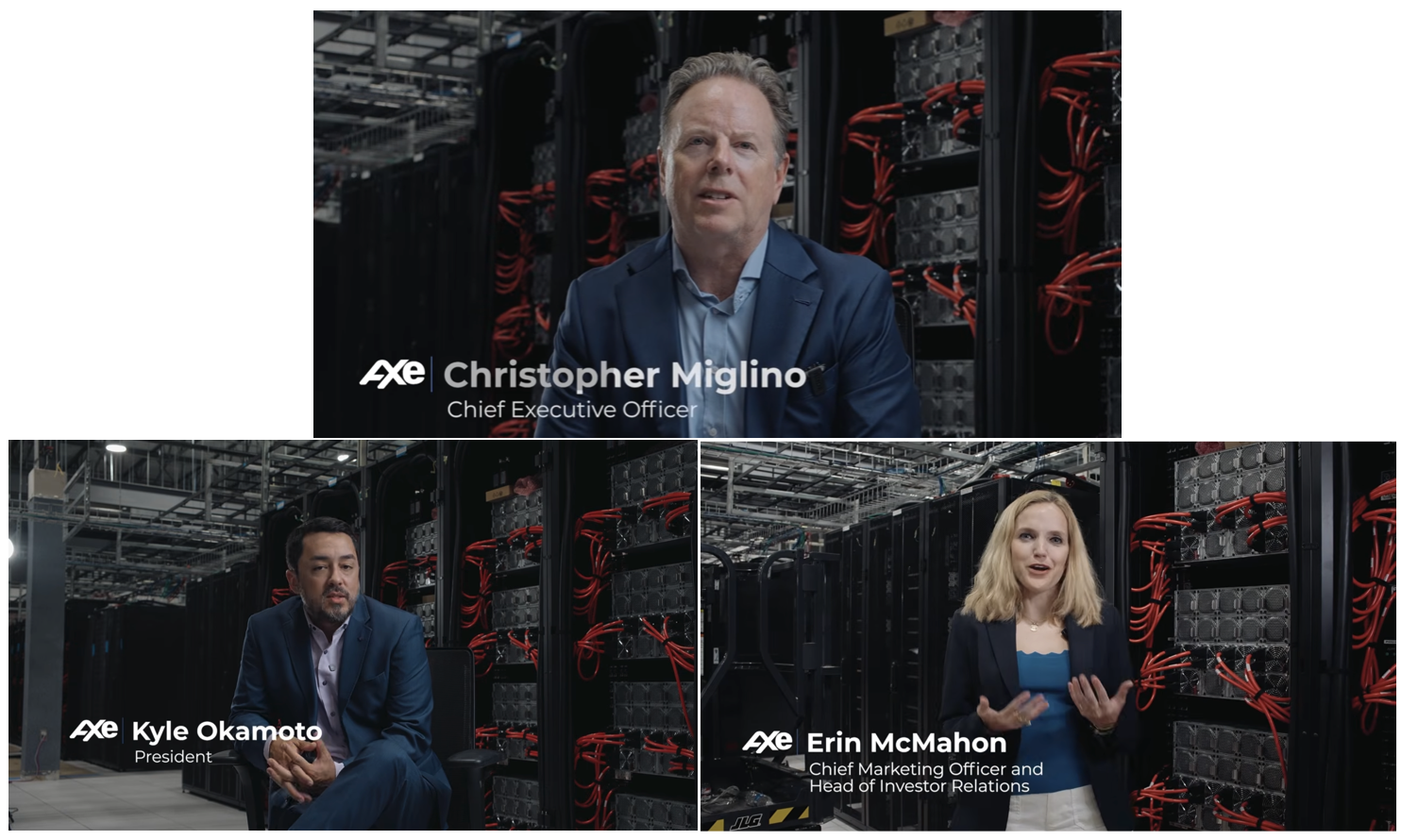
Axe Compute Management Team
At the business unit level, Axe Compute now has two main lines of business.
The first business line is Axe Compute Access, which schedules third-party GPU capacity that is already online, providing customers with immediate computing power. This line mainly leverages the Aethir distributed computing network to access third-party data center resources globally, covering a network of over 200 nodes across 93 countries, with access to over 435,000 GPUs.
The second business line is Axe Compute Build, which designs, deploys, owns, and operates dedicated GPU clusters for enterprise customers. Customers do not need to purchase their own machines or find facilities, nor do they have to take on hardware ownership and maintenance responsibilities. The ownership of the GPU infrastructure remains with Axe Compute, and after the contract period ends, these GPUs could theoretically continue to serve the next customer.
Evidently, the Build business line better showcases the company's ambitions.
In April of this year, Axe Compute secured its first landmark Build contract: valued at approximately $260 million over 36 months, the plan is to deploy 2,304 NVIDIA Blackwell B300 GPUs and associated high-speed storage in a Tier 3 data center in the United States, aiming for a third-quarter launch. If the service period starts smoothly, this contract could bring in around $20 million to $21 million in revenue per quarter.
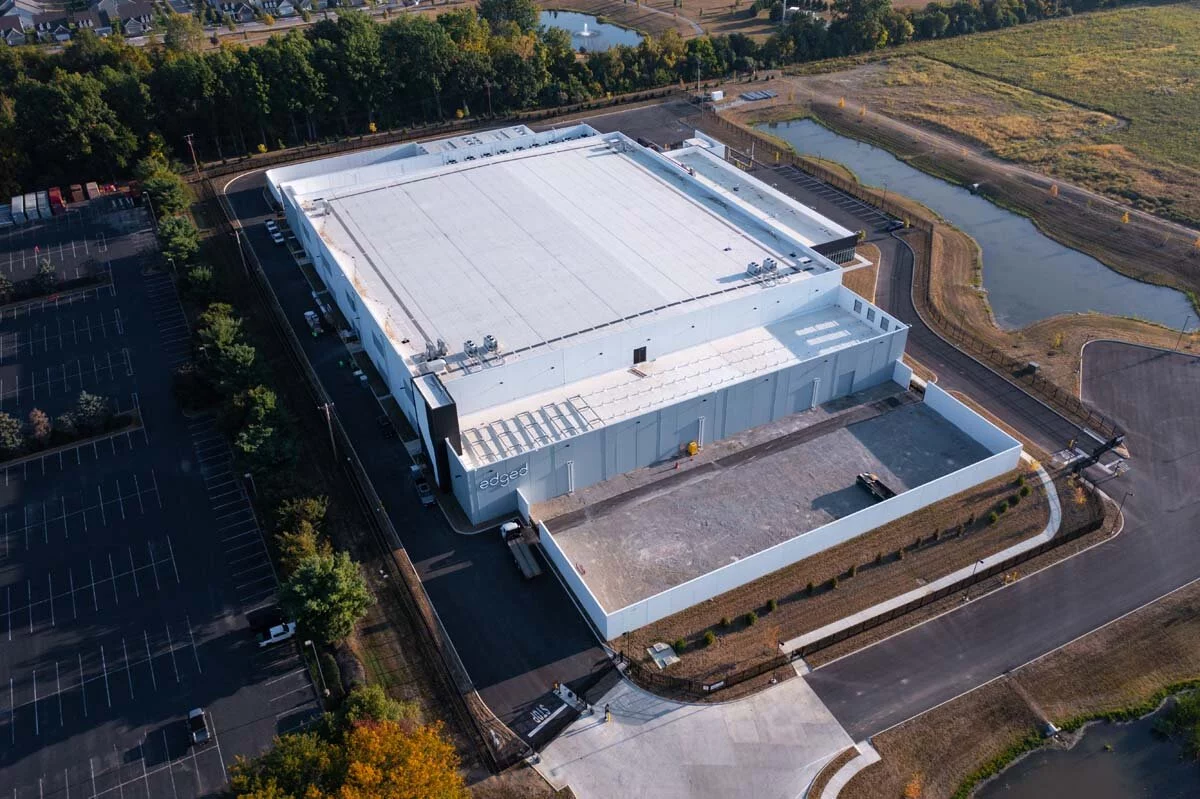
Axe Compute's First Data Center Exterior Built for Duos Company
On the other end of the contract, it will be implemented in a city called Columbus in the southeast of the United States. This was originally an unnamed place on the U.S. data center map. However, in the past two years, due to the inability to expand the power capacity and grid connection schedule in primary hubs, a large number of AI data centers have been migrating to such secondary cities.
The first B300 cluster from Axe Compute is housed in the Duos Edge AI Tier 3 data center park in Columbus. The cluster consists of 288 nodes, with each node containing 8 B300 cards and 288GB of HBM3e memory, totaling the specified 2304 cards in the contract. The nodes are interconnected with InfiniBand Quantum-X800, providing a per-node bandwidth of 6.4 Tb/s, and accompanied by over 20PB of high-speed storage from WEKA.
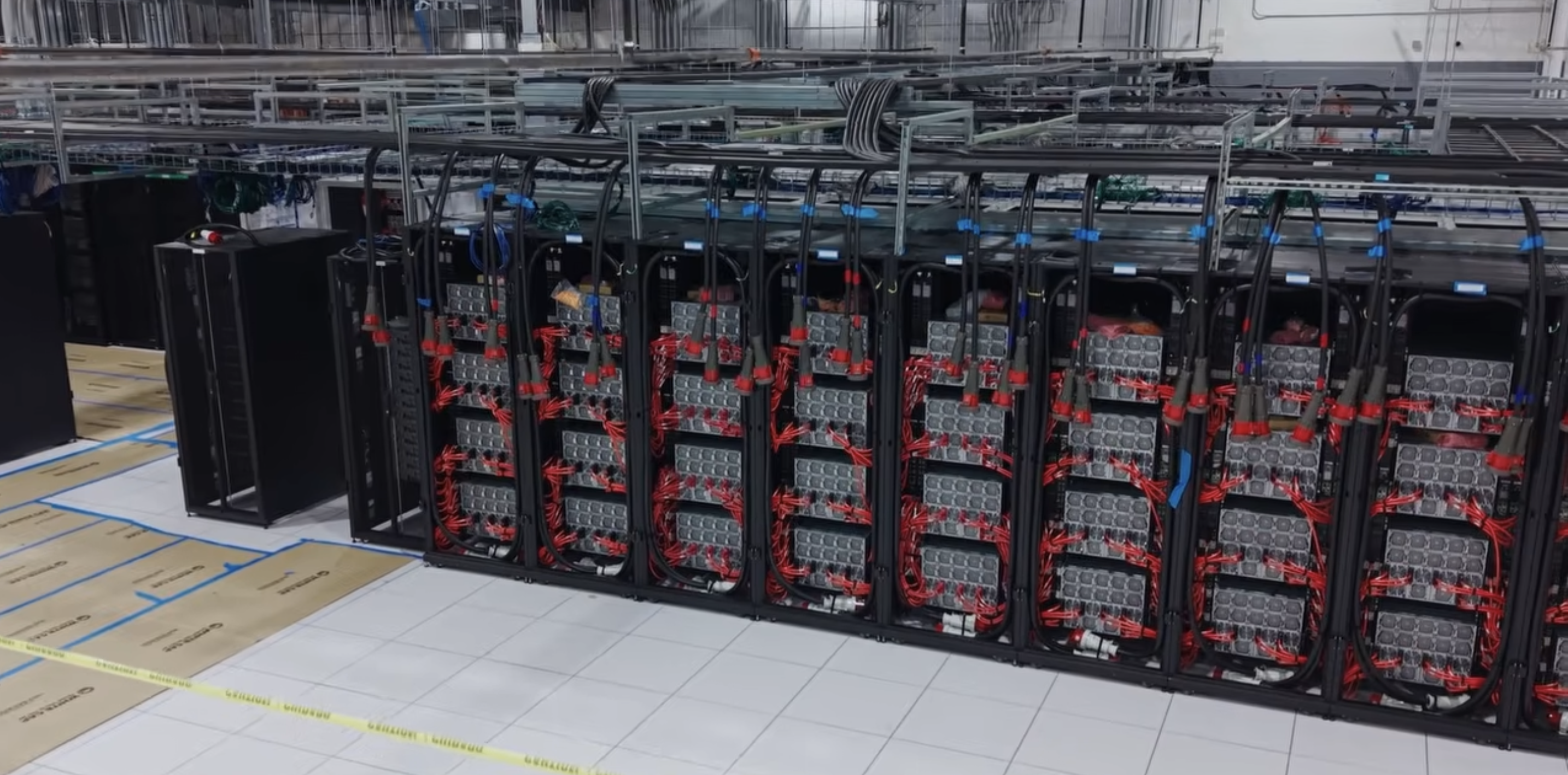
Inside Duos Edge Data Center
Interestingly, during the Q2 earnings call on August 17, the company actually live-streamed from this data center. The first line of the call was: "Today we are live from Columbus, Georgia, where the B300 cluster announced in April is located."
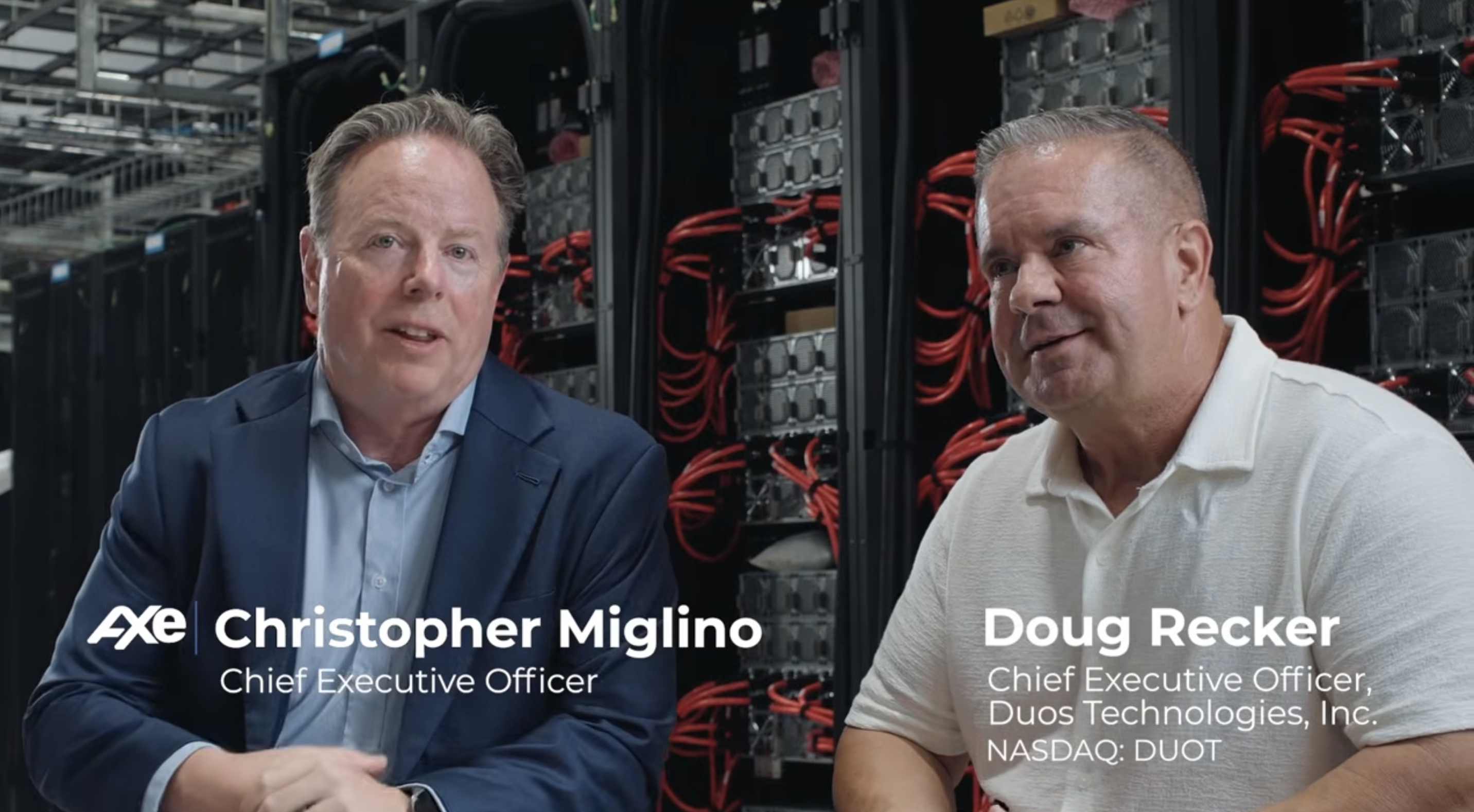
Axe Compute CEO Christopher Miglino and Duos CEO Doug Recker
Duos' CEO, Doug Recker, was present on-site and described the construction progress as follows: "The accomplishments in these 45 days are incredible. If you set up a camera and walk around the site, you'll see how remarkably fast things have progressed." He added, "We won't tell you we can do 100 megawatts in three weeks, but everything you see here was done in 45 days."
The cluster is expected to go online in a few weeks with plans to triple in size over the next several months. Simultaneously, another cluster is being built in Boden, Sweden, consisting of 256 B300 nodes plus spares, utilizing RoCEv2 networking and WEKA storage, and is expected to be online by the end of 2026.
Following this, the signing spree that started in July continued like a tidal wave.
On July 22, the company announced over $1.3 billion in new contracts in the U.S. and Europe, surpassing the $1 billion annual target set just in May. Five days later, on July 27, they revealed another five-year contract exceeding $1.5 billion for deploying a dedicated cluster with over 9200 B300 cards in the U.S., with both contracts including extension options. By mid-August, the cumulative contract value for 2026 had exceeded $3.2 billion, with over $2.8 billion coming from three Build contracts signed in July.
Tripled the full-year target in three months.
Secured $3.2 Billion in Orders Within Six Months
From the Axe Compute Q2 earnings report, the most significant change observed was in revenue.
The company's quarterly revenue was $3.215 million, compared to just around $35,000 in the previous quarter, a nearly 90x increase. For comparison, in the same period last year, this number was $3,000. Operating cash flow for the first half of the year was positive $17.4 million, with $21.9 million in cash at the end of the quarter, compared to $6.9 million at the end of the first quarter.
The cost of revenue in the second quarter was $3.013 million, roughly estimating a gross profit of only about $200,000, resulting in a gross margin of 6.3%.
Whether 6.3% is considered high or low, it is not easy to judge based solely on Axe Compute. To provide context, let's compare this industry leader within the same sector.
During the same quarter, CoreWeave had revenues of $2.58 billion, adjusted EBITDA of $1.51 billion, and an EBITDA margin of 59%. While the revenue scales of the two companies differ by a factor of eight hundred, making them incomparable, the difference in gross profit structures still highlights some issues.
The gap in gross profit structures is not due to scale but rather the nature of the business.
The majority of Axe Compute's revenue in the second quarter came from Access, which is essentially a resale business. Axe Compute purchases capacity already online from a third-party network, marks it up, and sells it to customers, earning the difference in the middle. After all, they do not own the hardware, the data centers, and their pricing power is limited. The gross margin ceiling for this type of business is inherently low. On the other hand, CoreWeave and Nebius sell their own GPUs that they buy, install, and operate, with customers signing multi-year pay-or-play contracts. They earn returns on assets, not matchmaking commissions.
This is also why Axe Compute shifted its main focus to the Build project starting from the second quarter.
Perhaps Axe Compute realized that the Access model could only go so far. These figures may be decent for a company that has just started selling hashrate, but they cannot sustain Axe Compute's true ambitions. Axe Compute needs its GPU infrastructure. As of now, Axe Compute has secured over $3.2 billion in contract orders, and management has estimated a gross margin of 28% to 44% for the Build project.
We all know that the deadline for the second quarter is June 30. Therefore, the three Build contracts signed in July, totaling over $2.8 billion, were explicitly marked as post-quarter events in the company's financial report. It can be said that the second quarter financial report that the market is currently seeing is actually the last report before Axe Compute's transformation.
In the announcement of the $1.5 billion contract on July 27, the company said it expects to receive accumulated prepayments of over $534 million within 30 days. During the call on August 17, Miglino announced the first one: over $317 million in prepayment has already been received for the expanding cluster.
In other words, the $3.2 billion contract and the $300 million prepayment already received can be said to be more important data in the Q2 financial report than revenue.
This is the most counterintuitive part of the Neocloud track: long-term committed contracts' future cash flows can be pledged. The $104 billion order backlog at CoreWeave is essentially a risk mitigation mechanism that locks in future income before asset depreciation, allowing the company to borrow at a lower cost. In March 2026, CoreWeave used these contracts as collateral to complete a debt financing of about $8.5 billion, becoming the industry's first GPU collateralized loan to receive an investment-grade rating. Nebius is following the same path, with over 70% of its new deals in the second quarter bringing prepayments, expecting to receive over $9 billion for the full year.
And the willingness of major players to be the "prepaying party" is a key motivation: purchasing computing power from Neocloud can be recognized as operating expenses according to the contract term, without the need to capitalize it all at once as in a self-built data center, which would crush the already strained free cash flow. Therefore, the order has been completely reversed. In the past, the supplier would first invest money to build the infrastructure and then wait for the customer to migrate gradually; now, the customer first locks in capacity, pays in advance, and the supplier uses the contract and prepayment to purchase GPUs, reserve data centers, and secure financing.
With $317 million in cash coming in, it means that a significant portion of the external financing required for this deployment has been directly compressed, allowing the company to immediately initiate equipment purchases and lock in data center capacity without the need to first go through a round of equity or debt financing. The fact that customers are willing to pay upfront before the cluster is operational is the most direct endorsement of order authenticity and stickiness; for downstream project financing parties, this is also a cash voucher that can be used for due diligence.
Axe Compute has also provided its cash realization rhythm for the near future: end-of-second-quarter annualized revenue run rate of $37 million, rising to approximately $139 million after the Columbus cluster goes online, exceeding $696 million after the deployment of all signed contracts, almost doubling the previous guidance of $385 million, pointing to the fourth quarter of 2026 to the first quarter of 2027.
Looking ahead, the company's disclosed qualified sales pipeline size is $5.9 billion, with 98 opportunities, nearly double the size of current signed contracts. Miglino stated during the performance call on August 17, "We are still confident that we will sign an additional $2 billion in contracts by the end of this year."
From Accessible Computing Power to Power Control, Axe Compute Aims to Go Deeper
In the AI infrastructure, the most prominent term is GPU, but what is truly hard to come by is often power and space.
After a B300 is delivered to a data center, it still requires high-density power supply, liquid cooling, networking, and a sufficiently stable data center environment. While chips can be produced, obtaining a site and grid connection often takes longer. Therefore, whoever secures land and power capable of running next-generation GPUs first is closer to landing the next big contract.
This is also the essence of Axe Compute's recent collaboration with Duos Technologies.
On August 17, the two parties announced an additional allocation of up to 55MW of AI data center capacity, with projects spread across multiple locations in the United States, with total expected payments exceeding $500 million. As mentioned earlier, prior to this, the two had been advancing a 10MW project in Columbus, Georgia, with Duos in the delivery phase. The preliminary project readiness target for the additional capacity is to begin by the end of 2026 and continue into early 2027.
However, the most crucial aspect of this agreement lies not in the capacity but in a change of identity.
The two parties simultaneously signed an agreement, with Axe Compute making a minority equity investment in the relevant project entities, expecting to hold approximately 49% of the shares, participating in the ownership and financing of some facilities through special purpose entities.
In other words, Axe Compute is no longer just leasing someone else's data center but holds equity in the building and power facilities that support its own clients. Ownership brings long-term control over capacity and costs, a real asset behind multi-year customer contracts, and the right to expand at its own pace without having to queue up each time.
At a time when power resources have become the most critical bottleneck in the entire AI infrastructure, the value of this move is easy to understand. GPUs can be ordered, data centers can be rented, but whether a site can secure enough power and when it can be grid-connected is a scheduling issue that money cannot solve. By securing a 55MW capacity ahead of time, it ensures that customer deployments will not be delayed due to site, power, or construction progress, thus achieving certainty ahead of schedule.
Initially, Axe Compute accessed online computing power through a third-party network; subsequently, it began building dedicated GPU clusters for clients; now, it is attempting to enter colocation data centers and power projects hosting clusters. It aims to move from a role of "purchasing capacity to resell to customers" to a position of "co-owning and operating infrastructure."
This is also the difference between Axe Compute and CoreWeave.
CoreWeave is already a scaled AI cloud company, with strengths in large-scale GPU clusters, mature deployment capabilities, software systems, and a plethora of operational customer contracts. Operating dozens of large AI data centers in North America and Europe, it leverages InfiniBand high-speed interconnects and Kubernetes native orchestration to build single-room multi-card training clusters, serving the large-scale training needs of top AI labs.
Axe Compute does not yet have this scale. Its starting point is more suitable for its own situation, initially meeting immediate needs through Access, using Aethir Network's distributed resources for global coverage and rapid access, then embarking on Build projects for customized heavy asset delivery. The combination of light asset access and heavy asset customization allows it to penetrate areas of the market uncovered by CoreWeave and meet more diversified customer demands in deeper market segments.
It must be objectively acknowledged that Axe Compute is still far from CoreWeave.
It does not have the scale that CoreWeave has already achieved; its $104 billion order backlog is over thirty times its $3.2 billion contracted value. It also does not have the power assets accumulated over many years by traditional data center companies; the 55MW equity arrangement still needs to go through formal documentation, delivery conditions, and approvals from both sides. The adjusted EBITDA for the second quarter was -$4.9 million, and the company is still in the early investment stage; the management's provided gross margin for Build projects is 28% to 44%, with an EBITDA margin of 62% to 76%, but these are only estimates once projects are mature and operational.
Of course, this does not mean that AGPU can be directly compared to CoreWeave or Nebius. The market's undervaluation of it is fundamentally pricing in early delivery risks: contracts need to turn into prepayments, prepayments need to turn into live clusters, and only then will they translate into revenue on the financial statements. However, the misalignment of a "large order, small company" is precisely the aspect of this company that is most worth monitoring going forward.
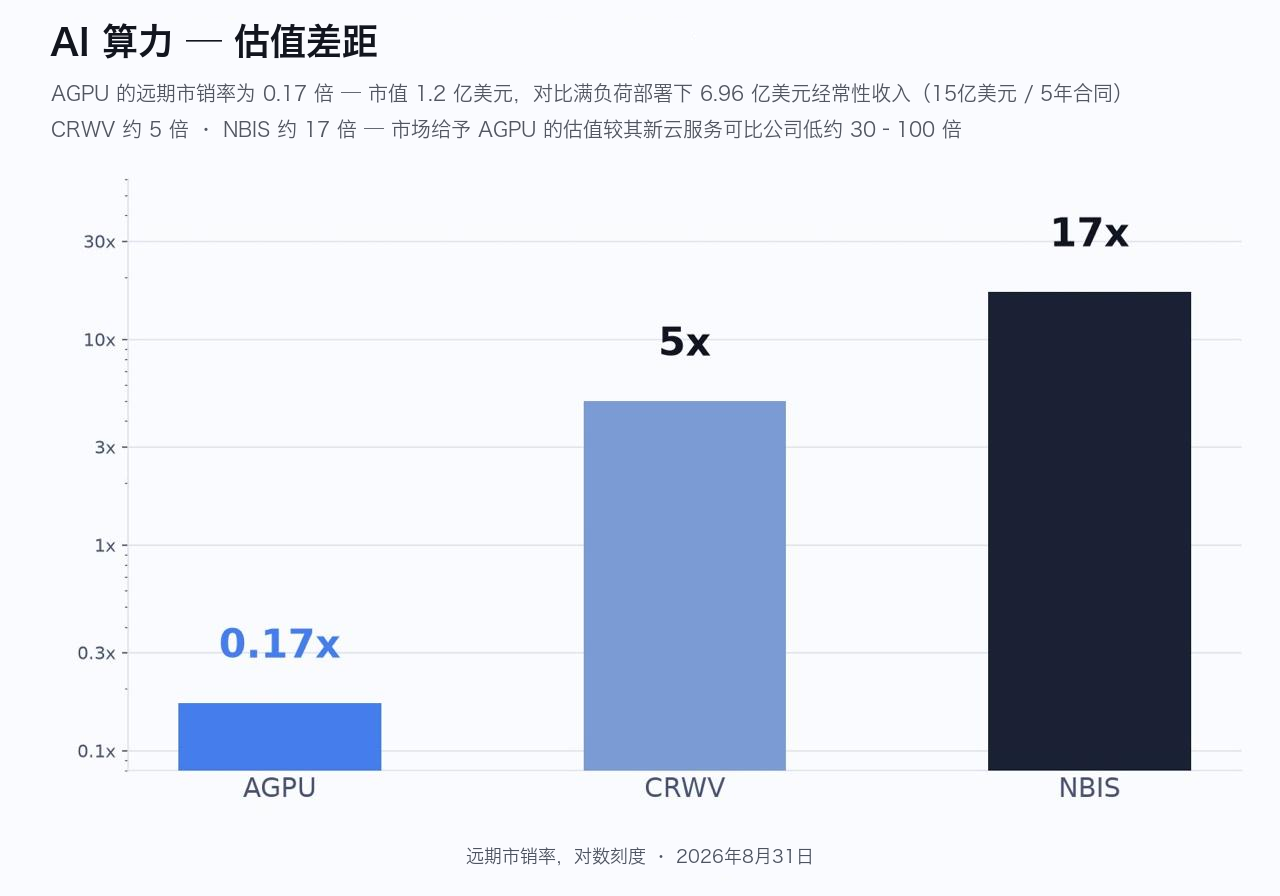
Market-to-Sales Ratio Comparison Chart
Translating orders into valuation language more familiar to the capital markets, the contrast of Axe Compute would be more intuitive. As of August 17, AGPU's market cap was approximately $90 million; and the company's stated projection is that after the deployment of all signed projects, the annualized revenue run rate is expected to exceed $696 million. Based on this forward-looking estimate, Axe Compute corresponds to a market-to-sales ratio of about 0.13x.
Comparatively, at the same time, industry leaders like CoreWeave and Nebius, with market caps in the tens of billions of dollars, have market-to-sales ratios of 5.5x and 24x, respectively. The significant gap highlights Axe Compute's potential as a company with a large order book but still a small market cap.
After all, its advantage lies precisely in its light start and quick pivot. The Aethir network allows it to provide callable computing power even without its own data center, enabling it to earn its first revenue; Build contracts and the subsequent prepayments then provide it with an entryway to transition to heavy asset delivery without having to first burn through a round of equity to build the first data center.
CoreWeave has shown the capital markets one thing: AI computing power can be turned into a business involving long-term contracts, equipment financing, and infrastructure operation. Axe Compute is far from reaching that stage.
However, from the initial $260 million contract in April to the $317 million prepayment received in August and the Columbus cluster about to be lit up, Axe Compute has at least found its own path to enter the field.
In the coming months, things worth keeping an eye on include: whether the B300 cluster in Columbus can be lit up as scheduled; whether the received prepayments can continue to be converted into equipment deployment and revenue; and whether the "additional $2 billion contract signed by the end of the year" mentioned by Miglino in the conference call can truly materialize.
The $3.2 billion contract value has already brought Axe Compute to the forefront, and the 0.13x market-to-sales ratio also makes us aware of its potential as a company with a significant order book but still a small market cap.
Whether this dislocation can converge in the future will also depend on whether the contracts can be timely converted into live clusters and confirmed revenue. Therefore, in the next few months, we can also continue to pay attention to: when Axe Compute's cluster in Columbus will be lit up, when customers will start billing; Miglino's year-end target of $20 billion, and how much will actually be achieved.
Welcome to join the official BlockBeats community:
Telegram Subscription Group: https://t.me/theblockbeats
Telegram Discussion Group: https://t.me/BlockBeats_App
Official Twitter Account: https://twitter.com/BlockBeatsAsia