Where to Provide Liquidity for Stock Tokens? A Quick Look at the Top Five Emerging AMMs on Robinhood Chain

Original Title: "Where to Provide Liquidity for Stock Token LP? A Quick Look at the Top 5 Emerging AMMs on RobinhoodChain"
Original Author: Golem, Odaily Planet Daily
There is no doubt that the Robinhood Meme Trench environment has gradually become "hot." The dual concentration of funds and attention has greatly increased the heat of the game, making it difficult for ordinary people who cannot be faster and more agile than P Junior to be eliminated.
Fortunately, there is more than one way to make money on Robinhood, and players have found that providing LP for stock tokens and Meme coins is also a good business. The reason is that currently, most of the Meme coins that are trending on the Robinhood Chain are trading pairs with stock tokens. The usual trading path for ordinary players in the front-end aggregator is WETH → USDG → Stock Token → Meme Coin. If a user is using a FOMO platform, they may even have to go through an additional process.
Moreover, the trading demand for Meme coins is most easily influenced by market sentiment. Once a certain Meme coin receives sudden attention, the underlying LP fees can skyrocket instantly. Crypto KOL @0xanonnnn posted, "On the Robinhood Chain, LP for Stock or LT base pool meme on uni V4 has a high fee level, with daily APY reaching over 100000%." This shows that the returns from providing LP for stock tokens and popular Meme coins may not necessarily be lower than those from Meme coin farming.
Providing LP, as one of the classic gameplay methods in DeFi AMMs, is familiar to veteran players. Since the launch of the Robinhood Chain, Uniswap has quickly become the mainstream AMM and liquidity infrastructure, with Uniswap V2, V3, and V4 accounting for over 90% of the trading volume on the Robinhood Chain. Therefore, most users choose to provide LP on Uniswap.
However, in the Robinhood Chain ecosystem, some emerging AMM projects are also rising and attracting attention. The advantage of participating in early-stage AMM projects is the ability to enjoy the "head mining bonus," speculate on the project's subsequent token issuance and airdrop expectations. This article will introduce 5 emerging AMM projects on the Robinhood Chain.
(Risk Warning: Players need to consider and evaluate a series of "hidden" costs, including impermanent loss from LP, high price volatility, new protocol risks, etc.)
up.: Protocol Revenue 100% Returned to Token Holders
up. is the native ve (3,3) trading and liquidity layer on Robinhood Chain, launched on July 11, with the official release of the UP token at the same time. The current market cap is $3.9 billion with a total token supply of 5 billion. However, this includes non-circulating tokens, with over half of the supply being burned. The actual circulating supply at launch was only 20 million tokens, with approximately 1 million tokens released into circulation weekly. Therefore, the true circulating market cap is only around $15 million.
As of the time of writing, up.'s total TVL has reached $12.74 million, ranking 7th in the Robinhood Chain. There are two pools on the platform with TVL exceeding $1 million, with the UP/WETH liquidity pool TVL at $2.39 million and the UP/STONKBROKER liquidity pool TVL at $1.64 million.
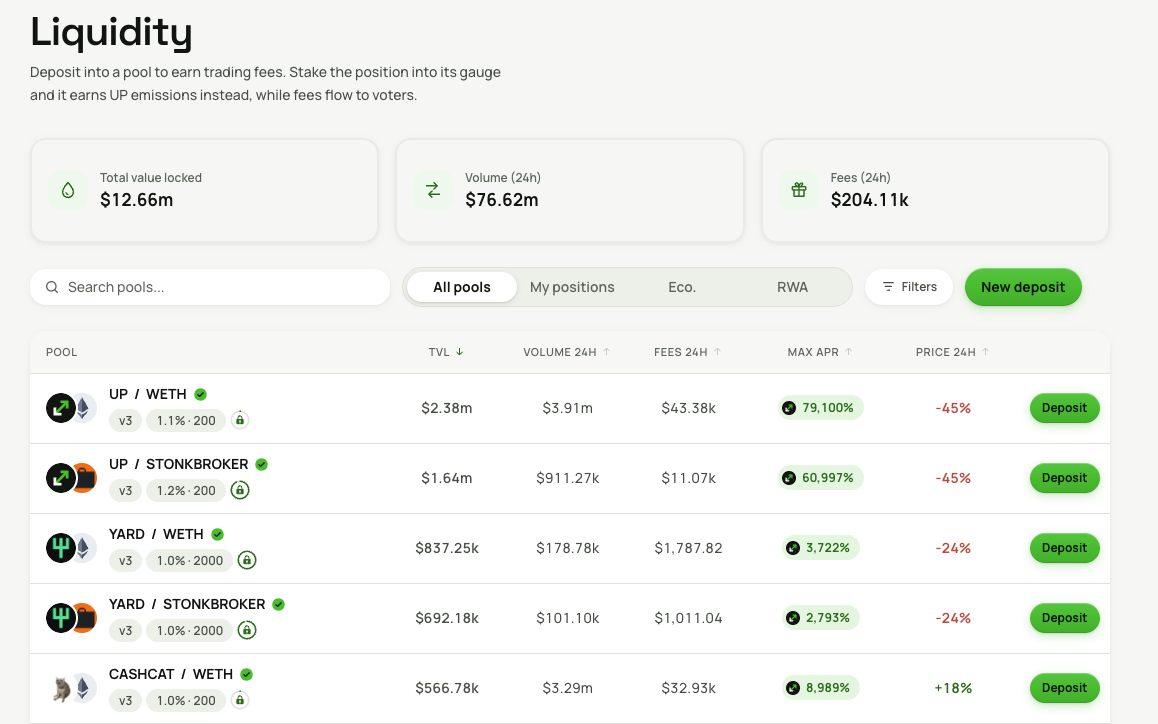
up. will return 100% of the protocol revenue to UP holders. According to DeFiLlama data, up. is also the third-highest protocol in terms of token holder revenue on the Robinhood Chain in the last 30 days.
Fables: Points Program Launched, October TGE
Fables is also a native ve (3,3) DEX on the Robinhood Chain, launched on August 18, with the main difference from up. being the introduction of the Hook. Fables uses the Hook to individually write fee logic for each liquidity pool, setting fees at transaction time to adjust fee rates in real-time with market fluctuations.
At the same time, Fables has also issued a token called PROLOGUE, with a total supply of 10 billion and a current market cap of $5.7 million. However, Fables has announced a TGE where the official governance token, FABLES, with a total supply of 10 billion, will be introduced. During the TEG, PROLOGUE can be exchanged for FABLES at a ratio of 40:1, and all creator fees generated by PROLOGUE transactions will be rewarded to Fables' LPs in USDG.
According to the official announcement, during the FABLES TGE, a maximum of 115 million tokens will be airdropped directly to the community. Fables has also launched a 6-week TGE program (August 24 to October 5), and at the end of this program, Fables will TGE. The entire event consists of 1 billion points distributed daily, where LPs for all liquidity pools on Fables can earn points.
However, Fables did not specify whether the TGE would launch on a trading platform or just issue tokens on-chain.
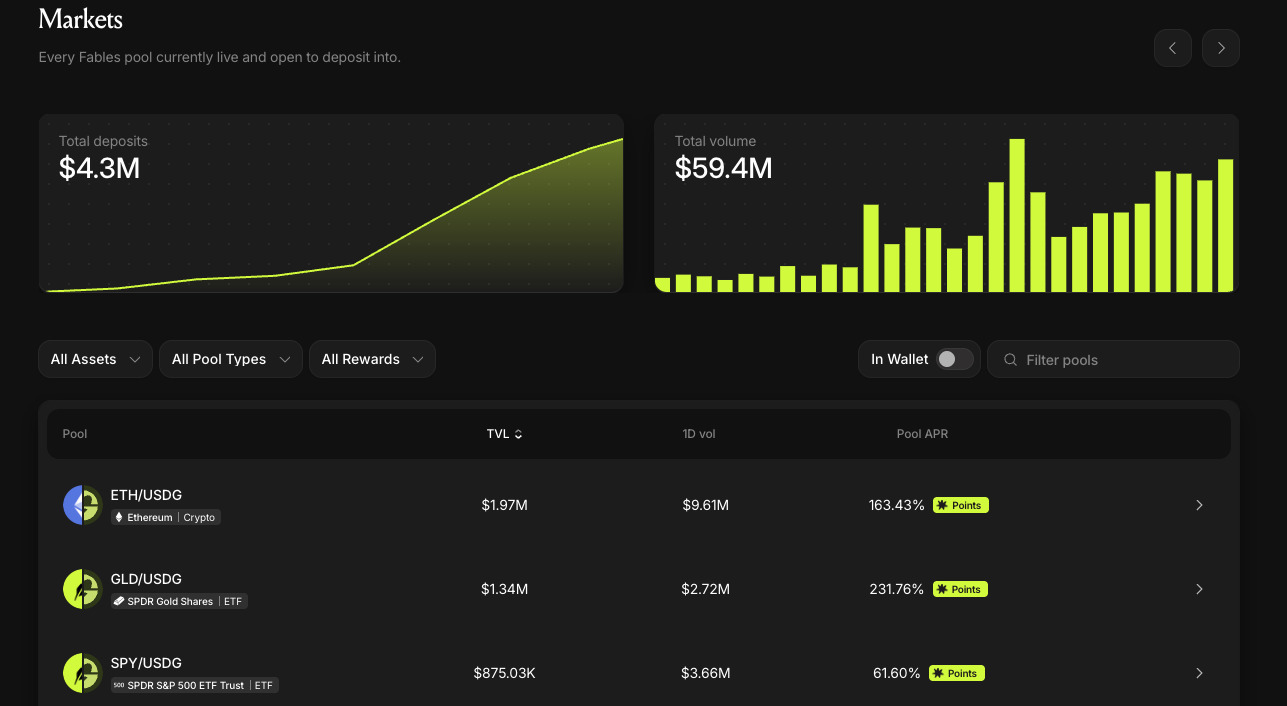
As of the time of writing, the total value locked (TVL) on the Fables platform has reached $4.3 million. Among the pools with TVL exceeding $1 million, there are two pools: the ETH/USDG liquidity pool with a TVL of $1.97 million and the GLD/USDG liquidity pool with a TVL of $1.34 million.
RAMSES: Prominent AMM on Arbitrum
Ramses is a cross-chain AMM that has been live since 2023 and is a well-known AMM on Arbitrum, now deployed on the Robinhood Chain. The key difference between Ramses and up. and Fables is its use of a pure V3 DLMM fee model on the Robinhood Chain, without ve governance.
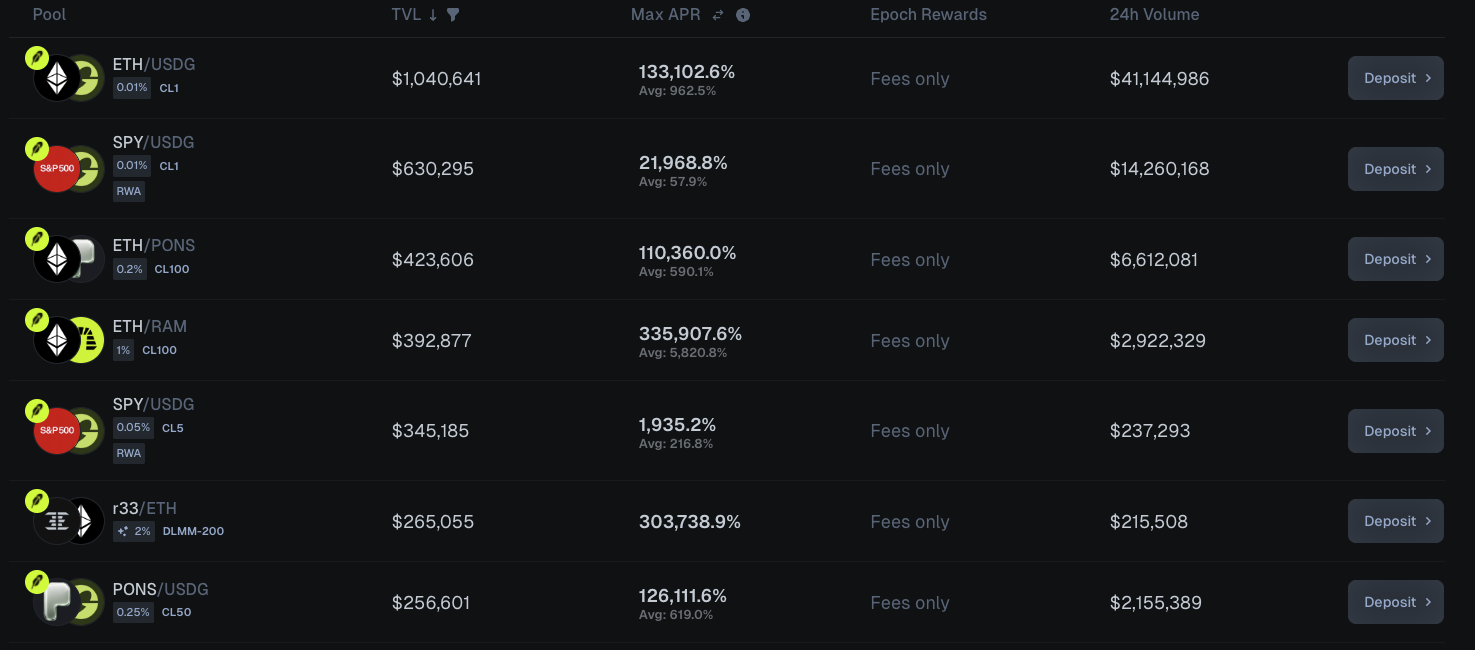
Ramses has also launched a new token, RAM, on the Robinhood Chain, with a current market value of approximately $8 million. As of the time of writing, the largest pool on the Ramses platform on the Robinhood Chain is the ETH/USDG pool, with a TVL of around $1 million.
Delta: Automatically Converting Protocol Fees to Liquidity
Delta is the liquidity layer on the Robinhood Chain, launched on August 10. Delta adopts a traditional AMM architecture, supporting users to provide both bilateral and unilateral liquidity for token pairs. Users can also directly deposit tokens into the staking pool, where the project will automatically convert revenue into liquidity and reinject it back into the pool. As of the time of writing, the total TVL on the Delta platform has reached $1.37 million, with total fees amounting to $895,000.
Delta has also issued the DELTA token, with a current market value of approximately $16.8 million, reaching a peak market cap of $38 million.
Ekubo: "Gilded" Old Project on Starknet Fails
Ekubo is an AMM project founded in 2023 that was previously active on Starknet and in the Ethereum ecosystem, with a total TVL on Starknet reaching $19 million.
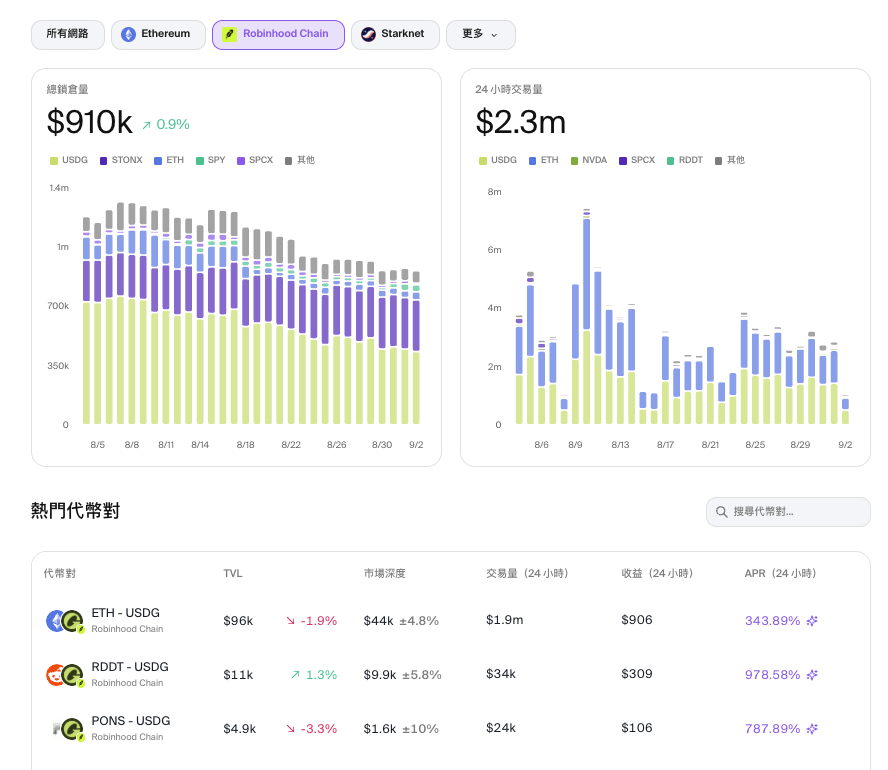
On July 31st, Ekubo announced support for Robinhood Chain, allowing players to provide liquidity for the token pairs on the chain. However, Ekubo's Total Value Locked (TVL) on Robinhood Chain is not high, only $910,000, with the most popular liquidity pool being ETH/USDG with a total TVL of $96,000. It can be seen that the project did not achieve much success in "gilding" on Robinhood Chain.
Original Article Link
Welcome to join the official BlockBeats community:
Telegram Subscription Group: https://t.me/theblockbeats
Telegram Discussion Group: https://t.me/BlockBeats_App
Official Twitter Account: https://twitter.com/BlockBeatsAsia