Interview with Transtronics' CEO Wang Fangzheng | From Lab to Market, the Commercial Adventure of a One-Legged Robot

Original Title: "Interview with Wang Fangzheng from Leap Robotics | From the Lab to the Market, the Business Adventure of a One-Legged Robot"
Original Author: DeepTechBeating
In June 1984, roboticist Marc Raibert and two colleagues published a paper on a robot with only one leg.
The machine hopped on a single, elastic leg on a flat surface. Researchers attempted to control it from three aspects: direction, posture, and bounce height. The paper demonstrated that jumping could be systematically controlled. However, limited by the technological level of that era, the robot was always tethered to hydraulic hoses and data cables, connected to an external power source and computer, making it unable to operate independently outside the lab.
Two years later, Raibert incorporated this research into "Legged Robots That Balance." Starting from a single leg, he extrapolated the same principles of motion to bipeds and quadrupeds. In 1992, he founded Boston Dynamics from MIT's Leg Lab. Spot was not commercially available until 2020.
It took over thirty years from the first one-legged robot hopping to a quadruped robot being purchased by customers.
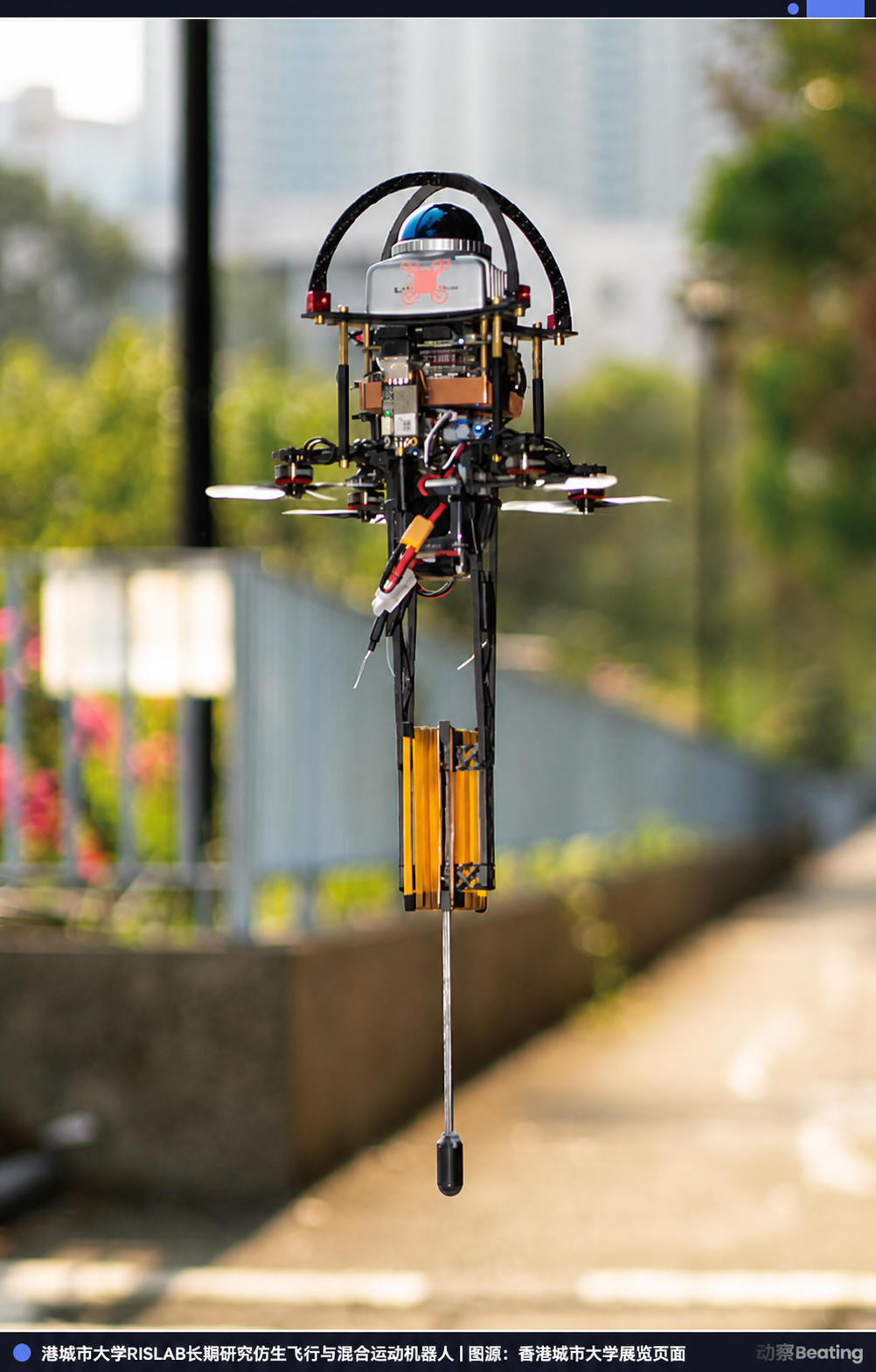
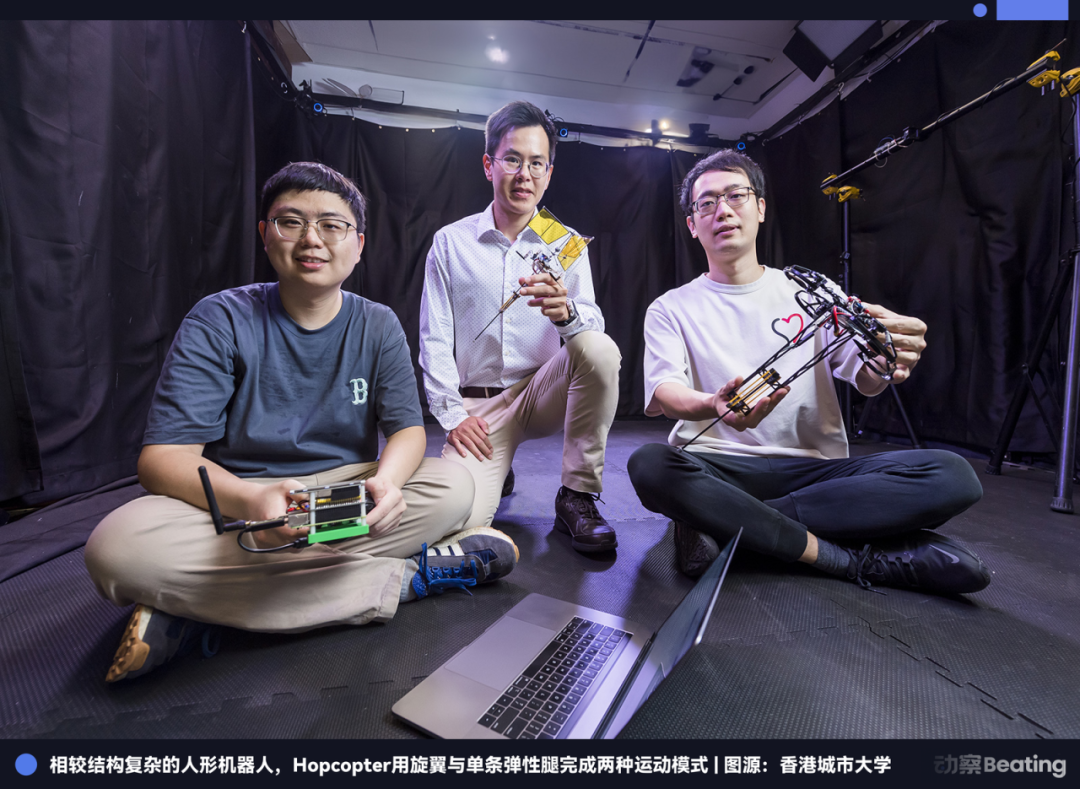
In August 2026, we witnessed another one-legged robot that could stably hop continuously without relying on external devices. Moreover, it took less than two years from paper publication to mass production. It consists of a carbon fiber elastic leg and four rotors. Upon landing, it compresses a spring, takes off using rotors, adjusts posture, and can even fly directly over uncrossable gaps. The research team at the City University of Hong Kong named it Hopcopter. MoonLeap Tech, based in Hong Kong, gave it a more direct Chinese name, "Jumping Robot."
MoonLeap Tech originated from the City University of Hong Kong's Robotics and Artificial Intelligence Laboratory. In 2024, Bai Songnan and others published a paper on Hopcopter in Science Robotics. Wang Fangzheng then joined forces with his senior Bai Songnan and supervisor Professor Pakpong Chirarattananon to turn the research project into a company. The company has received a million-dollar seed round of investment exclusively from ENNO Capital and is advancing towards the next round of funding. The first-generation remote-controlled product is aimed at enthusiasts, with a future version for developers to further customize.
Our burning question is simple, "What is this thing for?"
Wang Fangzheng admits that MoonLeap Tech is wielding a big hammer and is still searching for the nail that best fits it. He also insists that jumping will become a distinct form of robotics. When investors inquire about profits and PMF, he discusses the principles of motion and future visions. At the end of the conversation, he says:
“More importantly, being able to survive ten years later.”
A Spring
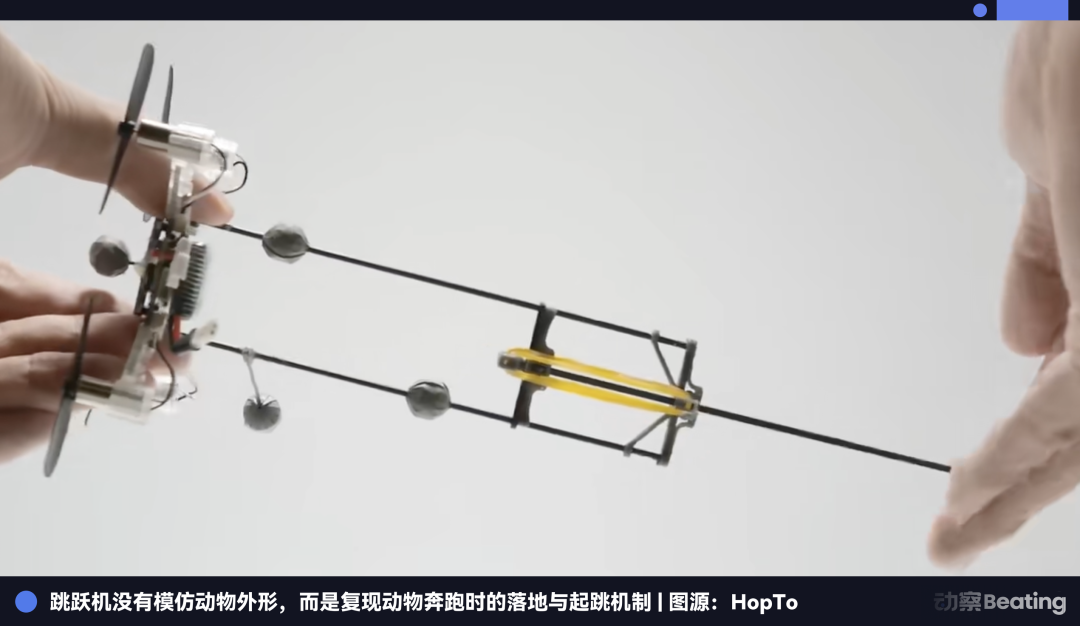
Wang Fangzheng, born in 1999, obtained a master's degree in Human and Biological Robotics from Imperial College London, and then pursued a Ph.D. at City University of Hong Kong. The original technology of Tiao Yue Technology came from his senior brother, Bai Songnan. Bai Songnan and the team abstracted the process of an animal running, landing, compressing, and taking off again into an inverted pendulum spring, and then attached a passive retractable leg under a quadcopter.
This route carries a strong laboratory flavor, and all the commercial issues faced by Tiao Yue Technology later started from this spring.
Dynamic Beating: First, please introduce yourself and how Tiao Yue Technology started.
Wang Fangzheng: My name is Wang Fangzheng, and I have a master's degree from Imperial College London, specializing in robotics. After graduation, I went to City University of Hong Kong to pursue a Ph.D. under Professor Pakpong Chirarattananon, where I met Dr. Bai Songnan, my senior brother, and was exposed to his research on the Hopcopter, or jumping robot.
I thought this was a very meaningful research achievement with a lot of future possibilities; perhaps it could become a new form of robot. Later, my senior brother, advisor, and I co-founded Tiao Yue Technology and have been working on it ever since.
Dynamic Beating: What problem did the lab initially want to solve, and why did it end up creating a jumping robot?
Wang Fangzheng: The lab we are in is one of the world's top drone labs and has explored many forms. Some drones can roll on the ground like wheels, some can spin and fall like seeds, some are flown with a motor attached to a rope, and we have also developed drones that can transform, combine, and disintegrate.
As long as a drone remains in the air, it cannot escape gravity, and it is challenging to simultaneously solve payload and endurance. We thought of using gravity to make the robot bounce back after landing. This way, both payload and endurance could be significantly improved.
A Machine “Person” Doesn't Necessarily Have to Look Like a Human
The bionics of the jumping robot lie in its motion. It did not replicate the shape of any specific animal but only took that moment when a human or animal lands, compresses, and pushes off during a run. Wang Fangzheng believes that the form a robot adopts should be determined by the task, cost, and efficiency.
This judgment also determined how Tiao Yue Technology describes its technology. It is primarily a means of movement responsible for bringing the machine to places that wheeled and legged robots find difficult to reach. The mechanical arm, sensors, and large-scale models can be considered later.
Interview Beating: Why do you think many tasks do not need to be assigned to humanoid robots?
Wang Fangzheng: I have always believed that robots do not have to look like humans. Of course, humanoid robots have their advantages. They can dance, and many real-world environments are designed according to the human body, making it easier for humanoids to adapt to these environments.
If a screw needs to be tightened in a factory, you can either have a humanoid robot reach out to tighten it, or you can have a screwdriver come down from above to tighten it, and after it's done, the assembly line will send the product to the next station. I prefer the latter approach because cost and efficiency need to be considered.
Many people say that a leaping robot is not biomimetic, and I must correct this. It is very biomimetic; it just doesn't look like familiar animals to us. It mimics the moment when a person lands and jumps during a run. We call this motion model a spring-loaded inverted pendulum. Biomimicry only needs to capture the core features. Humans make radars without needing to shape them like bat ears.
Interview Beating: Compared to robot dogs and wheeled-legged robots, what are the most suitable work scenarios for leaping robots?
Wang Fangzheng: The two core advantages of leaping robots are all-terrain capability and long endurance. Any place that requires these two capabilities could become its advantage in the future.
It can be imagined that there will be many robots in future life. Humanoids may be more suitable for homes, where they can do household chores. Wheeled-legged robots can be used in cities to perform basic obstacle avoidance. In outdoor and more complex spaces, where there is currently no efficient robot form that can move, leaping robots have the opportunity to appear in these places.
Interview Beating: Is it possible for leaping itself to become an obstacle?
Wang Fangzheng: It is difficult to fully describe its drawbacks because it has not yet entered a specific scenario. One limitation that can be thought of is transporting liquids, as leaping can cause liquids to slosh around.
Human running itself is a series of jumps, also experiencing free fall. What people can carry while running, leaping robots can probably carry similar things.
It looks intense when it moves but can stop at any time and work in one place. It doesn't have to hover all the time; it can use landing gear to support itself on the ground without extra power consumption. There will be a solution in the future where the legs can be retracted.
Interview Beating: Leaping robots are still in the early stages. What indicators should be used to measure their progress?
Wang Fangzheng: Stability is definitely one. It needs to remain stable in stronger disturbances and more complex environments.
Looking ahead, the jumping robot will have more forms. After understanding the act of jumping itself, it may not necessarily rely on one leg to jump on the ground. The specific form cannot be revealed at the moment, so stay tuned.
Scalability and intelligence are also inevitable directions. In the future, more functions need to be developed with developers to advance with the power of more people.
Dynamic Perception Beating: Will a large model be added to the jumping robot in the future?
Wang Fangzheng: The ultimate goal of the jumping robot will definitely involve a brain and eyes, capable of autonomous movement and cognitive abilities. Currently, we are primarily focusing on the lower body to enable stable jumping. The aspects you mentioned such as perception, decision-making, and execution tasks belong to the upper body.
The jumping robot has good load-bearing capacity, and in the future, these elements can be added. We will first launch a more open version and then move towards autonomous movement and cognitive capabilities.
The First Generation Is Not Called a Toy
A new form of robot needs to step out of the laboratory, first addressing issues of mass production, pricing, and durability. Moon-gazing Technology chose to start with a remote-controlled jumping robot. It does not have autonomous navigation; users control the direction, height, and jump through a joystick.
A more realistic issue is whether users will continue to use it after the novelty wears off. Wang Fangzheng has focused the product on performance, impact resistance, and price. The team even abandoned the sci-fi shell they had created, opting for a more exposed carbon fiber structure instead.
Dynamic Perception Beating: Such cutting-edge technology, yet the first step is a remote-controlled product aimed at enthusiasts. Does the research team feel that it has become a remote-controlled toy?
Wang Fangzheng: Let me correct one point first—it is not considered a toy. Indeed, the first generation is a remote-controlled product, but looking back at Boston Dynamics and DJI, the earliest things they made also relied on remote control.
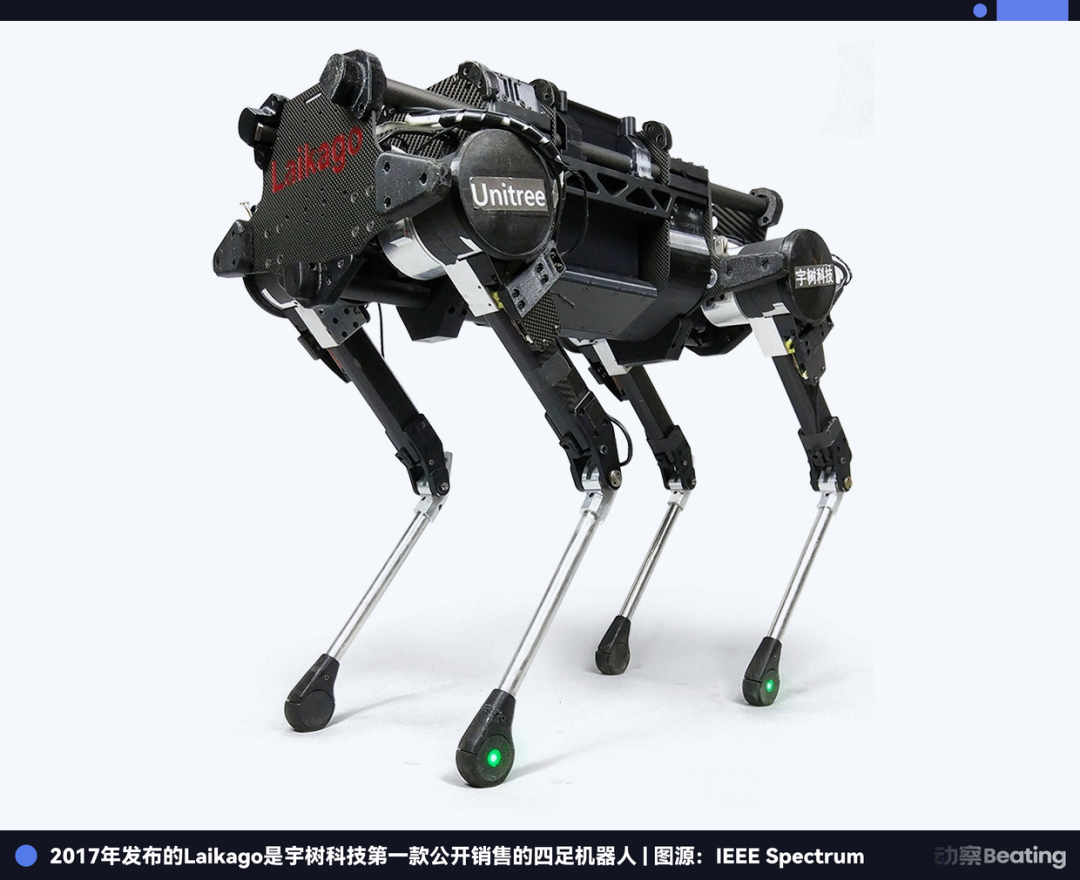
Boston Dynamics' Laikago initially did not have as many capabilities as it does today, mainly relying on remote control. At that time, it sold for tens of thousands of yuan, and its high price made people see it as very professional, making it difficult to enter the mass market. However, this does not mean that Boston Dynamics does not want more people to see and use it.
Our advantage is that the jumping robot can leverage Shenzhen's mature drone supply chain for production, reducing costs. We hope to meet everyone at a price that users are willing to accept, so that more people can see and use the jumping robot.
Insight Beating: Can the current pricing be revealed? Some colleagues in our office are already interested in buying.
Wang Fangzheng: Currently, it is not convenient to reveal the pricing. We have conducted a survey, and those who are indeed interested in buying can generally accept this price, so there is no need to worry too much.
Insight Beating: Jumping is a very intense activity. Will the springs, body, and rotors wear out easily, requiring users to frequently replace parts?
Wang Fangzheng: We have considered these issues. During internal testing, we played quite violently. The latest footage was shot in South Africa, where we took it to jump on seaside rocks and in the wilderness. The machine can operate normally and can jump continuously for a long time.
There was a significant shift in the product concept along the way. Initially, we wanted to create a product with a very sci-fi appearance, similar to the concept aircraft in the promotional video. That machine was already capable of jumping and demonstrating. Later, when we played for a long time, we found that everyone always wants to perform some intense and exciting maneuvers, and falls and control errors are difficult to avoid completely. The shell is easily damaged in these situations, and the dispersed weight also affects control stability.
We rethought what the first batch of users cared most about. They are primarily concerned about the jumping itself and that they can continue playing after a fall. This version now mainly uses carbon fiber, prioritizing performance.
Insight Beating: What is the current level of control precision?
Wang Fangzheng: There is an indicator that can demonstrate its stability. When no directional control is given, it can basically jump in place within a small range and will not jump further and further away.
This generation does not have additional sensors, so it cannot precisely determine how many centimeters to jump or where to land. The operation logic is very simple, similar to a remote-controlled car. Pushing the joystick forward makes it go forward, and pulling it back makes it go backward, following the intuition of using remote-controlled products.
Insight Beating: Many robotics companies usually start with B2B customers. Why did you start from the consumer market?
Wang Fangzheng: There is a saying, "If you can do direct-to-consumer, why do B2B?" B2B often requires a lot of resources, and the reasons behind it are also more complex. Direct-to-consumer allows the product to be directly validated by the market, giving everyone who wants to buy a chance to purchase.
We seriously considered starting with B2B directly, and many B2B customers approached us. However, our team is very small, and the technology is still at a very early stage. If we were to start with inspection tasks, the team would have to spend a lot of effort researching the inspection equipment carried on top. Our advantage lies in the jumping movement itself, not in inspection equipment.
From the very beginning, focusing on inspection robots, we realized that refining our jumping technology would take time and could easily lead us into a dead end. By first developing a consumer product and then releasing a more open version to allow more people to contribute to its development, we believe this approach is more suitable.
Dynamic Beating: The first-generation product mainly targets enthusiasts. How do you envision building a community around it?
Wang Fangzheng: The community can be divided into two parts. The first part consists of enthusiasts who will share creative ways to use the product. The second part consists of developers who will add functionalities to the robot, such as follow-up capabilities, obstacle avoidance, or integration with large models.
The first-generation product does not yet have the ability for secondary development and primarily serves enthusiasts. A semi-open-source version will be released later, mainly targeting developers.
Using a Big Hammer to Find Nails
Obtaining the technology first and then identifying the problems to solve follows through the company's product development and fundraising efforts. Investors in consumer electronics often inquire about the target market, while deep tech investors are more interested in the potential capabilities of the technology.
Wang Fangzheng summarizes this divergence as "seeing up close" versus "seeing into the distance." This statement reflects the entrepreneur's perspective and the early-stage company's practical need for funding. The company aims to continue its research, prepare for mass production, and get the product ready for the market, all of which require funding.
Dynamic Beating: Your approach is to first have the technology and then look for the problems it can solve. This differs from the typical startup sequence. Why is that?
Wang Fangzheng: This is precisely what sets us apart from most companies in the market. Many companies first identify a pain point and then seek technology to address it. We already have a very powerful big hammer in hand, and then we consider where the nails might be in the future.
By 2024, humanoid robots were just starting to gain popularity. At that time, many humanoid robots were still unstable in walking, requiring assistance or only being able to move on flat ground. We have been exposed to some unpublished outcomes in the lab. The jumping robot can run quickly on a campus, leap over obstacles, and adapt to different terrains. I believe this is a significant technological breakthrough in the field of robotics, and its future possibilities may be broader than those of humanoid robots.
The company has been discussing potential applications of the technology since day one. There are many possible directions to consider, but it is still too early to directly enter a specific scenario at this stage. One thing is clear to us: this technology has the potential to change the world in the future, and we want to drive it forward.
Dynamic Beating: Why were the initial investors willing to invest in your company when the scenarios were not yet fully defined?
Wang Fangzheng: Willing to invest in our institution, can be considered willing to invest early, invest in startups, invest in deep tech. Many deep tech projects in the early stages often do not have a clear use case, and investors first look at the technology itself.
Now, compared to the seed round, the product has made great progress, and our thinking about the roadmap is clearer. We start with enthusiasts, then build a community, allowing everyone to develop this technology together and explore use cases collectively. We have now made the road and several milestones clearer.
Dynamic Insight Beating: Will you define Lunar Technology as a commercial company or a new lab?
Wang Fangzheng: We are a technology company. The company side is responsible for technology transfer, refining the product, and ensuring the technology quickly enters daily life.
The lab is also a crucial part. My senior brothers, mentors, and I have always maintained collaboration; they are now all teaching at universities. New lab discoveries will be handed over to the company for commercialization, allowing Lunar Technology to stay continuously engaged with cutting-edge disruptive technology.
If we only look at the company side, research and commercialization investment probably account for half each. The lab side focuses solely on research.
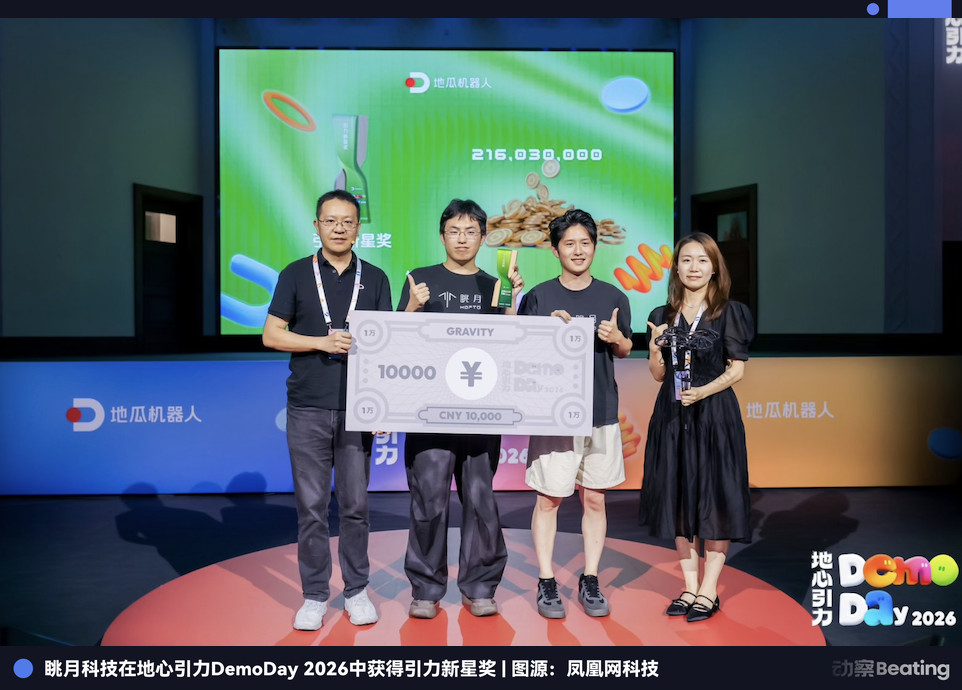
Dynamic Insight Beating: You have recently joined the Sweet Potato Robotics ecosystem and participated in the "Core Gravity DemoDay 2026." What support do you currently need the most from them?
Wang Fangzheng: We have just joined the Sweet Potato Robotics ecosystem. Participating in that DemoDay was mainly to connect with more investors. The company is currently undergoing a Series A funding round, and at this stage, what we need most is funding.
With funds, we can hire more people to accelerate technological development. Research needs to continue, products need to be ready for mass production, and marketing efforts need to commence.
Dynamic Insight Beating: How was your experience at DemoDay?
Wang Fangzheng: I am very grateful to them. When we signed up, most slots seemed to be filled, with only the last two spots left on the poster. Initially, I thought I might just be filling the numbers.
It turned out that our product did impress, and I gave a good presentation. In the end, we secured the third position and took home a prize of ten thousand yuan, which made me quite happy.
Dynamic Insight Beating: How is the progress of the new funding round? What are the most common questions investors ask you?
Wang Fangzheng: The current progress is still smooth. Many people's first question is, what can your thing do, and where is the use case. Someone who asks the first question like this probably won't be genuinely interested by the end of the conversation. They may have been focused on consumer electronics for a long time and have not yet understood this from a deep tech perspective. Based on research data, our first-generation product seems to sell well and can increase the company's cash flow, but what we hope for more is that investors can support our future development strategy from the perspective of technological advancement.
Everyone is interested in the Leaping Machine, and there is also a great debate. I've heard about some heated debates within investment institutions, which are similar to the comments section on Douyin. One group of people care more about how long it will take to be profitable and when they will find PMF. There are also people who genuinely love technological development. They believe this technology will be useful in the future and are willing to promote it first.
Dynamic Perception Beating: How do you see the conflict between these two judgments?
Wang Fangzheng: I think it's about looking near and looking far.
Yushu is a good example. Many investors I've talked to have either invested in Yushu before or wanted to but didn't. Yushu had difficulty raising funds before appearing on the Spring Festival Gala. Before and after its rise, it was difficult for people to determine its most certain use case, apart from university labs and the developer market. The biggest change was in how the market viewed it.
Currently, MoonGazing Technology may be earlier in its development than Yushu was. When Yushu started, there was already Boston Dynamics ahead. We are somewhat like when Boston Dynamics first released the robot dancing video, and people had just seen this kind of thing. There is still a long way to go to make the world realize how amazing the Leaping Machine is and what it can do in the future.
Substance in the Bubble
Robotics is one of the hottest entrepreneurial trends for 2026. Wang Fangzheng acknowledges that there is a bubble in the industry, and some have advised him to follow the heat and tell a bigger story. Start with a group of B-side intentions, then expand the financing scale, and slowly find a direction after the money is in hand. However, this approach did not convince him.
He likes Xiaomi and Yushu, and the reasons all come down to the word 'substance.' His assessment of Musk also follows the same line, admiring someone's ability to create technology, while also maintaining judgment on how to make money and entrepreneurial responsibility.
Dynamic Perception Beating: Which tech company do you like the most?
Wang Fangzheng: Xiaomi. First of all, I admire Lei Jun. From early entrepreneurial setbacks to Kingsoft, Xiaomi, and now Xiaomi Cars, he has been striving and achieving greater life value.
Xiaomi is a very down-to-earth company. When it enters an industry, it often reshuffles the market, making a lot of information and prices more transparent. A tech company should bring tangible benefits to ordinary people, and I think Xiaomi has achieved that.
Dynamic Analysis Beating: Is there a bubble in the robotics industry now?
Wang Fangzheng: I think it's significant. Other FAs have approached us, saying that the story we are telling now is wrong. They feel that we should be like some rapidly funded robotics companies, securing many B2B cooperation intentions and then telling a big story. Holding fifty billion yuan in hand, we can develop however we want later on.
For now, we don't want to do that. We will stick to the path we believe in.
A car is a very good form of robot. It travels on basically fixed roads every day, with buildings and roads that don't suddenly change. With four wheels underneath, the dynamics are relatively simple. Yet, despite so many cars collecting data every day, fully autonomous driving has still not been achieved.
A humanoid robot is much more complex in structure, requiring investment in production, entering homes, and still has a long way to go. The dynamics of a jumping robot can be fully analyzed, with lower costs and a simpler structure. We have the opportunity to introduce jumping robots into practical work scenarios earlier than humanoid robots.
Dynamic Analysis Beating: What is your view on Musk?
Wang Fangzheng: In the capitalist environment of the United States, he has a deep understanding of the entire set of business rules. He has technological ideals, knows very well how to make money, and can also navigate the cryptocurrency field.
Looking only at his contributions to the tech industry and entrepreneurial achievements, I greatly admire him; he is indeed very impressive. But to judge a person comprehensively, I hope someone in the future can do better than him.
Living Ten Years Later
On the morning of the interview, Yushu Technology was listed on the Shanghai Stock Exchange's Sci-Tech Innovation Board. In Wang Fangzheng's circle of friends, investors congratulated each other, with some making money from this investment.
Tiao Yue Technology is still far from that day. The company is still collecting user feedback on the first-generation product, planning KOL beta testing, and preparing to participate in an exhibition in the United States. It has also just won third place at the Sweet Potato Robot DemoDay and is currently meeting with investors for the second round of funding. Wang Fangzheng talks about DJI and Yushu ten years from now and is also clear about the toughest conditions ahead.
Dynamic Analysis Beating: What is the entrepreneurial environment like in Hong Kong? What support have you received from the government and schools?
Wang Fangzheng: Hong Kong, China, provides great support for technology startups. Our first investment came from Innovo China Hong Kong. The funding behind it is connected to Hong Kong, China's support system for startups.
We were also selected for the Hong Kong-Shenzhen Innovation and Technology Park's incubation program. The park is located at the border between Shenzhen and Hong Kong, and it will provide companies with space and subsidies. The policy strongly supports technology entrepreneurship.
Educational institutions are also crucial. City University of Hong Kong has the HK Tech 300 program, which has supported many startup teams. For students, taking the first step in entrepreneurship is very challenging, and the school's help is key.
Dynamic Watch Beating: What are the next steps?
Wang Fangzheng: We have recently been conducting user research to gather everyone's expectations for the product. We will continue to refine the productized features to make the first generation more user-friendly.
Next, we may engage Key Opinion Leaders (KOLs) for internal testing. The product is expected to be released after participating in CES in early 2027.
Dynamic Watch Beating: Ten years from now, what kind of company do you hope Lunar Tech will be?
Wang Fangzheng: If I were to make a comparison, I would choose DJI and Autel Robotics.
If a very clear scenario emerges in the future where we have an absolute advantage, similar to aerial photography for drones, we will independently develop relevant technology for that scenario and strive to achieve an 80% market share. That would be a DJI-style path.
If in ten years there is still no clearly defined, large-scale scenario and much exploration is still needed, we may be more like Autel Robotics.
More importantly, it's about surviving for ten years.
Dynamic Watch Beating: What was your biggest takeaway from Autel's IPO?
Wang Fangzheng: I saw many investors in my social circle congratulating each other, as they may have also made money from it. Autel took a very solid path. Among these robotics companies, my favorite is still Autel as it has indeed driven the development of quadruped robots.
Many people invested in Autel, especially the later-stage investors, who were attracted by the market hype and market share. They may not necessarily appreciate how cutting-edge the technology itself is or agree with the practical and solid approach Autel has taken. I find this a bit funny for a technology company.
I have been in touch with some of these people. If they were asked to chat with Wang Xing a few years earlier, they probably would not have invested.
Dynamic Understanding: What do you think is the proportion of such investors in the market?
Wang Fangzheng: I'm not saying they are not good. Investors have a responsibility to their LPs. Of course, they will invest in projects within their cognitive range, ones they can understand, and ones where the returns are more apparent. I completely understand this.
Such investors still make up a high proportion in the market. In RMB funds, the proportion may be even higher.
In Raibert's "Legged Robots That Balance," he writes about how a single leg maintains balance. At that time, no one could see, directly from that constantly rising and falling machine, the Spot that would appear over thirty years later. What the research left behind is a set of principles about dynamic balance. It later grew two legs, four legs, and also grew into a company.
Wang Fangzheng is taking a more direct path. He already has a machine that can jump, and next, he will turn it into a product that people will buy and continue to use. This process will not be completed with just one beautiful jump.
Every time a machine lands, the spring compresses. To jump again, it must first support its own weight.
Original Article Link
Welcome to join the official BlockBeats community:
Telegram Subscription Group: https://t.me/theblockbeats
Telegram Discussion Group: https://t.me/BlockBeats_App
Official Twitter Account: https://twitter.com/BlockBeatsAsia