Continuing its winning streak for the 7th consecutive quarter, Emerging Markets Arbitrage Trading Outperforms All

On August 23, Bloomberg reported that USD-funded emerging markets arbitrage trades had recorded positive returns for the seventh consecutive quarter, marking the longest winning streak since 2008.
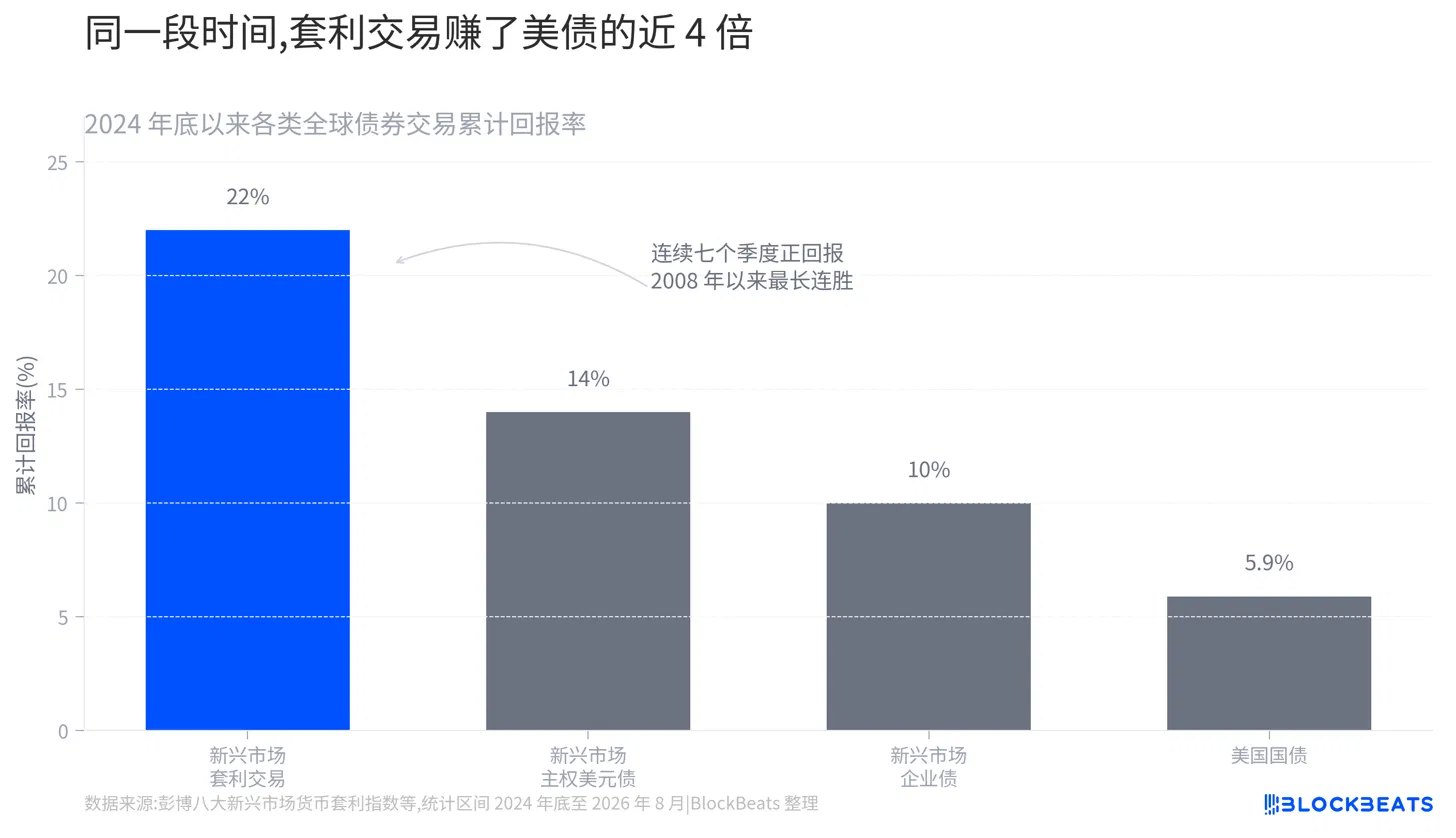
Based on Bloomberg's Eight Major Emerging Markets Currency Arbitrage Index, this trade has accumulated a return of around 22% since the end of 2024. During the same period, U.S. Treasury bonds returned 5.9%, emerging market sovereign USD bonds 14%, and emerging market corporate bonds 10%—arbitrage trades outperformed U.S. bonds by nearly 4 times.
Cathy Hepworth, head of the PGIM Emerging Markets Debt team managing $1.5 trillion, was asked about the most certain theme, to which she replied, "Arbitrage, arbitrage, arbitrage." Her exact words were, "It's an arbitrage world," with a straightforward reason: "There is a massive amount of money looking for yield."
The practice of arbitrage trading itself is not complex: borrowing in low-interest currencies like USD, JPY, or EUR, converting it into high-interest currencies like Turkish Lira to buy bonds or money market funds, and earning the interest rate differential. The interest return on the Turkish side can be as high as over 40%.
How did these seven quarters unfold?
The interest rate differential is the foundation, but what truly doubled the returns is the exchange rate. The USD weakened against emerging market currencies outside Asia, while it also became cheaper against EUR, CHF, and other low-interest peers used as funding currencies—both ends were assisting. The most extreme case was Colombia: a 12% bond return combined with a 45% spot appreciation. Even in Turkey, where the Lira depreciated by 26% against the USD, the over 32% yield on a 10-year local currency bond still kept investors in the profit zone.
Over the past 12 months, USD-funded arbitrage trades gained 48% on the Colombian Peso, 23% on the Turkish Lira, 21% on the Brazilian Real, 19% on the Mexican Peso, and 18% on the South African Rand.
They went through a real test in the middle. The backstory recorded by the Bloomberg team is as follows: at the beginning of July, arbitrage funds had notably shifted from developed markets to emerging markets bets, and the USD was being sidelined; on July 23, the JPY hit a more than 40-year low; at the beginning of August, a historically significant joint US-Japan forex intervention was carried out.
That sudden JPY surge in August 2024 had once roiled global markets—Bloomberg's Emerging Markets FX Arbitrage Risk Premium Index dropped by 4% at that time. However, this time, the same index only fell by around 1% after the intervention. The reason was that funds had already switched funding currencies: the JPY's place was taken over by EUR, CHF, and USD. Thierry Larose, a portfolio manager at Swiss asset manager Vontobel, stated, "The threshold for disorderly unwinding is higher than a few weeks ago," as he continued arbitraging but avoided the JPY.
The intervention also failed to change the yen's situation. By mid-August, the yen had returned to the 159–160 range. Although the yen shorts of hedge funds were cut in half to 59,526 contracts since the intervention, some arbitrageurs took advantage of the rebound to rebuild their shorts at better prices. On August 17, the Emerging Markets Currency Index hit a record high of 1906.98.
The buying spree continued in the past week. The U.S. Treasury Department announced this Wednesday that it would increase long-dated Treasury repurchases. In a report to clients, TS Lombard's Head of Macro Strategy, Daniel Von Ahlen, wrote, "The U.S. government's tolerance for rising bond yields seems low, catalyzing trades that are long emerging markets arbitrage." The company's Emerging Markets FX Arb Index "has improved again, strengthening our confidence."
Next, What Is the Market Watching?
First is when the Fed will act. This is the single biggest risk event for the entire trade. Kamakshya Trivedi, Chief FX and Emerging Markets Strategist at Goldman Sachs, assesses that "improvement in inflation is enough to keep the Fed on hold," but also warns that the recent rise in long-term rates is a near-term threat—as long as the increase is not too fast, emerging market currencies with high real rates can still provide a positive return. Ning Sun, Senior Emerging Markets Strategist at DWS, puts it more directly: U.S. data has not weakened enough to reverse the risk appetite for carry trades.
The second is crowding. The report specifically mentions that this trade could become a victim of its own success—there's too much money in it. This is the classic demise of an arbitrage trade: when everyone is on the same side, any reversal in movement leads to a stampede.
Naturally, high-interest rates are also a focal point, and the market wants to see how long they can be sustained. One pillar of support is that central banks in Latin America and Eastern Europe have kept high policy rates to control post-pandemic inflation, while the situation in the Middle East and persistently high energy prices is preventing them from shifting to more accommodative policies. Both of these conditions are exogenous.
Alejo Czerwonko, Chief Investment Officer for Emerging Markets Americas at UBS, prefers financing with euros and Canadian dollars, being long South African rand and Mexican peso; PGIM's Hepworth is eyeing sub-Saharan Africa's frontier markets, as well as Turkey, Colombia, and Brazil.
Welcome to join the official BlockBeats community:
Telegram Subscription Group: https://t.me/theblockbeats
Telegram Discussion Group: https://t.me/BlockBeats_App
Official Twitter Account: https://twitter.com/BlockBeatsAsia