Xiami Music Returns After Five Years, Alibaba Teaches Another "Xiami" to Write Songs with AI

Original Title: "Xiami Music Left for Five Years, Alibaba Taught Another 'Xiami' to Write Songs with AI"
On August 17, Xiami is back.
Alibaba released the AI music model HappyShrimp 1.0, Chinese name "快乐虾米" (Happy Shrimp). Users only need to write a sentence, and it can generate a complete song.
You don't even need to know what chords, time signatures, or keys are. You can tell it you want to write a song for your recent graduate self, preferably suitable for a cafe ambiance; or you can say it's almost time to leave work, it's suddenly raining outside, and you want a bit of melancholy but not too heavy. Words that used to only describe feelings can now also become musical instructions. HappyShrimp will try to understand and then create.
Currently, it has launched a web version for testing. Alibaba stated that HappyShrimp adopts end-to-end whole-song generation, incorporating style, emotion, era, and vocals into the same generative process. In actual tests, it is particularly sensitive to Chinese daily expressions. Many times, when users are unclear about what kind of music they want, they only know "lighter," "like the summer ten years ago," or "not too bitter," it can still follow these vague descriptions and proceed.
This makes music production very cost-effective. Adding background music to a short video, creating a sample for an ad, finding background music for games or podcasts, no longer requires starting a full production process from scratch. The standard membership price on the test page is about 30 yuan per month, allowing the generation of 150 songs. On average, one song costs about 20 cents.

On the day of the launch, HappyShrimp also announced a partnership with Taihe Music. Alibaba also plans to have it appear at this year's Anaiya Xiami Music Festival. It is also the third member of Alibaba's "Happy + Animal" series, with HappyHorse for video generation, HappyOyster for global modeling, and now the third member focusing on music.
Xiami Music took twelve years to become the later nostalgic Xiami.
HappyShrimp can generate a song in about one minute.
Handcrafted Era
The old Xiami started very small.
Wang Hao, originally an Alibaba programmer, was also in a band with the online alias "Pumpkin," named after his favorite band Smashing Pumpkins. During college, he played the guitar and formed a band called "Black Water." During his sophomore year summer break, he was once bitten by a dog on his finger during rehearsal, rendering him unable to play the guitar temporarily. With time on his hands, he started learning to code.
It started with HTML, then moved on to PHP. He even translated the PHP manual and built websites for others to earn some pocket money, charging 200 RMB for a static page. Later on, he created his own forum called "SoundNet," dedicated to sharing underground music and concert information in Hangzhou. By 2001, the forum had tens of thousands of registered users, with hundreds online every day. A group of young people passionate about bands and rock music gathered on the platform to organize performances, find band members, and chat. When out-of-town bands came to Hangzhou, Wang Hao sometimes helped them find venues.
He later realized that although he might not have had the talent to become a professional musician, he was very good at bringing music enthusiasts together.
After graduating from college, he shared an apartment with Zhu Qi, who would later co-found Xiami. During the week, both were busy with their jobs, but on weekends, Hangzhou's musicians and friends would gather at their place for food, drinks, and music discussions. Sometimes, the apartment would be packed with people. Wang Hao made a living selling musical instruments online, conducting business during the day and helping bands find performance venues at night and on weekends.
In 2003, he believed that e-commerce could be a viable business, so he went to Alibaba to learn about the internet. He started with Java and later moved to requirement analysis. After a few years, he started thinking about music again.
At that time, people used eMule, Kazaa, and BitTorrent to download movies. Wang Hao wondered if a similar P2P system could be created for music, but with organized files that would allow both uploaders and music creators to earn some money.
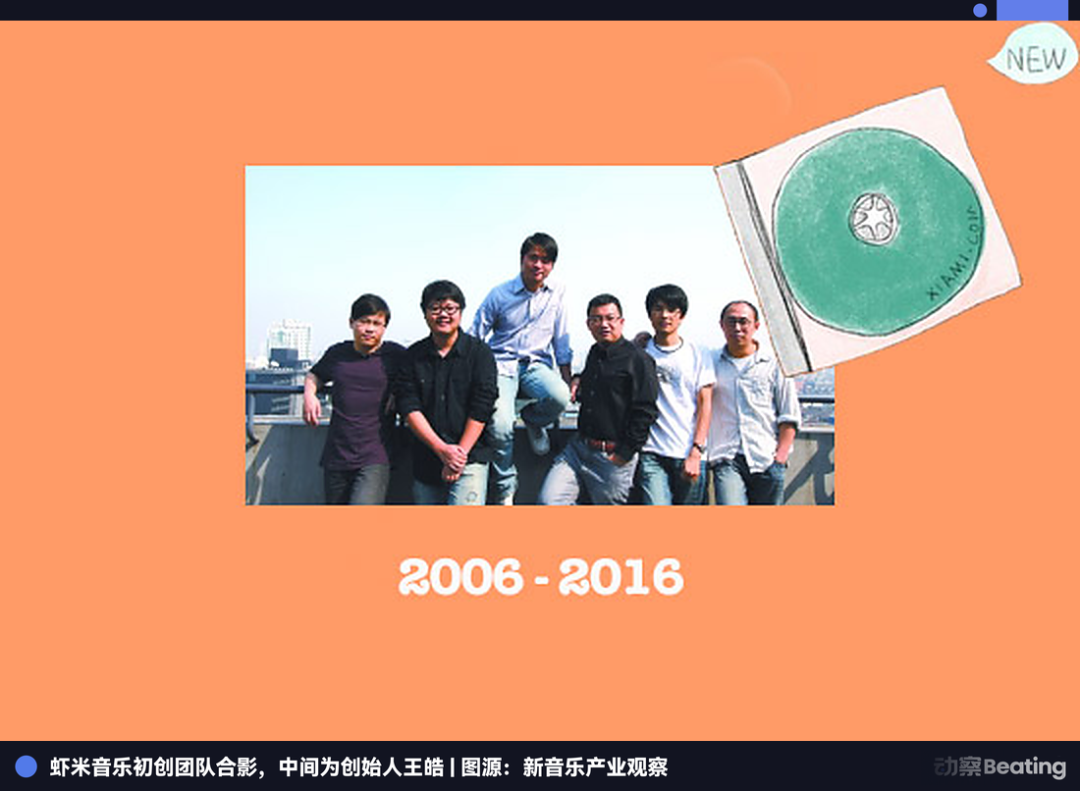
In 2007, he left Alibaba. Initially, there were six people in total, with Wang Hao as the general manager, Zhu Qi in charge of content, and others handling operations and programming. Everyone invested roughly the same amount of money and held similar shares, paying themselves a monthly salary of 3000 RMB.
They named their website EMUMO, which stood for Earn Music & Money. This name almost entirely encapsulated their initial ambition: listeners get music, creators get paid.
It was later rebranded as Xiami. Their explanation was, "We may be small shrimps, but we have big dreams."
In November 2008, Xiami.com officially launched.
The first office also resembled a "small shrimp" company. Located in the Longdoo Building in Gudang, Hangzhou, it was a 70-square-meter mixed residential and commercial space. The previous tenants didn't leave much behind, so they didn't do much decoration either. They just brought in a few tables and chairs to start working. With no space to store the server, they placed it on the balcony. Every day when they walked into the office, the constant whirring of the fan could be heard. Wang Hao later reminisced that one advantage of that place was being able to see Xiaoheshan Mountain when they opened the window, a view filled with lush greenery.
That was 2008. The iPhone 3G had just been released, and smartphones had not yet consolidated all music into one app. Chinese people, when listening to music, were often still searching for song titles on Baidu, clicking around forums, blogs, and resource sites, trying to find an MP3, downloading it to their computers, and then transferring it to an MP3 player. What they found was purely based on luck.
The file names could be garbled, "320K" was written in the name but the sound quality was blurry; one song title had over a dozen download links, and it was unclear which one was real. Album information was incomplete, featuring missing or incorrect details, with multiple singers simply labeled as "Various Artists." The track order was often mixed up, and few people cared about which album or year a song belonged to.
At that time, online music was already one of the most widely used internet services among Chinese netizens. According to a 2008 CNNIC survey, 86.6% of internet users had listened to online music in the past six months, and 71.2% had downloaded music. Hundreds of millions of songs were circulating on the internet, most of the time, existing only as an MP3 file.
Xiami, however, wanted to transform these files back into "albums."
Albums needed to be arranged in their original order; for songs with multiple singers, each name had to be written out in full instead of being lumped into "Various Artists"; sound quality aimed for 320K; different versions of the same song needed to be separated; and all available information about singers, albums, years, record labels, and genres was to be included.
Since its founding, Xiami's largest team has always been its editors. Their daily work involved researching and verifying data to reconstruct complete albums. Even when the website had only 100,000 users, Xiami had six editors proficient in different languages, including Chinese, English, Japanese, Korean, Russian, Thai, and Spanish. Users could even search directly using these languages.
When the company's own staff wasn't enough, they turned to users. Xiami recruited over 300 experienced music lovers worldwide to help enhance their music library. Over time, a group of users specializing in data correction emerged, calling themselves the "Wiki Team."
This name was not an exaggeration at all. They would discuss whether an album should be classified as a Studio Album, EP, or Live Album; what structure should be used for classical music track names; whether composers' full names or abbreviations should be used; and how European and American singles should be categorized. Some even wrote specific rules, reminding editors to refer to several classical music websites more frequently and to "not disappoint the expectations of so many classical music enthusiasts."
For some information that couldn't be found online, they would go dig through CDs. Opening the jewel case, taking out the booklet. Who was the producer, who played the bass, who arranged the strings, where was the recording studio—line by line, word by word, they entered it all into Xiami. Later, when asked where, aside from buying the original CD, one could find complete production information for a Chinese song, Xiami staff said that oftentimes even the digital materials provided by record companies were lacking, so they had to rely on users flipping through CD booklets to fill in the gaps.
A user named Desperado once single-handedly contributed data for 943 artists and 214 album entries, and also served as the leader of the Xiami Lyrics Group.
This group of people even established a comprehensive set of folk academic norms for "listening to music." Xiami's early community resembled a music-oriented BBS. Some curated featured collections, some wrote lengthy music reviews, some corrected errors, and some researched how to compress higher quality 320K MP3 files. Early music reviews required a minimum of 300 words. You couldn't just leave a one-liner like "sounds good" and walk away. Since you specifically clicked to discuss a song, you had to say something meaningful.
When a user clicked into a genre, they could continue to delve deeper. What was under Dream Pop, where did Shoegaze originate, and what's the difference between Post-Rock and Progressive Rock? For many, Xiami was more like an ever-expanding music map. They would journey from one album to another, from one band to an artist they had never heard of, ultimately forgetting what they initially set out to find.
This classification system grew larger over time. The genre system left behind by Xiami was eventually organized by users into a 436-page document, with 24 primary categories and 548 sub-categories. Many of these categories might be ventured into by very few people in a lifetime, but Xiami still provided a spot for them.
There was also a section called "Desert Island Records."
This section posed an interesting question: "If one day you were stranded on a desert island and could only bring a few albums, what would you bring?"
Riding on this question, the editors recommended lesser-known but worthy albums one by one. Later on, the section had its own motto: "Don't let good music continue to wander." In 2020, they even collaborated with Hema to open a "Desert Island Records Bakery."
Actually, this name is quite fitting for Xiami itself. A vast sea with a small island in the middle. It's noisy outside, and on the island, there are some songs that no one is in a hurry to listen to. Those willing to swim over can sit for a while.
Xiami's office later became more and more like such a place. Several former employees recalled that there was a small stage in the lounge area, with guitars, pianos, and keyboards nearby. During dinner, someone would go up to play the guitar and sing; some newcomers to the company would form a band with colleagues shortly after joining.
A group of people running a music website, to some extent, used company resources for personal interests. They brought their hobbies into the office, and then found a very legitimate reason to keep listening to music every day.
Even the initial business model carried this idealism. Wang Hao wanted to create a closed P2P system. Users would download a song for 0.8 yuan. According to the early design, a portion was intended for the copyright holder, a portion for those uploading and distributing music, and the platform itself would only take the remainder. After users downloaded the music, their computers would become nodes in the network, continuing to share that song with others.
Xiami even gave its own cryptocurrency a user-friendly unit: "Mi".
Uploading original albums and helping to spread music both offer the opportunity to earn Mi. The listeners are also distributors of music. Wang Hao wanted to shorten the long chain in the record industry, allowing music to more directly reach the audience from the creators.
This design now seems a bit naive. However, in the first few years, Xiami grew little by little in this way.
Troubles were also embedded right from the start. P2P helped Xiami rapidly accumulate a large music library, but at the same time, it left behind a copyright issue that would eventually have to be addressed. In 2010, dozens of musicians such as Li Zhi, Zhou Yunpeng, Wan Xiaoli, and Zuoxiao Zuzhou publicly protested against their works appearing on Xiami without authorization.
Occasionally
The old Xiami, of course, also used algorithms. By 2011, Xiami's recommendation system had taken shape. Employees later recalled that Wang Hao requested the backend to create over thirty music tags for each user, while at the same time, Douban FM only recorded about four to five.
But Xiami didn't allow the algorithm to simply please people. It would first give you mostly familiar things, then deliberately mix in something a bit unfamiliar. In the product concept of the early years, this ratio was about nine to one, with ninety percent sticking closely to the taste already formed by the user, and the remaining ten percent left for those who had not listened to music before.
That 10% later became something many old users missed the most.
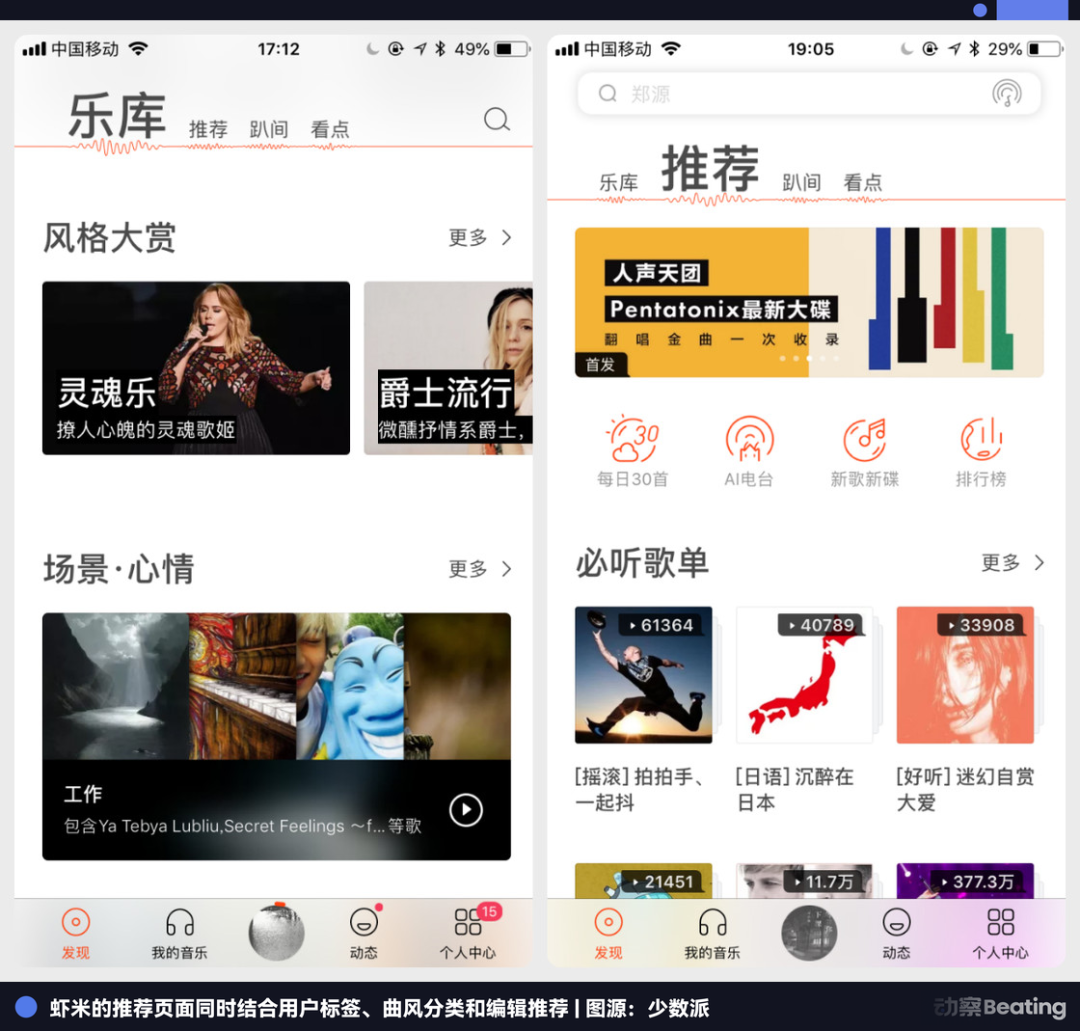
There was a user named "Qing" who usually listened to Japanese visual kei and hardcore music. In her daily playlist of 30 songs curated by Xiami, one day, a very warm English song, "The High Road," was suddenly included. It didn't seem like something she would like at all. However, after listening to it, she put it on repeat for three days.
Another user, Ah Cu, was obsessed with black metal for a while. Xiami slipped in a German band, Empyrium, in the "Similar Artists" section. However, upon clicking, it turned out to be folk music. A week later, she became a fan of Empyrium. As she delved further, she discovered that this band did indeed play black metal in the early days but later switched to unplugged folk music. Although the music genre changed, the reclusive and hermit-like quality remained constant. Ah Cu later recalled that her aesthetics were influenced by this recommendation for the next year or two.
This was probably the old Xiami's understanding of algorithms. It would guess what you liked but also allowed itself to be occasionally unconventional.
On Xiami, there is a group of users who like to call themselves "Diggers." They would follow through a producer, label, and genre of an album all the way down.
Xiami Music user "Throw Throw" accidentally heard the work of an Italian musician in 2014, found the sound very strange, and very fresh. Following the information, he learned for the first time that this kind of thing actually had a name, called Vaporwave.
He continued to listen, and later started to create his own music. Throw Throw applied to become a Xiami musician and uploaded his work. Several songs were discovered by editors and featured on the Xiami homepage multiple times.
This kind of story is not uncommon on Xiami. The Xiami editorial team calls their work "Music Piloting." Editors listen to a large number of new songs every day, create thematic recommendations, write music reviews and recommendations, and select those sounds that have not yet entered the mainstream. By 2020, they were still producing programs such as "Deserted Island Records" and "Global Music Map."
The editor in charge of "Deserted Island Records," Feng Xia, used to drive two hours to the city center Livehouse to attend performances when she was in college. After joining Xiami, her job became listening to music every day and then finding ways to pass on what she discovered to others.
In July 2013, the "Xiami Musician" platform was launched. Independent musicians and labels could upload their work, set their own prices for legitimate downloads, and receive 100% of the download revenue. In the first year, over five thousand musicians joined.
In the second year, Xiami launched the "Searchlight Plan." Initially, the plan aimed to select artists from the platform and help them further develop their demos. If they lacked a producer, Xiami would help connect them with one; if they didn't have a recording studio, Xiami would fund it; from master tapes, album releases, music videos, to tours, Xiami helped with preparations. In the earliest public plan, they even planned to release fifteen albums or EPs in a year, a production volume that could already match that of a professional record company.
By the end of the first season, 13 groups of musicians and 14 albums were left, accumulating approximately 160 million trial listens.
Cheng Bi was one of them. She later described Xiami as her "patron." Her first three albums were all released on Xiami. At the beginning of the first Searchlight Plan, she also became a Searchlight musician, and later people had the opportunity to get to know Cheng Bi in "Poetry Meets Song" and "I Want to Waste Time with You."
More and more stories like this emerged. Eventually, Xiami attracted more than 40,000 original musicians. The music library contained thirty million songs, over a thousand genres, and users created over five hundred million playlists. In February 2018, in an industry report, Xiami had 9.685 million daily active users. The scale was already considerable, but compared to the largest music platforms, it still resembled that small initial shrimp.
The Last Night
Then the times have changed.
The copyright war became more intense. Tencent Music and Netease Cloud Music spent a lot of money to acquire exclusive rights, causing Xiami's music library to turn to ashes in batches. Music has become ammunition in the war for traffic. In 2015, the "Iron Triangle" composed of Gao Xiaosong, Song Ke, and He Jiong took over Ali Music. The following year, they transformed TTPOD into Ali Planet to focus on fan economy, transferred staff from Xiami, and slowed down product updates.
In January 2016, Wang Hao left Xiami, which he had founded, and switched to Ali DingTalk. He said the music industry had become absurd to the extreme.
When he made that statement, Xiami was still operating. Five years later, it shut down. By 2020, Xiami had about one million daily active users. From 9.68 million to 1 million, it took just a few years.
On January 5, 2021, Xiami announced that it would shut down its service in one month. The platform allowed users time to export their playlists, which could be saved as a static webpage or Excel file.
Two days after the announcement, Wang Hao was interviewed by PingWest and said:
"I don't think there's anything worth reminiscing about."
On February 4, 2021, it was Xiami's last day.
On that day, the personalized daily recommendation lost its individuality for the first time. When all users opened Xiami, they received the same playlist. Over the past twelve years, this section recommended songs for individuals daily; on the last day, the editorial team selected thirty songs for themselves.
"Long Time No See," "You Have Always Been," "I Don't Want You to Be Alone," "When Love Has Become the Past," "I Finally Lost You," "Goodbye." The song titles were straightforward, and each had a brief recommended message above it. These thirty messages strung together formed Xiami's last letter to the users. It even contained a very Xiami-style joke: "Although in the end, we still didn't get Jay Chou's copyright (laughs)."
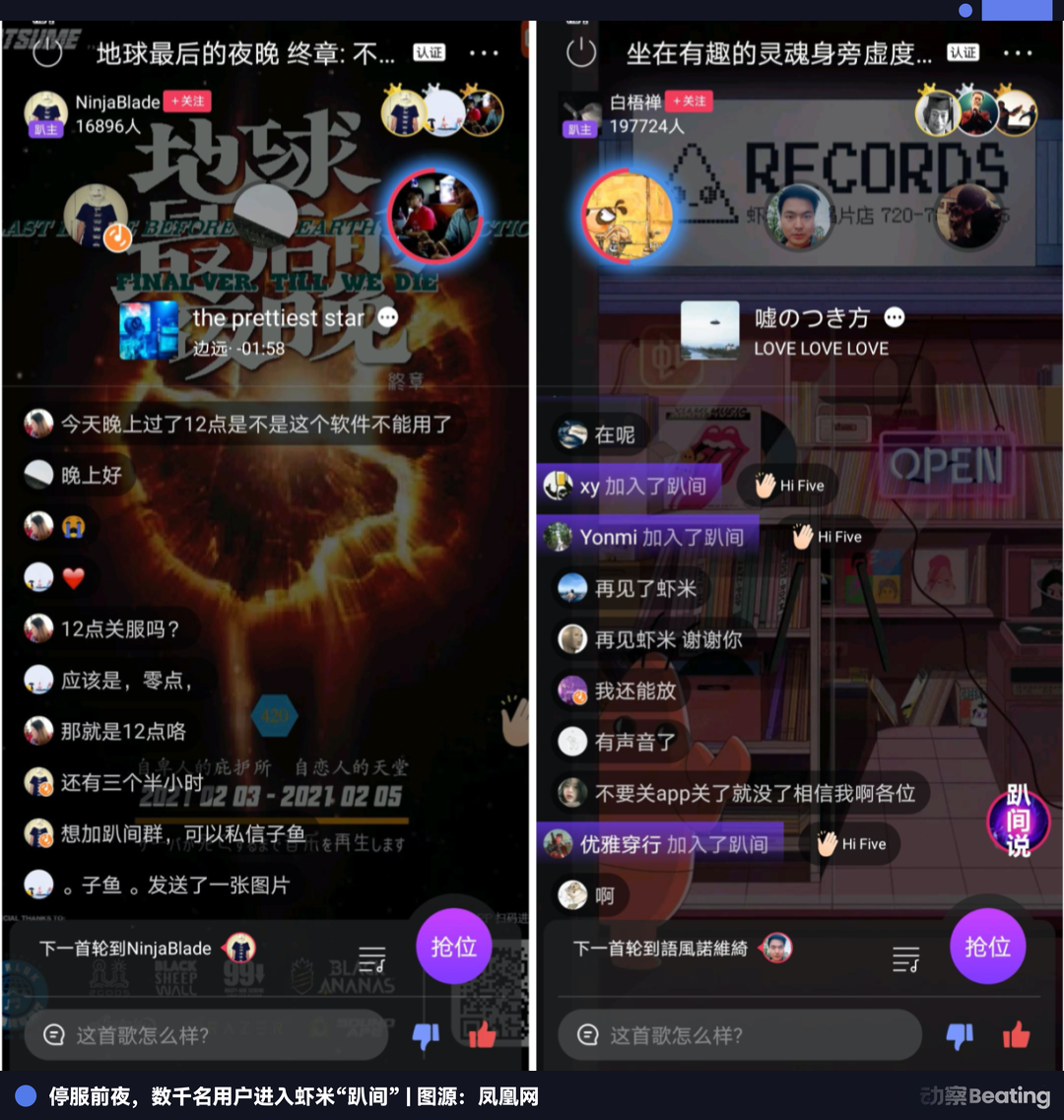
The real farewell began at eight o'clock in the evening.
At that time, the Xiami app had a feature called "Room," which could be understood as a music live broadcast room where some people hosted, played songs, others came in to listen, request songs, and chat on the screen. Several Xiami user groups had connected in advance and agreed to open a room together that night, naming the room "The Last Night of Xiami Planet." The event description read: "Perhaps we cannot change the situation, but we can accompany you in the countdown until the last second."
Thousands of people crowded in.
Some requested songs, some left messages, some did nothing but kept the app open. People from Xiami's editorial team also joined. Editor Agou bid farewell one by one in the broadcast room, first thanking the users, then thanking the editors who had worked at Xiami. He mentioned that over the years, dozens of people had worked as editors at Xiami. Many users, for the first time, found themselves in the same room as the people who created those playlists.
Everyone was waiting for midnight on February 5th.
It had been made clear by the official announcement that from this moment on, song streaming, downloads, comments, and profile exports would all cease. Some had taken time off in advance, some had closed the door after work and listened alone all night; there were also those who refused to exit the app, thinking that as long as the page was still open, the music might continue for a little longer.
Midnight arrived, and Xiami did not fall silent instantly like pulling the plug.
Some people's songs were still playing. So those who were supposed to be bidding farewell became excited instead, with messages popping up one after another on the screen:
“Do you still have sound?”
“I can still hear it.”
Some tried to disconnect from the internet, some reminded others not to close the app. Everyone was doing something a little absurd, spanning different cities and different phones, verifying whether a piece of software still had vital signs. As long as one person had sound in their earphones, Xiami seemed as though it hadn't completely died.
It eventually stopped.
The songs that some people were playing suddenly cut off, and some people's export progress was halted halfway. One hour later, there was no music in the room, but the screen kept showing “someone joined” notifications.
In the month leading up to the shutdown, users had actually been moving out.
Xiami had enabled profile exports, and QQ Music and NetEase Cloud Music had also provided song playlist migration services. Some spent six hours rescuing over six thousand songs they had collected; some took screenshots of their personal pages to see how many minutes and how many songs they had listened to; and some meticulously organized Xiami's nearly obsessive genre classifications into Excel, giving this file a very solemn title: “Saving Xiami's Legacy.”
Some took more direct actions. After the shutdown announcement, a few users went to the Alibaba office in Wangjing, Beijing, and hung up two banners:
“Xiami, please don't leave.”
“Xiami, please don't shut down.”
Xiami's founding team member and former Product Director Dao Cao ultimately only posted one sentence on social media: “Now the best form of farewell is to stay silent.” Founder Wang Hao posted five Weibo posts that day, and not one mentioned Xiami. He had left Alibaba several years earlier and had already bid his own farewell.
But the users hadn't.
Two years later, in February 2023, someone specifically wrote a “Xiami Music Two-Year Memorial.” An app that no longer existed was still commemorated by people in a human way, anniversaries, two-year anniversaries, death anniversaries, memorials.
What people later remembered as the beloved Xiami had actually died many times before its shutdown. Batch by batch, copyright was taken down, the founder left, management changed, the entrance was moved, and users dwindled. The surviving Xiami was left with only a million daily active users, no longer a significant player in the copyright war.
But when it truly died, those one million people suddenly had a name.
They called themselves “music refugees.”
After Xiami’s demise, the words “Xiami” did not disappear. Seven months after the music player was shut down, Damai established “Xiami Music Entertainment.” The old motto “Hear Different” was changed to “See Different”; the once headphone-bound Xiami started appearing in theaters, on stages, and at music festivals.
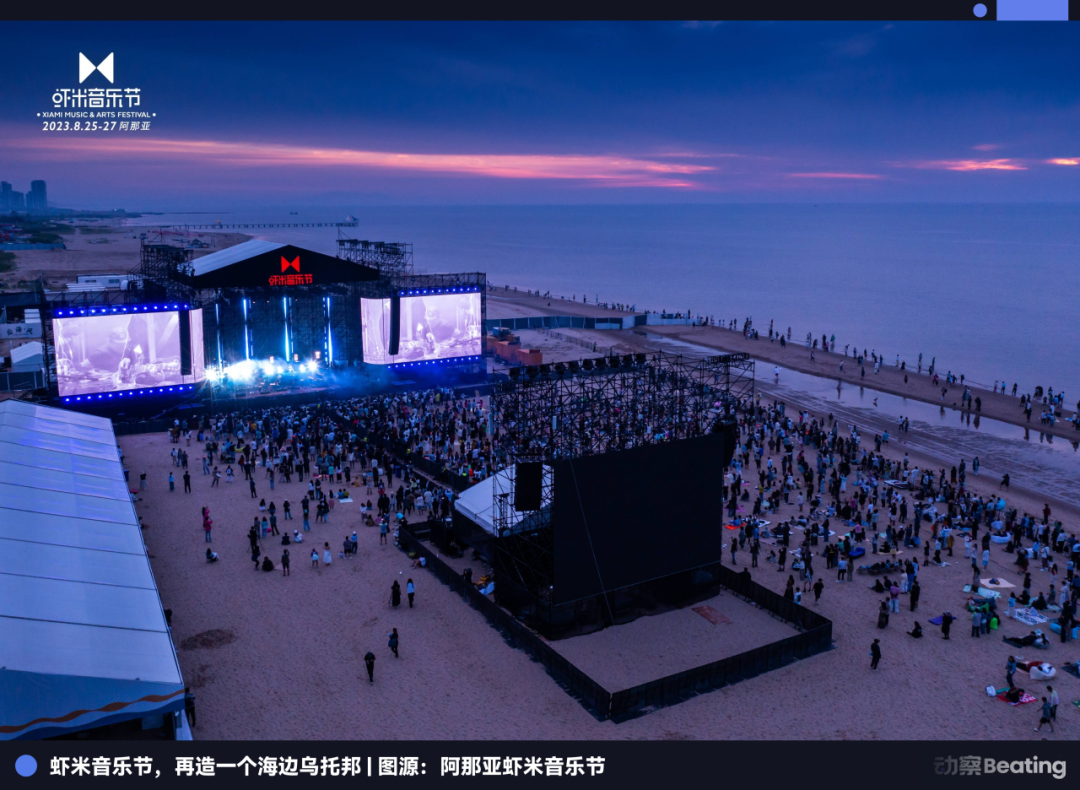
In 2022, the first Anaya Xiami Music Festival was held by the seaside in Qinhuangdao, themed “Keep Swimming Until the Sea Turns Blue.”
The crowds gathered once again under the name “Xiami,” but this time, they weren’t just listening through their players; they were standing by the sea, watching bands perform, watching the sunset. By the fourth edition of the music festival in 2025, six international musicians had had their mainland China debut here.
So Xiami had a strange “afterlife.” The product died, but the name lived on. The original team dispersed, but a new business continued to use it. The little shrimp that once resided in the player icon was scooped out by Alibaba from one place and placed into another.
By 2026, the name resurfaced for the third time. This time, there was no player or stage; it was placed on an AI music model.
HappyShrimp, the joyful Xiami.
Ten years ago, the person who founded Xiami left Alibaba, even venturing to Phuket; ten years later, Alibaba picked up the name he left behind. However, this time, a new group of people were running Xiami, and even the concept of “music” had changed.
New Form
HappyShrimp is still very young. In version 1.0, the vocals occasionally had a machine-like quality, singing Chinese lyrics with some ambiguity, and the section control was not as precise as professional production software. But these are probably just a matter of time. What today may require drawing lots multiple times to achieve, the next version may only need a few word tweaks.
What truly stands out is that suddenly, writing a song is becoming too easy.
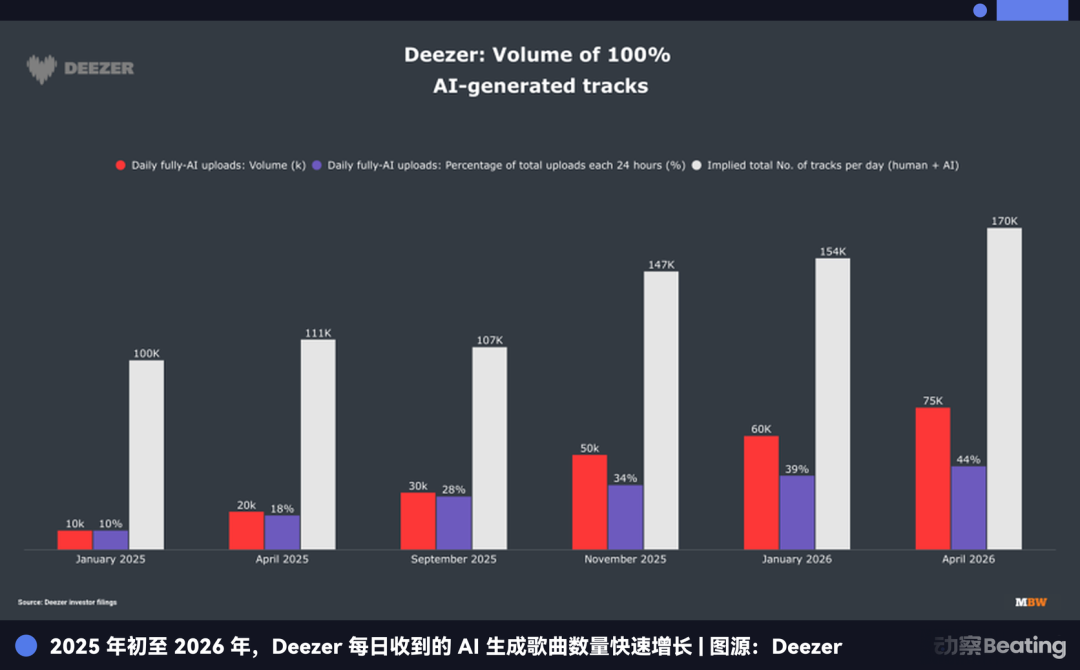
Suno can now generate over 7 million songs daily. In June of this year, Deezer received close to 90,000 AI-generated songs at its peak daily, surpassing half of the platform’s total new music for the first time.
The music industry used to rarely worry about "too many songs."
When the old Xiami was born, the internet certainly wasn't lacking in MP3s, but finding a song you truly wanted to listen to was still a challenge. It could be hidden in a niche album, under a little-known band, or you might not even know its genre. So Xiami put in a lot of effort to do one thing: discover.
At that time, music platforms feared that good content would sink, but the world where Joyful Xiami was located was just the opposite.
If you wanted a song to listen to on a rainy day, it could be made on the spot; if you wanted a female voice, slower, reminiscent of a summer ten years ago, that could also be adjusted. Short videos lacking background music, ads needing a jingle, games needing a piece of background music—all used to require searching a music library or finding someone to compose, but now it can all be generated instantly.
So, for the first time, music transitioned from "finding a suitable song" to gradually "creating a suitable song."
These two actions may seem to differ by just one word, but the worlds behind them are completely different.
When searching for a song, there was always a stranger on the other end. Perhaps an Italian musician you had never heard of, perhaps a college student who just uploaded their first demo, perhaps a German band that had disbanded decades ago. Xiami was responsible for taking you there.
When generating music, human presence is not needed at all. You describe the mood, and the model provides the melody; if you are not satisfied, another song can be made. Music has become something that can be instantly produced as needed. It doesn't have to belong to anyone first, nor does it have to wait to be discovered by anyone.
That's also why the name Joyful Xiami placed here seems a bit strange.
Eighteen years ago, Wang Hao named that website EMUMO, which stood for Earn Music & Money. One of the problems he initially wanted to solve was how music in the internet age should be monetized, how to ensure that music creators get more.
But today, Joyful Xiami is facing another problem. Has good music already existed, and is it no longer even important?
The trouble with copyrights has reappeared, just in a different form. The previous dispute was about a song being uploaded to a platform without permission, wondering who should receive the money; now the issue has turned into which songs the model has learned from and who the generated new music belongs to.
On August 17, the day Joyful Xiami was released, US independent music publisher Round Hill Music sued Suno, accusing it of using hundreds of song lyrics without authorization to train its model.
The old Xiami helped people find songs, while the new Xiami creates songs for people.
In the former world, a stranger's song could change a person's aesthetic sense, leading the listener all the way, and eventually, they might even become a musician themselves; in the latter world, all a person needs to do is say what they want to listen to.
Then wait for a minute, and the song arrives.
Swimming Until the Sea Turns Blue
The writer Yu Hua lived in Haiyan, Zhejiang when he was young, and the sea he saw was always yellow. However, textbooks said that the sea is blue.
He wanted to know where this blue was, so he swam into the sea. As the shore gradually moved away, the water became deeper, but he continued forward. When they were young, people would believe in many specific things, such as reaching the kind of blue described in textbooks as long as they swam far enough.
Of course, in the end, it didn't happen. But many years later, he still remembered that he had once swum in that direction.
I always feel that what the old Xiami left behind is a bit like this.
In its era, many things were still distant. A song that was truly liked might not be liked at first. A strange name wouldn't immediately become part of your aesthetic sense. People would continue to explore because of a faint sound they heard, not understanding it today but coming back in a few months; moving from one person to another, and from one type of music to another.
Looking back later on, it was discovered that many of a person's preferences grew during these detours.
Over the years, the Internet and AI have been shortening this distance. Search makes a song easier to find, and recommendations bring unfamiliar music to your ears. With generative AI, this process has taken another step forward: a person can even describe a mood without waiting for a suitable song to appear, and then have it written.
One minute later, the music arrives.
This has certainly changed many things.
In the past, there was a long road between the audience and the creator. Someone wrote a song, someone recorded it, someone distributed it, someone organized it, someone recommended it, and finally, someone accidentally heard it. Xiami spent twelve years putting up many signposts along this road, making it easier for people to discover music they wouldn't have encountered otherwise.
Today, this road is getting shorter. Sometimes, even the audience themselves can cross to the other side of the road. Someone who doesn't play an instrument or understand music theory can try turning their vague emotions into a song for the first time. Perhaps it's not mature, perhaps there are still obvious traces of the machine, but the act of "creating music" is closer to ordinary people than ever before.
This may also be the interesting point between the Happy Shrimp and the Old Shrimp.
Eighteen years ago, Shrimp tried to make more music heard. Eighteen years later, another shrimp began trying to make more people create music. They are facing not the same music world anymore, nor do they need to answer the same question.
Yu Hua did not swim to the blue sea when he was young. Later generations may not need to swim that far anymore. Technology continues to bring distant things closer, presenting to more people what only a few could do in the past.
However, people still have to decide where to swim.
HappyShrimp can generate a song in about a minute.
But some things may just happen beyond that minute.
Original Article Link
Welcome to join the official BlockBeats community:
Telegram Subscription Group: https://t.me/theblockbeats
Telegram Discussion Group: https://t.me/BlockBeats_App
Official Twitter Account: https://twitter.com/BlockBeatsAsia