Is Direct Federal Reserve Intervention in Long-Term Rates Effective?
Original Title: "The Treasury Department Steps In to Suppress Long-Term Rates"
Original Author: Odysseus
Original Source: Peifengke
Previously, we spent a lot of time discussing the logic behind the rise in long-term bond yields in Europe and the United States, as well as the various methods the central bank and the Treasury Department came up with to address this. Finally, last night, we saw the U.S. Treasury Department directly use repurchases to suppress long-term bond yields. His exact words were, "The current maximum size of 2 billion per operation will be at least 4 billion per operation." I think there are a few points I'd like to share: 1. Although this is not traditionally the so-called Yield Curve Control (YCC), from a definition perspective, and operationally, you can find many differences, but these nitty-gritty discussions are meaningless. This is the government directly intervening in its own cost of financing. And I also don't think there's a need to discuss whether this approach will have a long-term effect. The key issue is how far the government is willing to go and at what cost. 2. A few days later, the Fed's or Warsh's stance at Jackson Hole became very subtle. It is known that he often communicates with Bernanke. The market has always been saying that the Fed needs to raise interest rates, to increase communication and reduce policy uncertainty. However, you can see that Warsh is not as hawkish and in the latest minutes, he attempts to continue reducing communication frequency. This divergence is very clear. I think fundamentally, this is a short-term and long-term issue.
The long-term concern about U.S. Treasury bonds is the deficit rate, which has two components: economic growth rate and expenditure level. The expenditure level is unlikely to decrease, and may even continue to rise significantly in the fall and next January. So, to address the deficit rate, it can only rely on the economy. Currently, the economy consists of two parts: traditional industries and technology. Currently, it seems like a pipe dream for the U.S. to reduce the deficit rate through traditional industries. Everyone knows that if the U.S. wants to achieve a low deficit rate again, it needs a higher economic growth rate, and everyone is placing their hopes on technology. Of course, in the past six months, technology has been on the decline, especially in GAI, and GAI has shown some downward trends. I believe there will definitely be a new narrative coming up, because other than that, I really don't believe that the U.S.'s traditional industries can bring the U.S. back to its heyday.
This is the narrative that the White House, Bernanke, and even Warsh believe in more, that for the reshaping of the industry chain, for the development of technology, more financing, credit, and economic growth are needed, without mentioning the issue of populism. At this time, suppressing demand may be short-term monetary discipline, but in the long term, it may be a policy error. Powell has always said that without price stability we cannot achieve anything, but the actual situation in the U.S. is that they need some economic highlights to reduce the deficit rate. It's true that without price stability, we cannot achieve anything, but stability in price alone is of no use. So, I firmly believe what the market is saying, that raising interest rates can restrain long-term rates, increasing communication can reduce term spreads. I have no doubt that these measures can reduce short-term risks, but they are actually not helpful in solving the real problems.
A few days later, we will be able to see the Fed's attitude. If Warsh is willing to share, his choice may be a turning point, influencing how the Fed views the issue in the short term. However, I think in the medium to long term, they both face a strategic issue. How to make a huge investment in the United States while the deficit rate is high, trying to develop technology, reshape the supply chain, and at the same time minimize the pain felt by the American people. This is a very difficult problem. Money has three prices: interest rates, exchange rates, and inflation. You can see that over time, when the inflation problem is difficult to solve and the market does not buy the interest rates issue, Bernett, who has always supported a strong dollar, is now starting to disregard the dollar's exchange rate to try to buy some time. So the short-term core is to see if the Fed will cooperate with the Treasury Department's actions.
This kind of intervention in long-term interest rates has had several comparable times in U.S. history. By degree, they are as follows: 1. The Treasury Department repurchased government bonds from 2000 to 2002. This is the most similar in behavior, but the underlying logic is completely different. At that time, the U.S. deficit rate was very low, and the Treasury Department's bond issuance was not to lower funding rates. According to their own words, it was "Enhance liquidity of benchmark securities; prevent what would otherwise be a potentially costly and unjustified increase in the maturity of our debt; more effective use of excess cash." It was more about liquidity management than rate management. 2. Twist operation: in 2011-2012 and the 1960s, these operations were not conducted by the Treasury Department but by the Fed, on a larger scale, but the effect depends on whether the Treasury Department cooperates. 3. A true wartime Yield Curve Control (YCC) during World War II, where the interest rates of short-term and long-term debt were directly pegged. Currently, we are at most at the 1% or 1.5% level. If the Fed joins, it could be 2%. In the short term, I think the Fed may not need to be involved in this process. I guess Bernett's idea is still to do big things with little money. During the most tense months in the long bond market, not causing too much disruption, and not daring the market to keep inverting the curve. However, you don't know what Warsh really wants to do and how much influence Trump has on him. This is a practice that is very much in line with his character and fits his experience, but whether it will be effective in the end depends on the subsequent fiscal and economic policies.
The longer-term issue is the U.S. economy itself. These liquidity operations or the actions of technical officials are essentially palliative and not fundamental solutions. The two ends of the U.S. economy's K-shape, the downward part, are still in the quagmire.
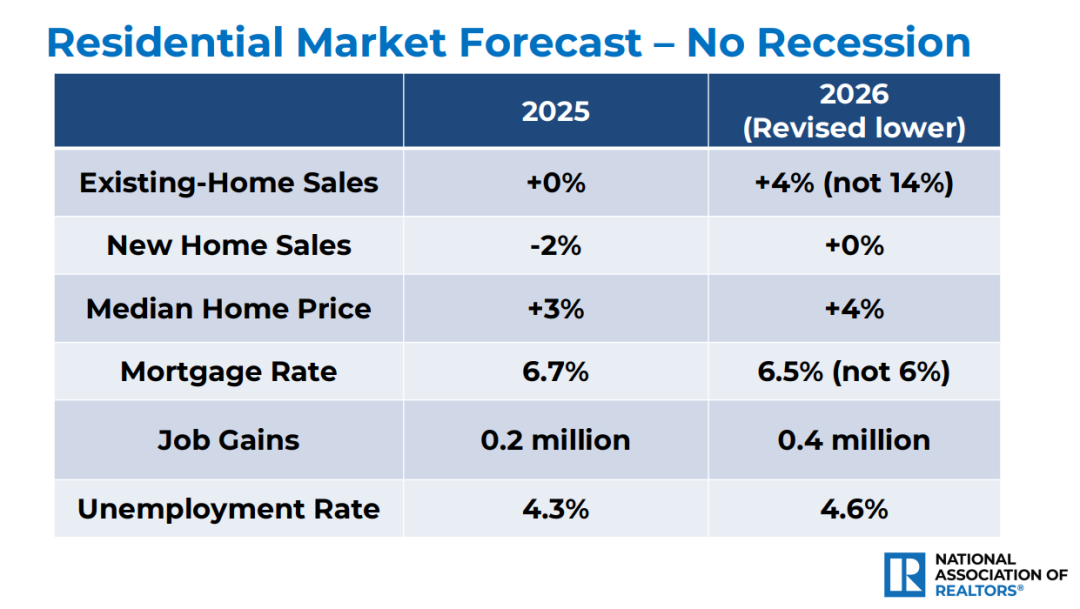
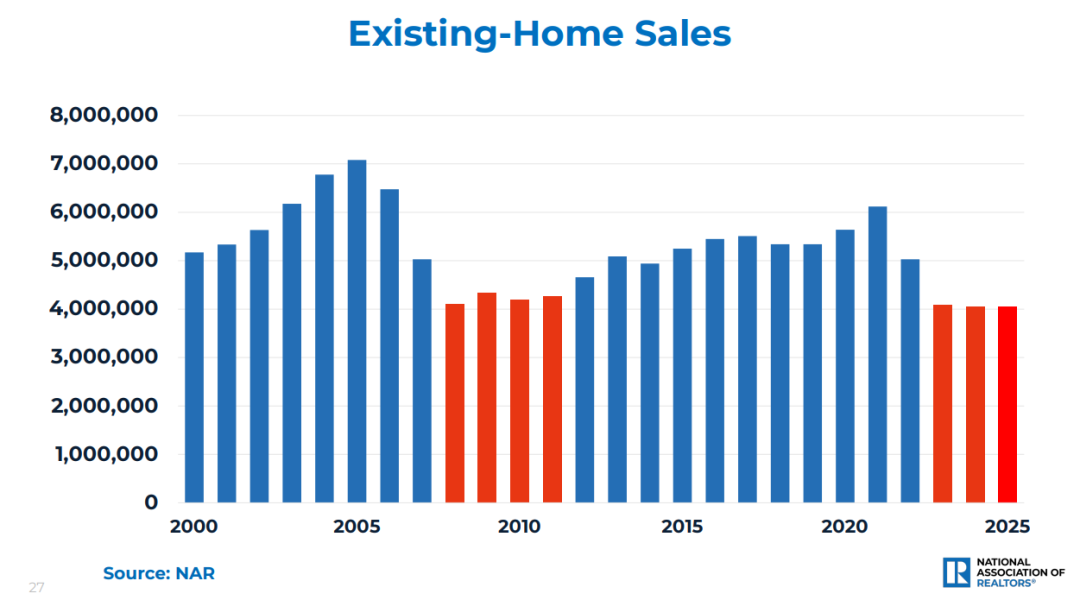
The seemingly positive absolute data in the real estate market is mainly due to the higher prices. Recently, the narrative of the upward part of the K-shaped recovery has weakened, indicating poor overall economic expectations. I understand Bernett's thoughts very well. Previously, when people saw weakening economic data, they thought about lower interest rates. Now, when seeing weakening economic data, they may think about higher deficit rates. In addition, the Fed's communication has led to a rapid widening of the term spread in the past month, prompting some administrative interventions. Removing part of the market speculation has its reasons.
Lastly, for gold, it may need to look at the Fed's attitude in the short term. If the Fed's approach is that hiking rates can only curb long-term rates, which is currently the view of many market participants, then gold may face some setbacks but it won't be a significant issue. If there is no actual improvement in productivity and rates are hiked just for various reasons, they will eventually come back down. If the Fed believes that only through easing can more supply be stimulated to enhance U.S. competitiveness and reduce inflation, then gold may have already broken through.
Finally, I would like to briefly discuss some theoretical topics today. Many of America's issues, whether getting stuck in the Middle East or making significant AI investments without seeing a reasonable short-term return, cannot be solved by fiscal or monetary means. Technical bureaucracy's operations do not address core issues. (Moreover, I don't think Bernett and Wash can be considered outstanding technical bureaucrats given the current situation. I don't understand why many people praise Bernett, saying, "China is like a broken house that will collapse with a kick; the dollar must remain strong for the U.S. economy; tariffs can bring in enough revenue; 3% economic growth, 3% deficit, 3 million barrels of oil." From 2024 to today, you can do the opposite of what he said to make money.) As a country enters the mid or later stages, the necessity and demands for reform increase daily, but the feasibility and impetus for reform decrease daily. There are successful reforms, but there are more failures. This matter itself is extremely difficult. Successful reforms are often subtle and quiet, while reforms that start from ideology often encounter too many opposition voices and fail.
For example, in Chinese history, many have heard of Zhang Juzheng and Wang Anshi, but few have sought to understand the Two Tax System reform, while the Tang Dynasty's Two Tax System reform was actually successful and far-reaching. In a sense, I think the views of many old-school financiers on Wall Street are more sophisticated than Bernett's. For example, Jamie Dimon and Ray Dalio have expressed their views on the Iran issue, suggesting that if there is war, it should be fought to the finish line rather than half-heartedly. They also believe that hiking rates may relieve long-term debt pressure. These are correct yet challenging matters. Sometimes, people have to do the right and difficult things, and a great politician is one who can lead society to do the right and difficult things.
If you have always wanted to find a clever way to achieve the so-called optimal solution. It feels a lot like many Indians I have encountered. They always think they can see things that others don't know and easily come out on top. The greatest lesson I have learned from history is that many things cannot be achieved by cleverness alone. If you haven't been through thick and thin with your brothers, there won't be anyone to save you when you are in deep trouble. Without years of experience and trust, you won't be able to build a core team to tackle tasks that take a decade or two to bear fruit. Our era is filled with rapid narratives, and while technology has reduced the importance of human beings, I believe the underlying logic remains unchanged. Many things, whether done with robots or humans, still require time.
Today, the U.S. Treasury's actions give me a feeling similar to what I've experienced with Indians in my work. They always think they can achieve great things with little money, believing they can see things others can't. I have never believed in this. I think anyone standing in front of you is not a fool, assuming you are not one yourself. So if this is just a short-sighted response by the Treasury to seasonal and geopolitical disruptions, I see no issue. If the Fed also joins in, then I think the fundamental logic will have changed.
I rarely discuss the demise of the dollar, not because I think the U.S. is without problems, but because I always feel these grand narratives take a long time. It is necessary to witness enough catalysts before engaging in a valuable discussion. I believe that if the Fed also participates in this kind of control over long-term yield and if the situation in the Strait of Hormuz ends in a fiasco, these will be sufficient catalysts. We can discuss more tomorrow.
Original Article Link
Welcome to join the official BlockBeats community:
Telegram Subscription Group: https://t.me/theblockbeats
Telegram Discussion Group: https://t.me/BlockBeats_App
Official Twitter Account: https://twitter.com/BlockBeatsAsia