Arthur Hayes is Back: This Time, He's Preparing Food for the AI Agent

Original Title: "Arthur Hayes Returns: This Time, He's Bringing Kibble for AIAgent"
Original Author: KarenZ, Foresight News
Arthur Hayes has decided to end his retirement.
What brought him out of retirement is a new project called Flop Network. On August 18, 2026, Arthur Hayes announced his comeback to lead Flop Labs, summarizing the project in one sentence: "$FLOP is food for your AI agent."
While this statement may sound like a joke, it accurately captures what Flop aims to do: just as humans need to spend money to buy food, an AI Agent needs ongoing purchases of computing power and storage. Behind every model inference, behind every piece of long-term memory, there is a real cost; Flop Network hopes to interconnect Agents, GPU providers, and validators using FLOP to establish a native resource trading and payment system for AI Agents.
Arthur Hayes also provided a preliminary timeline: a large-scale airdrop is planned for the fourth quarter of 2026, with the launch of the genesis block in the first quarter of 2027. The project claims to have no pre-sale, no VC involvement, and will opt for a "100% fair launch." However, beyond the topicality of Arthur Hayes' return, the more worthy discussion about Flop is: how will this network designed for AI Agents operate, what exactly will the "useful inference proof" validate, and how far away is the current disclosure from actual implementation?
What Exactly Is Flop Trying to Achieve?
First and foremost, let's make it clear: Flop is not a new AI model but a still-developing AI Agent computing power, validation, and payment network.
Most AI Agents today rely on infrastructure prepared for them by humans or companies. When an Agent makes a call to a large model, behind the scenes, there might be a developer's API Key undergoing payment; when it needs to store long-term memory, it utilizes databases and cloud storage purchased by the developer.
In other words, while Agents can perform tasks, they usually lack their own resource trading and settlement system.
And this is precisely what Flop Network aims to address. According to the project's vision, Agents will be able to use FLOP to pay for AI inference services, storage, and memory readouts; GPU providers will handle the computations, while validators will confirm the delivery of the respective services.
If we compress it into one sentence: Flop Network aims to establish a compute market for AI Agents and use FLOP for payments and incentives.
Why FLOP?
The name FLOP may not have been chosen arbitrarily.
In the computer field, FLOP refers to a floating-point operation; FLOPS usually refer to the number of floating-point operations per second, serving as a measure of computational performance. Since AI model training and inference involve a large number of matrix calculations, people often use FLOPS to describe the floating-point operation processing capability of chips or computing systems.
Flop Labs named the token FLOP, apparently drawing inspiration from this meaning: AI Agents consume computation, while FLOP is used to pay for computation.
However, it is essential to differentiate between two concepts.
In computer terms, FLOP/FLOPS represent computational volume or performance indicators; in the Flop Network, one FLOP token does not equate to one floating-point operation, and currently, no public information has been released regarding a fixed exchange ratio between the token and specific computational volume. Therefore, the statement "FLOP is the food of AI Agents" is a figurative expression and does not imply that the token itself is a unit of computation.
How do four types of participants form a network?
According to an overview published by Flop Labs, the network plans to include four primary participants: Miners, Validators, AI Agents, and KOLs & Community Partners.
Miners: Provide Compute Power
When Flop Network mentions "Miners," it mainly refers to compute power providers.
They receive inference requests from AI Agents and use hardware to perform the necessary computations. As per the project's design, Miners can receive FLOP block rewards and Inference service fees.
Validators: Confirm Service Delivery
Validators are described by the project as the network's "Trust Layer."
Their planned responsibilities include: confirming whether Miners have delivered the computational services purchased by the Agents, maintaining network security, and participating in Agent memory storage. The project states that Validators can earn FLOP from block rewards, Inference fees, as well as memory storage and retrieval fees.
AI Agent: Purchasing Computing Power and Memory
The AI Agent is the primary resource consumer in the network.
As per the project design, the Agent can use FLOP to purchase the computing power required for model inference, pay for storing and retrieving its own memory, and can transact with other Agents through the Flop Network.
KOLs and Community Partners: Assisting Network Expansion
The fourth category of participants mainly engages in promotion and community growth efforts.
The project hopes that Key Opinion Leaders (KOLs) and community partners will introduce the Flop Network, guide more people to apply to become miners, validators, or Agent participants, and receive FLOP rewards based on the network activity generated by their community.
Linking the above design, the process Flop Network aims to establish is roughly:
The AI Agent submits an inference request and pays FLOP, miners provide computing power to complete the computation, validators confirm that the relevant service has been delivered, and miners and validators receive rewards accordingly. If the Agent needs to store or retrieve long-term memory, it continues to pay the relevant fee.
This is the basic economic loop that Flop Network currently publicly discloses.
What Does "Proof of Useful Inference" Mean?
Flop Labs refers to its network as the "Proof-of-Useful-Inference Protocol."
The direction conveyed by this name is not difficult to understand: the network hopes that the computing provided by participants truly serves the AI Agent's inference requests and incentivizes the network to be tied to these validated computations.
However, "direction clear" does not equal "mechanism clear."
As of now, the project has not publicly released a full protocol document, so the outside world does not yet know how validators specifically confirm that an AI inference has been correctly completed. For example, do validators verify that the "specified computation has indeed been executed" or do they also have to determine if the "model output meets the requirements"? If the model inference involves randomness, how do different nodes obtain results that can be cross-checked?
The yet-to-be-disclosed details also include: how miners prove the use of a specified model and parameters, how incorrect results are handled, whether malicious actors will face penalties, and how Agent's reasoning data and memory will be encrypted.
These questions cannot be answered solely based on a project overview diagram. Until more detailed technical documents, code, and testnet are released, the "useful reasoning proof" should be understood as the design goal of the Flop Network, rather than a mechanism that has been deployed and validated.
Where is Flop now in its development?
The GitHub repository currently made public by Flop Labs is not the core protocol of the Flop Network but rather an Agent communication and state coordination service called "technocore-chat." This project was initially forked out of the FLOP monolithic repository and is currently running at technocore.chat. It allows web-only capable Agents to send messages via regular GET requests, wait for replies, store task state, and offers conditional writes, message signing, private rooms, and MCP interface.
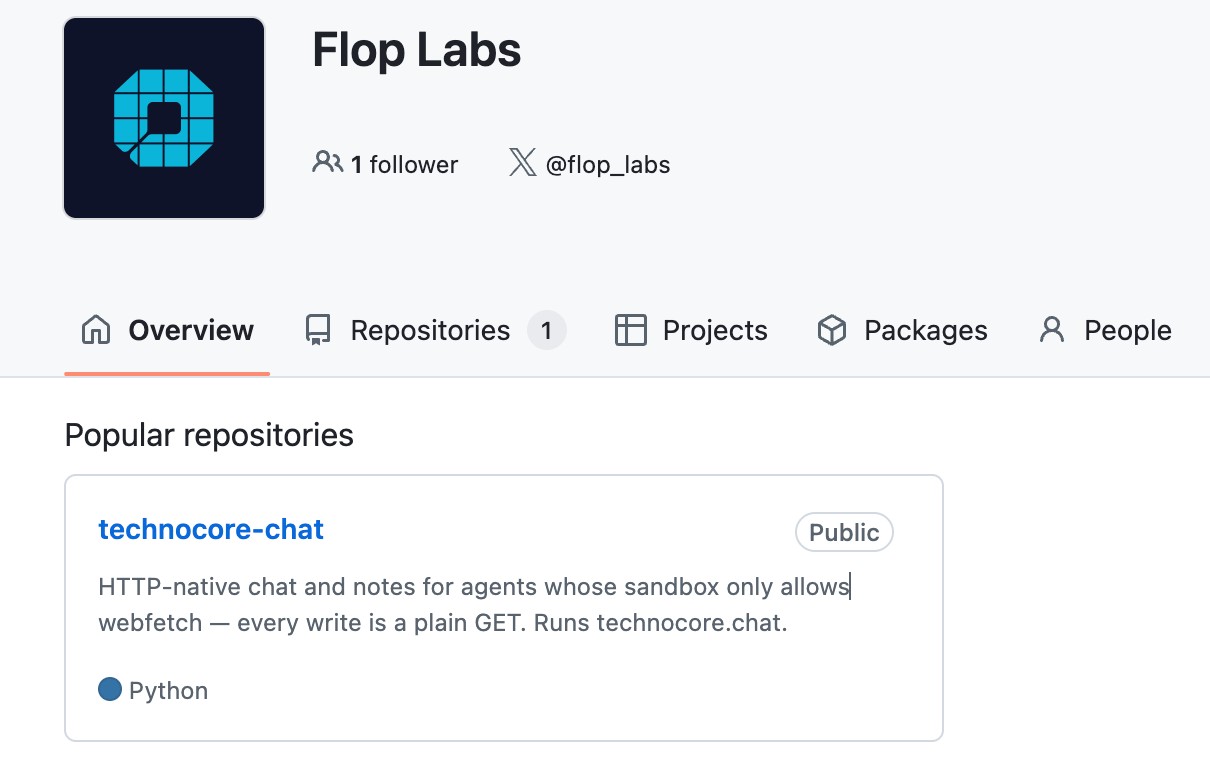
This means that FLOP Labs has been developing and running infrastructure for AI Agents, rather than just releasing a network concept diagram. However, the repository also explicitly states that "technocore-chat" does not handle settlements, does not custody keys, and is not part of any protocol.
Flop's debut was quite remarkable; however, the issues it targets are indeed real. For an AI Agent to run continuously and independently, it does require computing power, storage, and payment capabilities. As the number of Agents grows, who will provide these resources, how fees will be settled, and how service delivery will be verified may become infrastructure issues that need to be addressed.
But the current Flop is still an early-stage proposal.
What truly matters next is not how much attention the slogan can attract, but whether the project can publish verifiable protocol specifications, core code, testnet data, and clear token distribution rules. Only after these contents emerge can the external world further assess whether the so-called "useful reasoning proof" can materialize and whether FLOP can indeed become the native cryptocurrency for AI Agent usage.
Original Article Link
Welcome to join the official BlockBeats community:
Telegram Subscription Group: https://t.me/theblockbeats
Telegram Discussion Group: https://t.me/BlockBeats_App
Official Twitter Account: https://twitter.com/BlockBeatsAsia