30-Year Treasury Bond Yield Hits New High, This Time Due to AI

TL;DR
· The 30-year US Treasury bond yield briefly rose to around 5.3% intraday, with weak demand in the long bond auction.
· The AI financing frenzy is intensifying the competition for long-term funds, requiring tech stock valuations to face a higher discount rate.
· Related assets: TLT, TMF, NVDA, AMZN, GOOGL, MSFT, REITs, mortgage-related assets.
The 30-year US Treasury bond yield briefly rose to around 5.3% intraday, pushing the cost of long-term funds back to pre- and post-financial crisis high levels.
This will impact equity investors as the long-term interest rate is the underlying discount rate for asset valuation. The higher the rate, the less valuable future cash flows are discounted back to today, leading to a market repricing of growth stocks, AI infrastructure, real estate, and long-duration bonds.
The new variable this time is AI. Large tech companies are ramping up capital spending to build data centers, purchase chips, and secure electricity, pushing capital expenditures to higher levels. The question is whether the AI debt wave is merely a localized phenomenon in the credit markets or if it has already begun to compete with the US Treasury for the same pool of long-term funds.
A more conservative assessment is that AI financing is not the sole reason for the rise in long-term rates. Fiscal deficits, debt interest, and inflation stickiness still form the foundation. However, the AI debt supply is pushing the reevaluation of long-term rates toward a more crowded territory.
Long Bond Yields Weighing on Risk Assets
As the long-term US Treasury bond yield rises, the first thing to change is the reference return for all assets. When the 30-year Treasury bond offers over 5%, investors buying stocks, corporate bonds, and real estate will demand a higher risk premium.
The key concept here is term premium, which is the compensation for locking money in for the long term. If investors are concerned about higher future inflation, more government debt issuance, and central banks no longer stabilizing long bond prices, they will require a higher rate to lend money for 30 years.
The recent long bond auction sent a visible signal to the market. According to the Treasury Department and media sources, the US Treasury auctioned $250 billion of 30-year Treasury bonds on August 13 and issued them on August 17 at a yield of around 5.216%, the highest since 2001.
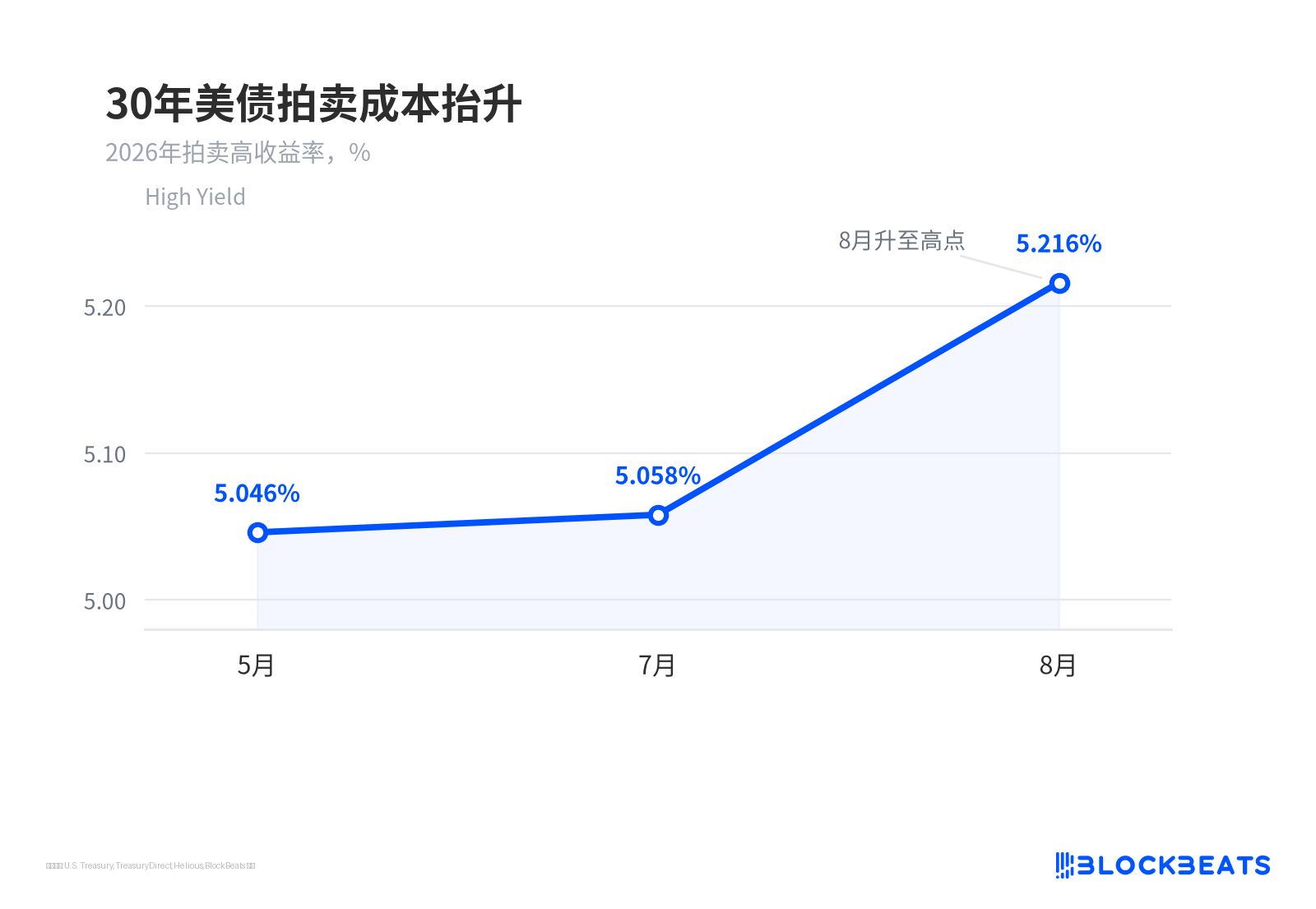
Increased cost of the 30-year US bond auction
This auction had a bid-to-cover ratio of 2.39, weaker than the recent average, with a higher takedown by primary dealers. It is not evidence of a systemic crisis but indicates that marginal buyers are starting to demand a higher yield compensation. Post-auction, the long bond yield in the secondary market continued to rise, showing that the pressure is not just a one-off technical disturbance.
Overseas markets are also feeling the impact. The yield on Japanese government bonds is at multi-year highs, driven by a mix of Bank of Japan policy normalization, inflation, and fiscal concerns. This serves as additional evidence of the global reassessment of long-term interest rates, but it cannot replace the U.S. fiscal supply as the main theme.
Fiscal Supply Foundation, AI Debt Amplifies Fund Competition
The foundation for the rise in long-term interest rates remains fiscal. The U.S. government needs to continue issuing debt to finance itself, and investors facing a larger debt burden and a more uncertain inflation path will demand higher returns. The CRFB, citing the CBO's budget outlook, emphasizes that rising deficits, debt, and interest costs will continue to squeeze fiscal space.
The uniqueness of AI lies in the fact that it has propelled the corporate sector into both major buyers and major issuers in the long-term capital markets. Cloud computing giants, in order to expand data centers, procure chips, and increase power capacity, have significantly amplified their capital expenditures, leading to a rise in bond financing and lease commitments.
According to Bloomberg citing Nomura's estimate, the borrowing volume of large tech companies now represents a portion equivalent to the U.S. Treasury's net issuance to private investors. While this measure needs to be taken with caution, it serves as a reminder to the market that U.S. bonds and tech company bonds are drawing from the same pool of funds from insurance companies, pension funds, and asset management institutions.
Institutional estimates also indicate that by 2026, AI-related debt supply has reached the level of several hundred billion dollars. By Morgan Stanley's estimate, AI-related debt by 2026 has reached around $250 billion to date and could approach $500 billion for the full year. Different statistics may mix investment-grade bonds, leases, and project financing, making direct addition inappropriate, but the trend is clear: AI is increasing the demand for long-term funds.
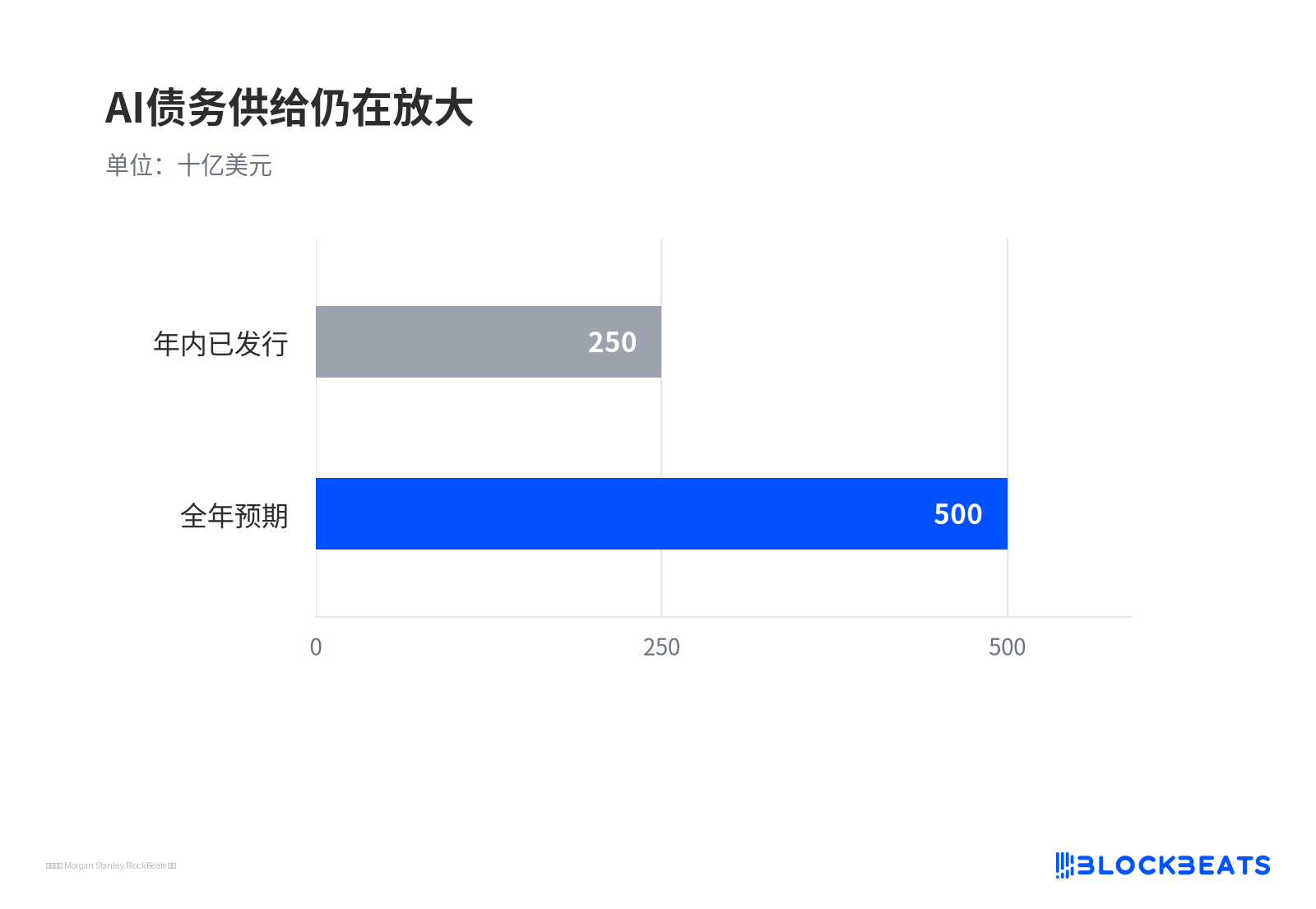
AI Debt Supply Continues to Expand
This is also why the AI positive trend is starting to experience reverse pricing. Previously, the market was more concerned about how much revenue and computing power AI could bring, but now it also questions where the money for data centers will come from. After the rise in financing costs, will the return on investment be able to cover the cost of capital.
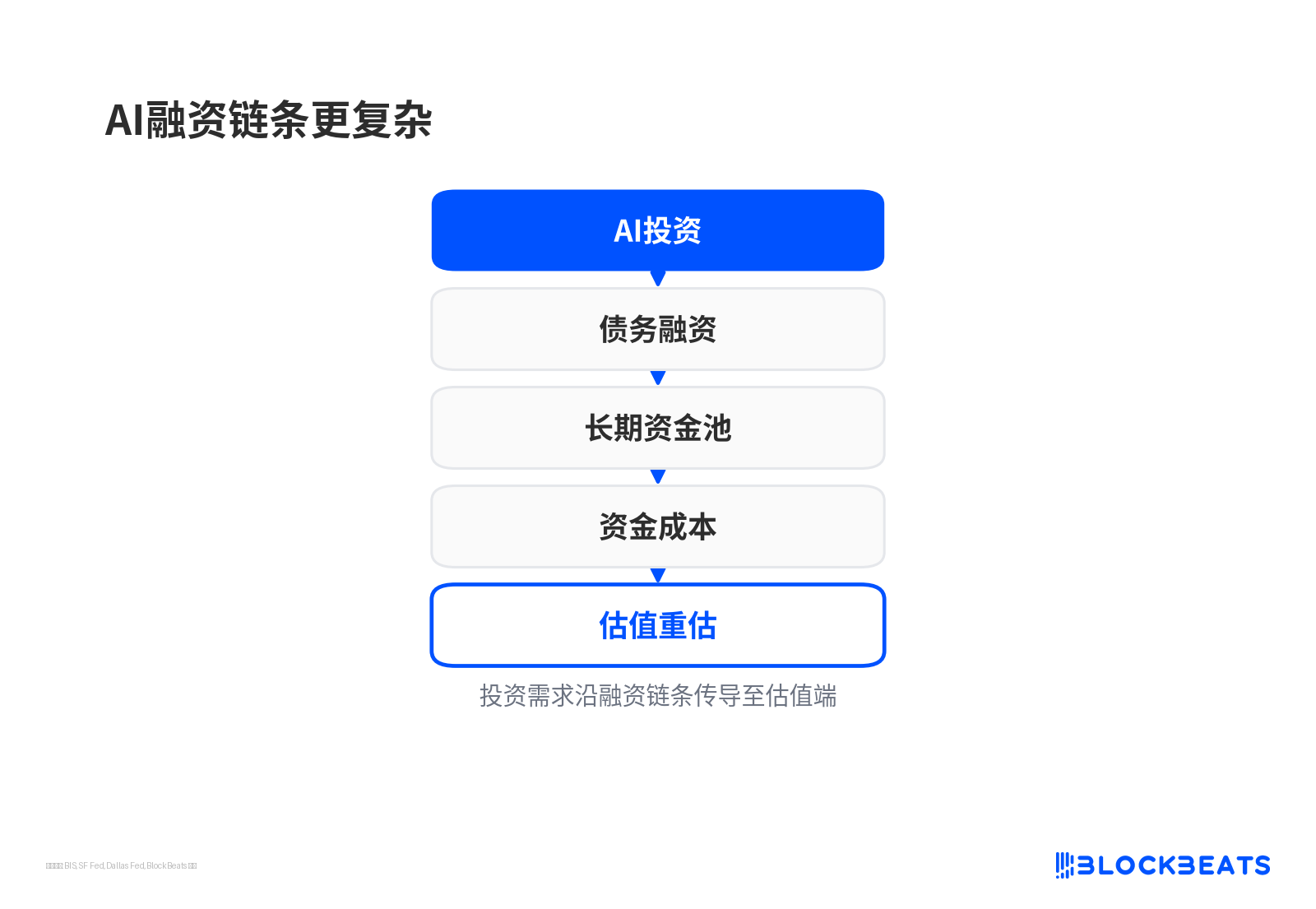
The AI Financing Chain Becomes More Complex
Higher Discount Rates Challenge AI Valuation
For large tech stocks, AI debt will not immediately turn into bad news. Microsoft, Amazon, Alphabet, Meta, and Nvidia still have strong cash flow, strong credit, and strategic positions, and the market is willing to offer them lower financing spreads.
The pressure comes from valuation slopes. The larger AI capital expenditure is, the more investors need to believe that future revenue will grow proportionally. The higher the long-term interest rates, the lower the present value of future income. As both variables change, the valuation anchor of tech stocks will shift from a growth story to capital return.
The BIS warning also applies here. It does not predict an immediate AI bubble burst but points out that AI investment demand may drive companies from operating cash flow to debt financing. If competitive investment leads to returns below expectations, the high issuance in the fixed-income market will become more fragile.
Different assets are stressed differently. Long-term bond ETFs will be directly impacted by rising yields as bond prices move inversely to yields. REITs and mortgage-related assets are more sensitive to financing costs. Growth tech stocks face both a rising discount rate and AI investment return validation.
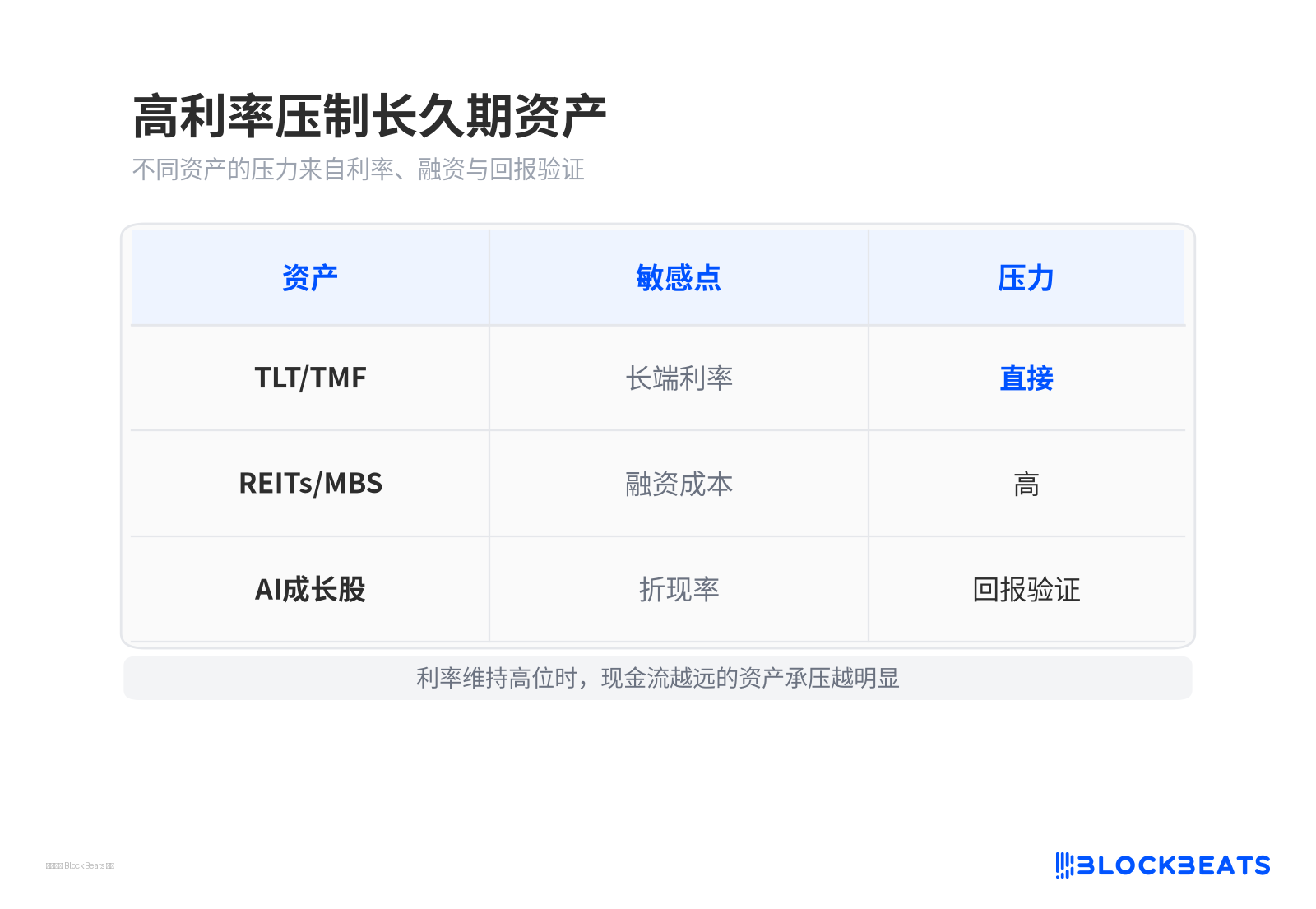
High Rates Suppress Duration Assets
A finer differentiation may emerge within the AI industry chain. Top-tier tech companies can withstand higher rates, but second-tier AI firms, unprofitable application layer companies, data centers, and power chains reliant on external financing will feel valuation contraction sooner. The market may not abandon AI altogether but will price AI more selectively.
Issuance Pace Determines Pressure Alleviation
This round of revaluation has not yet entered a crisis redemption phase. It currently resembles more of a fiscal deficit and inflation stickiness raising long-term capital costs, with the AI financing surge becoming a marginal amplifier by 2026. What it alters is not a one-time auction but the risk premium investors demand when pricing long-duration assets.
The key will be whether supply will self-restrict. If long-term yields continue to rise, tech firms might postpone some debt issuance or slow down capital expenditures. If AI revenue realization is quick enough, the market may continue to absorb this wave of debt supply.
The pressure scenario is clear as well. If Treasury auctions remain weak, corporate bond issuance keeps increasing, and tech stock earnings fail to prove the AI investment return, long-term rates will shift from a macro variable to a valuation variable. At that point, the focal point of market trading will not just be how high the Treasury yield has reached but also how much the AI capital expenditure cycle can withstand in terms of funding costs.
Welcome to join the official BlockBeats community:
Telegram Subscription Group: https://t.me/theblockbeats
Telegram Discussion Group: https://t.me/BlockBeats_App
Official Twitter Account: https://twitter.com/BlockBeatsAsia