OpenAI and Anthropic's Profitability Soaring Exponentially, Will IPO Valuation Anchor Change

TL;DR
· OpenAI's annualized revenue run rate is reportedly over $40 billion, while Anthropic's preliminary revenue in Q2 exceeded $11.5 billion.
· Market focus shifting to whether inference costs, customer retention, and cash flow trajectory can support IPO valuation.
· Related entities: OpenAI, Anthropic, xAI, NVIDIA (NVDA), Microsoft (MSFT), Google (GOOGL), Amazon (AMZN), data centers, and energy supply chain.
OpenAI and Anthropic have recently seen a rapid surge in reported revenues according to investor documents. OpenAI's annualized revenue run rate is reportedly over $40 billion, while Anthropic's preliminary revenue in Q2 exceeded $11.5 billion.
These figures touch on a core issue in AI investment. Are cutting-edge model companies still in the phase of burning money to train models, or have they already turned model capabilities into real revenue? The answer will impact private valuations and will also be reflected in the secondary market for compute-focused stocks.
It's important to first clarify the metrics here. The annualized revenue run rate extrapolates recent monthly or quarterly revenue to a full year but does not equate to realized annual revenue. Axios also notes that the run rate metrics for OpenAI and Anthropic may not be directly comparable.
Anthropic CEO Dario Amodei previously mentioned at a developer event in May 2026 that the company had initially planned for a 10x growth, but first-quarter revenue and usage extrapolated on an annualized basis reached 80x. What the market heard was not just a one-quarter surprise but a potential acceleration of the commercialization timeline.
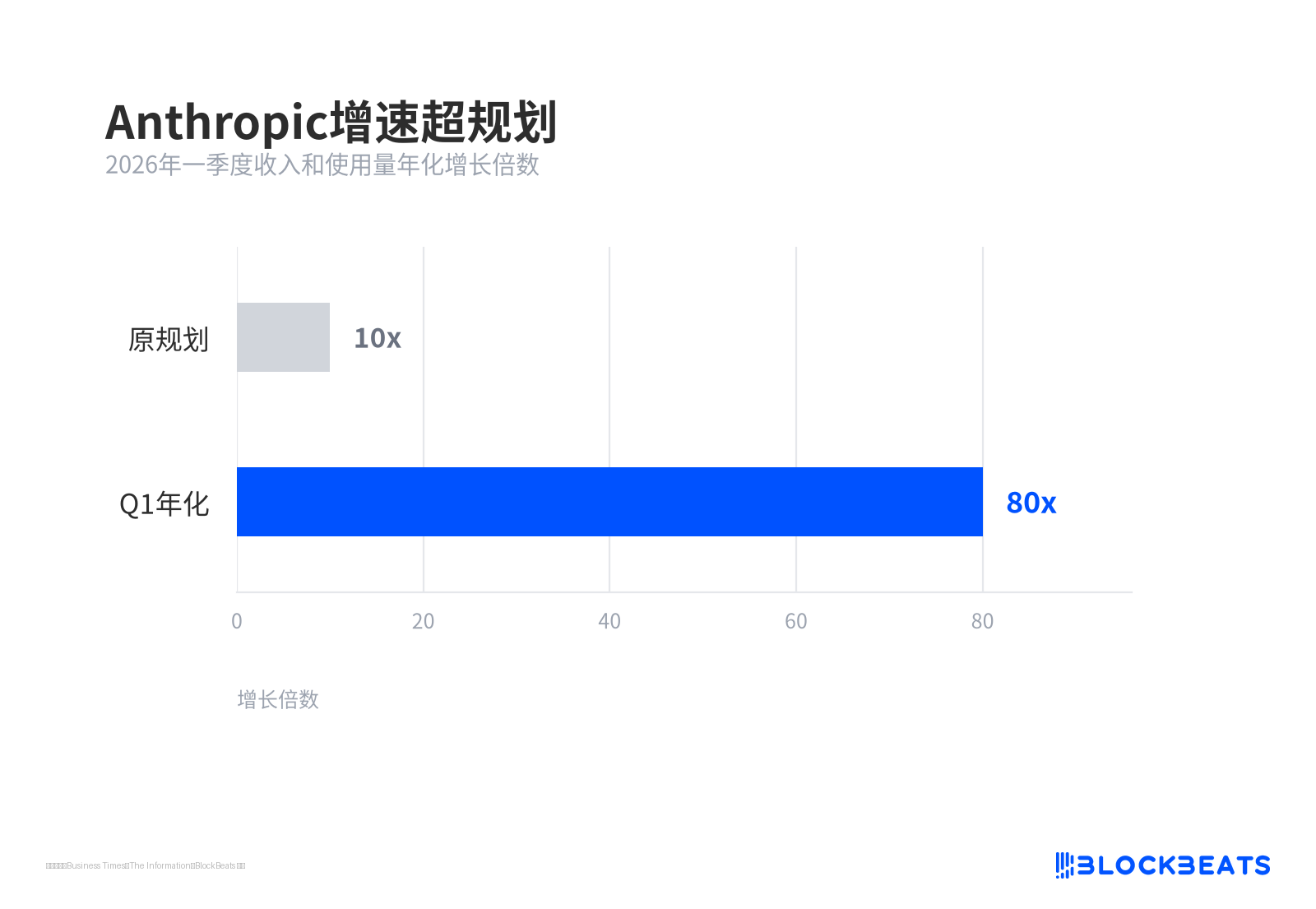
Anthropic Exceeds Growth Expectations
Revenue Slope Taking Over Financing Narrative
The first layer of meaning in this round of revaluation is that AI labs are beginning to show revenue volumes closer to infrastructure companies rather than just discussing long-term technical narratives.
OpenAI's $40 billion valuation comes from media-referenced internal sources, roughly double the level seen at the end of 2025. Anthropic's $11.5 billion valuation is based on investor documents seen by Bloomberg, representing preliminary second-quarter revenue, not annualized revenue. Reports also mention Anthropic's annualized revenue run rate exceeding $65 billion, and these two sets of numbers need to be understood separately.
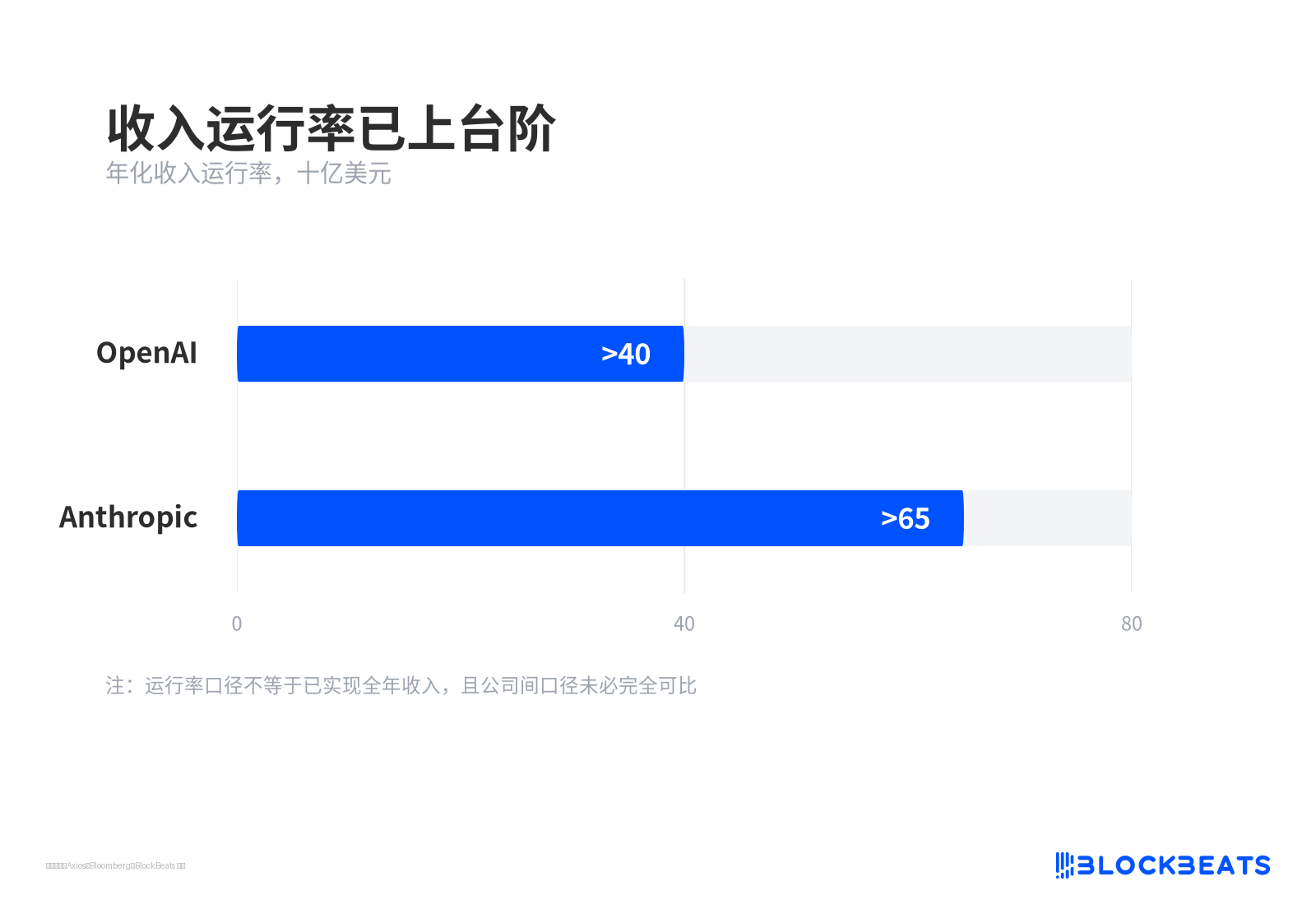
Revenue Run Rate Steps Up
Even with caveats, these numbers are sufficient to shift the market reference point. Previously, discussions about leading AI model companies often focused on training costs, funding rounds, and computational expenses. Now, the revenue slope itself is starting to become part of the valuation anchor.
Anthropic's second-quarter adjusted operating revenue is also worth noting, but it should not be framed as already profitable. Adjusted operating revenue typically excludes some expenses, only indicating that the company covers some operating costs in a specific context, not that it has achieved positive net income or free cash flow.
The market repricing is not about "AI companies are already making money," but about "AI labs may be entering the revenue validation stage sooner than expected." This is crucial for the IPO narrative and will also affect how long investors are willing to tolerate losses.
Coding Tools Pushing Revenue Toward Usage-Based Billing
Where the growth is coming from is more important than the numbers themselves. Currently, the most explanatory sources are coding agents (auto-coding tools) and API usage.
Coding agents bring AI from chat windows into the developer workflow. Previously, user payment was more like buying a smart assistant, but now, businesses and developers are starting to have models continuously involved in coding, debugging, generating tests, processing documents, and calling internal systems.
This will change the revenue model. Traditional software is often charged per seat, with revenue growth constrained by the number of people. AI coding and API consumption are more based on call volume, task volume, and context length. As long as the model enters high-frequency workflows, usage may grow faster than the number of users.
This is also why Anthropic's revenue slope is receiving attention. Claude's penetration in developer scenarios is showing the market that leading model companies are not just reliant on consumer subscriptions but may also enter enterprise production processes.
OpenAI's growth is also not solely from ChatGPT subscriptions. AI coding software, subscription sales, and advertising attempts could all bring incremental gains, but the advertising proportion remains unclear, is more suitable as a potential variable, and cannot be directly seen as a core revenue driver.
For the secondary market, this chain will spill over to NVIDIA, cloud providers, data centers, and energy companies. As long as the revenue comes from higher-frequency inference calls, the computational demand will not stop at the training stage but will continue into daily usage.
The Middle Eastern Capital Invests in Industry Entry Points
The move by Middle Eastern sovereign wealth funds is another validation line of this revenue narrative. They did not bet on a single company but diversified their layout across multiple cutting-edge labs.
The Abu Dhabi MGX holds stakes in OpenAI, Anthropic, and xAI and has completed the first phase of a $49 billion fundraise. The Saudi PIF-backed Humain invested in xAI, the Qatar Investment Authority also established positions in Anthropic and xAI through related arrangements, and confirmed participation in Anthropic's Series H funding.
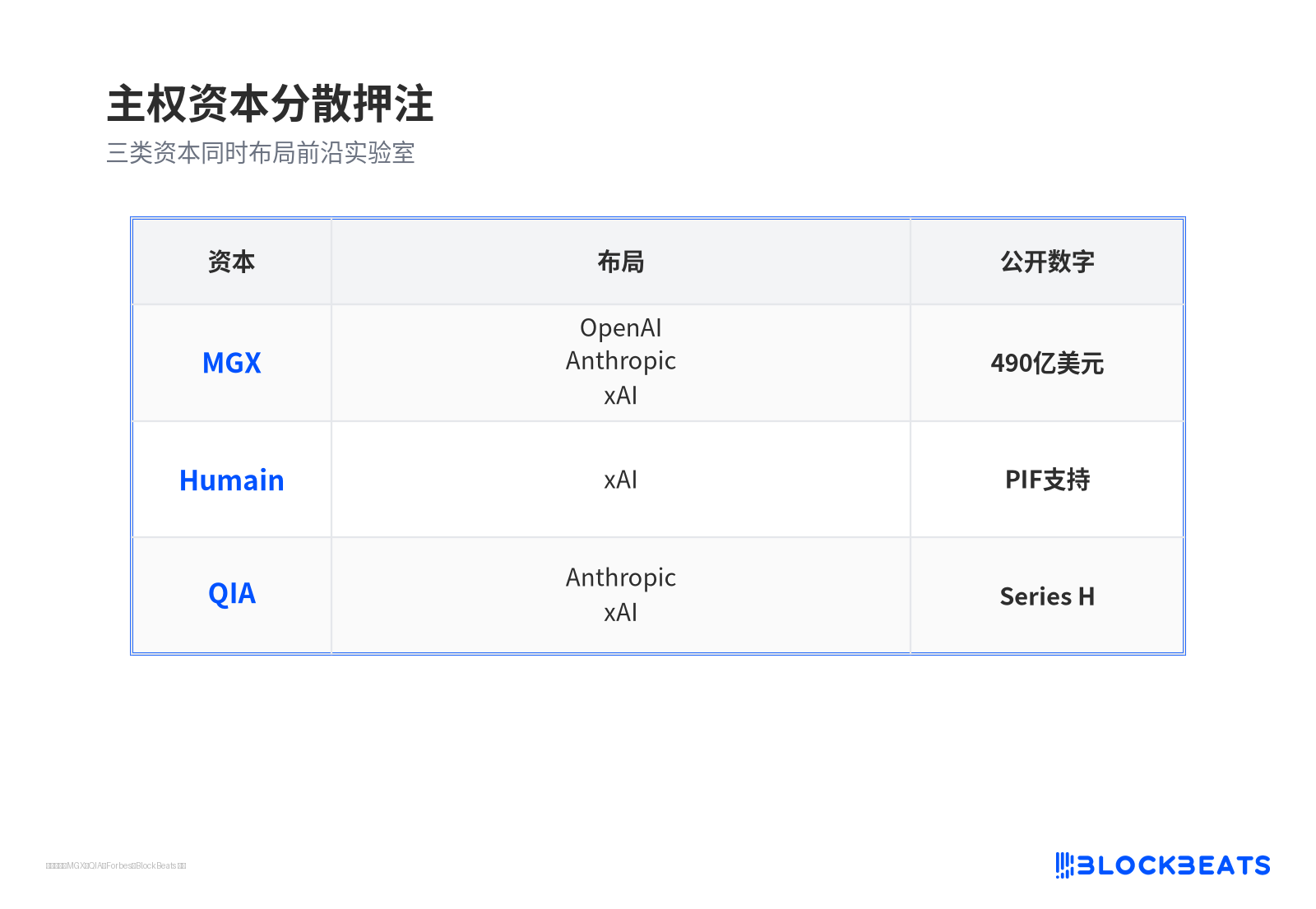
Sovereign Wealth Funds' Diversified Bets
The logic behind sovereign wealth funds' diversified bets is straightforward. If AI becomes the next-generation infrastructure, national capital cannot gamble on just one winner. Regardless of who the eventual leader is, it is more cost-effective to hold shares early, build relationships, and gain industry access than to buy capabilities after the fact.
However, this does not mean that Middle Eastern capital controls AI labs. The governance rights, technology-sharing terms, and export restrictions of most transactions are not transparent. A more prudent understanding is that sovereign wealth funds are increasing the financing certainty of AI labs and pushing AI competition into a more capital-intensive and longer-term phase.
Gross Margin Determines Whether Revenue Can Translate into Valuation
The revenue slope can stimulate IPO imagination but cannot solely support valuation. If OpenAI and Anthropic were to enter the public market, investors would ask the same question: For every dollar of AI revenue, how much is left after deducting the inference costs.
This is precisely the biggest difference between cutting-edge AI and traditional software. Traditional software has lower replication costs, naturally resulting in higher gross margins. Large models consume computational power for each response, and as the user base grows and tasks become more complex, the inference costs will also rise in tandem. If revenue growth is accompanied by cost expansion at the same rate, the valuation anchor will be lowered.
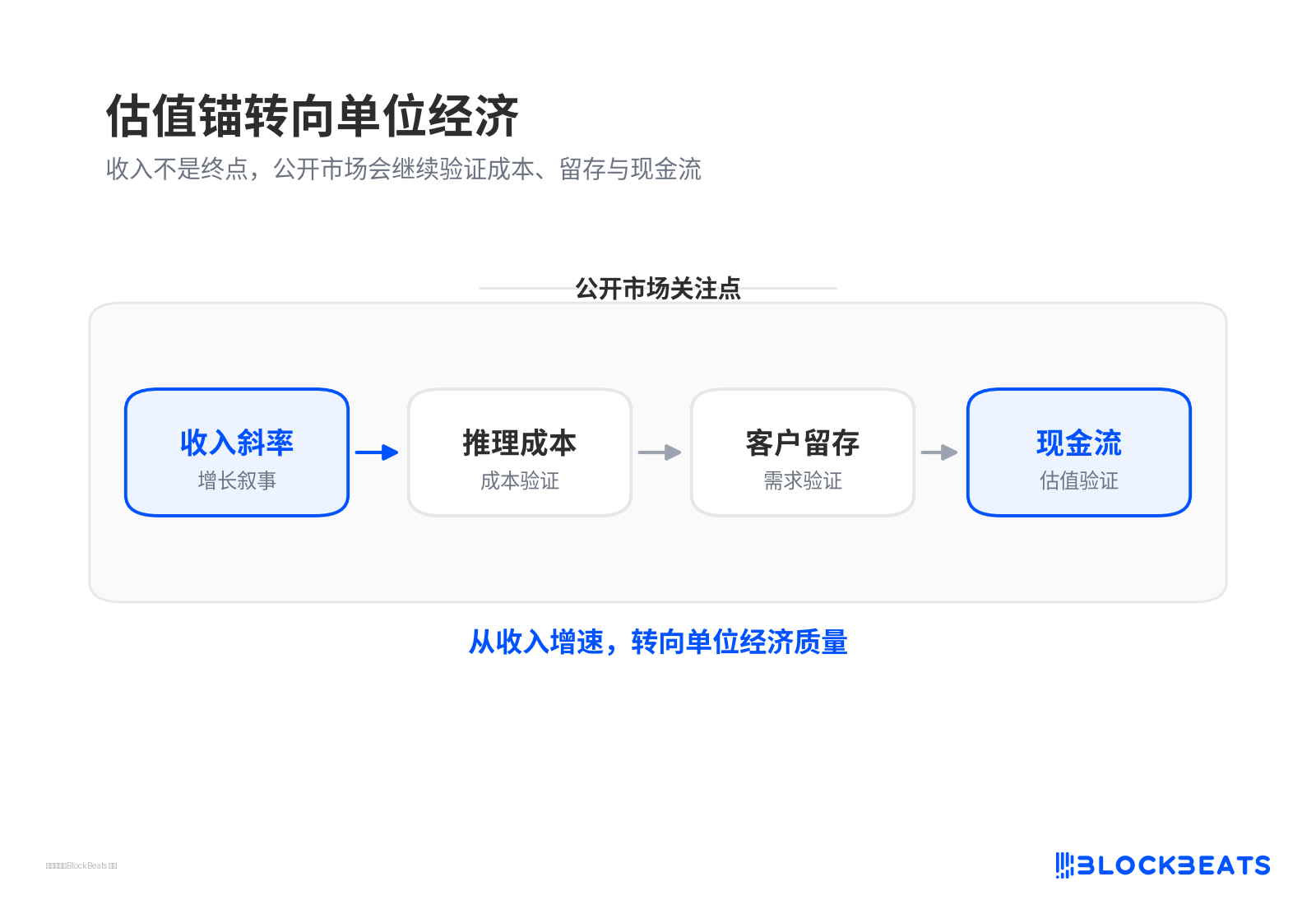
Valuation Anchor Shifts to Unit Economics
Customer mix will also be magnified. If growth is primarily driven by a few large customers, short-term promotions, or cloud partner subsidies, the quality of the annualized run rate will decrease. The market will only view it as infrastructure-level cash flow if enterprise retention, usage expansion, and gross margin improvement are synchronized.
This set of numbers is already sufficient to prove that AI lab commercialization is accelerating, but it is not yet enough to demonstrate that the IPO valuation can unconditionally move upward. The key to reassessing whether it can hold steady is whether subsequent filings will reveal a clearer revenue breakdown, a cost curve for inference, customer retention, and cash flow trajectory.
Welcome to join the official BlockBeats community:
Telegram Subscription Group: https://t.me/theblockbeats
Telegram Discussion Group: https://t.me/BlockBeats_App
Official Twitter Account: https://twitter.com/BlockBeatsAsia