Stripe’s $7 Billion Acquisition of OpenRouter: Why Did the Fintech Giant Eye Model Routing?

According to Bloomberg, the payment company Stripe has reached an agreement to acquire the AI model routing platform OpenRouter for a transaction value exceeding $7 billion. TechCrunch followed up on the report, stating that neither company has publicly confirmed the acquisition. While Stripe has stated they do not comment on rumors or speculation, OpenRouter has declined to comment.
OpenRouter's product documentation indicates that it does not train its own models. Instead, it aggregates different models behind a single API, allowing developers to switch between them based on tasks or automatically select based on price, speed, and availability. This intermediary step, often referred to as a "middle layer," has now been assigned a very high potential price tag.
The questions start from here. If OpenRouter is viewed simply as a model directory, the reported lower limit of the price is difficult to explain. One possible answer lies in its placement at the decision point before each call is made.
A Rapidly Escalating Price Tag
As reported by The New York Times earlier, OpenRouter was valued at around $1.3 billion after its Series B funding round. The recent Bloomberg report states that the minimum transaction value is over $7 billion. The two reports are separated by less than three months, and both figures come from media coverage, which cannot be directly equated as a return on investment or a definitive premium.
Even considering only the lower limit reported, the price is at least 5.4 times the previous valuation. This provides a clue to understanding the reported price; models may not be purchased from a single supplier at a fixed price, and the ability to interchange models may itself have been assigned commercial value.
According to earlier negotiation reports by The Wall Street Journal, some insiders believed OpenRouter could fetch around $10 billion. Those were possible prices at the negotiation stage and cannot be placed side by side with the current minimum transaction value as two definitive answers. That hint left behind is that the interchangeability of models may have also been assigned independent commercial value.
This ability can be likened to routing in payments. When a card is swiped, a merchant does not wish to decide which acquiring institution to go through. It only cares about success rate, speed, and cost. Model calls have a similar selection process, except the entities being routed are tokens instead of funds.
How Much Water Is Really in the Pipeline
Valuation speaks to expectations, while token volume per week is closer to describing a real pipeline. OpenRouter stated in its Series B announcement that its weekly token volume had increased from 5 trillion to 25 trillion in approximately six months. This metric is not revenue or market share but indicates the actual load of tokens passing through this infrastructure layer.
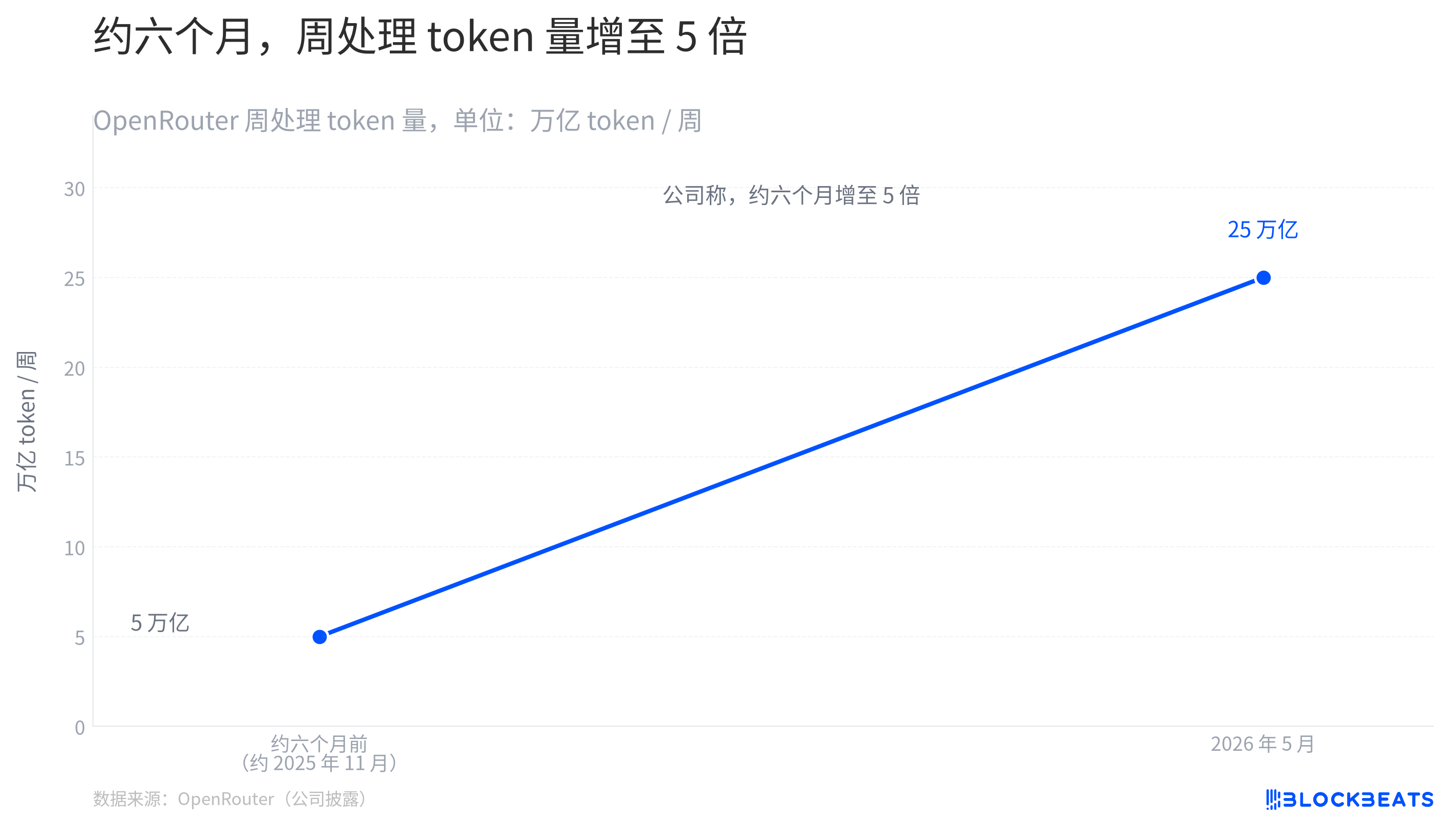
The second graph does not reveal the motivation behind this transaction, but it demonstrates why "model interchangeability" may no longer be just a developer preference. When the call volume is low, engineers can manually switch models, which is cumbersome but tolerable. However, as requests continue to pour in, price fluctuations, supplier failures, and new model deployments all become part of daily operations, and manual maintenance quickly escalates into a full-time job.
In the same announcement, OpenRouter stated that it serves over 8 million developers, covering more than 400 models. While the company's disclosed metrics need to be taken with a grain of salt, putting these two numbers together is enough to outline its position. It not only places models on the shelf but also considers the model's price, availability, and replacement cost at the same entry point.
For enterprises, the value of model routing does not lie in choosing the cheapest model for every transaction. It is more akin to the procurement department setting different budgets for different tasks. Simple summarization, classification, and customer support replies can initially prioritize cost. On the other hand, for code, lengthy reasoning, and high-risk outputs, the requirements are elevated. The role of the routing layer is to ensure that this set of choices does not need to be made from scratch every time.
Ranking by Capability Does Not Equal Ranking by Cost
This is precisely the question the third graph aims to answer. Artificial Analysis listed seven models in its Intelligence Index, alongside task-weighted cost metrics, shedding light on the fact that the index and cost are not always in sync.
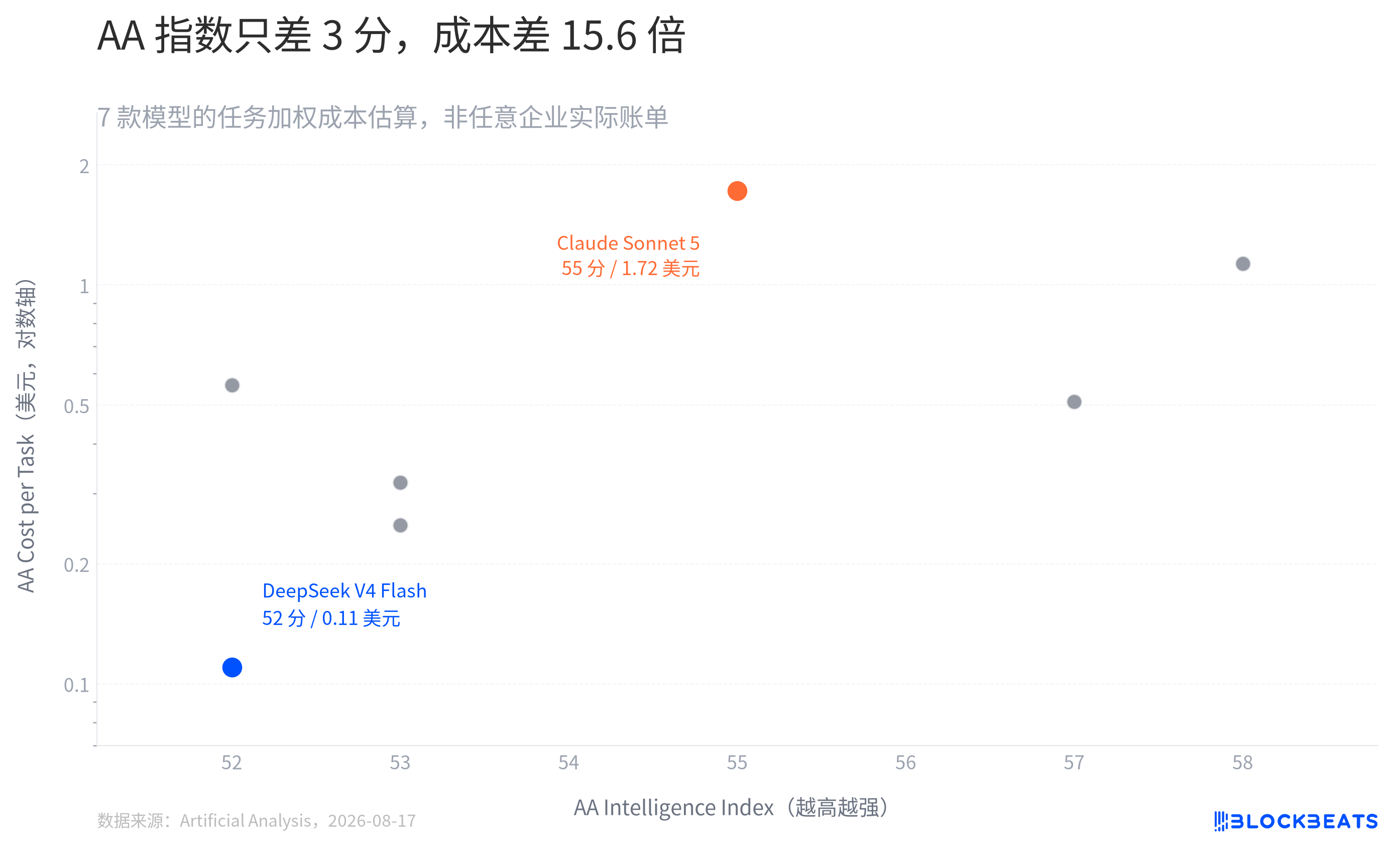
The highlighted models, DeepSeek V4 Flash and Claude Sonnet 5, differ by 3 points in the Artificial Analysis Intelligence Index. However, this difference does not imply that their capabilities in all tasks are only 3 points apart. For teams that require stable reasoning capabilities, the final decision will still consider external variables such as reliability, context length, and product fit.
But in the platform's task-weighted cost metrics, the two models differ by approximately 15.6 times. This gap does not represent any company's actual bill, but it offers the routing layer a quantifiable value. Model invocation is not like buying a machine; it involves continuous small expenses. Each slight difference, when scaled, eventually becomes a visible cost.
OpenRouter's product documentation breaks down this choice straightforwardly. Users can sort by price, throughput, and latency or choose to retain a fallback. In other words, developers do not have to bet on a single model path remaining effective forever; instead, they can treat models as a dynamically schedulable supply.
This provides an explanation for why low-cost models have become part of this transaction discussion. They are not meant to prove that high-cost models are not worth using. According to the task-match model, it may allow the routing layer to shift from a convenient development tool to an entry point that helps companies manage the cost of inference.
What Stripe Aims to Achieve
Stripe did not just get to know OpenRouter right before the acquisition announcement. According to a Stripe disclosure, earlier this year, Stripe had already provided OpenRouter with usage-based billing, tax, and risk capabilities. OpenRouter is responsible for connecting the models, while Stripe has been handling how it is billed on the backend.
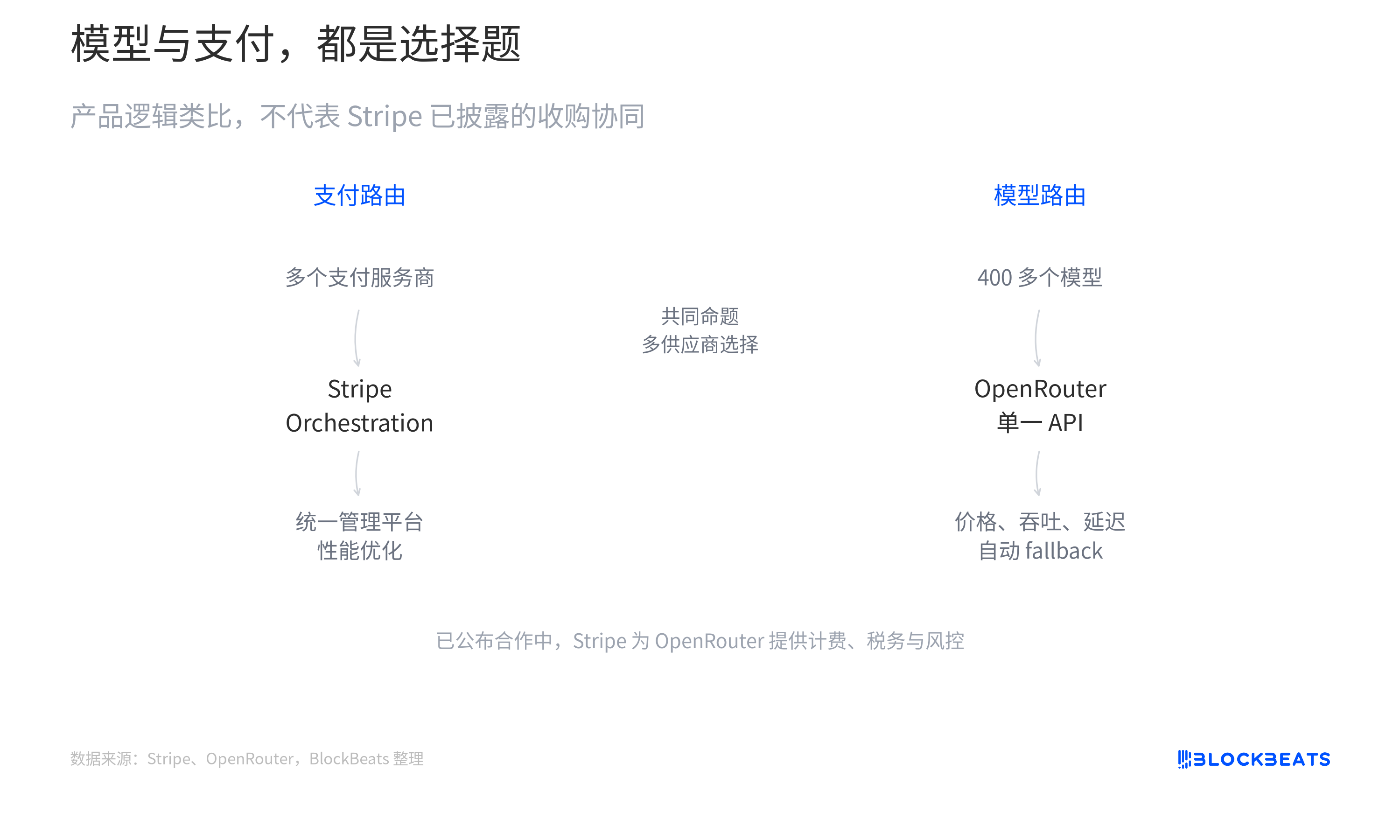
In a product announcement, Stripe revealed that they also have a payment orchestration product called Orchestration to help businesses set up, manage, and optimize performance across multiple payment service providers. It did not explicitly mention integrating this product into OpenRouter. The fourth slide simply juxtaposes the publicly known product logics of both sides.
Both products can be seen as addressing the same issue. As options multiply, customers do not want to maintain a set of rules for each vendor. They want to push complexity behind a single interface and only focus on the outcomes. Payment routing decides how funds flow for merchants, while model routing helps applications decide how requests flow.
What truly brings people back to the question in this report is who holds the decision-making power before the call occurs. The value of model routing may lie precisely in this step.
Welcome to join the official BlockBeats community:
Telegram Subscription Group: https://t.me/theblockbeats
Telegram Discussion Group: https://t.me/BlockBeats_App
Official Twitter Account: https://twitter.com/BlockBeatsAsia