First-quarter capital expenditure was $5.6574 billion, where did Nebius's expansion funding come from?

On August 12, AI cloud infrastructure company Nebius released its second-quarter performance ending on June 30. According to the company's performance press release and shareholder letter, the group's quarterly revenue was $5.823 billion, while cash spent on purchasing property, plant, and equipment reached $5.674 billion.
On one side is the newly recognized revenue, and on the other side is the upfront deployment of GPUs and data centers. In the same quarter, Nebius also disclosed four landmark AI cloud contracts, with an average contract value exceeding $1 billion. Putting these numbers together easily tells a smooth story. Customers signing deals, company expanding capacity, and revenue continuing to climb.
However, the contracts, cash, equipment, and revenue in this chain are not moving at the same pace. The real dissecting point of Nebius's second quarter is how customer demand is participating in expansion funding and what has made its way into the financial statements versus what is still within contract terms or management estimates.
$30 Billion ARR, What Has Already Happened
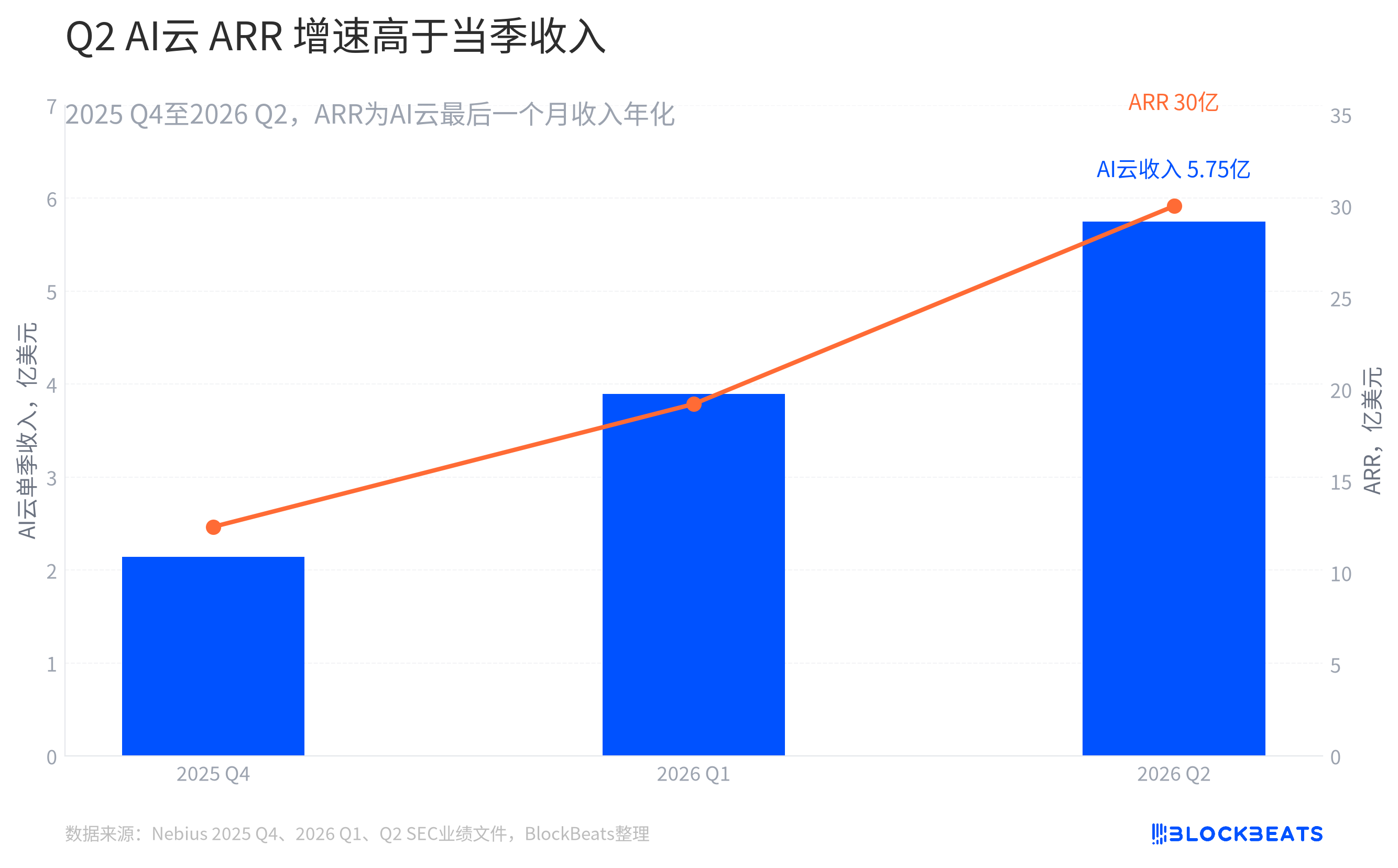
Let's first look at what has already occurred. According to Nebius's Q2 2026 shareholder letter, the group's revenue increased from $2.277 billion in Q4 2025 to $5.823 billion in the current quarter. In the second quarter, the AI cloud business contributed $5.749 billion, almost constituting the entire revenue.
The orange line on the graph represents a $30 billion AI cloud ARR. It is not revenue already locked in for the next 12 months but an annual run rate calculated by multiplying the last month's AI cloud revenue by 12. This metric is more like a current speedometer, informing readers how fast this business was running at the quarter's end.
As per the calculation, the ARR grew by 56.3% quarter-over-quarter, slightly faster than the group's revenue growth rate of 45.9%. These two metrics are not entirely comparable; the former only observes the last month of the AI cloud business, while the latter represents a full quarter for the whole group. Placing them on the same graph is to visualize the time lag between demand momentum and confirmed revenue, rather than treating ARR as order amounts.
The profit metric needs to be viewed separately. According to the company's performance press release, the group's Q2 non-GAAP adjusted EBITDA rose to $2.362 billion. At the same time, the GAAP net loss from continuing operations was $1.904 billion. The adjusted EBITDA excludes items such as depreciation, amortization, stock-based compensation, transaction-related costs, and interest, describing the adjusted operating performance but cannot be directly translated into cash profit already secured.
Revenue growth does not mean that the funds for construction have already been covered by the revenue itself. For a company that continues to purchase GPUs, connect to power, and build data centers, this money is often spent upfront before service delivery.
Why Customer Payments and Equipment Investment Misalign
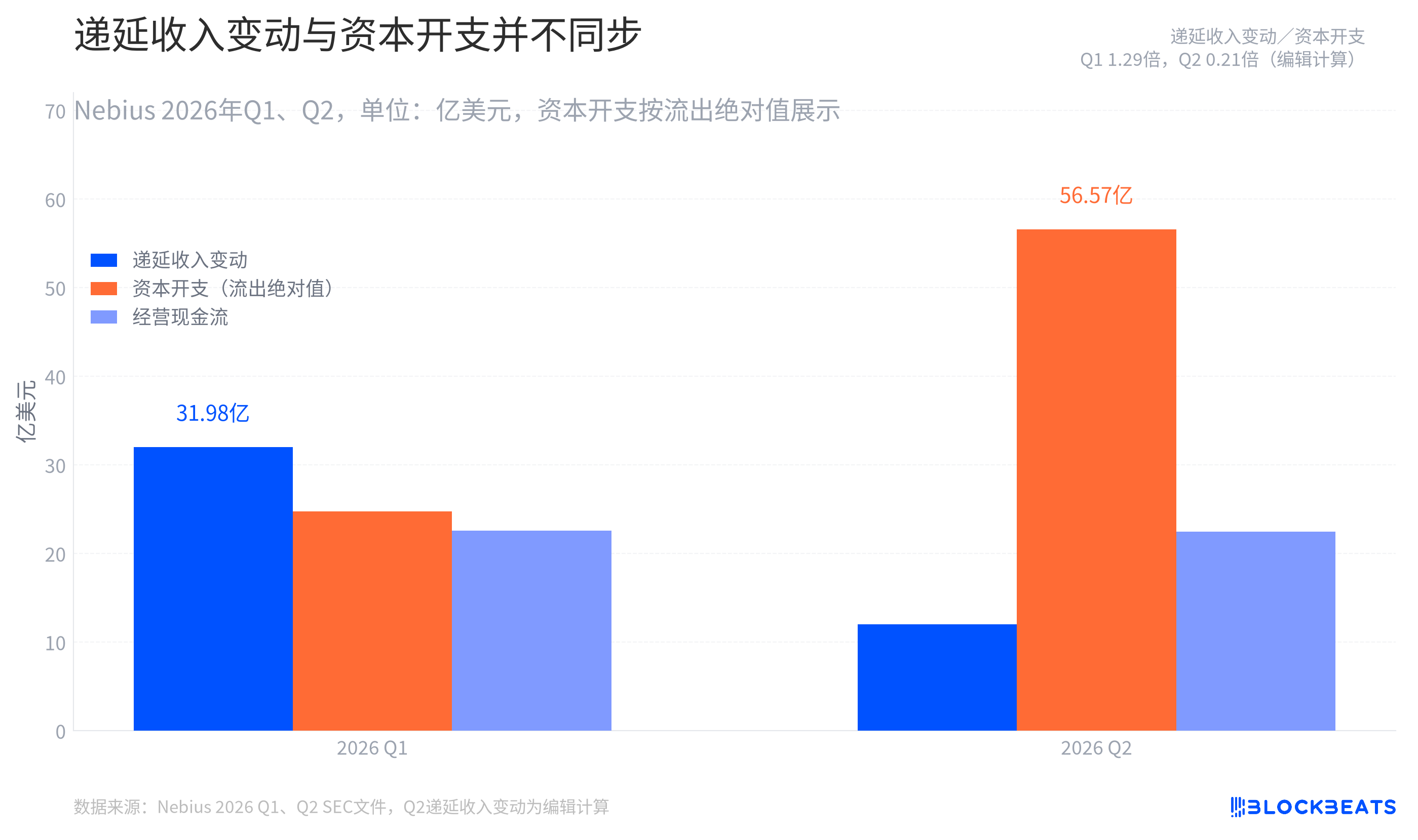
The second figure juxtaposes several easily confused numbers from the cash flow statement. In the first quarter of 2026, the change in deferred revenue exceeds capital expenditures. By the second quarter, capital expenditures suddenly spike, far surpassing the change in deferred revenue.
According to Nebius's second-quarter unaudited consolidated financial statements, the first-half change in deferred revenue was $43.95 billion, and capital expenditures were $81.303 billion. The change in deferred revenue shown in the second quarter is calculated by subtracting the first quarter's disclosure from the first half's disclosure. It is not second-quarter revenue and cannot be directly referred to as all customer prepayments received in that quarter.
This differentiation is crucial. The change in deferred revenue is an item in the cash flow statement that affects operating cash flow, while the year-end deferred revenue balance is a stock item on the balance sheet. Both are related to the timing of customer payments but cannot be added together to be called customer deposits for a particular quarter.
The operating cash flow in the second quarter remains positive, but capital expenditures, when calculated as an absolute cash outflow, are about 9.7 times the quarterly revenue. According to the company's financial reports, this is more like first loading the power, racks, and servers of a computing power market and then waiting for customers to settle based on their usage. Customer cash can alter the timing of construction funds, but it cannot be inferred from this that every equipment investment has already been covered by customer payments.
Customer Prepayments, What Exactly Do They Cover
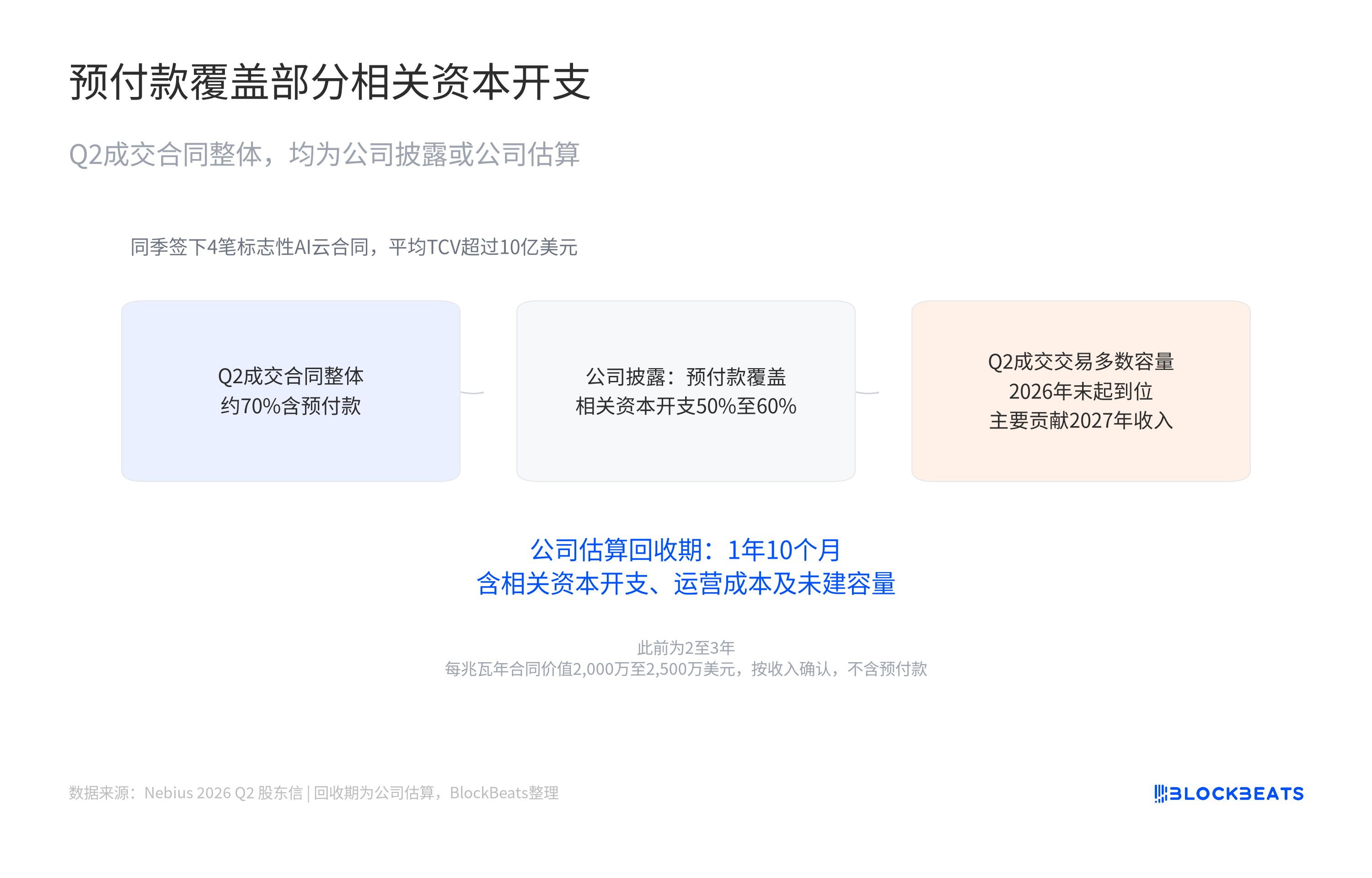
Nebius provides a more contract-economic-centered view in the shareholder letter. Four landmark AI cloud contracts signed in the same quarter have an average TCV, Total Contract Value, exceeding $1 billion. This number describes the contract scale, not the revenue already recognized by the company.
Another set of data is more broadly applicable but requires more caution. The company disclosed that in the second quarter, approximately 70% of all closed deals included customer prepayments. These prepayments cover 50% to 60% of the related capital expenditures. This does not mean that every deal from the four landmark contracts aligns with this ratio, nor can it be extrapolated to imply that all of Nebius's capital expenditures are already covered by customer payments.
Nebius estimates that the capital expenditures and operating cost payback period for these newly signed transactions is 1 year and 10 months, with a historical range of 2 to 3 years. The key word here is "estimates." It relies on cost forecasts and contracted future capacity, including parts that are not yet built. The company disclosed that the contract value per megawatt-year is $20 to $25 million, based on revenue recognition criteria and excluding prepayments.
Most of the trading volume corresponding to the second-quarter transactions will be gradually rolled out by the end of 2026, contributing primarily to the 2027 revenue. As a result, prepayments, capital expenditures, and revenue recognition form a rather uneven relay race. Prepayments first alleviate some of the expansion-related funds, equipment is deployed first, and revenue will only enter the income statement after the capacity is actually delivered.
Five Clocks in the Same Financial Report
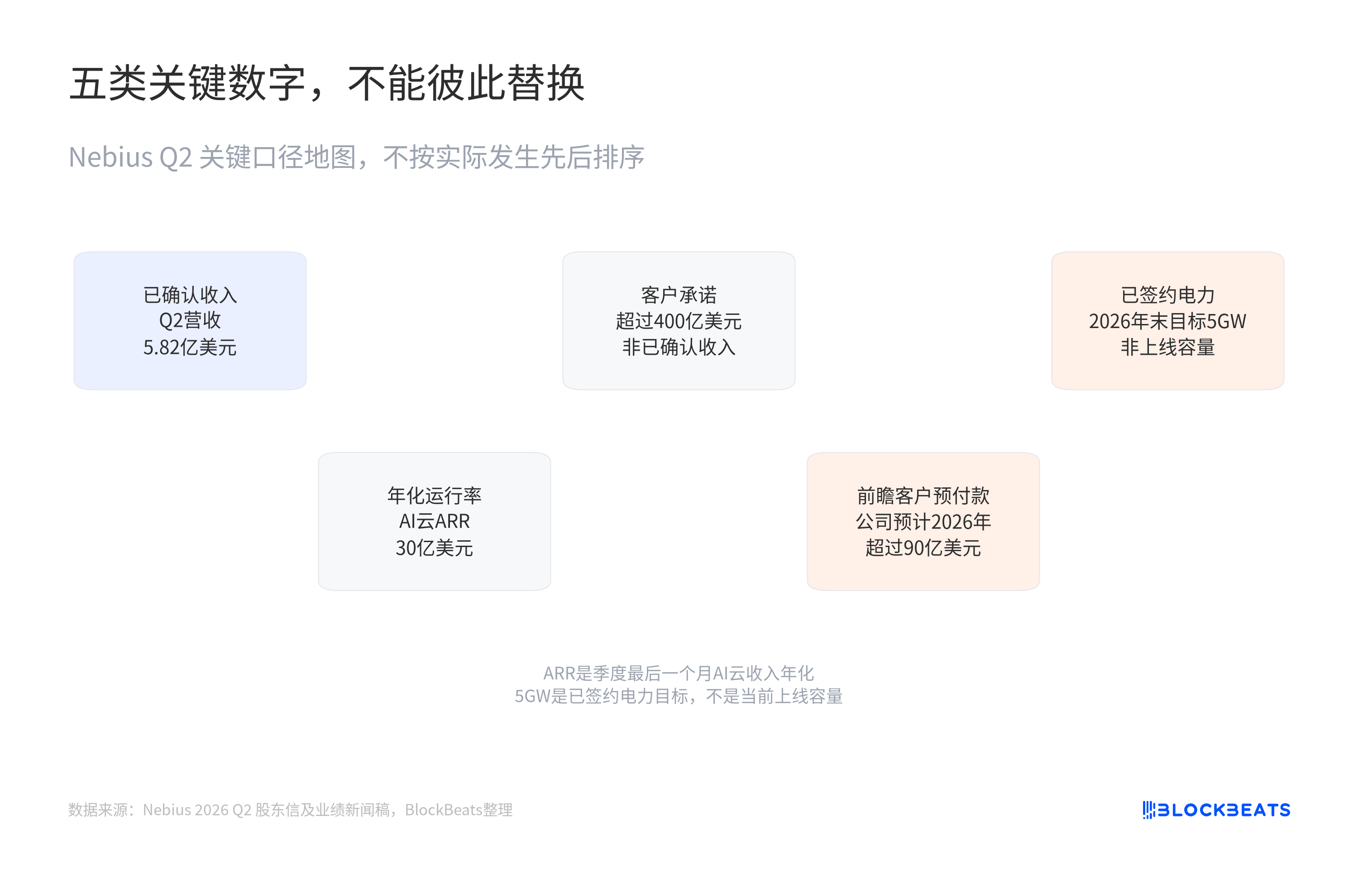
The fourth figure does not rank indicators by the amount but separates the five indicators that are commonly grouped together in a paragraph. The $5.823 billion is the quarterly revenue already recognized as of the end of June. The $30 billion represents the annualized run rate of the AI cloud business at the end of the quarter, both describing business activities that have already occurred but with different observation windows.
The customer commitments exceeding $40 billion are disclosed contractual commitments of the company, reflecting the subsequent fulfillment and revenue trajectory. According to the company's shareholder letter, customer prepayments are expected to exceed $9 billion in 2026. This is a forward-looking expectation by management, not cash already listed on the second-quarter balance sheet.
Also noteworthy is the 5GW. Nebius is referring to the contracted electricity target expected to be reached by the end of 2026, supported by signed land and electricity commitments. It does not represent the current online GPU capacity, nor can it be directly converted into computing power that can be delivered to customers in the quarter.
In Nebius's second quarter, the worst thing to do is to add up contracts, prepayments, equipment, and revenue to arrive at a larger growth number. They are all entering the same expansion chain at different speeds.
Welcome to join the official BlockBeats community:
Telegram Subscription Group: https://t.me/theblockbeats
Telegram Discussion Group: https://t.me/BlockBeats_App
Official Twitter Account: https://twitter.com/BlockBeatsAsia