Trading volume has increased 2.5 times, why has Circle's revenue only increased by 7%?

Stablecoin issuer Circle has delivered a somewhat mixed-up second-quarter performance. The on-chain transaction volume of USDC reached $14.8 trillion, with "Total Revenue and Reserve Revenue" amounting to $701 million. According to Circle's unaudited performance press release filed with Form 8-K, these two figures were placed in the same announcement, making it easy for people to mistake the transaction volume as revenue amplification.
When compared year over year, the transaction volume grew by 151%, while revenue only grew by 7%. These are not two malfunctioning data lines, but rather the true outline of Circle's business model coming into focus. The on-chain transaction volume records the intensity of USDC usage, while the revenue sheet is more concerned with how much USDC, on average, remains in the system and how much return this reserve can generate for the quarter.
Why is On-Chain Transactions Busy While the Account Balance Isn't Keeping Up?
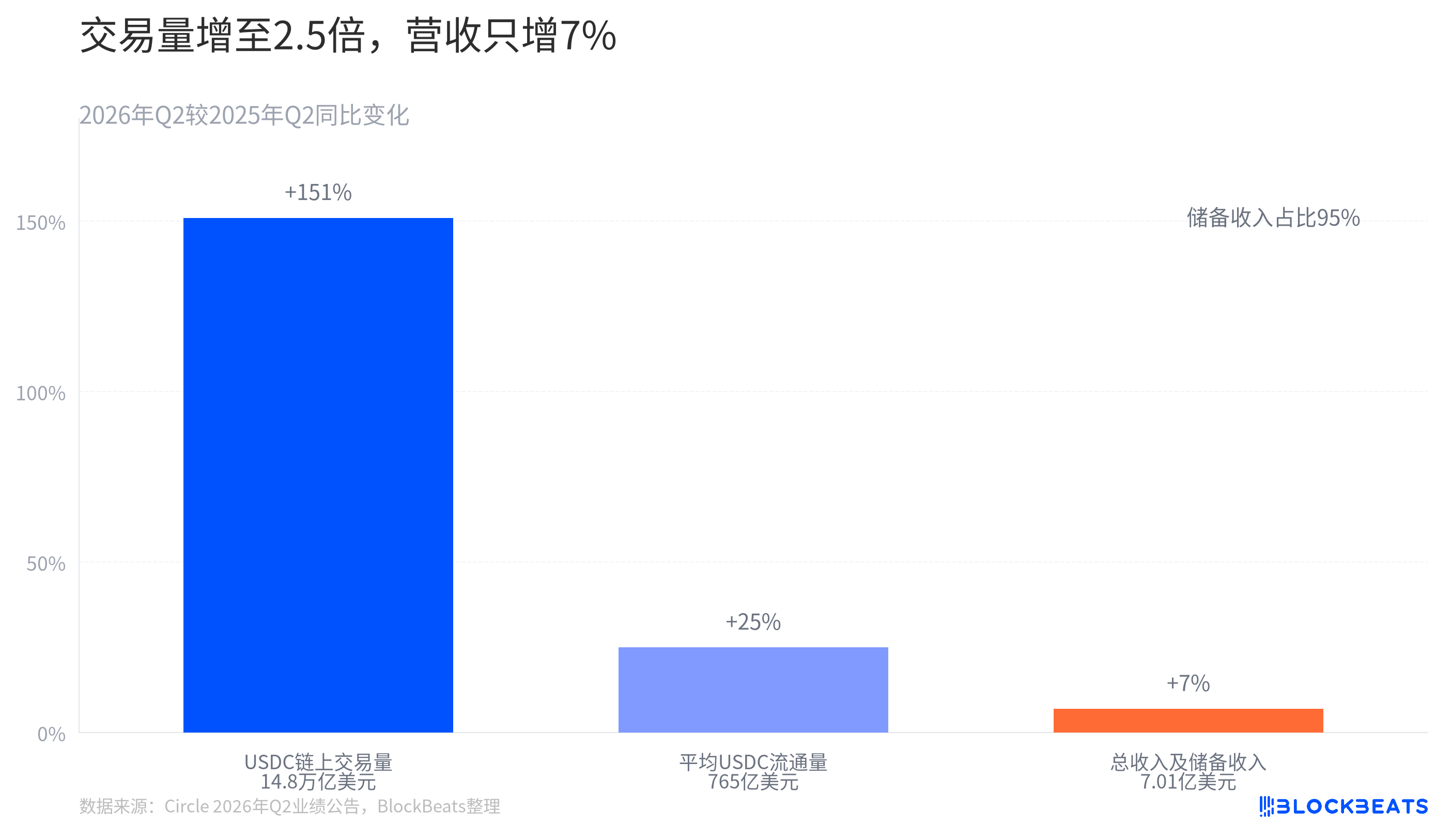
When the three growth rates are put together in a graph, the gap immediately becomes tangible. The transaction volume is the largest blue pillar of the quarter, with the average USDC circulation ranking in the middle and the smallest revenue increase. According to Circle's announcement, reserve revenue accounts for over 90% of "Total Revenue and Reserve Revenue." For this performance, transaction volume is not the variable closest to revenue.
This relationship is not difficult to understand. A single on-chain transfer can indicate that USDC has been mobilized in payments, exchanges, or settlements, but it does not mean Circle will earn equivalent revenue for each of these transactions. The announcement did not list the on-chain transaction volume as part of the revenue calculation basis. Instead, reserve revenue varies with the average circulation and reserve yield, which are the two most direct switches for quarterly revenue.
Circle's other revenue for the quarter was $34 million. According to the company's announcement, the year-over-year growth mainly came from subscription and service revenue. However, the announcement did not break down the Circle Payments Network, Arc, or Agent Stack into separate revenue items. Converting the operational progress of these products directly into revenue would skip over that part of the company's disclosure that has not yet been revealed.
Why Didn't the Excess USDC Bring in an Equivalent Amount of Revenue?
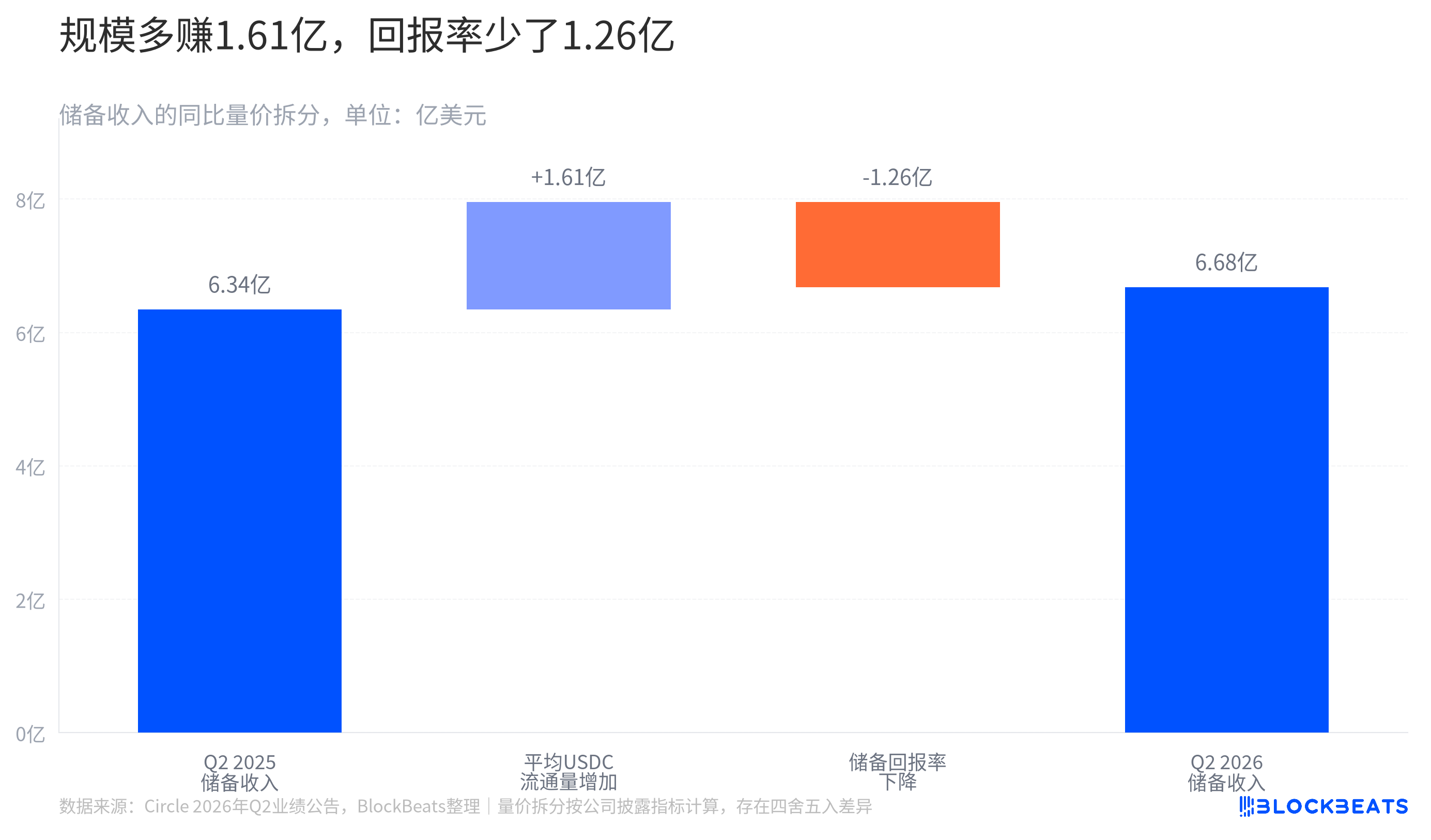
Circle's explanation for reserve revenue is straightforward. According to Exhibit 99.1 of the 8-K, the average USDC circulation increased by 25% year over year, while the reserve yield decreased by 66 basis points. One quantity is growing, and the other is shrinking, resulting in reserve revenue being only about 5% higher than the same period last year.
Figure 2 breaks this down into quantity and price. The two changes in the figure are not formally attributed by Circle alone, but are static, quarterly estimates based on the company's disclosed average circulating supply and reserve yield. If only the growth in average balance is considered, reserve revenue would be significantly overstated. Following a decrease in yield, almost all of this additional income is nearly offset.
It can be seen as a continuously growing deposit. More dollars are being deposited, but the return each dollar can generate in a quarter is thinner. The on-chain activity has not disappeared; it just needs to first be converted into USDC held in reserve, and then enter Circle's income statement through the reserve yield. This process is much slower than a single transaction and is more affected by the interest rate environment.
This also explains why the same announcement would contain both the expressions "network expansion" and "current interest rate environment slowing down revenue." The former refers to the use and distribution of USDC, while the latter refers to the pricing of reserve returns. Both can coexist.
Before Revenue Comes In, It Must Pass Through a Distribution Cost
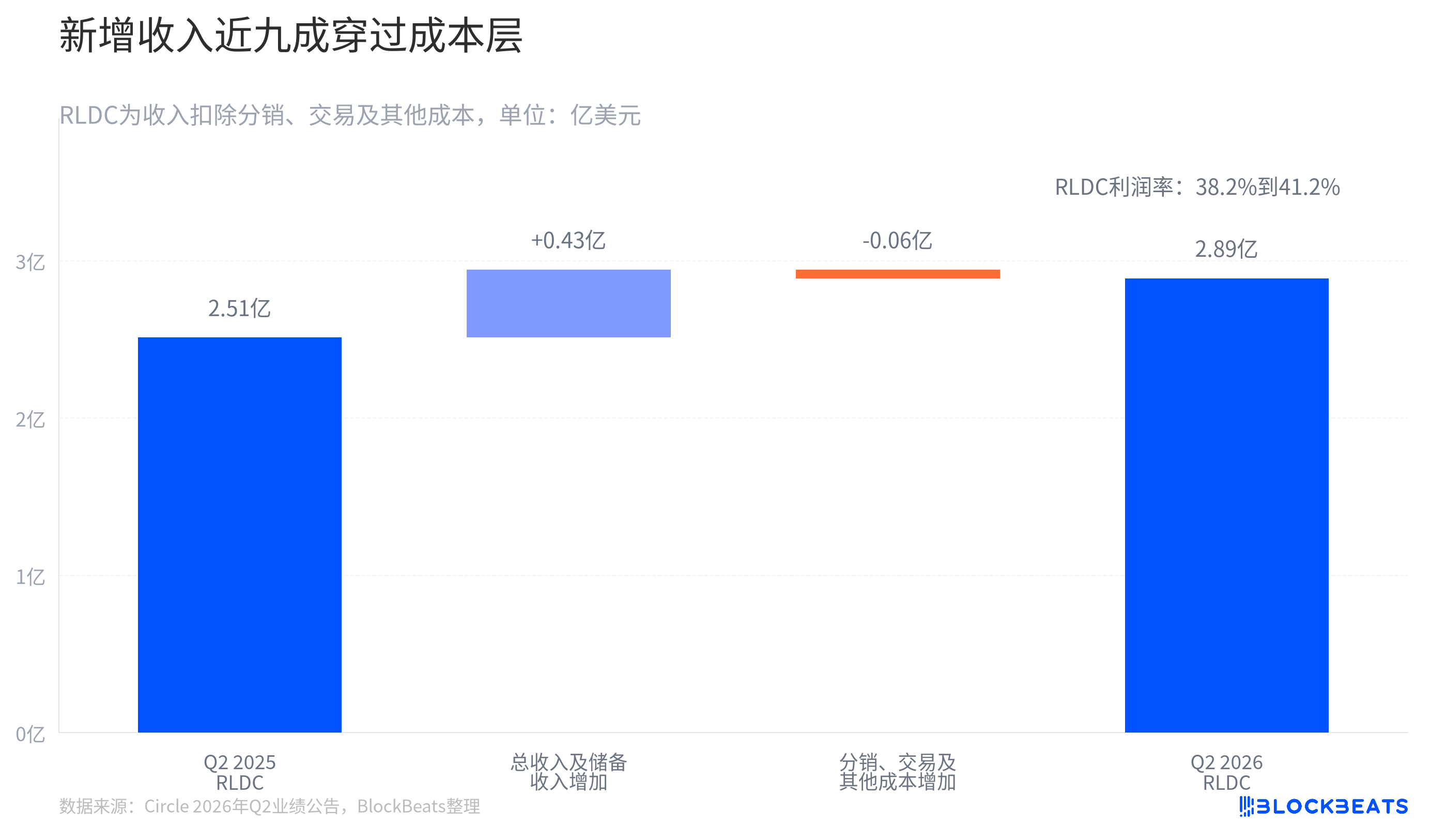
Even when revenue reaches Circle, it does not yet translate into operating profit. The company deducts "Total Revenue and Reserve Revenue" from "Total Distribution, Transaction, and Other Costs" to arrive at an intermediate metric called RLDC. In Figure 3, this number increased from $251 million to $289 million, and according to the company's announcement, the growth rate exceeded that of Total Revenue and Reserve Revenue.
The most easily misunderstood part of this chart is the very short orange bar. It does not represent Circle paying less in costs but rather that the year-over-year additional costs are far less than the incremental revenue. Based on the unrounded announcement data, close to ninety percent of the incremental revenue passes through this cost layer, becoming an RLDC increment. The RLDC profit margin also increased from 38.2% to 41.2%.
However, RLDC is not gross profit, let alone adjusted EBITDA or net profit. There are still operational expenses such as R&D, infrastructure, and personnel behind it. According to Circle's announcement, adjusted operating expenses increased by 23% year-over-year, while adjusted EBITDA only increased by 8%. Interpreting the improvement after distribution costs directly as "all incremental revenue staying in the company" would be advancing through the financial report too quickly.
The quarter-over-quarter pace is not as lively as the year-over-year headline. According to Circle's first-quarter performance announcement and this quarter's announcement, the average USDC circulation increased by only 1.7%, and Total Revenue and Reserve Revenue increased by only 1.0%.
During the same period, adjusted operating expenses increased by 7.9%, while adjusted EBITDA decreased by 5.2%. These changes do not indicate business stagnation but rather hint at another issue. When the USDC supply moves only slightly between quarters, investments in new products and infrastructure will initially reflect on the expense sheet, and the profit sheet will not automatically accelerate in sync.
New Network Signals Emergence, Revenue Boundary Still Beyond Financials
Circle provided many updates on the network layer this quarter. According to the company's announcement, as of the end of the quarter, the Circle Payments Network had reached a 30-day annualized transaction volume of $14.7 billion, with 175 financial institutions onboarded. This is a metric about network density, not quarterly revenue, and cannot be compared on the same scale as on-chain transaction volumes of USDC.
The announcement also stated that Arc is set to launch its mainnet publicly on September 16, and Agent Stack has over 900 paid services. The former is still a disclosed launch plan by the company, while the latter is a count of services, not the number of customers, revenue amount, or profit. They illustrate that Circle is connecting the infrastructure beyond stablecoin issuance, but the disclosures this quarter are not enough to validate that these products have become a second revenue stream yet.
Circle's second-quarter performance is, first and foremost, a report card determined by the average USDC circulation, reserve return rates, and distribution cost structure. The transaction volume proves that USDC is being frequently used, while the revenue table answers how that usage traverses the dual-layer structure of reserves and costs.
Welcome to join the official BlockBeats community:
Telegram Subscription Group: https://t.me/theblockbeats
Telegram Discussion Group: https://t.me/BlockBeats_App
Official Twitter Account: https://twitter.com/BlockBeatsAsia