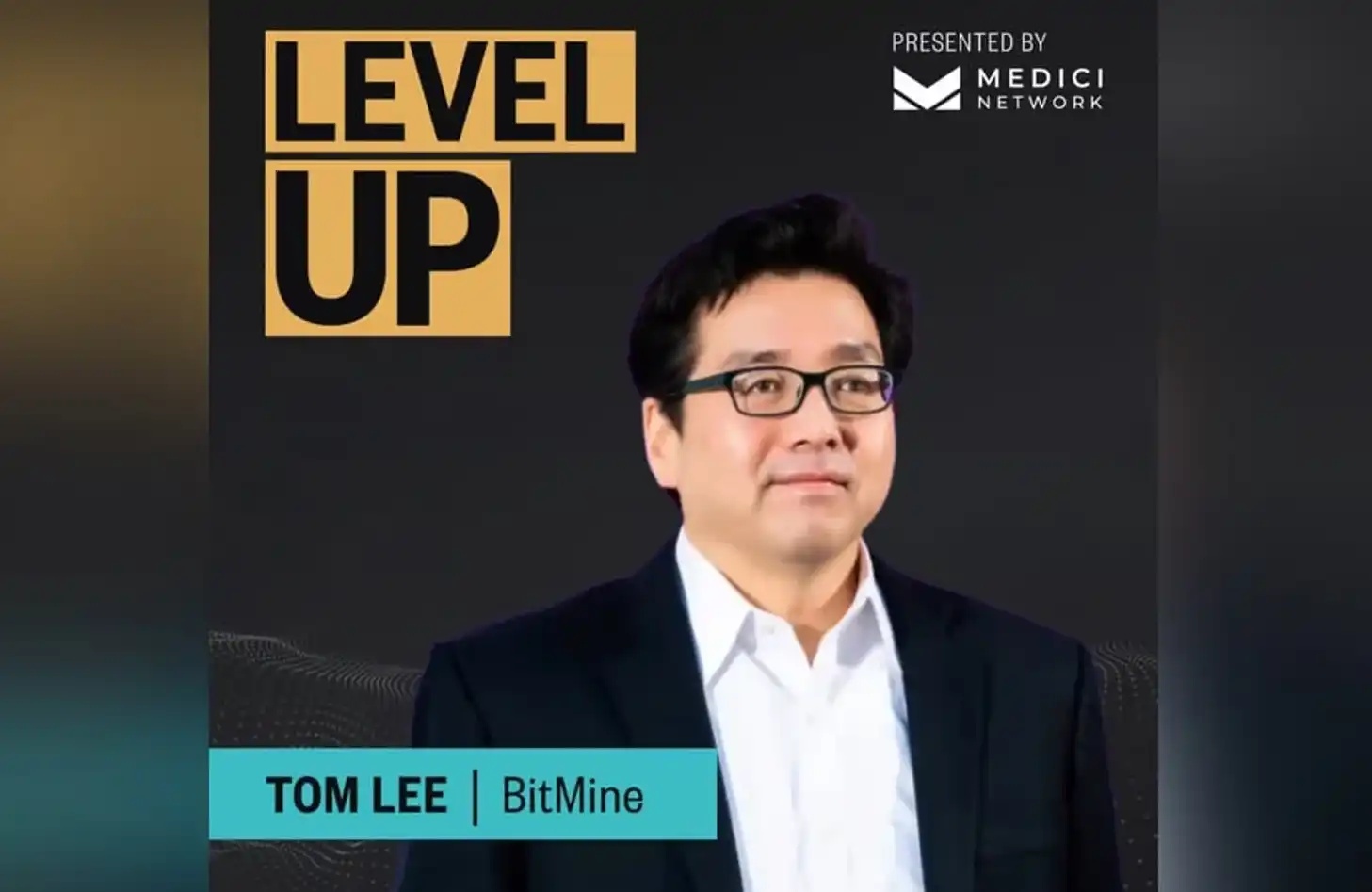
Interview with Tom Lee: The recent sharp drop in the South Korean stock market is a result of forced deleveraging. Avoid trading the volatility within a structural trend.
Original Title: Tom Lee: "We are Close to the Bottom"
Original Source: Global Money Talk
Original Translation: Deep Tide TechFlow
Disclosure: Tom Lee, as Chairman of BitMine Immersion Technologies (BMNR), holds approximately 5.78 million ETH, making it the world's largest Ethereum holding institution. Lee also serves as the CIO of Fundstrat Capital, overseeing the $5 billion GRNY ETF, which holds positions in entities like Robinhood discussed in this issue. Lee's personal wealth is highly tied to the price of ETH and the performance of GRNY. All opinions in this issue regarding Ethereum and the crypto market align with his significant financial interests. Furthermore, Fundstrat's core business model revolves around paid research subscriptions, and Lee's public statements serve a client acquisition/marketing function. Readers are advised to consider these relationships in their judgment.
Tom Lee is one of Wall Street's staunchest bulls. His firm Fundstrat sells research monthly to hedge funds and family offices in 26 countries globally. The GRNY ETF he manages has consistently outperformed the S&P 500 since launch. He also chairs BitMine, the world's largest ETH holding company. This episode was recorded live at the NYSE amidst the one-month freefall of the South Korean Kospi, a collective flash crash in AI semiconductor stocks, and a market debate on whether the "AI bubble has burst." Lee's core argument is blunt to the point of near aggression: the current crash is a result of leveraged funds being forced to liquidate, not a fundamental turning point. He cites Cisco's history from 1993-2000, where it saw four 40%+ retracements and eventually surged 100-fold, believing that even the late stages of the AI bubble are not comparable.
Key Points Summary
Tom Lee believes that the recent one-month plunge in the South Korean stock market and AI semiconductor sector was a "forced deleveraging" event. The Korean market has seen a significant influx of leveraged products in recent years, amplifying bidirectional volatility. According to data from U.S. prime brokerages, hedge funds unwinding long tech positions have set a near 10-year record pace; the "weak hands" have been shaken out. He quotes two sayings from Peter Lynch and Charlie Munger to support his core advice: do not trade in structural trends, "money is made by sitting, not trading."
Lee uses Cisco's 1993-2000 history to illustrate where AI stands: Cisco saw multiple retracements of over 40% during that period, with doomsayers declaring "tech stocks were over," yet it eventually climbed from $0.80 to $80, a 100-fold increase. The crucial difference is that the 2000 peak was a true bubble: buyers were companies using unrealistic DCF models to justify fiber optic purchases, "today's buyers are hyperscalers, companies truly buying equipment, putting it on shelves, and making large orders." Regarding the impact of the Chinese AI model (Kimi K3), Lee acknowledges this as an existential issue "beyond my pay grade," but notes that open-source models are essentially generic drugs—someone's R&D costs will always have someone footing the bill. He is more focused on downstream AI opportunities (Mag 7, software, crypto) starting to outperform upstream semiconductors, and his GRNY ETF is excelling by sticking to this framework, outperforming 92% of its peers this year. For the macro call in the second half, Lee bets that inflation will be lower than expected (peak oil price impact has passed, housing and wage growth are slowing), which will prompt the Fed to turn more dovish.
Key Insights Summary
Deleveraging Pressure, Not the End of the Story
“The speed at which hedge funds have been liquidating tech stock long positions is the fastest in nearly 10 years. Weak hands have been shaken out.”
“Every time the market goes straight up, leveraged longs get trapped, and then they get liquidated. That's what's happening now.”
“No one can perfectly time the bottom. But if you sell now, exit, and wait for a signal to get back in, you'll only end up chasing at a higher level.”
Pruning Flowers: Avoid Day Trading in a Bull Market
“Peter Lynch once said, selling your winners is like cutting flowers to water the weeds.”
“Charlie Munger said it better: Money is not made through buying and selling, it’s made by sitting. Wait for it to come to you.”
“If there's a structural theme, you should buy into it and then forget about it.”
NVIDIA at 16x PE Is Not Expensive, But Memory Stocks Are Naturally More Cyclical
“NVIDIA's forward PE is 16x, not over twenty. It has a CUDA moat and an almost certain upgrade roadmap, should be re-rated as a 25-30x growth stock.”
“Memory and semiconductor equipment are two steps removed from the end customer, with risks of whip-saw effect: hyperscalers might over-order due to expected price hikes, memory manufacturers could overexpand in the future.”
“Cyclical stocks have the lowest PE at the peak of the cycle, but that doesn't mean it's a sell signal. You just have to bet that earnings estimates will continue to rise.”
Cisco 100x Despite Four Halvings: AI Is Not Yet in the Late Stage
“Cisco rose 100 times from 1993 to 2000. It was halved at least four times in between, and each time people said tech stocks were done.”
“If this is truly the late stage of the AI bubble, people should be shouting ‘this is the bottom, hurry up and buy semiconductors’. But what are they doing? They are selling like crazy.”
“In 2000, Cisco had a PE of 200x, buyers were fiber optic companies doing 10-year DCF at a 6% discount rate. Today's buyers are hyperscalers, not hippies digging and selling fiber.”
Ethereum vs Bitcoin: Yield Asset vs Digital Gold
“Bitcoin is a store of value, with the ecosystem aiming to ‘harden’ it as digital gold. Ethereum is a yield asset, with a staking yield of around 3%.”
“The current staking yield of BitMine is approximately $6 million per week, $3 billion per year. If ETH reaches $5,000, this figure would be close to $1 billion annually.”
“Our perpetual preferred shares only require a $30 million dividend payout annually, which can be covered solely by staking rewards.”
Crypto Catalysts in Line: CLARITY Act + Robinhood Chain + Institutional Onboarding
“Since the end of June, Ethereum has outperformed the memory stocks by 72 percentage points. Some have lost 40% on memory and gained nearly 30% on Ethereum.”
“Robinhood Chain is built on Ethereum, not another chain. The daily trading volume has already exceeded $1 billion, and Robinhood could potentially earn $1 billion in just one year from this chain.”
“The CLARITY Act has already been put into law, which will establish a single regulatory authority for the entire crypto economy. Japan and Russia have already passed similar bills, and the U.S. must catch up.”
Gold Isn't Losing Its Luster, Just Taking a Breather from the Rally
“Gold's price surge over the past 3 years is at a level of 5 standard deviations in the 12-century history. It certainly needs to digest that.”
“In an AI world, gold's hedging function as a store of value will remain. I recommend everyone to hold some, perhaps 1%.”
South Korea Plunge: Leverage Products Amplified Volatility, But the Narrative Remains
Host: On June 22, South Korea's Kospi touched nearly 9,300 points, with the Philadelphia Semiconductor Index hitting a peak on the same day. The past month has been a true rollercoaster. People are wondering: why the sudden parabolic rise followed by a sharp reversal? Are we following the Kospi, or is there global concern about AI trading overheating?
Tom Lee: South Korea has performed remarkably well in recent years, not just in 2026, but over the past few years. The underlying logic is that the amount of semiconductor and memory per unit of global GDP output continues to rise. This means that South Korea as an economic entity and stock market will be much more important in the next ten years than it has been in the past 30 or even 50 years. Earnings should perform well.
However, in the past few quarters, the Korean market has introduced a large number of leverage products, which have amplified bi-directional volatility. When the market surges in a straight line, leveraged longs get caught, and then they get liquidated. This is what is happening now: a forced deleveraging event. But this does not mean the underlying story is over. So I think this pullback will prove to be one of the best buying opportunities for semiconductor and AI stocks. Consequently, the Korean stock market, AI stocks, memory stocks, and semiconductors will ultimately reach highs much higher than before.
Host: It's hard to believe before seeing it, but what signal are you waiting for to confirm the end of the pullback? Or, is now the opportunity and should one enter in batches?
Tom Lee: First of all, timing the market has never been profitable. If you hold these stocks, you should continue to hold. If you sold and exited, and are now waiting for a signal to enter, you will end up chasing at higher levels. No one can perfectly time the bottom.
However, the signal you want to see (massive deleveraging) has already occurred. If you look at the data from U.S. prime brokerage firms, the speed at which hedge funds have been unwinding their tech stock long positions is the fastest in nearly three years, possibly the fastest in nearly a decade. They have already gone through a round of massive deleveraging. We have also seen some very high-profile forced liquidation stories in Korea. So, if someone was forced to sell ("weak hands"), they are already out. I judge that we are very close to the bottom.
But people still make mistakes: trying to guess the top, trying to guess the bottom. In fact, the ones who make the most money are those who hold on. Peter Lynch once famously said: Selling your winners and holding your losers is like cutting the flowers and watering the weeds. Charlie Munger said it even better: "Money is not made in buying and selling, it's made by sitting." If this is a more structural theme involving more semiconductors and memory, you should buy and forget about it.
NVIDIA 16x PE vs. Memory Stock 4.5x PE: Not a Simple Comparison
Host: I remember you said in a previous conversation, "Shorts sound smart, but longs make money." I want to ask a valuation question. What is NVIDIA's forward PE ratio? I think it's around twenty-something times?
Tom Lee: Actually, it's 16 times.
Host: 16 times, indeed... Their earnings outlook is very strong. Looking at SK Hynix, it was around 7x at its high point, and now it has dropped to 4.5 times. Can we directly compare these two?
Tom Lee: NVIDIA has proven itself to have some level of recurring revenue because of the CUDA platform, and it almost has a deterministic upgrade path that keeps people buying. It should be revalued as a growth stock, and I think a reasonable valuation would be between 25 and 30 times.
Memory and semiconductor equipment, on the other hand, are two layers removed from the end customer, facing the risk of the bullwhip effect. In simple terms, these industries are more cyclical because they lack pure order visibility. Suppose the end market is a consumer using some AI lab service, such as ChatGPT or DeepSeek. He subscribes through an AI lab, which uses a hyperscaler, the hyperscaler buys chips from NVIDIA, and NVIDIA then places orders with suppliers. The suppliers are too far removed from the end user. In the process of passing through these layers, there will be a lot of duplicate orders. If the hyperscaler expects memory and chips to rise in price, they may order double the amount in advance to lock in the price. Then the memory manufacturer may overexpand in the future.
This has happened in every cycle, and of course, there is a risk it will happen this time too. So, the more cyclical the species, the lower the PE at the cycle top, which is normal, and you should expect the PE to compress. But this is not a sell signal; you just need to bet that earnings forecasts will continue to rise. In a machine-to-machine world, robots will need much more memory and storage than humans: humans eat, have nervous systems, robots need memory and storage. The economy is becoming increasingly memory-intensive and semiconductor-intensive. So, I think earnings forecasts will continue to rise. But don't compare the PE of memory with that of NVIDIA.
Cisco's History Lesson: Slashed Four Times, Eventually Rose 100x
Host: You mentioned earlier that you didn't want to give too long a history lesson, but I think your memory of history is very useful for investors. I remember when Cisco ran into trouble, to some extent, it was a bullwhip effect: in 2001, orders suddenly collapsed because people had previously placed too many duplicate orders, falling like a row of dominoes. Is this lesson applicable? Or is it too early now?
Tom Lee: The AI story will eventually turn into a bubble; this is inevitable. At any time, whenever there is a structural demand story and the market underestimates volatility, people will make misjudgments about risk adjustment: underestimating risk.
But I don't think we are in the late stage of an AI bubble. The reason is simple: the stock market has just started to fall, and most people are calling the top. If it were really a bubble, people should say "this is the bottom," and then wildly pour money into semiconductors. But they didn't, they are selling like crazy.
Let's take a look at Cisco. From 1993 to 2000, over 7 years, which actually represented just one cycle: the Internet infrastructure build-out cycle. Cisco's starting point was $0.80. By 1997, it had surged to $9, a 10x increase. Then in 1997, it retraced by 40% during the Asian financial crisis, and everyone was saying "Cisco's story is over." But what happened? By 1998, it had climbed from $5 to $18, doubling from its previous high. Then in 1998, amidst Greenspan's "irrational exuberance" speech, the Russian default, and the collapse of Long-Term Capital Management, Cisco plummeted from $18 to $9, a 42% drop. Many proclaimed the end of the tech stock era. I vividly remember that time when many danced on the grave of tech stocks, declaring the end of that trade. Then Cisco climbed from $9 all the way to $80 by 2000. From 1993 to 2000, it had increased a total of 100x. And starting from the previous high in 1998, it had surged 5x in just 18 months.
That was the real peak for Cisco. In the year 2000, I was a tech analyst. Why was that peak real? Because nobody believed the valuation: Cisco was trading at a 200x PE ratio. The underlying issue was that the companies laying fiber (CLECs) were Cisco's real buyers, and to justify the CLEC's valuation, you needed a 6% cost of capital, a 30x exit multiple, and a 10-year DCF. These assumptions were completely unrealistic. It was a farce. If someone asks if today is the same story, it's not. Today, the number of people using AI is still relatively small, but AI has already demonstrated significant productivity. The companies (hyperscalers) buying these devices today are very serious companies. They are not hippies who come to dig the ground and sell IRUs; they are actively purchasing equipment, deploying them, and taking large orders. So, I don't think we are anywhere near a bubble stage yet.
Kimi K3 Impact and the China Model: A Question Beyond the "Pay Grade"
Host: Regarding AI, we have just experienced the "Kimi moment," likened to the DeepSeek moment. This Chinese open-source model has 28 trillion parameters, not as cheap as some models, but still impressive. If the Chinese model can approach the level of American models, would it slow down investments in companies like OpenAI and Anthropic? Or would the demand shift towards Chinese models?
Tom Lee: To be honest, the answer to this question is beyond my pay grade. What we already know is that AI is actually very capital-intensive; just maintenance alone costs a fortune, devices age, and there's also token consumption. Open-source models are indeed cheaper, but part of the reason is that they are like generics: they have no R&D costs, many are distilled models. These models are open-source, but they can't truly be free. Someone always foots the bill.
The second dimension, as Elon Musk put it, we are heading towards the "singularity." AI and robots may create such enormous productivity that everything becomes almost free. This is disruptive even to capitalism itself. So the answer is: I don't know. Just as there is Linux and Windows, Android and iOS, this logic makes sense. But is this negative for hyperscalers? I don't think so. These are very serious companies. They can choose not to participate, just as Apple did in the past. Apple consequently generated a lot of free cash flow, but also faced criticism for not being AI-forward enough. For investors, this existential question is hard to answer. They should focus more on where the opportunities lie.
Second Half Outlook: Betting on Lower-Than-Expected Inflation, AI Outperformance
Host: Speaking of opportunities, the first half of the year has already ended. What is your outlook for the second half of the year? July has historically been favorable for the stock market, but this year's performance has been mixed due to some events transcending wage levels.
Tom Lee: Our strategy has been effective this year. Our Granny Shots ETF (GRNY) has outperformed the S&P 500 by about 120 basis points year-to-date, ranking in the top decile among its peers and outperforming over 92% of fund managers. The reason we've been able to do this is because we stick to long-term themes: AI downstream, cybersecurity, and Fed monetary easing. Even if the market becomes hawkish, we are still betting on the Fed turning dovish. Small-caps have performed exceptionally well this year, which is actually the biggest signal of the Fed leaning dovish.
We haven't made too many adjustments for the second half of the year. Earnings growth is accelerating, we are in the midst of earnings season, and the AI narrative is very compelling. But we are willing to buy downstream: Mag 7, software, and crypto. These are part of the AI downstream narrative, and they have already started outperforming.
Regarding the Fed, the bond market is currently hawkish, believing the Fed must raise rates. Our bet is that inflation will be lower than expected. People are overly focused on oil as an inflation driver, and the oil price shock has already happened; I believe the impact of oil prices on inflation has peaked. The underlying drivers of inflation are weakening: housing is soft, and wages have not really accelerated. This will eventually put the Fed in a position to cut rates.
Host: I completely agree. I don't think this Fed really intends to raise rates. Your GRNY has reached $5 billion in AUM now, right?
Tom Lee: To be precise, it's close to $5 billion.
Host: That's great, I hold some myself. Maybe I should just go all into GRNY instead of trying to time the market.
Tom Lee: When AI and memory stocks were surging, people criticized our fund for not having a heavy allocation to AI and semiconductors. We had exposure, but not a heavy allocation. As a result, when memory and AI experienced a 40% drawdown, our fund outperformed because of our longer-term thesis anchored in AI trades.
BitMine vs MicroStrategy: Why an ETH Treasury Company is a Different Ball Game
Host: I'd like to switch gears and talk about BitMine. It's an Ethereum treasury company, perhaps the first and most well-known of its kind. MicroStrategy was the first Bitcoin treasury company, but they went through some very public struggles. What sets BitMine apart in its approach?
Tom Lee: First, a clarification: BitMine is the world's largest Ethereum hodler, holding around 5.78 million ETH, making it the largest ETH holder globally. However, we are not actually the first Ethereum treasury company; we are probably the fourth or fifth; we just became the largest. We recently crossed the one-year mark since our inception.
We have three core differences compared to MicroStrategy.
First, the asset focus. Bitcoin is a store of value, and the Bitcoin ecosystem aims to "harden" it, avoiding changes and maintaining its status as digital gold. Ethereum, on the other hand, is a yield-bearing asset, with a staking yield of around 3%. The Ethereum ecosystem is continually growing, being the largest ecosystem in the crypto space, even bigger than Bitcoin. The entire ecosystem's goal is to make Ethereum the financial settlement layer of Wall Street, with the entire financial stack eventually running on stablecoins built on Ethereum.
Second, MicroStrategy has taken a relatively passive approach towards Bitcoin: holding and issuing digital debt. BitMine, on the other hand, deeply engages with the Ethereum ecosystem. We led investments in three companies spun out of the Ethereum Foundation, all focused on strengthening Ethereum (improving the price or enhancing the ecosystem). We are actively shaping Ethereum's future.
Third, Balance Sheet Complexity. MicroStrategy's balance sheet is intentionally designed to be complex: it has convertible bonds, four classes of preferred stock, and common stock, with these components sometimes competing against each other. Because Bitcoin does not have native yield, they have to sell stock to pay dividends. BitMine's capital structure is extremely simple: it only has common stock and recently issued perpetual preferred stock. The current staking rewards are approximately $6 million per week, around $300 million per year. If ETH rises to $5,000, the annual staking rewards will be close to $1 billion. The perpetual preferred stock only needs to pay $30 million in dividends each year. The staking rewards alone can easily cover this.
So you should view BitMine as a company deeply embedded in the Ethereum ecosystem. We are betting on Ethereum to become not only Wall Street's settlement layer but also the settlement layer for inter-robot communication.
Host: So, is there a significant difference between buying ETH tokens itself and buying BitMine stock?
Tom Lee: If you can directly buy ETH and stake it yourself, that's fine. But there are two types of investors who can't do that. The first type is institutional investors: asset management companies that manage large sums of money cannot directly hold ETH tokens because it requires maintaining a crypto wallet. But they can buy stocks. BitMine has been included in the Russell 1000 large-cap stock index and trades on the NYSE. It is currently the only Ethereum large-cap stock available for large fund managers to buy. The Russell 1000 is the largest and most widely used benchmark index. If you manage a large fund in Boston and want Ethereum exposure, you can only buy BitMine.
The second type is investors who want to use options and derivatives or want higher ETH exposure. BitMine outperforms ETH in an uptrend and has a rich options and perpetual contract market. The world of stock investors is $240 trillion, while the world of native crypto investors is only a few hundred billion. Betting on the stock world coming to buy BitMine may be a better choice.
The Catalysts for Crypto Are Lining Up, but the Current Quietness Is Exactly What the Bottom Looks Like
Host: The crypto market has experienced a significant pullback and is now almost in a state of oblivion, with few participants and no discussions. However, looking at Bitcoin's chart, it seems poised to break a fairly long downtrend. Will this quietness end soon?
Tom Lee: What you are describing is the look of a bear market. In a bear market, nobody talks about stocks. When Apple was falling in price, nobody talked about Apple either. Price drives emotions; in the midst of a pullback, everyone is naturally bearish. This is exactly what the bottom formation mechanism looks like: deleveraging and resetting expectations.
But there are plenty of crypto catalysts. Since the end of June, Ethereum has outperformed the stock market by 72 percentage points. Some have lost 40% on stocks but gained nearly 30% on Ethereum. The CLARITY Act has just "moved to code," aiming to establish a single federal regulatory agency for the entire crypto economy. Currently, the U.S. is regulated by each state, leading to fragmented rules. Japan has already passed a similar version, and Russia has just done the same. The U.S. must catch up. This will mark the era of institutional adoption of cryptocurrency, which is a market bigger than anything in crypto history.
If you've been in the crypto space for a while, what you've experienced is the "hobbyist phase," what I call Ethereum 1.0, the era of meme coins and NFTs. The future market is stablecoins and payment rails. Robinhood wants to tokenize everything. They could choose any blockchain to build on, and they chose Ethereum, launching Robinhood Chain. This has already been a groundbreaking success: the daily trading volume exceeds $1 billion, and Robinhood could potentially earn $1 billion just from this chain in a year, which is a huge success for them. Every Wall Street company is watching what Robinhood has done and realizing that tokenizing assets on Ethereum can generate a lot of money.
Host: I noticed that Robinhood is one of the top holdings of your GRNY fund.
Tom Lee: Yes.
Host: Speaking of the bear market that no one is discussing, the same goes for precious metals; everyone was talking about gold and silver six months ago, and now no one is asking. What is your take?
Tom Lee: Gold's price increase over the past 3 years is at about 5 standard deviations in the entire 12-century history. It surely needs to digest. Perhaps there is another 10% downside potential, but that's about it. At Fundstrat, we have always recommended allocating a portion to gold, such as 1%. Because whether it's debt uncertainty, AI's impact on society, or social unrest, gold's hedging function as a store of value will not change. In an AI world, this is especially important. So I think everyone should hold some gold, but it has risen too much and needs a break.
Original Article Link
Welcome to join the official BlockBeats community:
Telegram Subscription Group: https://t.me/theblockbeats
Telegram Discussion Group: https://t.me/BlockBeats_App
Official Twitter Account: https://twitter.com/BlockBeatsAsia

 Related Articles