Citi Analysis: Upgrading China, Downgrading South Korea, Is the Emerging Markets Rally Starting to Diversify?

TL;DR
· Citi upgrades Chinese equities to overweight, tactically reduces South Korea, maintains overweight on Taiwan market.
· MSCI EM target points to 1870 by end of 2026 and 2050 by mid-2027, with earnings revisions still focused on IT.
· There are still limits to this bullish view, with EM global allocation remaining neutral and the broadening rally not yet fully completed.
According to Citi's latest Emerging Markets Strategy report, Citi has upgraded its allocation to Chinese equities from neutral to overweight, while tactically reducing South Korea from overweight to neutral, maintaining overweight on the Taiwan market, and providing MSCI EM index targets of 1870 points by the end of 2026 and 2050 points by mid-2027.
The most direct market hook in this report is that despite the MSCI EM having already risen by about 20% year-to-date, Citi still believes there is room for further upside. At the current level of around 1664 points, 1870 points represent approximately 12% upside. The 2050-point target implies an even higher level, with Citi stating about 20% upside potential by mid-2027.
However, Citi is not betting on a blanket emerging markets bull run. The recent EM gains have mainly come from South Korea, Taiwan's tech sector, and the AI hardware chain, while other countries and sectors have not kept pace. The decision to upgrade China to overweight is precisely because Citi is beginning to look for "diffusion" candidates beyond the AI chain.
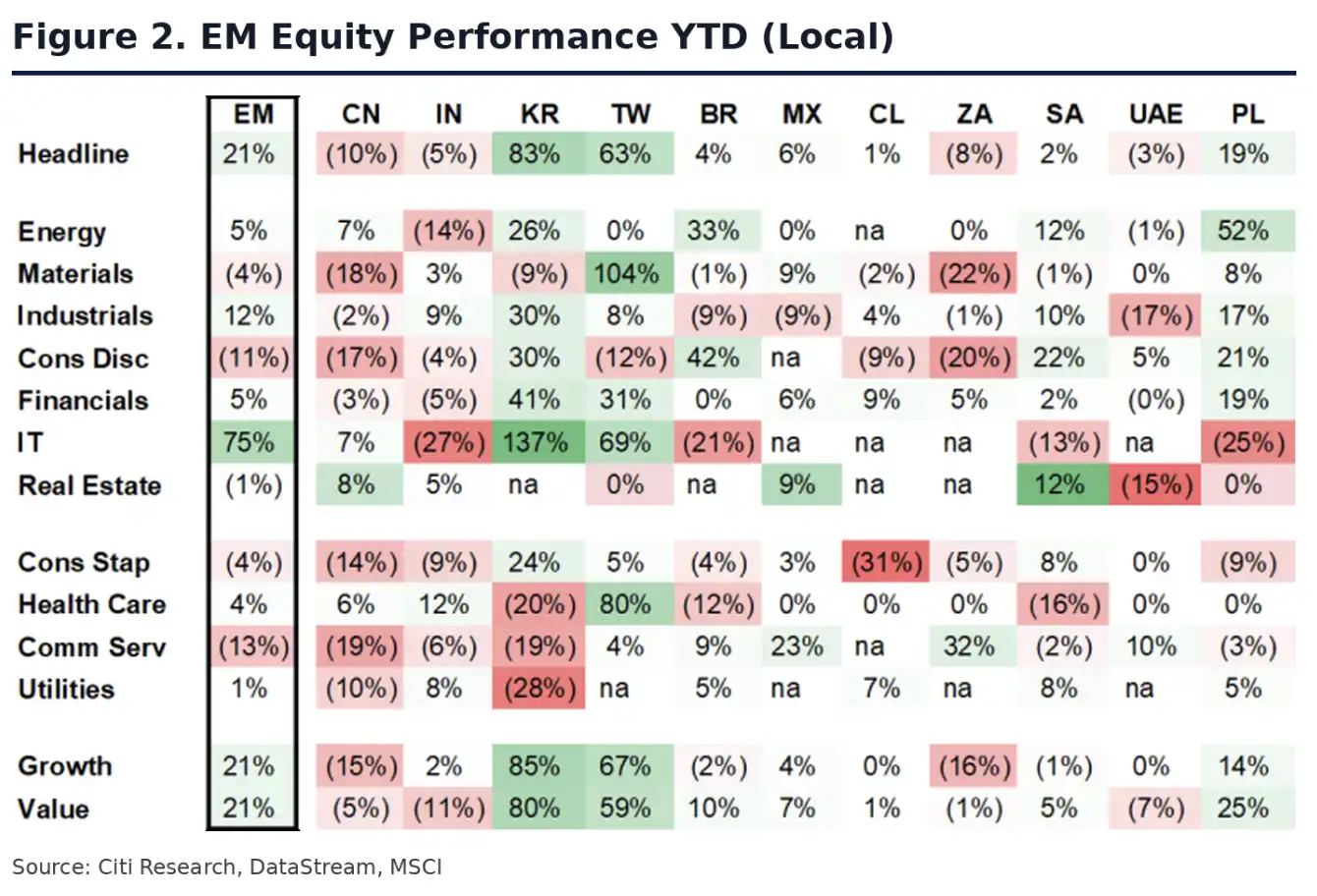
South Korea up nearly 40%, Taiwan market up over 30%, this year's EM rally highly concentrated.
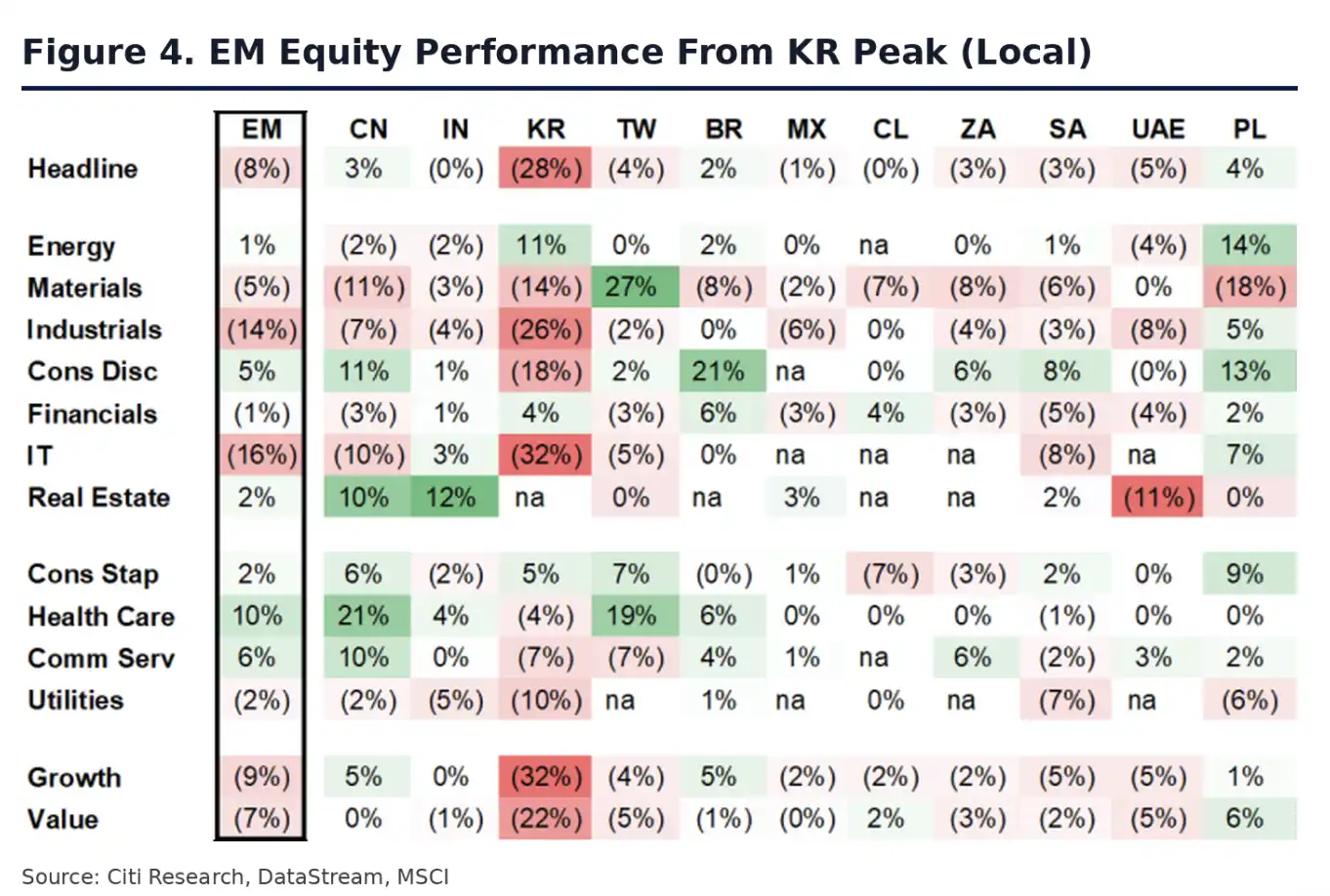
South Korea retracement and other markets have yet to show broad-based relay
China Upgraded to Overweight, South Korea Cools First
In this round of allocations adjustments, China has been upgraded from neutral to overweight, while Mexico has been moved up to neutral. South Korea has been downgraded from overweight to neutral, and the Taiwan market continues to remain on the overweight list.
China's attractiveness stems primarily from three factors. Foreign investors still hold a relatively light position in Chinese equities, so there is more room for fund inflows once global risk appetite improves. The decline in oil prices benefits energy-importing markets like China. With global growth data improving, some cyclical assets are receiving renewed support, positioning China favorably in this round of macro-sensitive markets.
This differs from the main theme of the emerging markets in the past two years. Previously, the strongest trades were centered around the AI hardware chain, with South Korea and Taiwan's market emerging as the biggest winners due to semiconductor, memory, and AI server demand. However, for the index to continue to rise, relying solely on a few tech stocks for support will become increasingly challenging, and funds need to find more markets capable of sustaining the upward trend.
Being downgraded in Korea does not mean the fundamentals are weakening. Public reports show that Citi maintains a strong long-term view on the Korean stock market, with a local strategist previously setting a KOSPI target of 10,000 points. According to the source report, the logic behind this includes the possibility of a memory shortage continuing until 2027, as well as AI token growth and customized demand continuing to drive storage prosperity. The short-term issues lie in Korea's previous excessive gains, high implied volatility, and retail leveraged products amplifying the volatility.
The mid-tier market remains one of the most direct beneficiary markets in the AI hardware chain. According to the source report, the local strategist has set a mid-tier weighted index target of 53,500 points by 2027. However, this market also faces similar issues, with trading becoming crowded. Once AI capital expenditure returns trigger more significant controversy, the volatility often first reflects on these early winners.
EM Still Has Room to Grow, but Earnings Revisions Remain Muted
Citi has set two points for MSCI EM in this report, which are the most clear-cut numerical judgments: 1,870 points by the end of 2026 and 2,050 points by mid-2027.
The support point does not come from a significant valuation expansion. The current MSCI EM forward P/E ratio is around 11.5 times, roughly in line with the long-term average. After the emerging markets' rise this year, valuations have not been pushed into an obvious bubble range; the index's increase is more driven by improving earnings expectations.
The earnings figures look robust. The MSCI EM's 2026 EPS growth expectation has reached 63%, with a cumulative upward revision of 28 percentage points since the end of February. The growth rate is expected to slow to 24% in 2027 but remains higher than similar assets in developed markets.
The issue lies in the narrow source of earnings improvement. In the 2026 EPS upgrade, the IT sector accounts for about 85%, with Korea and the mid-tier AI chain still being the major contributors. Revisions in most non-tech sectors such as consumer goods, real estate, and utilities remain weak. In other words, the EM index appears to have earnings support on the surface, but the earnings upgrades have not expanded to more industries.
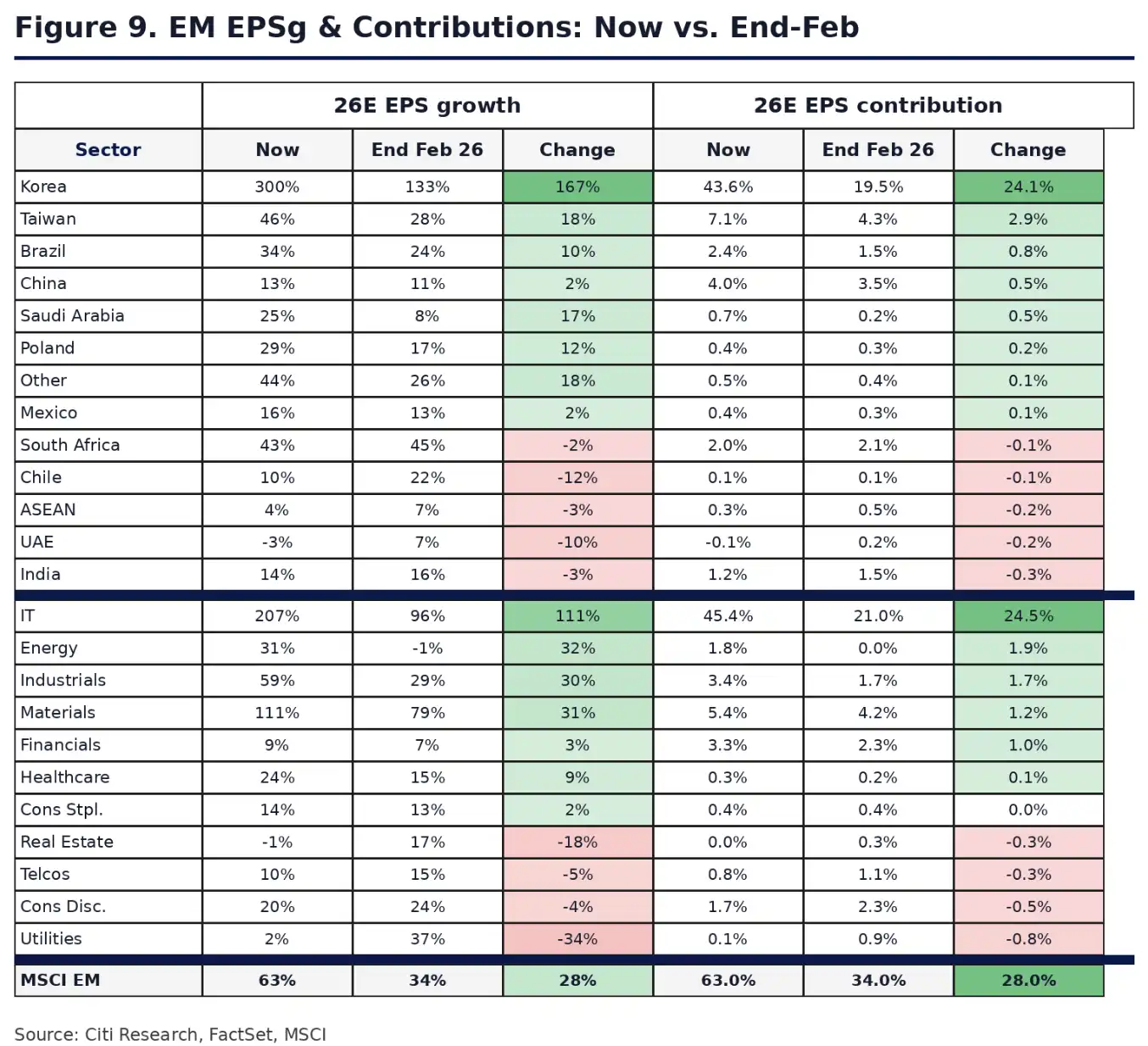
MSCI EM 2026E EPS is expected to grow by 63%, with the IT sector contributing about 85% to the upward revision.
This is also why Citi has not raised EM to an overweight position in global asset allocation. While the regional allocation can increase the weight of markets like China, at the global asset allocation level, emerging markets remain neutral. Citi's stance is more of "selectively adding to beneficiaries' spread" rather than confirming a round of overall bull market.
The So-Called Diffusion Means the Rally Must Move Away from a Few AI Winners
Citigroup’s so-called "diffusion trade," in plain terms, means that this year's emerging markets cannot continue to rely solely on the Korean, Taiwanese, and AI tech sectors for an upward trend. Capital either needs to find new countries and sectors, or the upside potential of the indices will be limited.
This selection process primarily looks at several conditions. It considers whether the market benefits from a weak U.S. dollar and declining U.S. bond yields, whether it benefits from falling oil prices, how it historically performs when global economic data improves, whether short-term earnings revisions are turning positive, and whether the current trade is already too crowded.
Within this framework, China, South Africa, and Mexico rank highly. According to the report, China, South Africa, and Mexico have composite scores of 4.2, 5.0, and 5.3, respectively, in the "diffusion candidate" selection. While Korea and the Taiwanese market are still recent winners, issues of short-term crowding and volatility are more prominent.
Oil prices are a real consideration. Citigroup's base case assumption is that the average oil price in the third quarter of 2026 will be around $75 per barrel, then falling to $65 per barrel by early 2027. Falling oil prices usually benefit energy import markets such as Korea, Taiwan, India, and China, while posing pressure on some resource and oil-sensitive markets.
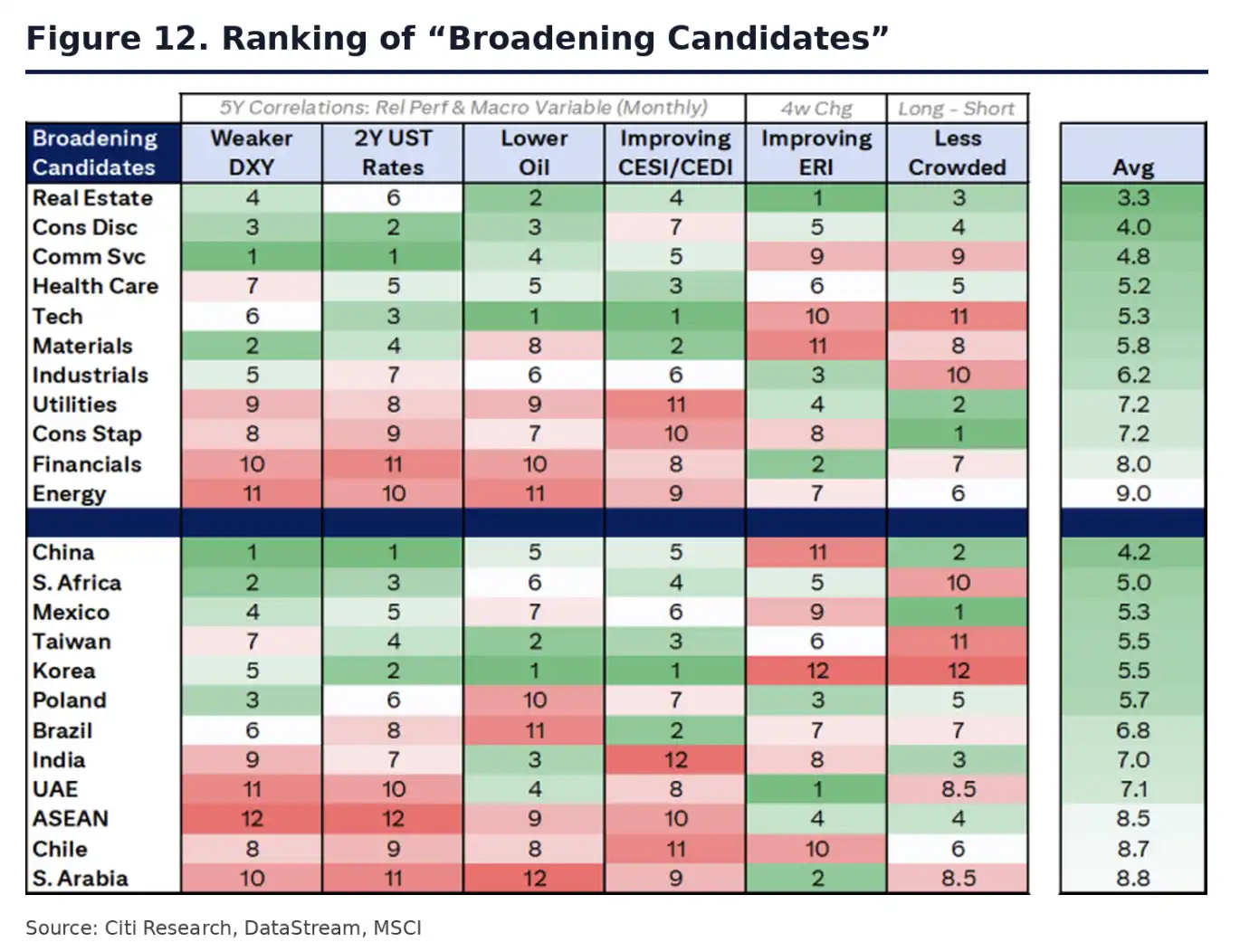
The "Broadening Candidates" table shows that China, South Africa, and Mexico rank highly, with dimensions including a weak dollar, U.S. bond yields, oil prices, and crowding.
The key background for the upward revision of China lies here too. It is not the market with the strongest performance this year, nor is it the most crowded trade in the AI hardware chain. However, with the combination of global growth improvement, declining oil prices, and position replenishment, it has the conditions to receive rotational capital.
The Diffusion Is Not Yet Complete, AI Tech Remains the Biggest Divergence
The caution in this report is that Citigroup has not presented "diffusion" as a completed fact.
The rally in emerging markets this year has been highly concentrated, and cross-market returns dispersion has risen to a 25-year high. Korea and Taiwan's technology and AI sectors have contributed almost all of the index-level returns. If future earnings revisions continue to focus on the IT sector, the so-called diffusion is more like short-term fund reallocation rather than a broad improvement in fundamentals.
AI capital spending is also a major uncertainty. Previously, the market was willing to have higher expectations for memory, semiconductor, and AI infrastructure due to the continuous rise in demand for training and inference. However, if investors start to question the return on capital expenditure, early winners like Korea and Taiwan may face increased pressure.
Macroeconomic risks have not disappeared. If geopolitical tensions escalate again, oil prices may deviate from the downside scenario. There is still divergence in the Fed's policy, and if the interest rate cut is less than expected, the US dollar and US bond yields will suppress emerging markets. The potential super El Niño may also bring new inflationary pressures.
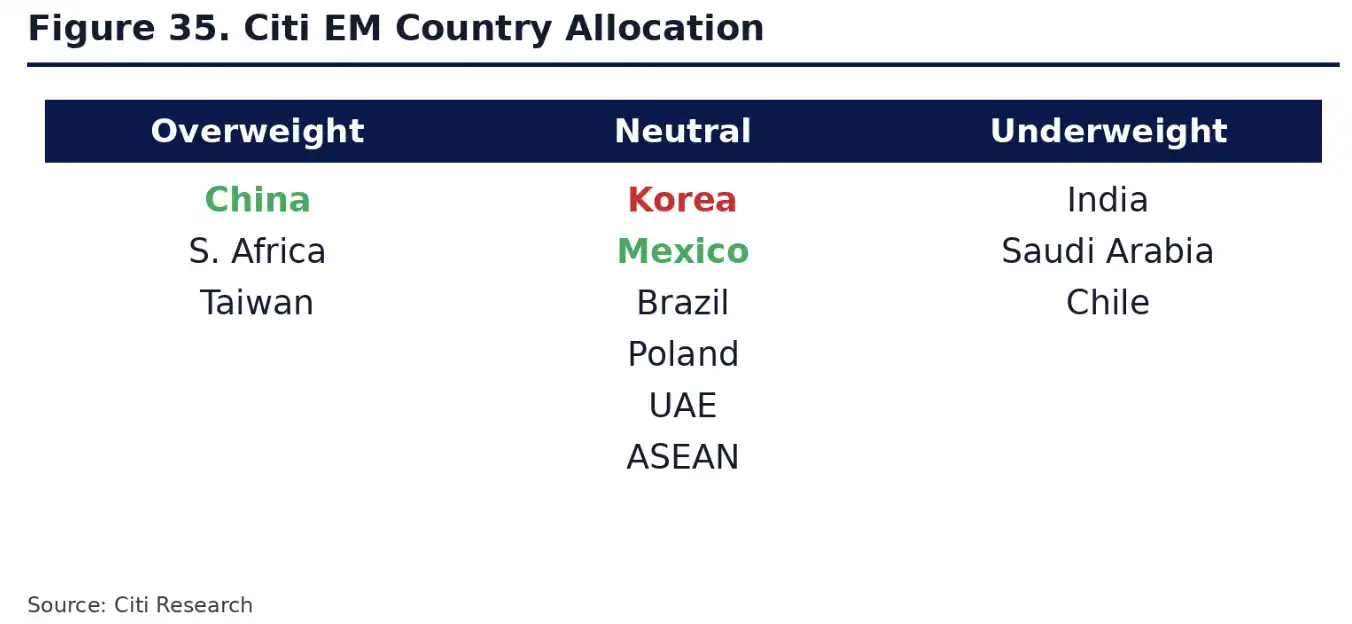
The Citigroup EM Country Allocation Table shows an overweight position in China, South Africa, and the Middle Taiwan market, with South Korea reduced to neutral.
Citigroup's assessment of emerging markets is more like "the uptrend has a chance to broaden" rather than "a full-fledged bull market has been confirmed." China's outlook has been raised because it has better odds in this round of dispersion trading. The cooling off of South Korea indicates that previous winners may continue to rise, but the short-term gains and volatility have weakened their attractiveness.
Whether MSCI EM can trend towards 1870 points or even 2050 points depends not only on how much further the AI chain can rise, but also on whether non-tech sectors can stop earnings downgrades, whether global cyclical improvements can be sustained, and whether funds are truly willing to flow from a few winners to more markets.
Welcome to join the official BlockBeats community:
Telegram Subscription Group: https://t.me/theblockbeats
Telegram Discussion Group: https://t.me/BlockBeats_App
Official Twitter Account: https://twitter.com/BlockBeatsAsia