BofA Analysis: Upward Revision of DRAM Price Increase to 21%, Is the Server Memory Price Surge Spiraling Out of Control?

TL;DR
· Bank of America has raised its third-quarter global DRAM ASP growth to 21%, with server DRAM contract prices already up by 20%-30%.
· High percentage of non-LTA orders and eight consecutive weeks of spot price increases are the main drivers for the continued DRAM price hikes.
· Samsung, SK Hynix, and Micron are benefiting from the rising prices, but the high prices may suppress downstream inventory restocking.
Bank of America's latest channel check has raised its forecast for the third-quarter global DRAM average selling price (ASP) growth to 21%, significantly higher than TrendForce's previously announced 13%-18% growth range for general DRAM contract prices.
This upward revision is not driven by the overall recovery of the storage industry but by the price hike in server memory. Bank of America states that third-quarter server DRAM contract prices have risen by 20%-30% compared to the previous quarter, surpassing the market's earlier expectation of under 20%, mainly driven by the demand for high-speed LPDDR5.
For investors, as memory prices climb, it directly impacts the revenue and profit elasticity of storage manufacturers such as Samsung, SK Hynix, and Micron. It also validates the strength of AI server, PC, and mobile inventory restocking. The current question is whether the price hike in the third quarter, now at multi-year highs, can be smoothly implemented. This will depend on the September peak season shipments and whether AI capital expenditures can continue to translate into orders.
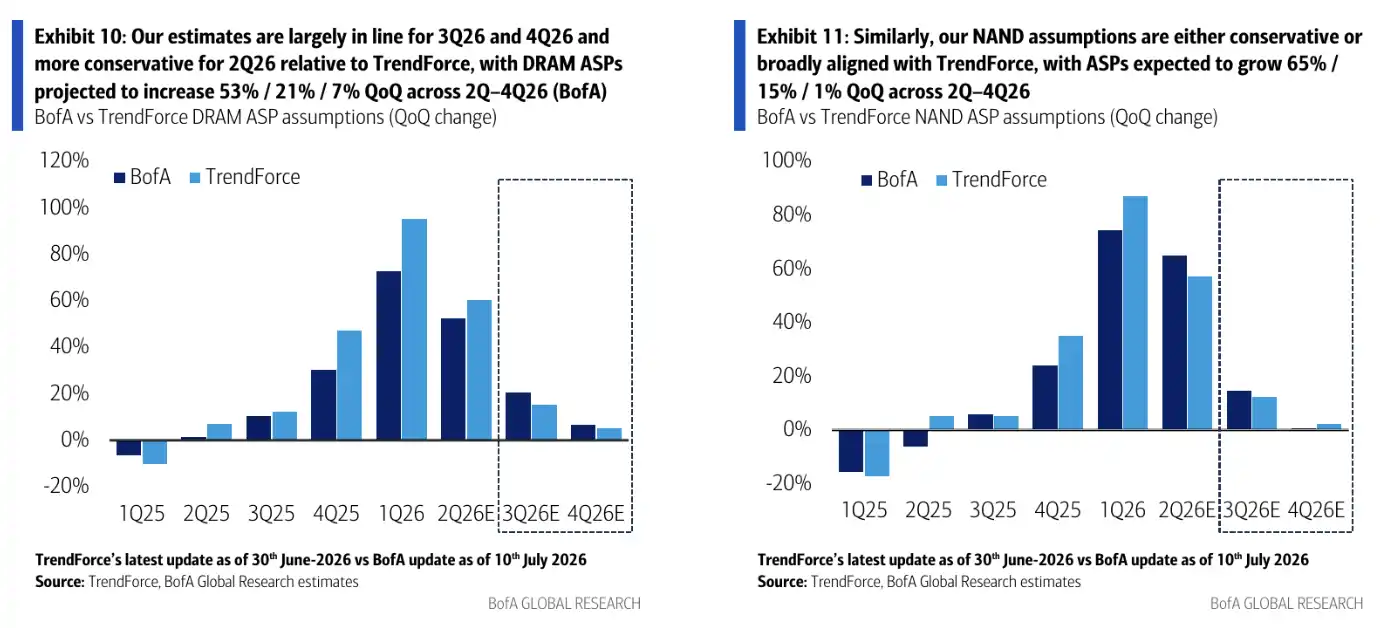
Comparison of TrendForce and Bank of America's DRAM/NAND ASP forecasts: Bank of America projects +21% for DRAM in the third quarter, while TrendForce predicts +13%-18% for general DRAM.
Server Memory Leads the Increase, Non-LTA Orders Amplify Price Elasticity
Bank of America is more optimistic than TrendForce, with the key difference lying in the contract structure.
In the server DRAM market, long-term agreements (LTA) do not lock in all prices. Bank of America estimates that non-LTA sales account for 60%-70%, making these prices more responsive to supply and demand changes. Even under some LTA contracts, suppliers can achieve a 5%-10% price increase.
This allows the third-quarter DRAM prices to not be solely determined by early-year or previous agreements. As long as the demand remains strong for AI servers, high-speed LPDDR5, and related memory, spot and short-term prices will transmit the price hikes into ASP.
Bank of America's current DRAM ASP trajectory is +53% QoQ in the second quarter, +21% in the third quarter, and +7% in the fourth quarter. Compared to TrendForce, Bank of America remains significantly more optimistic about the third quarter, but there are differences in the second-quarter baseline and calculation criteria. The divergence mainly focuses on how much ASP can increase in the third quarter and to what extent the fourth-quarter increase will retract.
NAND is also heating up, but it is not the highlight of this report. Bank of America expects a 15% QoQ increase in NAND ASP in the third quarter, higher than or close to the 10%-15% range given by TrendForce. In the NAND spot market this week, the price of a 1Tb wafer increased by 4% WoW, providing some support for the price hike in the third quarter.
Spot Prices Up for Eight Consecutive Weeks, Prices are No Longer Cheap
DRAM spot prices have risen for eight consecutive weeks, with prices continuing to rise MoM in July. Bank of America's channel checks show that DDR5 and DDR4 spot prices both point to a roughly 20% QoQ growth in the third quarter.
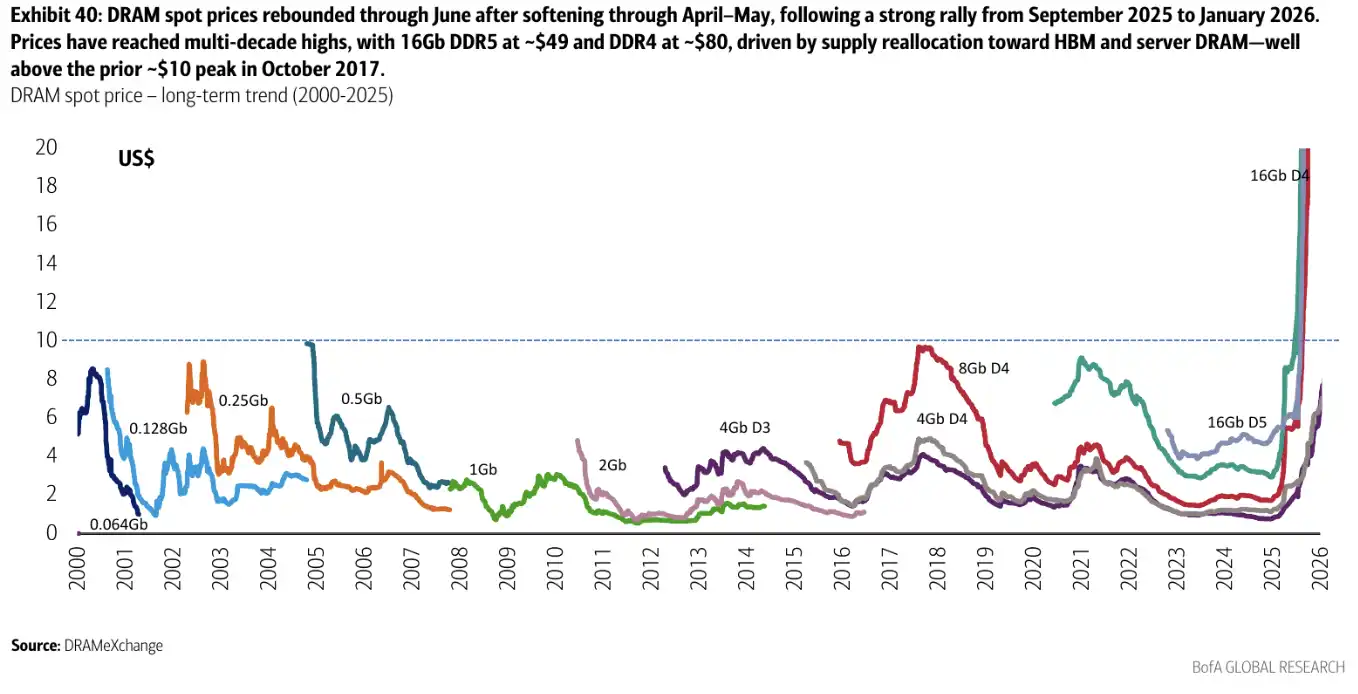
What needs more vigilance, however, is the absolute prices.
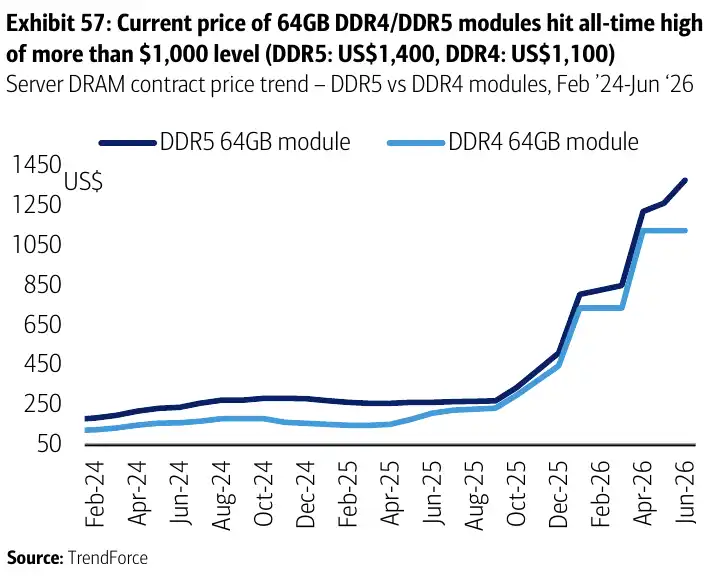
The current price of a 16Gb DDR5 spot is around $49.2, up 28% QoQ. The price of a 16Gb DDR4 spot is about $80.1, up 16% QoQ. The contract price for a 64GB DDR5 module for servers has exceeded $1,400. The price of a 1Tb NAND wafer is around $25.1, also at a high level.
These numbers indicate that the memory price hike is no longer just a low-end correction but has entered an abnormally high price range. Continued price increases will amplify the profitability of memory manufacturers but will also compress the tolerance of downstream customers for restocking. If PC, mobile, or some server customers begin to delay purchases, a spot price decline in the summer would not be surprising.
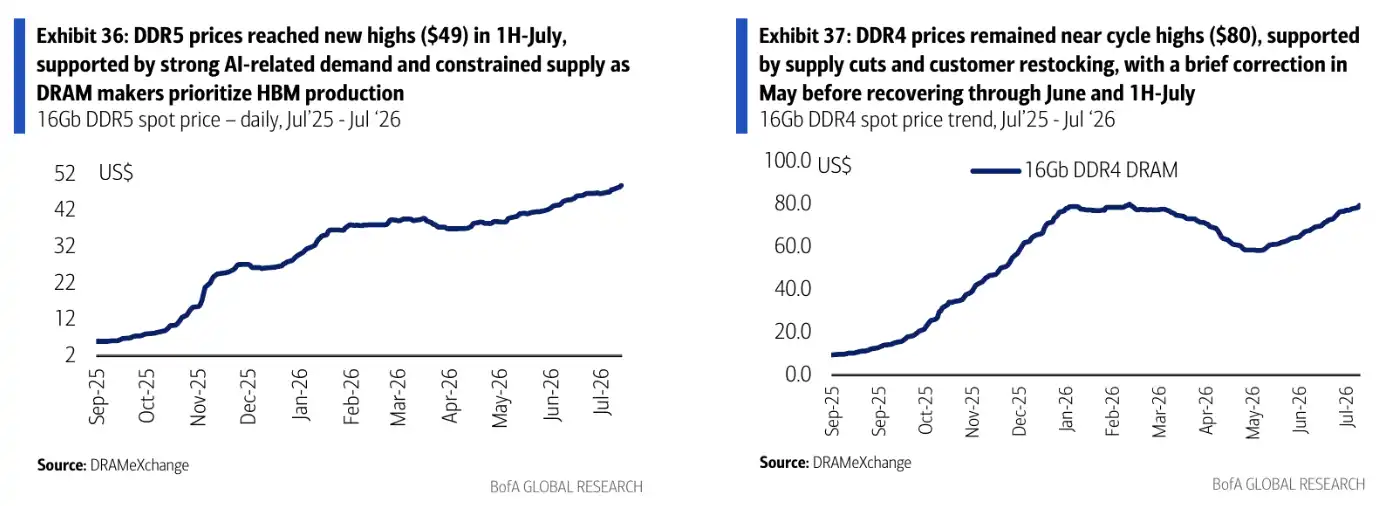
DRAM/NAND Spot and Contract Price Trends: 16Gb DDR5 spot around $49, 16Gb DDR4 around $80, server 64GB DDR5 module contract price exceeds $1,400.
This is also the most crucial boundary in Bank of America's assessment. Prices can continue to rise, but the third-quarter price hike cannot be directly extrapolated as a risk-free upward trend for the entire year. The higher the memory price, the easier demand elasticity and customer bargaining will reemerge.
AI Capital Expenditure Still Supporting Memory Demand
The performance signals from TSMC and ASML provide corroboration for the memory demand.
In the second quarter, TSMC's net revenue was approximately $40.2 billion, a year-on-year increase of 34%, with an operating margin of 60.3%. Importantly, TSMC has raised its 2026 capital expenditure guidance to $60-64 billion and still has additional investment plans for US factories. Strong demand continues for AI chips, advanced packaging, and high-end servers, providing support for memory-related products such as HBM, SOCAMM, and enterprise SSDs.
In the second quarter, ASML's net sales were €9.3 billion, an increase of about 21% year-on-year. By region, South Korea accounted for approximately 43% of the system sales in the second quarter. This indicates that Korean memory factories are still investing in equipment for future advanced processes and high-bandwidth memory demand.
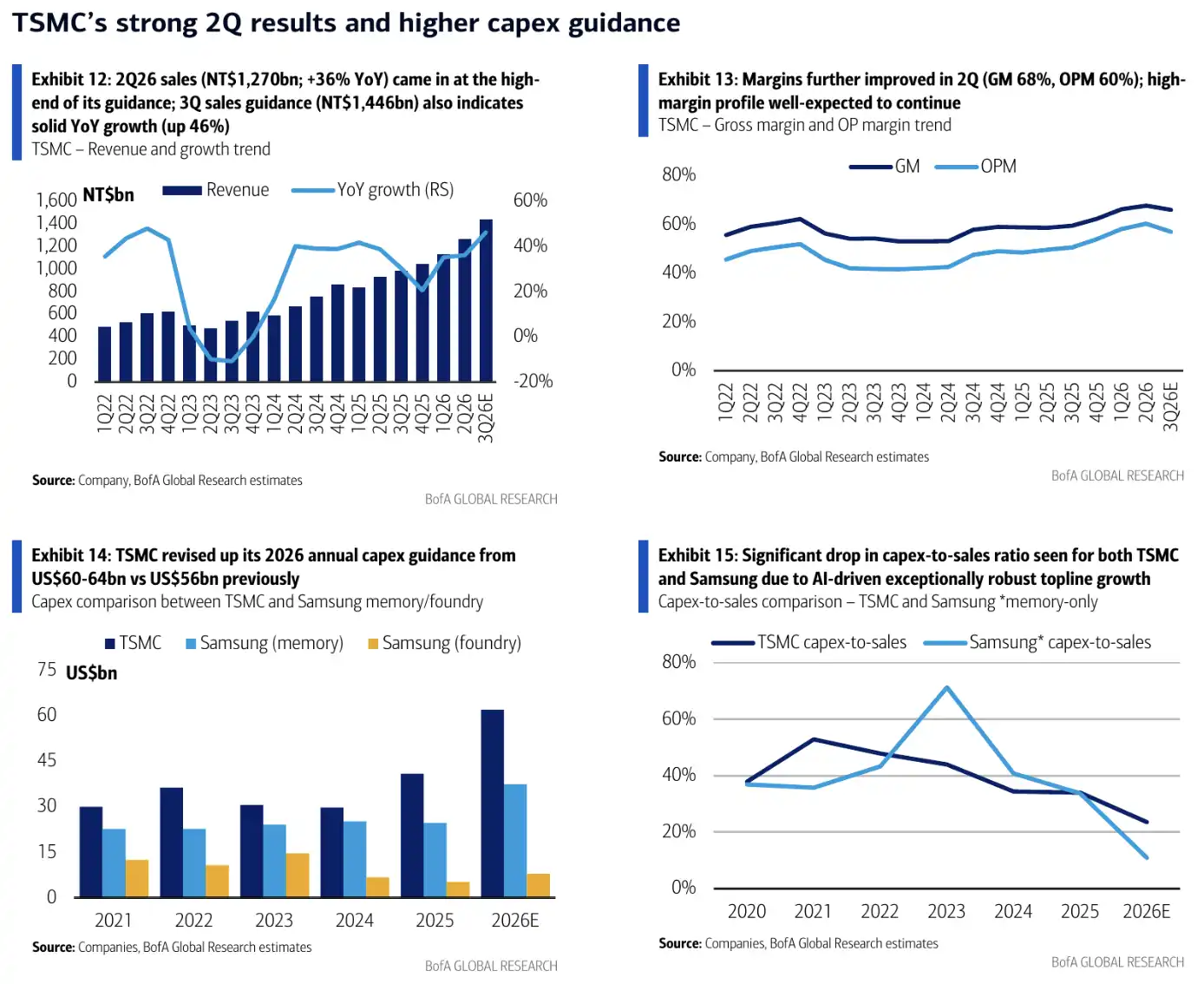
Comparison of TSMC's revenue, profit margin, and capital expenditure: The second-quarter operating margin was about 60%, with the 2026 capital expenditure guidance raised to $60-64 billion.
These signals cannot simply be equated with "memory prices will definitely continue to rise," but they explain why the price increase in memory is not just a short-term speculation. The expansion of AI servers will consume more HBM and high-end DRAM, driving demand for complementary eSSDs and system memory. As long as capital expenditure does not significantly slow down, memory suppliers have a stronger basis for price negotiations.
However, the transmission of AI capital expenditure to memory orders takes time. The order rhythm between chip fabs, cloud providers, server ODMs, and memory factories is not completely synchronized. If capital expenditures are concentrated in logic chips or advanced packaging, it may not immediately translate into price increases for all categories of DRAM and NAND.
Inventory replenishment data is strong, but end demand has not fully caught up
Supply chain data also supports the short-term strength of memory prices.
According to media reports of South Korean customs data, semiconductor exports from South Korea reached $11.2 billion from July 1 to 10, a year-on-year increase of 193%. Data cited by BofA also shows a 1.3% month-on-month growth, with six consecutive months of triple-digit year-on-year growth. In June sales for Taiwanese tech companies, logic, foundry, and ODMs showed strong performance on a month-on-month basis, while memory manufacturers led in the year-on-year dimension.
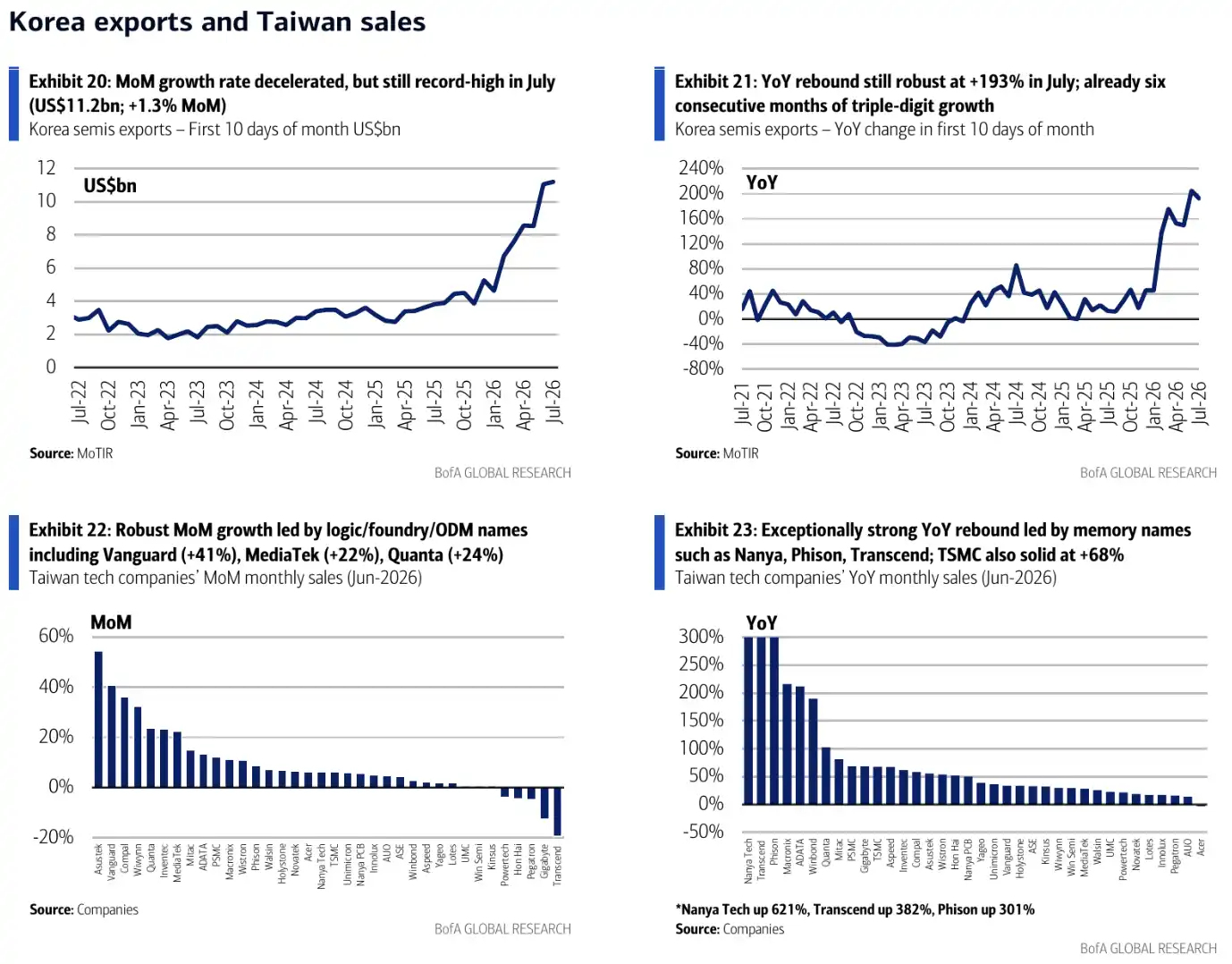
Chinese import data similarly indicate ongoing inventory replenishment. BofA cited data showing that China's integrated circuit imports hit a record $59.6 billion in June, a 72% year-on-year increase. Memory imports in May reached $30.8 billion, accounting for 54% of total imports, with a 249% year-on-year growth.
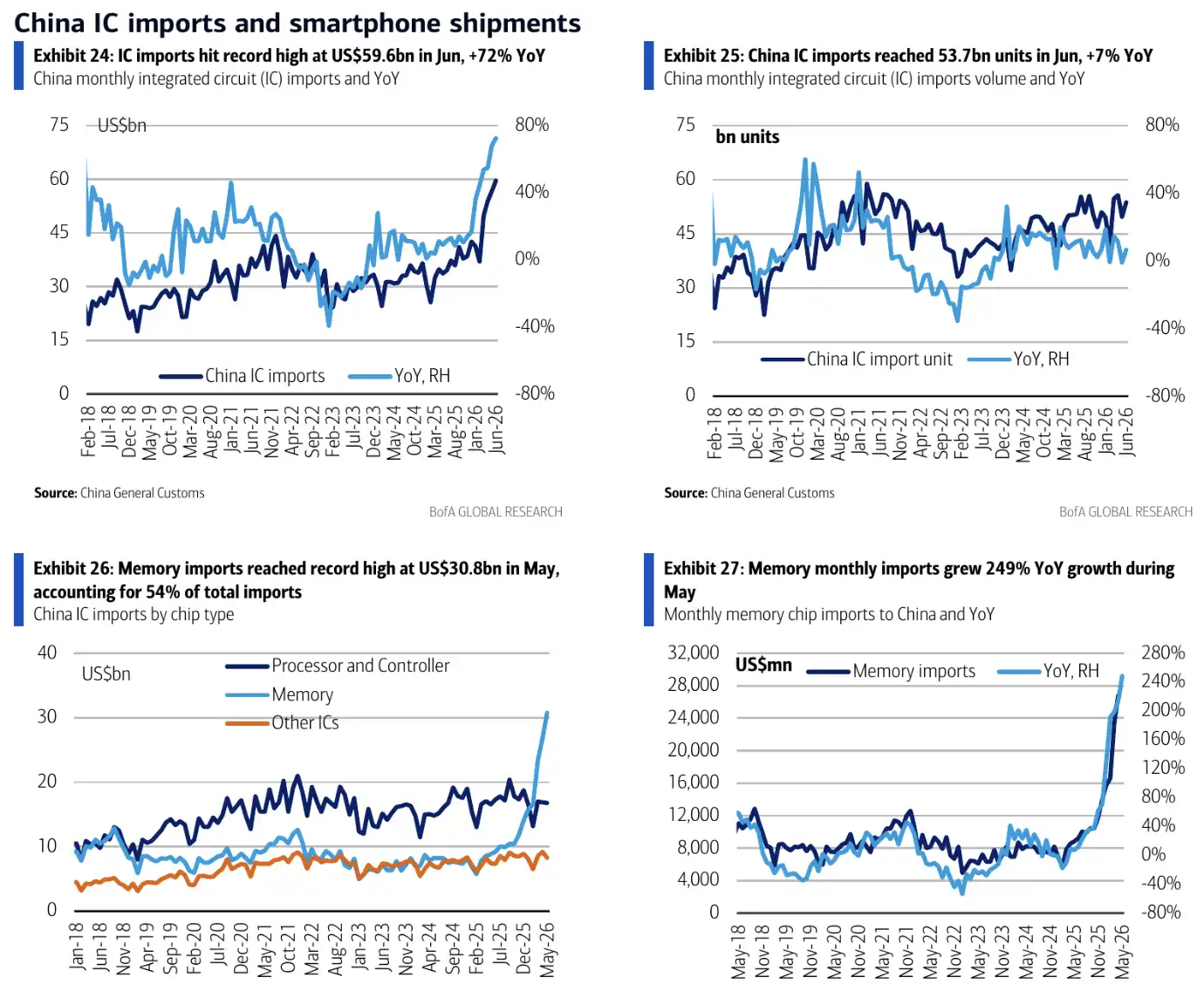
These data indicate that the demand side is not solely driven by one customer ramping up orders. However, they do not directly prove a full-fledged recovery in end-user consumption.
For example, Bank of America cited data showing that China's May smartphone shipment volume grew by 19% year-on-year to 26.8 million units, but overall declined by 4.3% in the second quarter. This suggests that some of the imports and order placements may stem from inventory restocking, product transitions, or supply security considerations, rather than solely from a sudden acceleration in consumer demand.
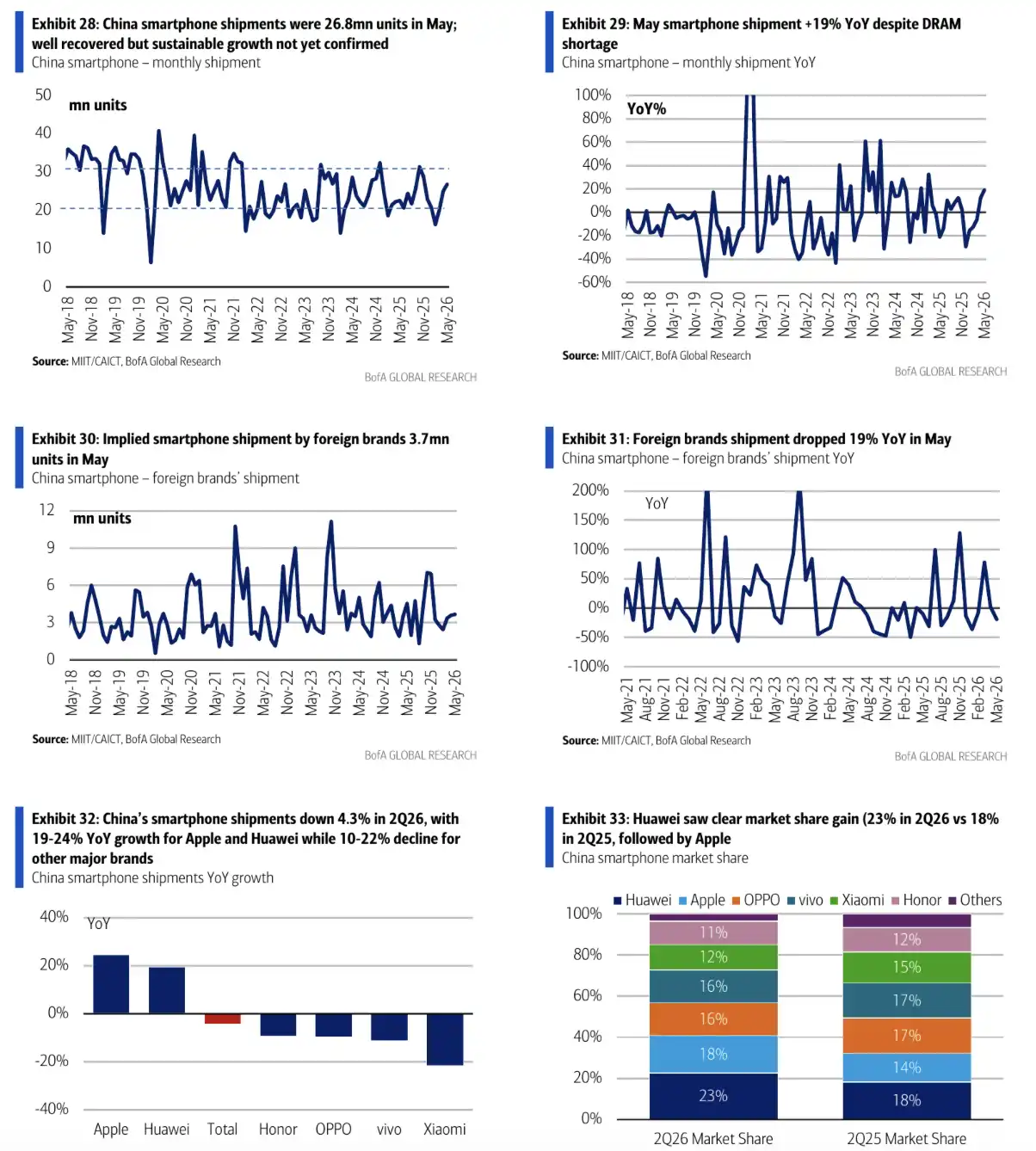
For memory prices, restocking can drive short-term ASP increases. If end-user sales do not catch up, high prices will eventually dampen customer purchasing pace.
21% Joy Index Stuck at High Prices and Caliber Discrepancy
The most noteworthy aspect of this report is Bank of America pushing the third-quarter DRAM ASP growth to 21% and using server contract prices, spot prices, capital expenditures, and supply chain data to jointly support this assertion.
However, it still faces several constraints.
Firstly, Bank of America and TrendForce have differences in calibration on the high base in the second quarter. If the actual growth rate in the second quarter is higher, the quarter-on-quarter growth rate in the third quarter might be suppressed. Secondly, although LTAs account for less than half, there are still variables in contract execution, customer acceptance, and specific settlement prices. Thirdly, current DDR5, DDR4, and server module prices have been at multi-year highs, and a summer spot market correction could occur at any time.
This is also the reason for the recent increased volatility in memory stocks. Since 2026, shares of companies like SanDisk and Kioxia have seen significant gains related to memory, but in the first half of July, there was a pullback due to concerns about earnings missing expectations. Low P/E ratios do not equate to low risk, and the profit elasticity and retreat speed of cyclical stocks at high price levels often magnify simultaneously.
What needs to be confirmed in the third quarter is not whether "memory prices have increased," but whether a DRAM price increase of over 20% can materialize at both ends of contracts and spot sales. If the peak season shipping continues into September, and AI server demand continues to absorb the high prices, Bank of America's optimistic forecast becomes more likely to materialize. If spot prices decline first and downstream customers delay purchases, the third quarter's 21% ASP increase will become the most contentious number in the market.
Welcome to join the official BlockBeats community:
Telegram Subscription Group: https://t.me/theblockbeats
Telegram Discussion Group: https://t.me/BlockBeats_App
Official Twitter Account: https://twitter.com/BlockBeatsAsia
 Related Articles