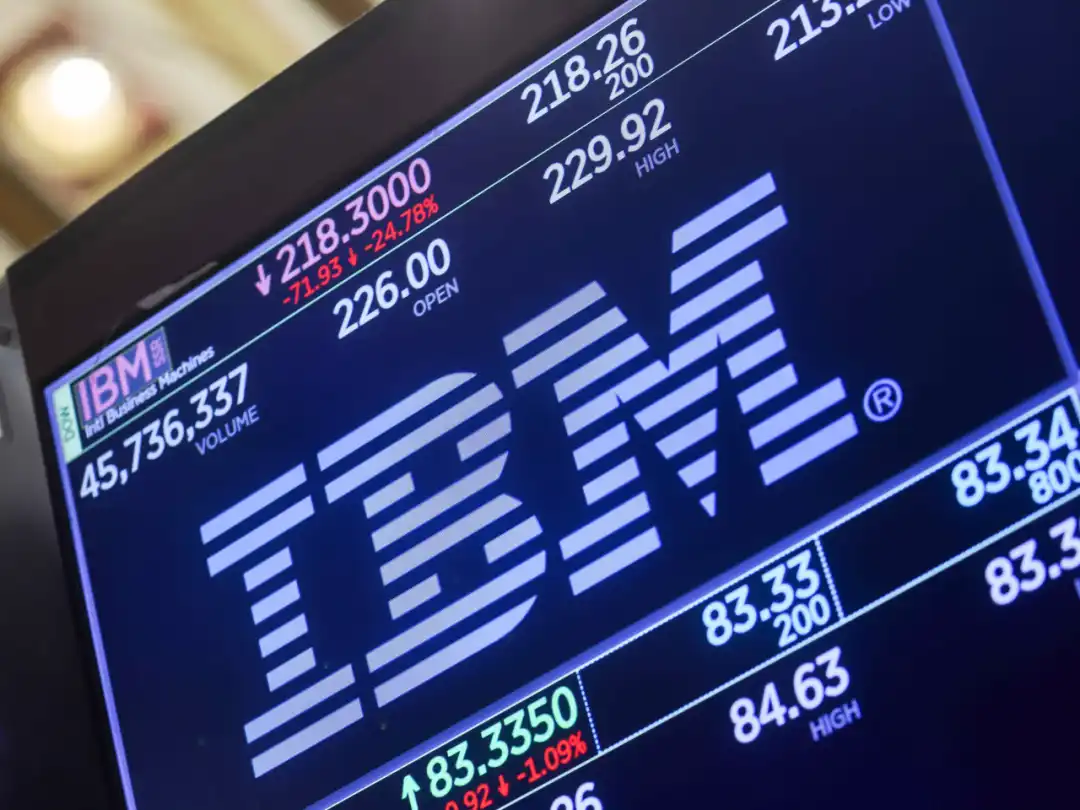
IBM, which survived the Great Depression and World War II, saw its market value plunge by $68 billion during the AI frenzy.

Author | Jialiu, BeatZ
At its peak, IBM was almost synonymous with "computer" itself.
This company has been around for 115 years. Founded in 1911, five years before Boeing and twelve years before Disney. In the 1960s, it held about 70% to 80% of the global mainframe market share, with seven competitors collectively referred to as the "Seven Dwarfs" and IBM being Snow White. In 1969, the Apollo moon landing trajectory calculations ran on its machines. It survived the Great Depression, World War II, the oil crisis, the Asian financial crisis, and the dot-com bubble, each time surviving through transformation, and even emerged stronger. For half a century, IT procurement managers worldwide had a mantra: "Nobody ever got fired for buying IBM."

IBM's personal computer introduced in 1981
Yet, this "Big Blue" with a market value of over $200 billion can see a quarter of its stock price wiped out overnight in today's AI frenzy.
On the same day, Micron was up 4.92%, NVIDIA was up 4.06%, SanDisk was up 5.01%, the semiconductor ETF rose by 2.51%, and the Nasdaq was up 1.12%. Every name associated with "AI infrastructure shortage" was being bought up by funds, and the overall market was flourishing. IBM saw a single-day trading volume of 67.439 million shares, which is 9.7 times the average trading volume over the past ten days. A century-old blue-chip known for "stability, dividends, defense" showed a stock market plunge on a green day.
In the U.S. stock market, hardware and software had divergent fates, so who should be held accountable for IBM's decline?
The Crisis Behind the 25% Plunge, IBM's Crisis
Superficially, this time IBM only issued a profit warning.
IBM's CEO, Arvind Krishna, sent a letter to investors on July 14, disclosing preliminary second-quarter results: estimated revenue of $17.2 billion, while Wall Street's consensus was $17.86 billion, a difference of about $660 million, a 3.7% deviation; adjusted earnings per share of $2.93, compared to the expected $3.02, a 3% variance.
Placed on any normal company, especially an elephant like IBM, a 5% to 8% drop would suffice. This indicates that IBM's problem is not just a performance crisis. So, what is the real issue?
First, the z17 mainframe cycle has declined too rapidly.
IBM Z is the large mainframe produced for its banking, insurance, airline, and government clients, with the z17 being the latest generation. Mainframes are not cloud software sold smoothly on a monthly basis; they are critical transaction computing systems that are replaced only every few years. When a new generation is released, customers upgrade en masse, and once that window passes, revenue naturally declines. Last year, the z17 sold too well, resulting in a 51.7% surge in IBM Z revenue. In April, management already cautioned that this year's infrastructure revenue would experience a low single-digit decline.
However, the outcome in the second quarter was not a "low single-digit decline" but a direct 7% decrease. The official wording was a "Z performance shortfall," indicating that Z's actual performance was below management's own expectations.
Even more troublesome is the ripple effect. Within IBM's software revenue is a segment called Transaction Processing, which includes middleware and transaction software that ensures high-frequency critical transactions such as payments, clearing, booking, and policy issuance run smoothly between the mainframe and new applications. In 2025, this business segment contributed $8.6 billion, nearly 30% of IBM's software revenue.
However, without large mainframe hardware deals, the associated software naturally suffers. The market initially believed that IBM's software had already transitioned to independent subscription business, but this turn of events revealed that mainframe hardware and software are still tied to the same fate. Naturally, the market will question: How much of IBM's software is genuinely growing independently, and how much is still bound to the old mainframe cycle?
Secondly, customers' budgets were truly seized by AI infrastructure investments.
In a recent letter to investors, IBM's current CEO Arvind Krishna provided a very specific description: in the final weeks of June, customers shifted their quarterly capital expenditures towards server, storage, and memory purchases to secure infrastructure amid supply shortages and price hikes.
Although IBM was aware of the supply chain impact in advance, it underestimated the magnitude of this budget reallocation wave.
A bank's IT budget is finite. If it must allocate millions of dollars more this quarter to seize memory and server resources, what can it postpone? It will not delay regulatory imperatives; instead, it will postpone precisely the mainframe upgrades, software upgrades, and consulting project signings that can be pushed to "next quarter." Since large enterprise software deals are usually signed in the last weeks of the quarter, signing fewer deals immediately skews quarterly revenue recognition.
On that day, Workday dropped by 6%, while Salesforce and Autodesk also weakened. The hottest topic recently discussed on Reddit's stock trading forum is: Is AI infrastructure investment starting to systematically crowd out the budget for software and IT services?
However, we cannot jump to conclusions too quickly. At the same time, we have a set of optimistic data: IBM's own Power servers and storage business (the part of infrastructure that does not belong to the Z mainframe) saw a staggering 37% revenue surge, marking its strongest performance ever recorded, with approximately $500 million in end-of-period orders already signed but not yet delivered.
In other words, IBM managed to capture a portion of the money from the hardware buying spree.
Thirdly, cybersecurity incidents disrupted customer decisions at the worst possible time.
IBM's customers were also affected by rapidly evolving, industry-wide cybersecurity issues.
For IBM's core clients, a security incident is not just ordinary IT news. It first freezes non-urgent purchases, consumes the time of architects, legal teams, and security officers, and throws them into patching, auditing, isolation, backup, and compliance. While it is optimistic to say that many projects and clients may not necessarily cancel transactions, the reality is that IBM indeed could not conclude these contractual processes by June 30.
Fourthly, there were internal issues at IBM.
Customer budget shifts are external variables, but whether the sales organization can proactively identify them, whether they can repackage Power, Storage, Red Hat, HashiCorp, data governance, consulting, and mainframe software, and whether they can close major deals at the end of the quarter, these are issues of IBM's own capabilities.
The market can forgive a supply chain mishap once, but when the mainframe cycle peaks, budgets are snatched away externally, and sales fumble, with these three things coinciding in the same quarter, the reason for holding IBM is no longer "stable defense."
Therefore, the 25% plunge was due to these events affecting three deeply ingrained characteristics of IBM: the certainty of the mainframe cycle landing smoothly, the certainty of software growing independently from the mainframe, and the valuation image of being a "high-dividend defensive AI beneficiary."
Prior to the crash, IBM had only fallen by 4.8% this year. Many investors holding IBM were attracted by its stability, dividends, and AI concept and were simply not prepared to withstand this kind of volatility. When IBM suddenly became a highly volatile asset with misalignments in mainframe, software, and consulting simultaneously, the selling from these investors was panic-driven.
What Kind of Company is IBM Today
Many people still think of IBM as the "old computer-selling company," but it actually sold its PC business to Lenovo in 2005. Today's IBM is a technology and services company focused on large enterprises' existing systems.
Its business is built on one fact: a company's data, core transactions, legacy applications, regulatory requirements, and organizational processes are extremely difficult to move all at once. IBM sells software, hardware, consulting, and long-term support exactly in these most challenging areas.
In full-year 2025, the revenue was $67.535 billion, divided into three main segments.
Software is the largest and most profitable engine, with revenue of $29.962 billion and a gross profit margin of 83.5%. The most market-valued part is Red Hat, the enterprise Linux and hybrid cloud software company that IBM acquired for $34 billion in 2019. Red Hat's OpenShift allows the same application to run on a customer's own data center, Amazon Cloud, Microsoft Cloud, or Google Cloud without being locked in by any of them. In 2025, Red Hat's revenue was $7.327 billion, growing by 12.9%. OpenShift's annual recurring revenue reached $1.9 billion, with a growth rate of over 30%. In addition to Red Hat, the software segment also includes tools such as HashiCorp for automating server configuration, managing keys and permissions, Confluent for managing real-time data streams, data governance for granting data permissions, tracking sources, and maintaining audit records, as well as the Transaction Processing software mentioned earlier.
Consulting is the delivery layer connecting products and customers, with revenue of $21.055 billion. It is responsible for integrating IBM's software and hardware into the processes of banking, insurance, and government clients, carrying out old system migrations, process transformations, and go-live validations. It is large in scale but grows slowly, with a profit margin far below software. When an enterprise's budget is tight, consulting contracts are always the first to be postponed.
Infrastructure includes Z mainframes, Power servers, storage, and support services, with revenue of $15.718 billion. The z17 cycle boosted last year's figures but also left this year with a high base number trap.
Looking at these three segments in a customer's one-time purchase, the relationship is not complicated: the core business runs on Z mainframes first; to integrate new applications and AI with these legacy systems, Red Hat and OpenShift are purchased to create a hybrid cloud environment; to manage servers, permissions, and real-time data effectively, HashiCorp, Confluent, and data governance are added; Power and storage are purchased for on-premises computing power and data capacity; finally, IBM's consulting team truly integrates these components into the business processes.
Every link on this chain is making money. The issue revealed in this pre-disclosure is that when a customer's budget priority is disrupted, this chain can be simultaneously broken.
This is the core contradiction in IBM today. It still sits at the foundation of the world's critical systems, but as the first stop for the budget flow in the AI era, it may not necessarily be it. Customers can continue to use IBM mainframes, or they can take the newly added money for this quarter and spend it on memory, servers, storage, and cloud capacity. IBM will not immediately lose customers, but it may lose growth in ranking.
This is also why IBM's most rational AI strategy now is not to directly challenge OpenAI, Google, Anthropic, or to compete with NVIDIA on selling more GPUs, but to become the control layer of enterprise AI.
Red Hat manages where applications run; HashiCorp manages how infrastructure is configured, how keys are kept; Confluent manages how real-time data flows between trading systems, databases, and AI applications; watsonx manages models, data, and governance; Consulting is responsible for integrating these things into the real processes of banks, insurance, and governments.
If this approach is successful, IBM doesn't need to be the sexiest AI company; it can become the most irreplaceable backstage pipeline of the enterprise AI era.
But if the grand plan cannot come together, IBM will be stuck in the middle of two worlds: the new AI budget will be taken by NVIDIA, AWS, Azure, Google, server and storage vendors; the old mainframes and transaction software will experience a slow decline. Then it is not the control layer but the sandwich layer.
The Fifth Pivot of the Elephant
IBM is not the first to encounter such a moment; this 115-year-old company always seems to start going downhill after its glory.
So IBM's path of decline is not a linear history. It is more like a cycle of repeatedly falling from the peak and then climbing up from the valley. Each time it survives through transformation, and each transformation leaves behind new burdens.
The first pivot was during the Great Depression when it transitioned from a time clock factory to an information processing company.
Founded in 1911, the Computing-Tabulating-Recording Company later renamed to International Business Machines in 1924. Early IBM did time clocks, tabulating machines, timing devices, which sounded mechanical and bulky.
In 1929, the U.S. economy collapsed, and most companies were laying off employees and cutting production. IBM's leader, Thomas Watson, made a counterintuitive decision: instead of layoffs, the factories continued to operate, punch card tabulating machines kept being produced, and the inventory piled up.
In 1935, when Roosevelt signed the Social Security Act to establish records for 26 million workers, only IBM had the ready-made machines and production lines. It gained fame through this opportunity and henceforth became deeply intertwined with the U.S. government, banks, and insurance companies. This was the "foundation of its nation": expanding capacity when others were retracting, waiting for a large order that only it could fulfill.
The second transformation was shifting from tabulating machines to large-scale computing platforms. The System/360 was IBM's most critical gamble in history.

In 1964, IBM's CEO Thomas Watson II posing with a System/360 computer.
In 1964, IBM invested $5 billion (exceeding that year's Manhattan Project) to develop the System/360, a unified architecture for a family of mainframe computers.
The System/360 was IBM's most critical gamble in history. It was a massive investment, nearly equivalent to redoing the entire product line of the company, but it established a compatible architecture and a platform business model. Customers could buy a small system and later expand it without rewriting software. This allowed IBM to dominate in the era of mainframes and become the king of global enterprise computing.

In 1964, people working among System/360 components.
This product defined half a century of enterprise computing thereafter and propelled IBM to a monopolistic peak, with a market share that once exceeded 70%. However, the side effects included the U.S. Department of Justice promptly filing an antitrust lawsuit, leading to a legal battle that lasted 13 years. A more profound side effect was the inertia of thinking: IBM began to believe that computing should be centralized, expensive, and delivered by IBM.
The third transformation, more of a cautionary tale, highlighted the victory and missteps of the PC era.
In 1981, IBM was in a hurry to create a personal computer and decided to sacrifice full self-reliance for speed. They chose Intel for the processor and Microsoft for the operating system. At that time, Bill Gates didn't have a ready-made system either, so he purchased a DOS package from someone else for $75,000 and sublicensed it to IBM, reserving the right to sublicense DOS to other manufacturers in the contract.
IBM agreed because in the era of mainframes, hardware was seen as the business while software was merely a bundled accessory. This open architecture attracted numerous compatible manufacturers, with the majority of the profits flowing to Intel and Microsoft, who controlled the standard.
IBM pioneered the PC era but ended up being one of many assembly companies in an era they created. Ultimately, in 2005, they sold their PC business to Lenovo. This history left IBM with two lessons: value migrates along the industry chain, and those who cling to hardware will be harvested by those who control software and standards; outsourcing key links is equivalent to handing over the lifeline.
In the fourth transformation, in the 1990s, IBM transitioned from a hardware empire to a service company.
Prior to the Internet, IBM faced a significant crisis. The failure of the PC business dragged the entire company down, mainframe demand slowed, competition intensified, the company became bloated, and the market questioned whether it would be split up.
From 1991 to 1993, IBM accumulated nearly $16 billion in losses. In 1993 alone, they lost $8 billion, marking the largest annual loss in U.S. corporate history at the time. Oracle's Larry Ellison even publicly stated, "IBM? We don't even think about them. They are essentially irrelevant, even if they haven't died."
IBM brought in an outsider CEO, Lou Gerstner, with a background in selling cookies. He cut 60,000 jobs, ended lifelong employment, and transformed IBM into an enterprise services and solutions company. The book about this transformation was titled "Who Says Elephants Can't Dance," and the "elephant's dance" almost became synonymous with IBM.
After transforming from a product company to a service company, IBM returned to profitability in 1994, earning $5 billion. However, this transformation also planted a long-term risk: IBM's revenue increasingly relied on customer complexity. The messier, older, and harder to move the customer systems were, the more money IBM made. This also set another path dependency for the next few decades: heavy on customers, heavy on services, heavy on long-term contracts. It allowed IBM to survive steadily but made it less and less like a high-growth software company.
Now, it is the fifth transformation. How can this traditional enterprise IT company better adapt to today's AI era?
When Amazon launched AWS as a public cloud in 2006, IBM's reaction was reminiscent of its response to the PC back in the day: believing that large clients would not migrate their core systems to the public cloud and not taking it too seriously. By the time it realized, Amazon, Microsoft, and Google had erected a barrier to entry with capital expenditures in the hundreds of billions of dollars.
However, IBM had once been at the forefront of the AI wave. In 2011, its AI system Watson defeated human champions on a US game show, putting IBM at the center of the AI narrative. It was the first time the public witnessed machines understanding natural language and answering complex questions, causing a global sensation, a full eleven years before the debut of ChatGPT.
Yet, Watson was packaged as a do-it-all solution. Its most ambitious project, Watson Health, poured $4 billion into AI-assisted cancer diagnosis but never met expectations. In 2022, it was sold at a discount to a private equity firm. From 2012 to 2020, IBM's revenue continuously shrank, its stock price stagnated, while Microsoft grew nearly tenfold. The media dubbed this period the "Lost Decade."
In 2019, IBM prescribed itself a remedy with the $34 billion acquisition of Red Hat. In 2021, it spun off Kyndryl, shedding nearly 90,000 employees from its low-margin IT infrastructure services. Then, it introduced Watsonx as an enterprise AI platform, acquired HashiCorp for infrastructure automation, and secured Confluent for real-time data streaming. By 2025, this narrative finally seemed to click: software grew by 10.6%, Red Hat by 12.9%, and the z17 achieved the strongest start in history. The market began to embrace a new story: IBM was no longer the cumbersome elephant; it was a perfect target for high dividends, defensive posture, and could reap the benefits of enterprise AI.
But on July 14 this year, in just one day, it all unraveled.
A Century of IBM, Standing on the Cliff Edge Again
IBM's next move is not to reiterate "We believe in AI."
Because the market already knows IBM will talk about AI, and it knows about its assets such as Red Hat, OpenShift, Watsonx, HashiCorp, Confluent, Power, Storage, Z mainframes, and consulting teams. The current issue is not the asset inventory but the causal chain: can these assets secure a share of AI infrastructure spending, offset the decline in mainframes, and re-engage postponed orders.
The most important points to focus on during the July 22 conference call are:
First, what happened to the large deals that were not closed on time in Q2? Were they delayed or lost?
This is the key question. If customers only postponed signing due to the rush for servers, storage, and memory at the end of June, or due to a temporary delay for a network security review, then Q3 should see these orders return. Conversely, if these large deals were downsized, canceled, or shifted to competitors, it's not just a quarterly timing issue but a question of customer relationships and product priorities.
Second, where did the shortfall in Z series come from?
Was it due to customers delaying upgrades, reducing capacity, or was there an issue with IBM's sales execution and revenue recognition timing? The answers lead to very different implications. Delayed upgrades can be recovered, but capacity reduction is more concerning. If key customers are just maintaining existing systems without expansion, IBM's most profitable traditional revenue pool will undergo a long-term reassessment.
Third, why is Transaction Processing underperforming?
This is crucial in assessing the quality of IBM's software offerings. While Red Hat is a modern growth asset, Transaction Processing is still tightly tied to the mainframe environment. If its underperformance is merely a short-term fluctuation following the z17 rhythm, the issue is manageable. However, if customers start cutting back on transaction processing software spending, IBM Software's "platform software valuation" will be discounted.
Fourth, can Red Hat sustain its independent acceleration?
In Q2, Red Hat's growth accelerated to 11%, which is IBM's most significant positive signal. The market needs to see if OpenShift ARR will continue growing rapidly, how RHEL, Ansible, and OpenShift are performing individually, and whether growth is being driven by genuine demand, pricing, or through mergers and bundled sales. IBM needs to demonstrate that software growth is not solely tied to mainframe cycles but can independently tap into enterprise AI and hybrid cloud budgets.
Fifth, is the 37% growth in Distributed Infrastructure sustainable?
Power and Storage showed great strength in Q2, with backlogged orders totaling around $500 million. The question is whether this surge is due to rush orders in a supply-constrained environment or if IBM can genuinely retain AI hardware budgets within its ecosystem. Furthermore, will customers who purchase Power and Storage continue buying Red Hat, automation, data governance, and consulting services? If hardware growth can drive software attach rates, IBM has the opportunity to transform "being displaced" into "internal migration."
Sixth, How much did HashiCorp and Confluent actually contribute?
IBM stated a strong recent acquisition performance, but the market needs more quantifiable metrics: revenue, ARR, customer count, cross-selling, renewal rate. Acquiring good assets is not difficult; the challenge lies in not executing on good assets slowly, not eroding developer trust, and not compromising their agnostic stance across clouds.
Seventh, Can the GenAI signings in Consulting translate into revenue?
Consulting is key for IBM to operationalize AI into enterprise processes but is also the most easily postponed budget item. While growth in GenAI-related signings is positive, the market wants to see how quickly it converts to revenue, what the profit margins are, and if it will drive software sales. If consulting is merely selling person-days, its valuation is limited; but if consulting can unlock sustained revenue from Red Hat, Watson, HashiCorp, and data governance, then it becomes IBM's amplifier.
Eighth, Will the full-year free cash flow, profit margins, and dividend capability be impacted?
IBM also has an identity as a high-dividend, defensive tech stock. Many invest in it not to take on the risk of high-growth stocks but for stable cash flow. If management revises down full-year free cash flow or profit margin expectations, the market will continue to reassess its defensive attributes.
All these questions point to one judgment: Has IBM missed the boat this time, or has its position fundamentally changed?
If it's the former, the 25% plunge may have been an overreaction. IBM still has mainframe cash flow, Red Hat growth, Power and Storage demand, data governance, and consulting delivery to support its shift from a mainframe revival story to an enterprise AI control narrative.
If it's the latter, the trouble is far greater. It signifies that in the AI era, enterprise IT budgets are not simply expanding but reordering. Old systems will still run, old vendors will still be needed, but new budget allocations will flow toward more forward positions: GPUs, memory, servers, storage, cloud, models, security, and business software entry points. If IBM cannot position itself at the forefront of these new budget allocations, it will continue to be valued by the market along its weakest thread.
IBM will not vanish overnight.
This company is still ingrained in the core of global finance, government, aviation, insurance, and large enterprises. Many systems are not easily or readily portable. Mainframes, transaction processing software, Red Hat, OpenShift, Power, Storage, Watson, HashiCorp, Confluent, and the consulting teams are all tangible assets, not just a hollow narrative.
Looking back at IBM's 115 years, it has always been pondering the same question: Can you pivot ahead of the money when your customer's money flow changes?
During the Great Depression, it bet on capacity and awaited the big order of the Social Security Act. With System/360, it staked the entire company on unifying computing standards. During the PC era, it pivoted too slowly, ceding the operating system to Microsoft and missing out on a whole era. In 1993, Gerstner led its transformation from products to services, narrowly escaping failure. In the first half of the cloud and AI era, it lagged again, losing a decade and spending $34 billion to acquire Red Hat to catch up.
The cruelest part of the AI era is that it didn't expand all IT budgets together but made the same money line up in a new queue. Whoever can directly address computing power, data, security, governance, efficiency, and business returns is at the front of the line; those considered "needed later" are postponed.
IBM's survival strategy over the past 115 years has been that whenever the previous fortress became a burden, it would dismantle itself once again. Now it finds itself at the same crossroads.
Whether the fifth elephantine pivot will succeed does not depend on whether IBM can still talk about AI or how much glorious history it has. It solely depends on a more practical question: When the CFO and CIO sit in front of the same budget sheet, can IBM still be the name that cannot be pushed back?
Your first encounter with IBM may have been through the ThinkPad, mainframes, Watson, or simply the blue logo. It once symbolized the future.
Now it has to prove that when the future turns back to squeeze itself, a century-old technology company still has the capability to reinvent itself.


Original Article Link
Welcome to join the official BlockBeats community:
Telegram Subscription Group: https://t.me/theblockbeats
Telegram Discussion Group: https://t.me/BlockBeats_App
Official Twitter Account: https://twitter.com/BlockBeatsAsia

 Related Articles