WAIC Real-time Update | President Xi Jinping Announces Major AI Initiative in China
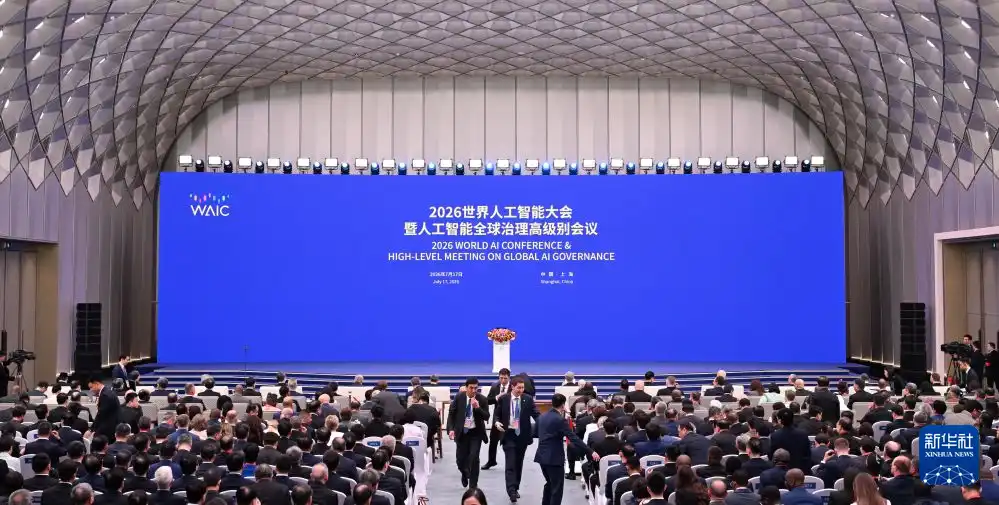
The 2026 World Artificial Intelligence Conference and Global AI Governance High-Level Meeting (WAIC) was held in Shanghai from July 17 to 20, and officially opened today. President Xi Jinping attended the conference's opening ceremony and delivered a keynote speech.
This is the first time in the history of the World Artificial Intelligence Conference that the President of a country has attended and delivered a keynote speech, fully demonstrating the conference's caliber and influence. It also signals that artificial intelligence, as the core driving force of a new round of technological revolution and industrial transformation, has been elevated to a national strategic height.
July 18
WAIC 2026 Roundtable: Leap and Shanghai AI Research Institute to Co-build Institute for Intelligent Entity
On July 18, Leap and the Shanghai AI Research Institute announced a formal collaboration to jointly establish the Institute for Intelligent Entity. The two parties will conduct joint research in areas such as intelligent entity networks and economic principles, AI Safety, exploring the foundational theory, core technology, standard system, and industrial paradigm of the Agent era.
The two sides jointly proposed the "Five Global New Propositions of the Intelligent Entity Era," addressing fundamental issues that human society must collectively face as intelligent entities massively enter the real world from the dimensions of action rights, responsibility order, safety paradigm, economic foundation, and human-AI symbiosis.
In the face of the Agent era, Leap officially launched the StepStar top talent program to recruit outstanding talents in the intelligent entity field globally. This program aims to gather innovative forces with a long-term vision and original spirit, support researchers in long-term exploration of cutting-edge issues in the intelligent entity field, and translate more original ideas into key technologies and real-world applications.
July 17
MiniMax Showcases Whole Modality Models and Products including M3, H3 at WAIC2026
On July 17, during the 2026 World Artificial Intelligence Conference (WAIC2026), MiniMax focused on showcasing the flagship model MiniMaxM3, as well as multi-modal models and AI-native products, with the next-generation multi-modal generation model H3 taking the lead at WAIC. Through ecosystem collaboration examples such as robotic dogs, AI glasses, smart headphones, NAS, financial services, and audiovisual content, MiniMax demonstrated the development and practical applications of AI from underlying models, intelligent entity products to specific applications.
This demonstration covered model capabilities, academic research, product tools, multi-modal creation, and industry applications among other aspects. Audiences could learn about M3's capabilities in long-context, coding, and agentic tasks, experience the use of multi-modal models in creative workflows, smart hardware, and industry services, and understand MiniMax's progress in open-source ecosystems, industry collaborations, and globalization.
WAIC 2026 Roundtable: Universal Embodied Intelligence Must Break Through Specialized Scenarios, Future Competitive Focus Shifts to High-Quality Data Acquisition and Scenario Closed-Loop Validation
Fudan University Vice President Jiang Yugang, Wisdom Element Robotics Partner Yao Maoqing, AtosAI CEO Chen Yilun, and Illumigen CEO Jiang Xu engaged in a roundtable discussion at the 2026 World Artificial Intelligence Conference focusing on the world model. The panelists unanimously agreed that the core of the world model lies in understanding the laws of the physical world and predicting the next state or action, rather than just rendering images. It requires native integration of multi-modal fusion, physical laws, causal reasoning, and long-range prediction capabilities. The current major bottleneck lies in data—Chen Yilun pointed out that video data lacks key modalities such as force and touch. Ideal training data should meet three criteria: complete modalities, high-frequency interaction, and real-world origin, with embodied intelligence requiring either high operational complexity or tens of millions of hours of real interaction data. Yao Maoqing analogized to the hundred billion hours of speech training for large language models, estimating that the physical world may require "over one hundred million hours" of real data to grasp common-sense physical predictions. At the architectural level, Jiang Xu pointed out that the current mainstream architecture conflates state prediction with action prediction, leading to a conflict between generation and understanding capabilities, making simultaneous optimization difficult.
In terms of implementation pathways, all three guests view the manufacturing industry as the most certain large-scale scenario in the next three years:
Yao Maoqing revealed that Wisdom Element Robotics has achieved a robot formation operation on the production line for six days, handling sixty thousand tasks with a 99.99% success rate;
Chen Yilun is betting on the manufacturing industry, citing reasons such as high data concentration, clearly defined task completion standards, and the existence of a large amount of human demonstration data. AtosAI has collaborated with automakers to advance the deployment of a thousand-unit industrial embodied robot cluster, emphasizing that China's manufacturing industry is the most concentrated globally and an ideal testing ground for physical AI;
Jiang Xu believes that embodied intelligence is an extension of multi-modal large models. With a hundred billion hours of video data suitable for pre-training on the internet, a leap in capabilities will first occur in daily scenarios such as homes and offices. However, commercialization needs to meet high fault tolerance conditions, and finding scenarios for large models is no easier than training models.
The consensus among the three is that the road to universal embodied intelligence is still far away, and breaking through specialized scenarios is a necessary stage. The future focus of competition will shift from model architecture to the capability of acquiring high-quality data and closed-loop scenario validation.
WAIC 2026 Roundtable: Decisions Involving Life and Death Must Never Be Entrusted to AI, Humans Can Authorize Actions but Not Responsibilities
Xue Lan, Dean of the Tsinghua University Institute for Artificial Intelligence Governance, Nicholas B. Dirks, President and CEO of the New York Academy of Sciences, and Mark Nitzberg, Executive Director of the Human-Compatible Artificial Intelligence Center at the UC Berkeley AI Research Lab, engaged in a roundtable discussion at the 2026 World Artificial Intelligence Conference focusing on AI agent governance. The guests pointed out that AI is transitioning from "assisted judgment" to "autonomous action," becoming an intelligent agent that acts in lieu of humans. This represents a new manifestation of the traditional principal-agent problem in the digital age. Unlike human agents, AI faces misalignment of goals and, as a black box, cannot bear legal responsibility. Accountability must shift to the entire execution chain, including developers, deployers, regulators, and others.
The guests reached a high consensus: decisions involving life-and-death consequences, scenarios where mistakes are irreversible, and all ethical and value-based issues should never be entrusted to AI. Humans can authorize AI to act, but cannot authorize AI to be responsible. Each authorization should be revocable, each action should be traceable, and the speed of transferring agency should never exceed the speed at which humans verify AI capabilities.
On the security mechanism front, the guests proposed that building trustworthy AI requires three key engineering features: a solid foundation, operational transparency, and controllability during use. At the institutional level, a globally unified AI security assessment standard, a mutually recognized testing system, and an incident data sharing mechanism need to be established. The boundaries of AI governance are not the end of technology, but the starting point for humans to reevaluate their own values, responsibilities, and the direction of civilization.
Alibaba Cloud Founder: AI will become a foundational scientific research tool, and the next key competition lies in the integration of multimodal scientific data
Academician of the Chinese Academy of Engineering and founder of Alibaba Cloud, Wang Jian, stated at the 2026 World Artificial Intelligence Conference that the term "artificial intelligence" still lacks consensus to this day, and AI is once again at a critical juncture. Scientific data will redefine the essence of artificial intelligence. Wang suggested that scientific data should become the "indigenous people" of foundational models, rather than relying solely on scientific papers. He criticized the current AI application in research for overly focusing on paper texts and code, far from touching the essence of scientific data itself. He proposed that the foundational scientific model is not a vertical domain model but a general-purpose technology architecture that integrates text, code, and scientific data. The core task is to tokenize scientific data and embed it in the same model space as text and code.
In conclusion, Wang summarized that AI is at a turning point—it is no longer a standalone technical field but is becoming a fundamental tool for scientific research, akin to mathematics. He predicted that in the next fifty years, AI's role in science will be equivalent to the role mathematics played in the past few hundred years, and the key to the next phase of AI competition lies in the ability to integrate multimodal scientific data.
SenseTime CEO: AI products should shift from substitution to enhancement, and from Token pricing to Task pricing
Xu Li, Chairman and CEO of SenseTime, delivered a keynote speech at the 2026 World Artificial Intelligence Conference, elaborating on the dual proposition of AI universality and security. Several AI applications that have been market-validated—software development, content generation, and embodied intelligence—are undergoing a common evolutionary trajectory: moving from single-module tools aimed at professionals to long-task closed loops aimed at the general public. The most significant change in this process is the migration of users—the original target customers are no longer important, and the real customers are emerging naturally from the demand side. Xu emphasized that true AI universality does not replace humans but amplifies the boundary of abilities that each person originally lacked.
Xu Li proposed that in the security governance dimension, AI security needs to run through three levels: product concept, model path, and physical boundary: the product should not be a substitute but an enhancement, not a dependency but a personal growth enabler; the model needs to ensure data security in both the pre-training and post-training stages and implement multi-model cross-validation during use; and embodied intelligence needs to gradually advance deployment through sandboxing and scenario constraints.
Xu Li also suggested that as AI's capabilities advance to the level of super individuals, the true future unit of account will no longer be Token but the price of completing tasks—Task economics will drive AI from computing power consumption to value delivery, and the continuing cost reduction will further lower the entry barrier. Xu Li cited data from the World Economic Forum, stating that by 2030, AI may reduce 90 million jobs but create 170 million new occupations; super individuals will become the core of the new form of employment.
General embodied intelligence needs to first break through specific scenarios, and the future competitive focus will shift to high-quality data acquisition and closed-loop scenario validation
Fudan University's Vice President Jiang Yugang, Zhiyuan Robotics Partner Yao Maoqing, Iteshi CEO Chen Yilun, and Bright Source Innovation CEO Jiang Xu held a roundtable discussion at the 2026 World Artificial Intelligence Conference to discuss the World Model. The guests unanimously agreed that the core of the World Model lies in understanding the laws of the physical world's operation and predicting the next state or action, rather than just rendering images. They need to have innate abilities for multi-modal fusion, physical laws, causal inference, and long-term prediction. The current biggest bottleneck is data—Chen Yilun pointed out that video data lacks key modalities such as force and touch. Ideally, training data should meet three conditions: complete modalities, high-frequency interactions, and real-world scenes. Embodied intelligence requires complex operations or millions of hours of real interaction data; Yao Maoqing analogized the hundred billion hours of language model voice training and estimated that the physical world might need "over one hundred million hours" of real data to master common-sense physical prediction. At the architectural level, Jiang Xu pointed out that the current mainstream architecture conflates state prediction with action prediction, leading to a conflict between generative and understanding abilities, making it difficult to optimize both simultaneously.
In terms of implementation paths, the three guests all see the manufacturing industry as the most certain large-scale scenario in the next three years:
Yao Maoqing revealed that Zhiyuan Robotics has achieved robot fleet operations on the production line for six days with sixty thousand operations and a 99.99% success rate;
Chen Yilun is betting on the manufacturing industry for reasons such as high data density, clearly defined task completion standards, and a large amount of human demonstration data. Iteshi Zhihang has cooperated with automakers to promote the deployment of a thousand-unit-level industrial embodied robot cluster, emphasizing that China's manufacturing industry is the most concentrated globally and is an ideal testbed for physical AI;
Jiang Xu believes that embodied intelligence is an extension of multi-modal large models; the internet already has 10 billion hours of video data suitable for pre-training. The leap in capabilities will first appear in daily scenarios such as homes and offices, but commercialization needs to meet high fault tolerance conditions. Finding scenarios for large models is not easier than training models.
Tripartite consensus holds that we are still far from universal embodied intelligence, and breaking through in specific scenarios is a necessary stage. The future competitive focus will shift from model architecture to high-quality data acquisition and closed-loop scenario validation capabilities.
British Silicon Intelligence CEO: AI Overlaying Chinese R&D Architecture Can Reduce Drug Development from 4-5 Years to 9-12 Months
Alex Zavalonkov, Founder and CEO of British Silicon Intelligence, delivered a keynote speech at the 2026 World Artificial Intelligence Conference, systematically elaborating on the transformative role of AI in drug discovery. Traditional drug development, from target identification to candidate compounds, usually takes 4 to 5 years. Relying solely on China's local R&D architecture and talent accumulation can be about 2 years faster than the global average. With the additional AI capability, this period can be further compressed to 9 to 12 months—an "AI plus Chinese-style architecture miracle."
Alex recalled that his team's 2019 paper published in Nature first demonstrated that reinforcement learning and AI can generate new molecules and successfully validate them in the laboratory within 46 days. The subsequent popularization of generative AI has fundamentally changed the research and development process. Open models like DeepSeek have also enabled scientists worldwide to use AI in public health and drug discovery.
Alex disclosed that the company has had drugs enter Phase III clinical trials in China, covering targeted therapies for complex diseases and candidate drugs targeting both disease and aging. The research results have been published in multiple Nature series papers. He specifically mentioned the establishment of a robot-driven drug development factory in Jinqiao, Pudong, Shanghai, China, which was built from concept to facility within 18 months, setting several records. Currently, this "superintelligent medicine" capability is being shared with other pharmaceutical companies to help them improve quality and efficiency in over 1,200 tasks required for new drug development.
In his concluding remarks, Alex called for the establishment of an academic community to allow AI to benefit the world with an open attitude, especially in public health and extending human healthspan.
Xi Jinping Attends WAIC for the First Time: AI Development Should Not Be a Solo Performance by Any Country
On July 17, President Xi Jinping attended the opening ceremony of the 2026 World Artificial Intelligence Conference and the High-Level Meeting on Global Governance of Artificial Intelligence, where he mentioned that the Chinese often say, "A single string does not make a harmony, and a single tree does not make a forest." The development of artificial intelligence should not be a solo performance by any one country but should be a global symphony of cooperation, encouraging openness, collaboration, and sharing so that AI can be used across all industries.
He also called for ensuring that AI always remains under human control. Countries should establish legal frameworks, technical monitoring, risk warnings, and emergency response systems to prevent the misuse of AI.
Xi Jinping also opposes the generalization of the national security concept and prioritizing one's own national security above that of other countries. AI should not undermine the cultural characteristics of any country or the diversity of world civilizations.
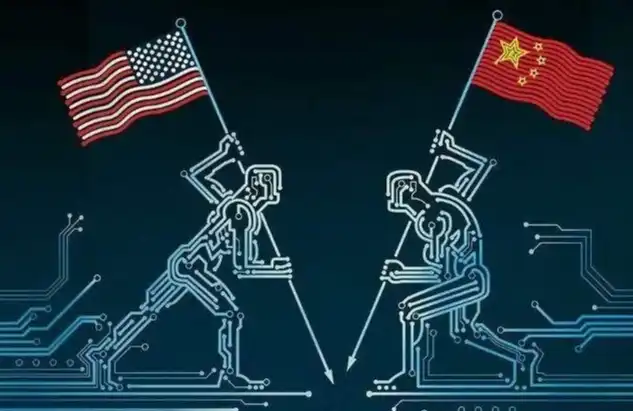
China will cooperate with countries in Asia, Africa, Latin America, and the BRICS countries to assist developing countries in building their AI capabilities, thereby avoiding the creation of new global inequalities by AI. The AI competition between China and the U.S. is expanding from chips and models to open-source pathways and global rules.
Xi Jinping Announces Major Initiative for China's Support of Global AI Development
On July 17, Chinese President Xi Jinping attended the opening ceremony of the 2026 World Artificial Intelligence Conference and the High-Level Meeting on Global AI Governance at the Shanghai World Expo Center and delivered a keynote speech.
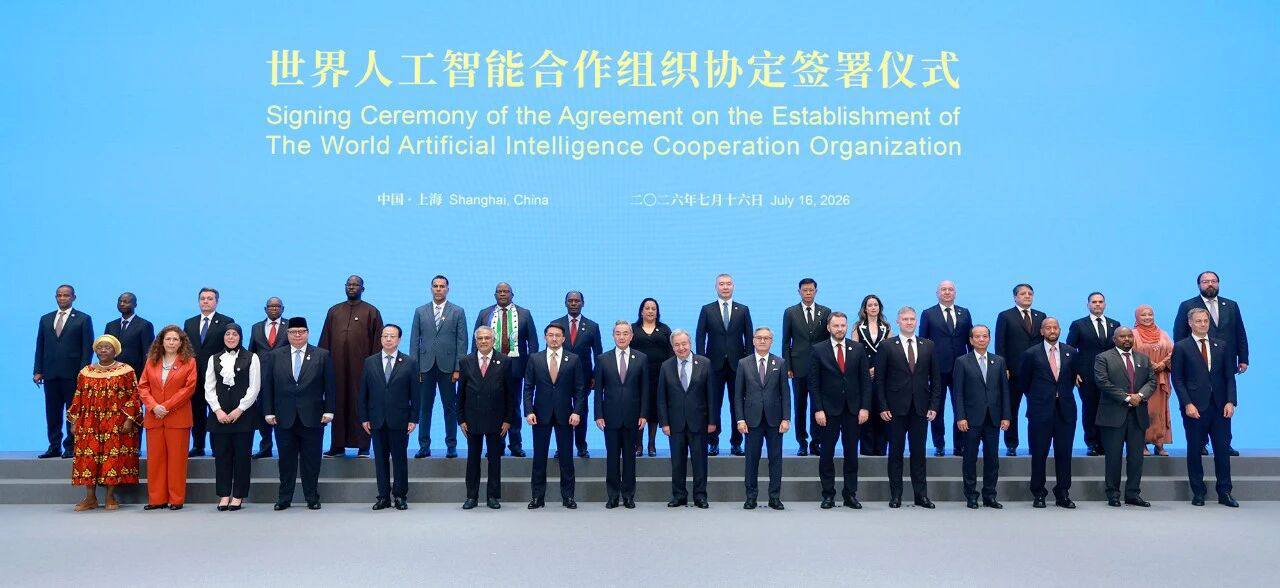
Xi Jinping pointed out that with the joint efforts of all parties, the World Artificial Intelligence Cooperation Organization was born in Shanghai. This is a significant move by China in response to the global South's call and to unite the international community to actively promote the development and governance of artificial intelligence. It will be an important milestone in the history of AI development.
Xi Jinping announced that to further support global AI development and promote the building of global AI capabilities, China will provide 5,000 AI training slots for developing countries over the next five years; establish International AI Application Cooperation Centers for ASEAN, the Arab League, the African Union, CELAC, the SCO, and the BRICS countries; and promote the meteorological intelligent warning system "Ma Zu" to be implemented in 30 countries, ensuring the safety and peace of millions of households.
China Leads Formation of Global AI Organization with 29 Countries Joining, Headquarters in Shanghai
On July 17, 29 countries signed an agreement to establish the World Artificial Intelligence Cooperation Organization. This is a government-to-government international organization headquartered in Shanghai.
Founding members include China, Russia, Brazil, Cuba, Serbia, and other countries, with 10 African countries and 12 Asian countries among them.
The organization will promote international AI cooperation, capacity building, and global governance. China proposed the establishment of this organization last year and has now received formal support from the first batch of members.
China hopes to help lower the AI adoption threshold for global South countries through open-source models and technological training. The China-U.S. AI competition has further extended from enterprises and products to international organizations and rule-making.
Welcome to join the official BlockBeats community:
Telegram Subscription Group: https://t.me/theblockbeats
Telegram Discussion Group: https://t.me/BlockBeats_App
Official Twitter Account: https://twitter.com/BlockBeatsAsia

 Related Articles