



Justin Sun's Favored Nuclear Energy Track Quietly Starts IPO Wave

For a period last year, there were rumors in the market that Justin Sun had bought a hydropower plant in Norway.
To understand his rationale, I dug through his previous YouTube videos and found a quote where he said, "If you missed out on Nvidia, you can keep looking down the road, such as electricity, such as nuclear fusion." He later made it more explicit, stating that the ultimate goal of AI is energy, and fusion is a direction worth focusing on in the AI era.
At that time, the term "fusion" was too distant, and the AI market was far from as hot as it is now, so the market didn't seem to care.
On July 14, Asia's richest man, Masayoshi Son, talked about AI without initially mentioning chips. Instead, he talked about fusion.
The SoftBank founder said that within fifteen years, fusion has the opportunity to power AI data centers, gradually replacing natural gas. As usual, he wasn't too concerned about the "AI bubble" and even advised Japan not to sit on the sidelines of this wave.
Two people, from completely different businesses and contexts, are looking at the same machine that ordinary people find hard to reach.
Data centers face power shortages.
While fusion has yet to generate power, General Fusion has already surged
On July 13, Canadian fusion company General Fusion went public on the Nasdaq through a SPAC merger, with the stock ticker GFUZ. It became the world's first publicly traded pure fusion energy company.
On its first day of trading, the stock price surged, closing up about 38%.
General Fusion has approximately $150 million in cash on hand, and the company expects this money to support its operations until 2028. They aim to build the first commercial fusion reactor around 2035.
In other words, what was traded in the market that day was not a power-generating plant already in operation.
It was a ticket for nine years later.
The fusion business has a cruel aspect. The progress of scientific experiments can be measured by a few seconds of plasma stability, a material test, or a device parameter; however, the capital markets do not have this kind of patience. They always have to ask: when can electricity be sold, who will buy it, and can the numbers add up.
In the past, fusion companies' answers were usually grand.
Clean energy. Artificial sun. Infinite fuel. Humanity's ultimate energy source.
These words are all correct, just too far from the balance sheet.
Now someone has replaced them with a more colloquial phrase.
An AI company is getting electricity.
As a result, a company planning to build a commercial reactor in 2035 suddenly has a visible future customer image. Not some vague public utility company, but rows of AI data centers that have already burned money to build and are waiting to be powered up.
The attitude towards money changed quickly.
According to the latest statistics from the Fusion Industry Association, the global fusion industry received a record $4.48 billion in new investments over the past year. This number is based on the industry's own criteria and cannot be taken as evidence that fusion has already won.
But it at least illustrates one thing.
There are suddenly many more people willing to pay a deposit for "distant electricity."
By the time X-energy went public, the market had already changed its algorithm
General Fusion is just the most distant ticket.
A closer ticket is X-energy.
This advanced nuclear energy company attempted to go public through a SPAC in 2023, but it didn't work out. At that time, when everyone looked at it, their gaze was a lot like looking at someone who claims they are going to build a rocket. The project is huge, the timeline is long, and the financial statements are right there on the table, and no one can ignore them.
Three years later, X-energy went for an IPO instead.
In April of this year, the company raised about $10.2 billion, with a market cap of around $91 billion, and its first-day trading closed up approximately 27%. Its estimated revenue for 2025 is around $1.09 billion, with a net loss of about $3.9 billion.
Looking at these numbers alone, they are not very promising.
But then there's Amazon.
The collaboration between Amazon and X-energy aims to deploy up to 5GW of small modular reactor capacity by 2039.
It's not just Amazon; Google has also partnered with Kairos Power to secure a place in advance for nuclear power.
These collaborations are still a long way from actual power plants. Approvals could be delayed, projects could change, and options do not equal revenue. Those who treat them directly as future revenue are the ones who are most likely to mistake a booking for an invoice.
But in the capital markets, a booked order has its own value.
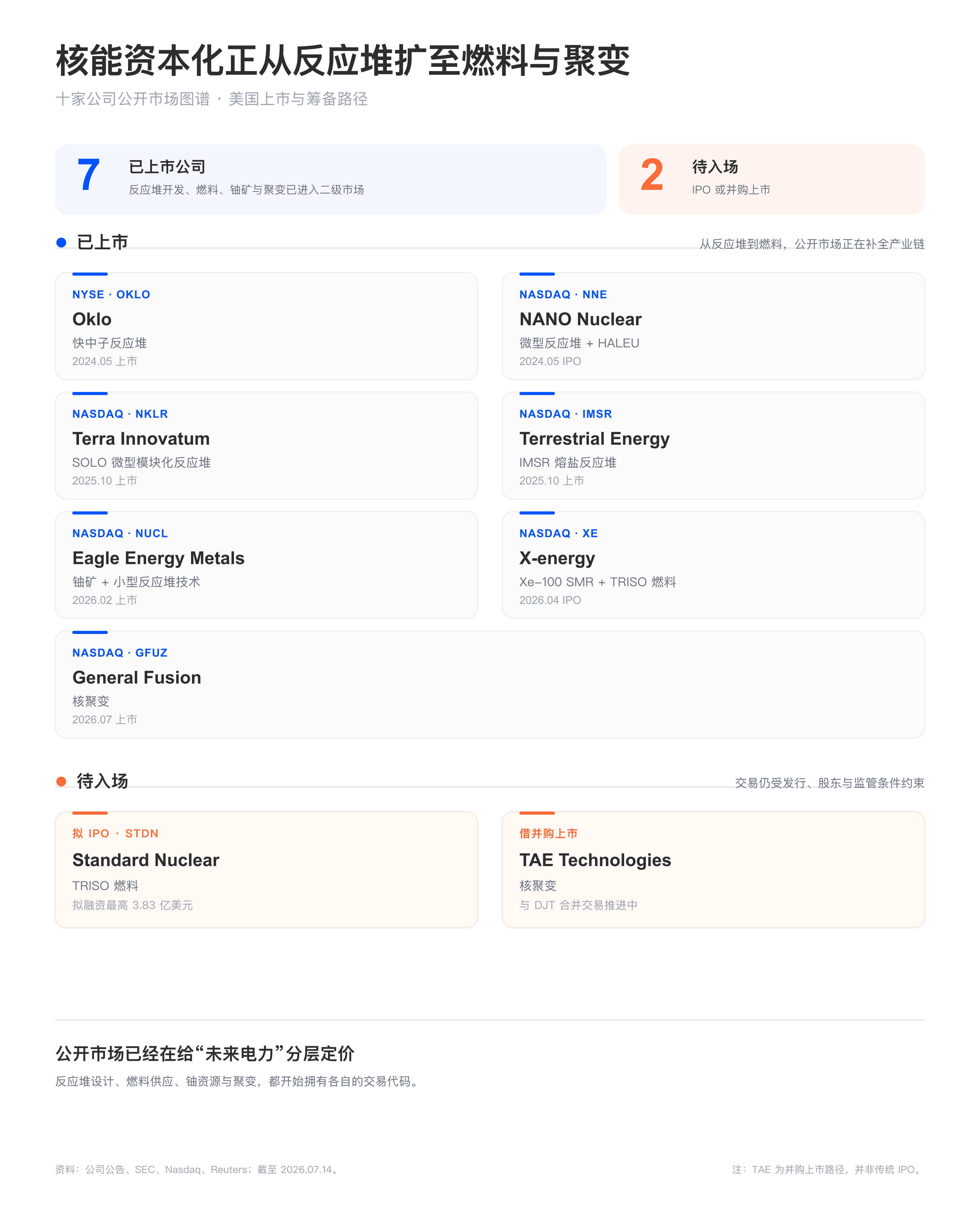
Zoom out on the timeline, and you'll see that in the nuclear energy track, companies have already gone public in bulk.
Oklo, TerraPower, Terrestrial Energy, and X-energy have taken reactor developers to the stock exchange; Eagle Energy Metals has capitalized on uranium mining and small modular reactor technology; Standard Nuclear has led the market all the way to TRISO fuel. General Fusion and TAE have also brought the farthest fusion story to the public market doorstep.
In the past, nuclear energy companies sold low-carbon, stable, and energy security.
Today, they are starting to sell something else.
The qualification for mining power expansion.
Secure the Electricity First, then Keep Stuffing Chips into the Data Center
Why would a data center push forward such a slow technology?
Because no matter how expensive the chips are, you can still place an order.
Not so with electricity.
Servers can be procured in advance, delivered to the site, and placed in the warehouse. If there's a shortage of GPUs, NVIDIA can ramp up production, AMD can follow suit, and customers can upgrade. But electricity doesn't work that way. First, there must be power generation, then transmission, followed by substations, local governments, regulatory bodies, utility companies, and communities all nodding in agreement bit by bit.
What AI companies fear most is not expensive electricity.
They fear that when the data center is ready, the power won't be connected.
A large data center complex operates around the clock, with machines generating heat and the cooling systems also generating heat. When training models, thousands of chips work simultaneously. You can't tell a customer, "The wind is weak today, so your model will have to wait until tomorrow to answer questions."
Wind and solar power are important, but they are weather-dependent. Natural gas plants are flexible but come with old issues of fuel, emissions, and supply. Large traditional nuclear power plants are stable but their construction schedules are long enough to test the patience of internet companies.
SMRs, or small modular reactors, fall right in the middle.
They promise to shrink nuclear power plants a little, make them more standardized, deploy a portion first, and then slowly expand. This promise has not yet been tested on a large-scale commercial basis but aligns well with the temperament of data centers.
They are not willing to wait for a giant power plant to be built.
They are willing to take a ticket first.
The long-term procurement agreements signed by tech giants like Amazon and Google are essentially about queuing up for future power capacity. They are buying not just a certain amount of electricity, but also reserving a slot for their future expansion.
What this brings to nuclear companies is much more effective than a technical whitepaper.
Data Centers Chase the Issue All the Way to Mines
When the need for electricity was first brought to the table, what the capital saw first was a reactor.
As a result, companies like Oklo, X-energy, Terrestrial Energy, and Terra Innovatum were pushed to the forefront. They all sell next-generation reactors that are still in development. Some are developing fast neutron reactors, some are working on molten salt reactors, and some are focusing on SMRs.
SMR stands for Small Modular Reactor. It involves breaking down the large nuclear power plants that could only be built on a city scale in the past, trying to make the equipment replicable and deployable in batches. Data centers like this concept because they also don't want to wait for a giant power plant to slowly come online.
But once a reactor is actually included in a project pipeline, the issue will delve deeper.
What does this machine eat?
X-energy's Xe-100 requires TRISO fuel. TRISO may sound like some kind of laboratory abbreviation, but it can actually be understood as a tiny nuclear fuel particle encased in several layers of ceramic materials. It needs to withstand high temperatures and stay in the reactor for a long time. No matter how beautifully designed the reactor is, without this type of fuel, it can only exist on a computer screen. This is what Standard Nuclear is up to.
So, Standard Nuclear is preparing for an IPO, no longer just a story of a fuel company.
What it sells is very unassuming. There are no flashy reactor launch events, no massive orders from data centers, and no 15-year visions like Masayoshi Son's. But as the market begins to believe in the development of advanced reactors, everyone will eventually ask, who can deliver the fuel on time.
Going further back, the fuel itself will also be a bottleneck.
Some advanced reactors require HALEU, which stands for High-Assay Low-Enriched Uranium. Its enrichment level is higher than that of traditional nuclear plant fuel but far below weapons-grade materials. The name is long, but the logic is not complicated. It's like a new machine that needs a different grade of oil that is not in the old oil tank, and there are not many factories producing this kind of oil.
Companies like Centrus are therefore being reconsidered.
The issue is far from over.
Where does HALEU come from? Where does the uranium come from? Thus, companies like Eagle Energy Metals, which hold both uranium mining assets and small reactor technology, can also enter the public market along the same line. The mine that was originally farthest from AI was illuminated all the way by the electricity concerns of data centers.
This wave of IPOs is not a sudden infatuation of the nuclear industry with Wall Street.
It is more like a data center laying out a power order on the table, then tracing back along this order. First, find out who can build a reactor. After building it, find out who has the fuel. If there is not enough fuel, then find out who can enrich uranium, who has the mines.
With each step upstream, you will hit a point that cannot be solved with overtime work.
Approvals can be expedited. Models can be iterated. Servers can be purchased additionally. But the fuel production line and uranium mines do not follow these rules.
So, the current market is no longer just asking which company has an appealing reactor design. They are starting to ask which link will delay this reactor from generating electricity for another year.
After 1973, Oil Was No Longer Just Oil
Before the 1973 oil crisis, oil was already crucial.
Cars relied on it, factories relied on it, airplanes relied on it. What really made governments around the world suddenly anxious was not the discovery that oil could burn that year, but rather the realization that they had almost no control over a long and intricate supply chain.
The wells were far away. The tankers were at sea. Pipelines crossed borders. Prices were set by others.
Since then, oil has not just been a commodity. It has become intertwined with diplomacy, reserves, wars, and industrial policy.
AI is now leading electricity down a similar path.
Electricity was originally too common. Plug it in, the light comes on, the computer runs. Because it was so common, people rarely thought seriously about where it came from.
It wasn't until a group of companies began planning to increase computing power tenfold, a hundredfold.
That was when they realized that electricity also has a geographic location, a queue order, and a construction period. It's not just a socket on the wall; it's a path that needs to be reserved years in advance.
Masayoshi Son says fifteen years, Justin Sun says fusion is the next stop, General Fusion soared on its IPO day, X-energy presented both losses and a high valuation to the market simultaneously.
All of these things together do not prove that fusion has arrived.
They simply demonstrate that more and more people are starting to worry about whether, when it really does arrive, they will make the cut.
Welcome to join the official BlockBeats community:
Telegram Subscription Group: https://t.me/theblockbeats
Telegram Discussion Group: https://t.me/BlockBeats_App
Official Twitter Account: https://twitter.com/BlockBeatsAsia



