ADI's Stealthy Victory: From World Cup Entry to Traditional Financial Ecosystem
The Hidden Winner of the World Cup
As one of the most watched sporting events in human history, the World Cup has never been just a game.
It's more like an attention machine that starts right on time. The match, the broadcast, the ads, the social media discussions, the pre-match predictions, and the post-match controversies all get swept into the same narrative stage in a short amount of time. The LED boards on the sidelines may seem like just a background, but they are repeatedly brought in front of a global audience with every attack, replay, and slow-motion footage.
This year, a name that was not commonly mentioned by ordinary users appeared on this advertising space: ADI PredictStreet.

Image Source: ADI PredictStreet's World Cup Sideline Ad
This is a very interesting clue.
Because what appeared here was not Polymarket, which already occupies a prominent space in the prediction market user's mind. As early as April this year, ADI PredictStreet entered into a multi-year partnership with FIFA and became the official prediction market partner of the FIFA World Cup 2026 as a top-tier partner.
Another prediction market star project, Kalshi, later collaborated with ADI PredictStreet on-screen, but Kalshi did not directly secure an official FIFA partnership. According to Bloomberg, for this joint brand collaboration, Kalshi paid ADI $20 million.
This means that ADI is the more discreet winner in the narrative of this World Cup's prediction market.
For no other reason than being the first to stand at the entrance of the world's largest sports event prediction market.
And behind this entrance is linked ADI Chain.
A Chain Starting from the Backstage
Unlike the chains commonly known to the public, ADI Chain has a different focus.
It is not a chain built around a single application, nor is it a trading venue serving only Crypto users. From the beginning, it has targeted governments, banks, financial institutions, and enterprise applications, aiming to accommodate stablecoin settlements, real-world asset tokenization, payment networks, and institutional asset infrastructure.
Over the past few years, the common path for new public chains has often started from within Crypto: first establishing a developer ecosystem, then attracting DeFi, NFT, memes, airdrops, and points, proving their market through TVL, trading volume, and daily active users, and then moving closer to the institutional world.
The pressure on this path is becoming increasingly evident.
The activity of a public chain largely depends on the asset's activity, and a chain's ability to continuously create new assets, narratives, and reasons for transactions is limited. After the meme craze recedes, the trading volume will drop; after the airdrop expectations end, users will leave; even foundational networks like Ethereum have long faced the tug-of-war between application growth and asset activity.
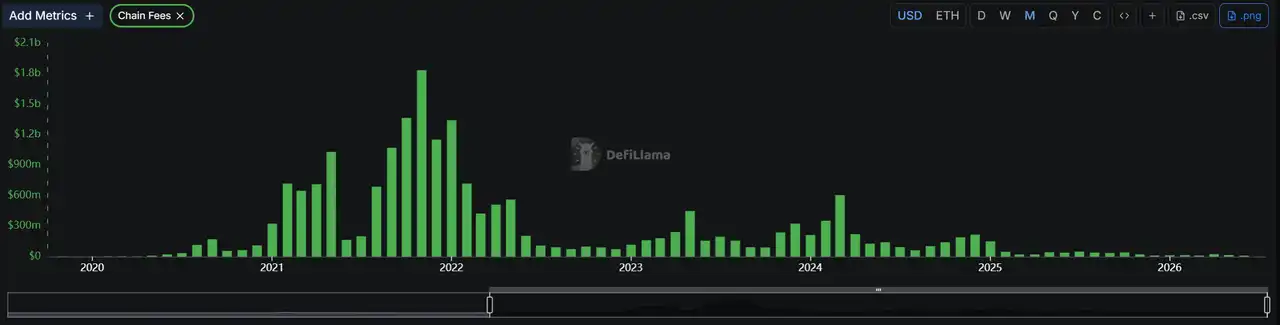
ETH network fees exhibit significant fluctuations with the asset cycle on the chain, data from: DeFiLlama
ADI Chain's path is more like the reverse.
It doesn't first generate a round of asset heat on the chain and then wait for funds and institutions to enter; it attempts to move existing financial activities onto the chain: issuing and settling stablecoins, tokenizing real-world assets, custodying and circulating institutional assets, and moving funds within payment networks.
This path is most clearly seen in stablecoins.
What best exemplifies ADI Chain's path is not USDT or USDC aimed at global crypto user liquidity but rather DDSC, which has more regional and institutional targeting.
DDSC is a stablecoin pegged to the Dirham, linked to FAB, IHC, ADQ, and the UAE Central Bank-authorized framework. It serves not the general transaction scenario but the payment, settlement, and institutional fund flow within the local financial system of the UAE.
A recent high-value public transaction took place in May.
The IHC disclosed in an Abu Dhabi Securities Exchange Platform filing that it conducted a $DDSC-powered transaction on the ADI Chain, amounting to 110 million dirhams, approximately $30 million. The filing stated:
This is one of the largest single stablecoin transactions in the region.
A similar choice was also made with PUSD.
The stablecoin issued by Palm Azgar Finance emphasizes not transaction liquidity, but compliance with Islamic law. Reportedly, PUSD targets the corporate treasury departments, exchanges, and payment processors, with a circulation of approximately $2.3 billion, aiming at a market exceeding $3 trillion in the Islamic finance sector.
At this point, the first-level path of the ADI Chain is clear: to first onboard the settlement needs within the regional financial system.
DDSC corresponds to the circulation of funds of local UAE institutions, while PUSD corresponds to the broader Islamic financial market. They are not addressing the issue of "whether there is a stablecoin on the chain," but rather whether money within the regional finance can enter the chain in a way acceptable to institutions.
This is also a prerequisite for the establishment of subsequent payment networks. Whether it is the Mastercard partnership for Middle East cross-border payments or M-Pesa, covering eight markets in Africa with over 60 million monthly active users, what is truly needed is not another on-chain asset, but an underlying network that can handle settlement and fund movement.
Once money comes in and starts flowing, the next step is assets.
From Regional Settlement to Institutional Assets
However, the ADI Chain's strategy is certainly not limited to the Middle East.
If DDSC and PUSD represent their penetration into the regional financial system, then BlackRock, Franklin Templeton, BNY Mellon, SettleMint, and other international institutions and infrastructure service providers represent another aspect: how global assets enter this on-chain financial network.
This matter cannot bypass custody.
In May, BNY Mellon announced a partnership with Finstreet and ADI Foundation to provide institutional-grade digital asset custody within ADGM and extend it to the ADI Chain. For institutional assets, custody is not a supplementary service but the gateway itself. If assets are not securely held in compliance, there will be no issuance, trading, and settlement afterwards.
After custody, issuance comes next.
The collaboration between ADI Foundation and SettleMint falls on the digital securities side. SettleMint is an institutional tokenization infrastructure service provider, and the collaboration occurs within the ADGM framework. In other words, ADI is not dealing with a packaged RWA product; it is dealing with a digital securities process in a regulated environment.
Further out is asset management.
BlackRock and Franklin Templeton appear here, not just to add two familiar names. If RWA relies solely on on-chain protocols to package assets, it will quickly reach its limits. What truly brings assets in are traditional asset managers, custodians, issuance tools, and settlement networks.
Only when these strings come together does the narrative of ADI Chain's assets make sense.
It does not start with slapping an "RWA" label and then stuffing partners inside. It begins from the most complex point of asset entry into the financial system: where the assets are held, who issues them, who manages them, and where they ultimately flow within the network.
When Real Finance Becomes On-chain Cost
At this point, ADI's resource puzzle has been largely unfolded.
World Cup gateway, regional stablecoin, institutional custody, digital securities infrastructure, and asset management institutions may seem like different businesses, but they all point to the same question in the end: can they be continuously onboarded into the ADI Chain network.
This is the true position of the ADI token.
It is not a token serving a particular application, nor an accessory to a specific type of asset. The value of the ADI token depends on whether the ADI Chain can organize these entry points, funds, and assets into a sustainable ecosystem.
If these partnerships are just independent advancements, the ADI token will only receive associated narratives; only when they truly transact, settle, and transfer assets on the same chain does the ADI token undertake the fundamental fuel circulating repeatedly in the ADI ecosystem.
This is also what sets ADI Chain apart from many public blockchains.
It does not first generate a round of asset hype on the chain and then wait for external funds to enter; it seeks to first connect the funds, assets, and transaction processes already present in real-world finance to the chain, and then use this activity to support the use cases of the ADI token.
The World Cup only brought ADI to the forefront.
What truly determines the value of the ADI token is whether these entry points, once seen, can continue to bring funds, assets, and transactions back to the ADI Chain.
This article is contributed content and does not represent the views of BlockBeats
Welcome to join the official BlockBeats community:
Telegram Subscription Group: https://t.me/theblockbeats
Telegram Discussion Group: https://t.me/BlockBeats_App
Official Twitter Account: https://twitter.com/BlockBeatsAsia
 Related Articles