Bottom Bounce Up 3X, How Did Lighter Take Off?

Original Title: "Triple Bottom Rebound, Why Did Lighter Take Off?"
The decentralized Perp DEX project Lighter (LIT) has recently shown a very strong price performance.
According to OKX data, as of 14:30 today, LIT is currently trading at 2.65 USDT, with a 24-hour gain of 19.4%. Calculated from the historical low of 0.78 USDT in early April, LIT has experienced a strong rebound of over 3x in the past three months.
Considering Lighter's recent developments in regulation, product, and tokenomics, LIT's strong price performance can be attributed to the simultaneous resonance of multiple fundamental narratives.
Compliance Progress: Narrative Advantage of "Domestic" Trading Platform
The first theme of Lighter's current strength is the rapid clarification of its compliance path.
This point is particularly evident in the comparison between Lighter and its main competitor, Hyperliquid (HYPE). While the latter has long held the leading position in the on-chain Perp DEX track, its offshore nature has always been seen as a potential compliance risk, especially against the backdrop of the gradually tightening U.S. regulatory framework, implying ongoing policy uncertainties.
In contrast, Lighter's positioning leans more toward being "a trading infrastructure inherent in the U.S. regulatory system." As a U.S.-based project, Lighter is actively embedding itself in the regulatory system to obtain a new form of "compliance premium."
During the Q1 investor conference call in early April, Lighter's founder and CEO, Vladimir Novakovski, explicitly stated that the company has initiated the process of applying for a blockchain-based derivatives trading license in the United States. Vladimir remarked, "It is unrealistic to serve institutions like Citadel without a license."
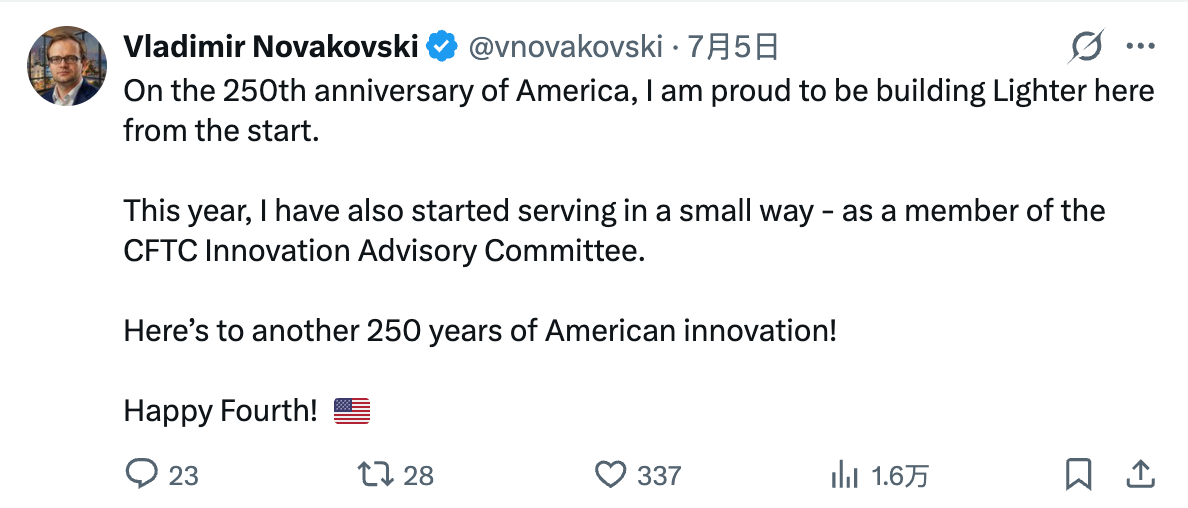
Yesterday, Novakovski once again stated on Platform X that he has now become a member of the Commodity Futures Trading Commission (CFTC) Innovation Advisory Committee. The significance of this in the market context far exceeds his formal title. The CFTC's Innovation Advisory Committee essentially serves as an "institutional buffer" between regulators and market participants, responsible for providing policy advice to the CFTC on the intersections of technology, law, and finance. In the current regulatory trend, Vladimir's new role signifies that Lighter is not just "adapting to regulation," but is participating in the early stages of rule-making.
In addition, there is another piece of information worth noting. The new Federal Reserve Chairman, Wash, disclosed in his pre-appointment financial disclosure that he holds a certain amount of LIT. Although this does not imply that Wash will use his authority for any purpose, this "potential policy network connection" will still strengthen the market's pricing imagination of Lighter's regulatory resource advantage.
New Channel Establishment: Deep Integration with Robinhood
In addition to regulatory progress, the second key variable driving Lighter's current surge is the opening up of new distribution channels, especially through deep integration with Robinhood.
Last week, Robinhood and Lighter jointly announced that the Robinhood Wallet now supports a native Perp trading gateway powered by Lighter, allowing users to directly trade perpetual contracts and tokenized stock assets within the wallet, using USDG as the pricing asset.
As an investor in Lighter, the market had previously anticipated potential cooperation between Robinhood and Lighter. However, some users were concerned that Robinhood might choose to build its own Perp product, thus competing with Lighter. The latest announcement indicates that Robinhood has ultimately chosen to integrate perpetual contract trading capabilities through Lighter.
For Lighter, this signifies a qualitative shift in its role — it is no longer just an independent DEX, but will gradually become the default execution layer and liquidity engine within the Robinhood Wallet ecosystem, allowing Robinhood's vast user base to access its services more conveniently.
Renowned trader Ansem, who recently gained attention due to the surge in his Meme token, also gave a highly positive assessment of this move: "The cooperation between Lighter and Robinhood seems to be aiming for something big."

Tokenomics Restructuring: Buyback and Token Burn
Another major strategic move by Lighter recently was the announcement on July 1st to update its tokenomics, further solidifying LIT as a "cash-flow-driven asset" in terms of pricing logic.
In this update, Lighter explicitly announced that all protocol revenue would be used for LIT buybacks, upgrading the buyback mechanism from "programmatic buyback" to "permanent burn." At the time, Lighter had already repurchased approximately 15.5 million LIT, accounting for about 6.26% of the circulating supply, and would conduct the first on-chain burn after the end of Q2.
Meanwhile, the staking mechanism for LIT has been redesigned. After subsidizing early revenue through the TGE, the team announced a gradual introduction of ecosystem tokens for staking rewards, targeting an annualized return of around 6%. With the current staked amount of about 125 million LIT, this corresponds to approximately 7.5 million tokens distributed annually.
Within this framework, the LIT economic model is beginning to take on a relatively clear structure: On one end, there is a sustainable protocol revenue ➡️ Full buyback and burn ➡️ Reduction of circulating supply; on the other end, there are staking rewards for long-term holders ➡️ Targeted distribution in the form of ecosystem tokens.
Tracking the Perp DEX race, data analyst ajey.lit posted a comparison of LIT's and HYPE's buyback data, with quite surprising results. In contrast to HYPE, which has always emphasized revenue and buybacks, LIT's buyback intensity is relatively stronger—currently, Lighter has repurchased tokens equivalent to about 6.26% of the circulating supply, significantly higher than Hyperliquid (HYPE) at about 3.34%; when comparing the buyback amount to market cap, Lighter's buyback ratio is about 4%, also higher than the latter at about 1.8%.
Chip Structure Transformation: Completion of Turnover, Light Enough to Pull
Looking at compliance, distribution, and the economic model together, it becomes apparent that LIT's rise is not driven by a single catalyst but rather by a typical process of "delayed pricing + collective revaluation."
And all this is predicated on the fact that LIT's bottom chips have completed sufficient cleansing during the previous prolonged decline.
Since the LIT TGE, influenced by the overall downturn in the cryptocurrency market, fierce competition in the Perp DEX race, and the continuous exit of early airdrop users, LIT has formed a typical downward selling pressure structure. Meanwhile, liquidity providers and long-term funds have continuously absorbed supply at low levels, gradually transitioning chips from "loosely distributed" to "concentrated accumulation." This process can be fundamentally understood as a bottom turnover.
As the fundamental factors of Lighter gradually improve, LIT's market structure has also transitioned from being dominated by profit-taking and selling pressure to being driven by incremental capital inflows. Under this new structure, the enhancement of fundamentals is truly starting to be amplified.
Additionally, this structure is further compounded by a concentration of short positions. During a prolonged period of sideways movement and expectations of a downturn, some short positions gradually accumulate. Then, when the price begins to break out of a key range, the market liquidity exhibits a significant asymmetry—there is insufficient selling pressure on the upside, and short covering becomes a source of new buying pressure, thus magnifying price elasticity.
In summary, the uptrend of LIT should not be understood as being driven by a single factor but rather as the combined effect of three levels: first, fundamentals transitioning from uncertainty to validation; second, chip structure shifting from being dominated by selling pressure to turnover completion; and third, shorts and liquidity structure amplifying elasticity in the opposite direction.
LIT did not suddenly become stronger; it is simply in the process of being gradually repriced.
Original Article Link
Welcome to join the official BlockBeats community:
Telegram Subscription Group: https://t.me/theblockbeats
Telegram Discussion Group: https://t.me/BlockBeats_App
Official Twitter Account: https://twitter.com/BlockBeatsAsia