BofA Analysis: Has the Memory Price Hike Cycle Peaked? BofA States Three Major Bearish Factors Have Not Altered the Supply-Demand Dynamics

TL;DR
· Following a collective pullback in semiconductor stocks on July 2nd, the market began to question whether the AI-driven memory price hike cycle was nearing its peak.
· Bank of America believes that Meta's hashpower rental, ChangXin's entry into iPhone, and South Korea's 800 trillion won plan have not altered short-term supply and demand dynamics.
· South Korea's exports, price forecasts, and cloud provider capex remain robust, but the divergence over the fulfillment of AI demand post-2027 persists.
On July 2nd, AI and semiconductor stocks faced a concentrated sell-off, dragging the memory sector down as well. SK Hynix, Samsung, Micron, Kioxia, Western Digital, and other assets experienced significant declines on that day. What triggered market concerns was not a single financial report figure but three simultaneous pieces of bearish news: Meta was reportedly planning to rent out AI hashpower, ChangXin Storage (CXMT) might enter Apple's iPhone supply chain, and South Korea announced an approximately 800 trillion won investment plan in semiconductors and storage. Bank of America's latest memory industry report concludes that while these developments are worth monitoring, they are not yet sufficient to prove a reversal in the AI memory cycle.
The main theme of this memory rally is not the traditional restocking for PCs and smartphones but the continuous push from AI data centers driving demand for high-end memory such as HBM, LPDDR5, and enterprise SSDs. For the market, the core question behind the stock price pullback is straightforward: Is AI demand starting to wane, and could supply suddenly surge? Bank of America's answer leans cautiously optimistic. Short-term prices and export data still support a bullish memory market, but investors are no longer just focused on price increases; they are beginning to question how long the upturn can be sustained.
Meta's Hashpower Rental Does Not Equate to AI Order Reduction
The most immediate market concern comes from Meta. According to Bloomberg Law, Meta is planning a cloud infrastructure business to sell AI hashpower and model access to external clients. Subsequently, media outlets like Tom's Hardware interpreted this as a source of "excess hashpower" concerns. If Meta indeed cuts long-term chip and component orders due to an overabundance of AI servers, demand for HBM, LPDDR5, and enterprise SSDs would all be impacted.
The feedback Bank of America received from the chip supply chain does not support this deduction. The report states that Meta's AI data centers continue to adopt advanced memory more aggressively, and there is no evidence of "order cuts due to server surplus." At least from the current supply chain perspective, Meta appears to be further expanding AI infrastructure rather than prematurely contracting it.
This sensitivity of memory stocks to rumors about a single customer is also why. AI servers consume memory far more than traditional servers, with HBM used for GPU acceleration, LPDDR5 and enterprise SSDs also meeting higher bandwidth, lower power consumption, and greater storage performance requirements. If major cloud providers reduce capital expenditures, prices and order expectations for high-end memory will quickly come under pressure. Conversely, as long as hyperscale cloud providers continue to ramp up, short-term supply-demand tightness will be challenging to alleviate promptly.
ChangXin Enters iPhone, Short-term More Like Apple's Bargaining Chip
The second concern is that ChangXin Storage may enter Apple's iPhone supply chain. If Apple were to widely adopt ChangXin DRAM, the pricing power of Korean and American memory giants in mobile DRAM could be weakened, strengthening expectations for local Chinese alternatives.
However, this impact is still significantly limited in the short term. Public reports mainly cite Bank of America's view that for ChangXin to enter the iPhone supply chain, it would need to overcome U.S. restrictions on semiconductor exports to China, Apple's quality and specification certification, and potential intellectual property litigation risks. The related low-power DRAM also needs to meet requirements such as speed, power consumption, and ECC, while Korean and American giants still face high technological and patent barriers in advanced mobile DRAM.
Even if Apple were to test ChangXin chips in small quantities on low-end iPhone 18e models, the actual order volume may still be limited. Bank of America believes that demand for low-end models in the Chinese market is relatively small, and the potential procurement scale is not significant. The more realistic impact would be for Apple to use this as leverage to strengthen its bargaining power with Korean and American giants for contract prices in the second half of 2026 or 2027, rather than immediately changing the global supply-demand structure of mobile DRAM.
The long-term impact of ChangXin should not be underestimated. China's localization efforts will continue to change the purchasing choices of some customers. However, in the current cycle, it is not yet evidence of a "sudden surge in supply." What the market is truly concerned about is whether ChangXin can stably pass Apple's quality certification, how U.S. restrictions will be enforced, and whether its production capacity can expand from low-end models to higher-spec products.
South Korea's 800 Trillion Won Plan Is Not Additional Supply in the Next Two Years
The third concern comes from the South Korean government's announcement of a large-scale semiconductor and storage investment plan. According to information released by South Korea in late June, the plan is approximately 800 trillion won, equivalent to around $520 billion, involving Samsung, SK Hynix, new wafer fabs, and HBM capacity expansion. Such a number can easily be interpreted by the market as a new round of significant expansion.
However, Bank of America believes this is not a direct supply signal for the current cycle. The report states that the construction of new clusters and related facilities is more aligned with long-term industry planning, with some projects still a long way from substantial production, and will not suddenly release a large amount of additional capacity in the next two to three years.
The memory industry has experienced many instances of "peak capital expenditures corresponding to peak cycles" in the past, so any large-scale fab plans will trigger caution. However, current corporate demand is focused on AI-related products such as HBM, SOCAMM, and enterprise SSDs, where constraints such as advanced processes, packaging, yields, and customer certifications are stronger than in traditional DRAM. Long-term investment plans do not equate to short-term effective supply, especially when high-end memory capacity remains constrained.
Exports and Prices Still Rising, Market Starting to Question Sustainability
Short-term data continues to favor the bullish side. Official data from South Korea shows that semiconductor exports in June were approximately $44.8 billion, a 199.5% year-on-year increase, with total exports reaching around $102.25 billion, a 70.9% year-on-year growth. This data is consistent with the ongoing increase in memory prices.
Price forecasts also remain strong. In its June update, TrendForce raised its forecast for the average selling price of DRAM in Q3 2026 to a quarter-on-quarter growth of 13%-18%, up from the previous forecast of 3%-8%. A report from Bank of America predicts quarter-on-quarter price increases for DRAM in Q2 to Q4 2026 at 53%, 17%, and 7%, respectively, while NAND prices are expected to increase by 65%, 13%, and 1% in the same period. Both sets of forecasts align broadly for Q3 and Q4, with differences mainly in the pace of Q2 and certain NAND price assumptions.
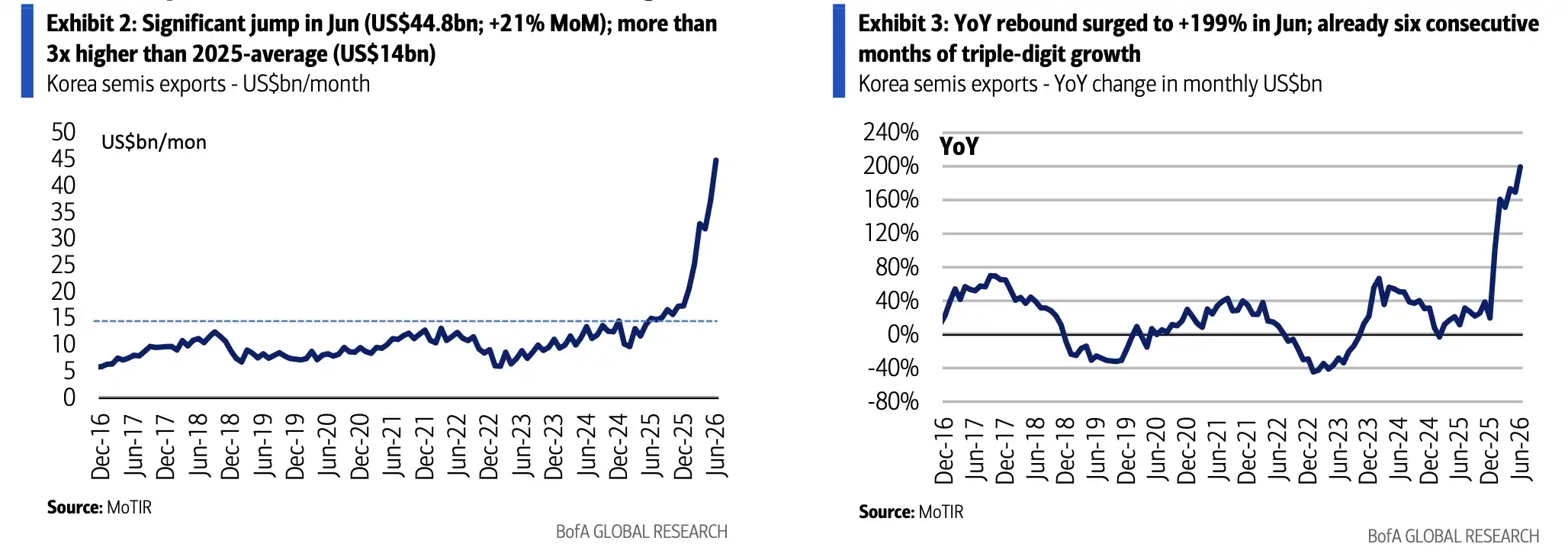
Semiconductor exports in June were approximately $44.8 billion, a 199.5% year-on-year increase.
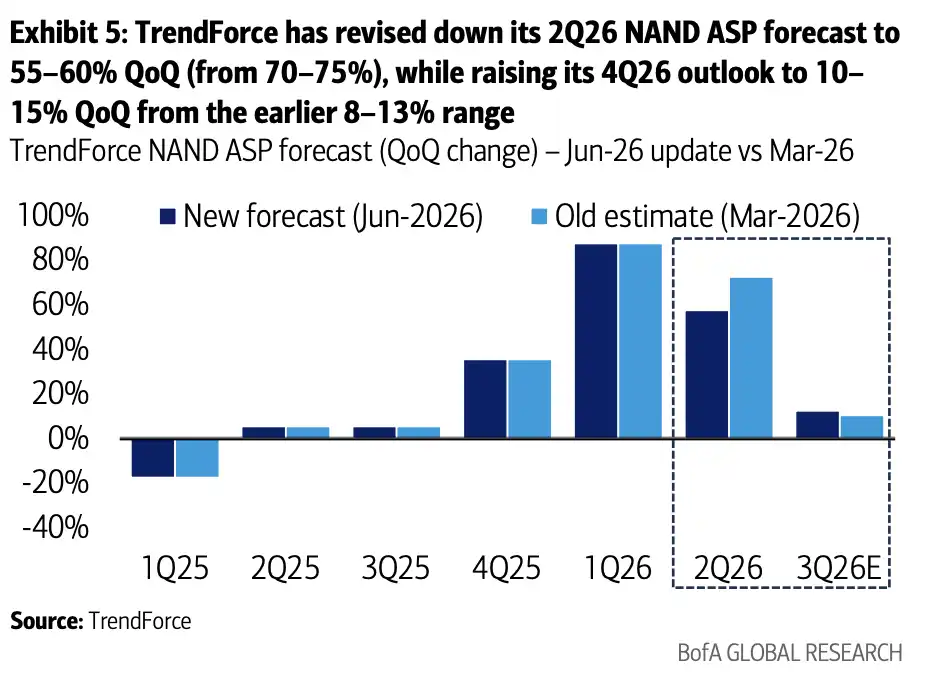
The price expectation for DRAM in Q3 2026 has been revised to a quarter-on-quarter growth of 13%-18%.
The spot market also indicates tight supply. According to a Bank of America report, in early July, spot prices for 16Gb DDR5 reached a new high of $47, 16Gb DDR4 was around $75, and 512Gb NAND wafers were near $20. Prices saw a correction from April to May but rebounded in June. DRAM manufacturers are prioritizing HBM production, further squeezing traditional DRAM supply.
As prices rise, concerns about a cycle reversal increase. The current debate is not about whether memory is strong in the short term but whether this strength has already been fully priced in by the market and whether AI demand can continue to absorb high prices.
Samsung's Q2 Guidance, a Close Test of Memory Prosperity
Samsung is expected to release its preliminary Q2 results on July 7, providing a short-term window for the market to gauge memory prosperity. According to Moneycontrol citing Bloomberg, the market is watching to see if its operating profit can alleviate the pressure from the AI trading cooldown.
The overall profit may be affected by factors such as the inclusion of first-quarter special bonuses and margin pressure in the smartphone business, potentially falling short of some optimistic expectations. However, Bank of America believes that the operating profit of the memory division is likely to exceed market consensus, primarily benefiting from the increase in average selling prices.
This is also the subtlety of the current memory stock. The overall company's profit may be disrupted by factors such as smartphones and bonuses, but the memory business itself is still in a price uptrend. If Samsung's memory division performs significantly better than expected, it will strengthen the view that the July 2 pullback was more of a release of emotions and concerns. If price transmission or profit margins are lower than expected, concerns about the peak of the cycle will continue to escalate.
Valuation cannot completely eliminate risk. After a significant expansion in earnings, the memory stocks' P/E ratio is still relatively low, and ROE has also significantly improved. However, the sector has seen a substantial increase since 2026, and the July 2 pullback indicates that investors are becoming more sensitive to every potential negative factor.
The Controversy Ultimately Centers on AI Capital Expenditure Post-2027
The larger context supporting memory demand is that the capital expenditure of cloud giants is still expanding. According to media summaries and analyst estimates, major cloud companies such as Amazon, Microsoft, Alphabet, Meta, and others are expected to have AI-related capital expenditures of about $700 billion in 2026, a significant increase from the previous year, and it may remain at a high level from 2027 to 2028. This criterion is not a unified official guideline of the four companies, and differences may arise depending on whether companies like Oracle are included in the statistics.
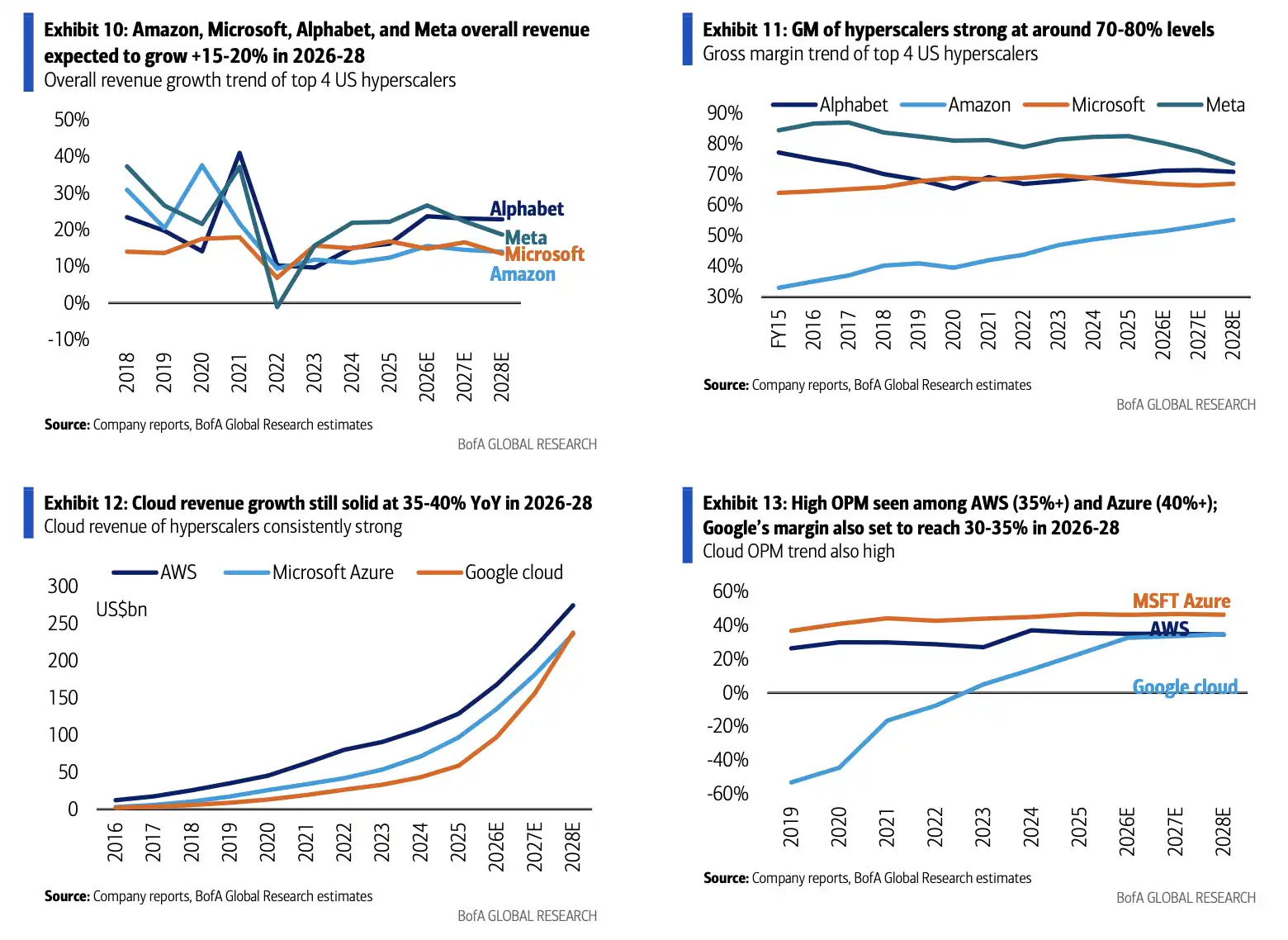
Trends in capital expenditure, cloud revenue, and profit margins of major cloud companies. The 2026 capital expenditure is estimated to be around $700 billion, which is a crucial support for the sustainability of high-end memory demand.
Therefore, this memory stock pullback is more like the market testing three questions in advance: whether Meta will indeed cut AI infrastructure investment, whether Longxing can transition from a symbolic entry into Apple's supply chain to a large-scale replacement, and whether South Korea's long-term investment plan will ultimately bring a new round of supply pressure.
Currently, these questions have not provided sufficient answers to overturn the cycle. Exports, spot prices, price forecasts, and cloud company capital expenditures still indicate a strong demand. But the risks have not disappeared. AI capital expenditure needs to continue to materialize after 2027, geopolitical constraints may alter supply chain choices, and China's localization process will continue to affect the negotiation relationship between Korean and American giants and their customers.
Whether the memory cycle has peaked is not yet a conclusion that has been confirmed by data. More accurately, the market has transitioned from "only looking at price increases" to "validating how long price increases can be sustained" stage.
Welcome to join the official BlockBeats community:
Telegram Subscription Group: https://t.me/theblockbeats
Telegram Discussion Group: https://t.me/BlockBeats_App
Official Twitter Account: https://twitter.com/BlockBeatsAsia