Venice AI Completes $65 Million Series A Funding Round, Can Privacy AI from the Crypto Community Enable End-to-End Revenue Circulation?

TL;DR
· Venice AI completes a $65 million Series A funding round, reaching a $1 billion valuation, with reports of profitability in Q1.
· Market focus is on whether the privacy-first multi-model inference gateway can sustain conversion to revenue and gross profit.
· Related topics: VVV, DIEM, crypto-AI, AI inference infrastructure.
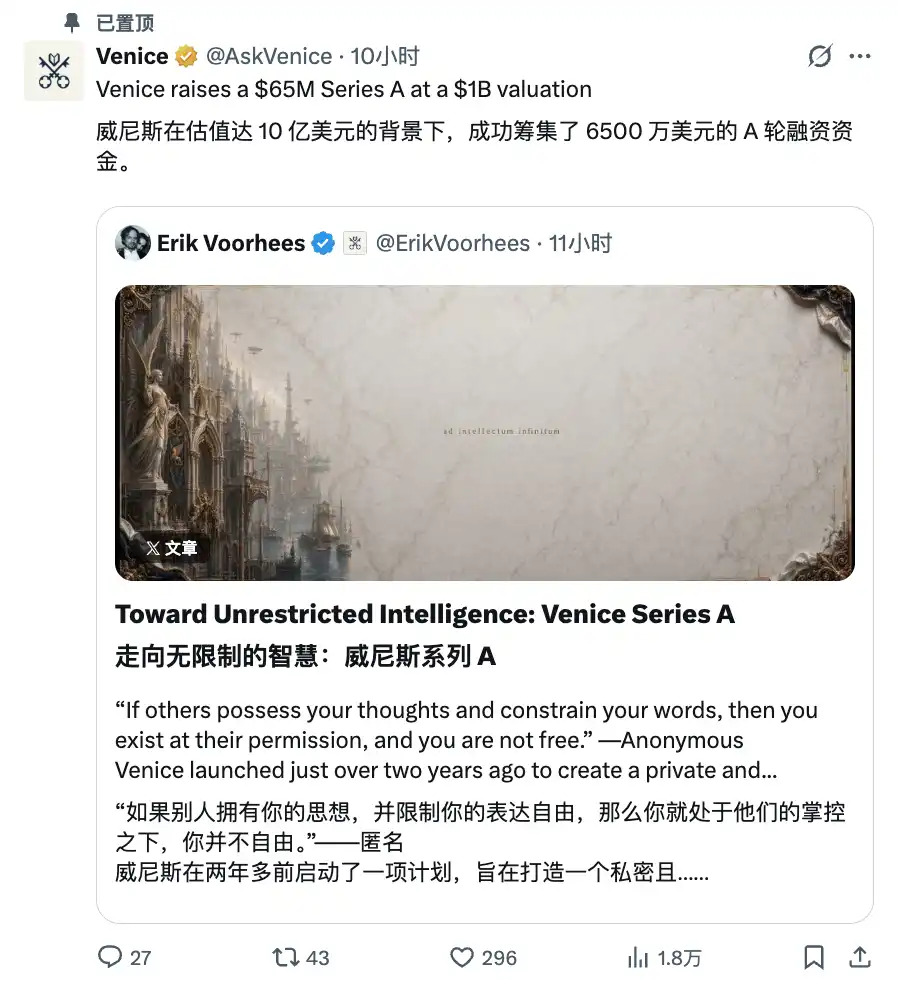
Venice AI announced on July 1st that it has completed a $65 million Series A funding round led by Dragonfly, with participation from Coinbase Ventures, F-Prime, North Island, among others, reaching a valuation of $1 billion. This marks the company's first external funding round and presents a proposition familiar in the crypto circle to the AI capital markets: can privacy and less scrutiny uphold a high-growth AI company.
According to The Block, Venice has informed the media that the company achieved profitability in the first quarter of this year, with an annualized revenue rate exceeding $70 million. This metric still needs to be discounted. Annualized revenue rate extrapolates current revenue to an annual basis, does not equate to confirmed full-year revenue, nor is it a conclusive audit of long-term profitability.
However, this explanation is sufficient to understand why the market is paying attention to Venice. Over the past two years, AI companies have generally faced the same issue: rapid user growth alongside increasing costs of training models and processing requests. Venice's anomaly is that it did not place itself in the most expensive forefront of model training battles, but instead created a privacy-first multi-model inference gateway.
Founder Erik Voorhees, who previously founded ShapeShift and is a long-time supporter of Bitcoin in the crypto industry, has set a very direct product philosophy for Venice: AI should remain neutral like Bitcoin, and the platform should not record everyone's identity for the sake of a few risks. The market is now tasked with verifying whether this set of principles can translate into sustainable revenue.
Venice First Bypasses the Training Arms Race
Venice is not aiming to be the "next OpenAI." It is more like an AI usage gateway: users pose queries on Venice, the platform sends the requests to different models for processing, and then returns the results. Users can switch models and can utilize both open-source and partially closed-source models.
This determines its cost structure. Training is about teaching the model new abilities, requiring ongoing investment in research teams, data, and massive-scale computing power. Inference, on the other hand, occurs each time a user asks a question, with the model generating answers in real time. Venice mainly focuses on the latter.
This does not mean that Venice has no computational cost. The more user requests, the higher the inference cost. The difference is that Venice temporarily does not have to bear the full cost of training the most powerful model, nor does it have to stake the company's future on the capabilities of a single model. For investors, this is a prerequisite for Venice to tell a profitable story.
According to the official announcement, Venice has 3.5 million registered users and processes 1.3 trillion tokens (the model's unit of text processing) per month. There are calibration differences in API call volume, with TechCrunch stating an average of around 1.7 million calls per day, while Venice claims around 2 million calls per day, peaking at 2.1 million. Regardless of which calibration is used, it is no longer just a conceptual project.
Privacy Premium to Become a Premium Reason
The core issue that Venice wants to validate is whether privacy can become a premium reason for AI products. When ordinary users use chatbots, what they are worried about is not technical terms, but whether their questions, files, ideas, code, and identity information will be recorded, used for training, or reviewed by the platform.
The solution provided by Venice is privacy layering. The platform promises not to store user queries on its servers but to encrypt and route requests to different models. Routing can be understood as a transit station where users are not directly exposed to the model provider but have their requests forwarded by Venice.
Boundaries need to be maintained here. According to Venice's privacy policy, in Anonymous mode, third-party model providers may see and retain prompts. End-to-end encryption (unreadable by parties outside) and secure execution environments (hardware isolation areas) are Pro features, and end-to-end encryption does not support certain functions such as web search or memory.
Therefore, Venice is better understood as a "privacy-layered gateway" rather than an absolutely unmonitored black box. It can reduce the risk of the platform storing and accessing user content, but when requests are sent to closed-source models, data boundaries still depend on the specific processing methods and partnership terms.
No censorship is the flip side. Voorhees' judgment is that users are adults, and AI platforms should not default to strong filtering to decide for users what can be asked and answered. This positioning can attract users dissatisfied with mainstream AI safety filters, but it also brings regulatory and platform distribution risks.
VVV Puts Revenue into Asset Circulation
What sets Venice apart from typical AI applications is that it embeds token design into its business model. VVV is not just a brand asset but is also integrated into a cycle of payments, credit, and buyback burns.
In April of this year, the company announced that over 33.7 million VVV tokens, approximately 42%, have been burned to date. Burning refers to the permanent destruction of tokens, reducing the circulating supply. Venice also stated that it would use revenue to buy back and burn VVV, allowing investors to connect platform revenue with token value.
DIEM represents another layer of the mechanism. Specifically, users stake VVV to receive sVVV, which is then locked to mint DIEM. DIEM can correspond to or generate API credits. Simply put, VVV serves as an asset entry point, while DIEM acts more like a spending limit, intertwining token holding, AI service usage, and platform revenue within the same closed loop.
This is why this funding round was not simply seen as equity financing. According to The Block, investors received approximately 8.98% equity, 1.5 million VVV tokens in ownership grants, and warrants to purchase 5 million VVV tokens over the next 8 years. The related tokens will be locked for 1 year and then linearly vested over 3 years.
For VVV holders, both positives and pressures exist. The positive is that revenue buybacks and burns provide a clearer asset narrative. The company's choice of equity financing may also reduce short-term selling pressure from direct treasury token sales. The pressure lies in the fact that if warrants are exercised in the future and tokens from the financing party are gradually released, the market will still need to absorb the additional supply.
$1 Billion Valuation Bet on Gross Margin Improvement
Venice's current valuation is not just a bet on the "privacy AI" narrative but on its ability to continue improving unit economics after scaling up. The company stated that the funding will be used for GPU procurement, building proprietary data centers, expanding the market, and team.
This step is crucial. Current profitability may come from a lighter structure: not training cutting-edge models, routing some requests to third-party models, and strong early expenditure control. In the future, if the self-built infrastructure is successful, Venice could theoretically reduce the cost of single inference, increase gross margins, and allocate more revenue to VVV buyback burns.
Risks also lie here. Data center and GPU purchases will bring capital expenditures that may squeeze profits in the short term. If user growth mainly comes from free or low-priced traffic, the cost of inference could eat into revenue again. The growth metrics disclosed by the company and profit information recounted by the media are not yet evidence of long-term financial stability.
This round of financing has transformed Venice from a concept project into a company that needs to deliver results. Whether the $1 billion valuation can hold will depend on whether, after building its own infrastructure, the gross margin, paid retention, regulatory pressure, and VVV supply changes can withstand validation simultaneously. For investors, the next stronger signal lies not in the narrative, but in revenue quality and the token supply schedule.
Welcome to join the official BlockBeats community:
Telegram Subscription Group: https://t.me/theblockbeats
Telegram Discussion Group: https://t.me/BlockBeats_App
Official Twitter Account: https://twitter.com/BlockBeatsAsia