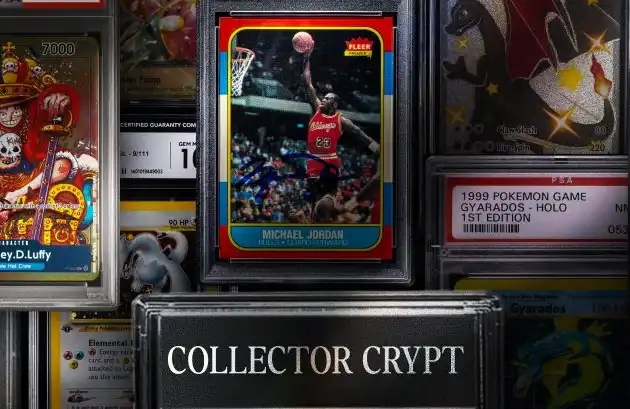
CARDS has surged 5x in the past 2 months. Are on-chain TCG cards the next major narrative after the HYPE?

Since mid-April this year, the token $CARDS of the TCG card market/lootbox platform Collector Cards on Solana has surged by over 5 times. Currently, the circulating market cap of $CARDS is around $60 million, with a fully diluted valuation of about $468 million.
In a year where the cryptocurrency market lacks narratives and the prices are sluggish, such a market performance is undoubtedly very impressive. Let's first analyze why Collector Cards has been able to show such a strong uptrend against the market, and then take an overview of the current on-chain TCG card games trend.
Reasons for Collector Cards Surge: Really Making Money
Perhaps unexpectedly, Collector Cards is now almost the second-highest-earning dApp on Solana, second only to pump.fun.
According to defillama's data, whether in the past 7 days or the past 30 days, Collector Cards' revenue has consistently ranked 2nd among Solana dApps. In the last 7 days, Collector Cards' revenue was $3.86 million, while in the last 30 days, it was $9.48 million.

Such revenue data surpasses Axiom, Phantom Wallet, Jupiter, Meteora, and other well-known Solana dApps.
Even placed in the entire cryptocurrency space, this revenue data is quite impressive. In the past 7 days, Collector Cards' revenue data ranks 7th among crypto projects, and in the last 30 days, it ranks 10th. Excluding stablecoin projects like Tether, Circle, and Polymarket, Collector Cards is almost second only to Hyperliquid and pump.fun as a crypto-native "money printer."
The revenue sources of Collector Cards are quite simple, with a part coming from lootbox openings and another part from card trading market fees. These two revenue streams are highly uneven. For example, looking at the May data, the total transaction volume of lootbox card pack openings in that month was around $194.7 million, while the total transaction volume of card trading market was only about $205,000.
Although the sale of card pack gachas is very hot, this is a "gambling-style capsule toy machine." Many players, after opening the card pack, find that the cards they have drawn are worthless and immediately sell them back to the platform at a discounted price. The buyback price ratio varies between different card packs. Generally, for cheap mass-market card packs, such as $25/$50 per draw packs, the platform only buys back at 85% of the price, while for $2500 per draw packs, it can buy back at 93% of the price.
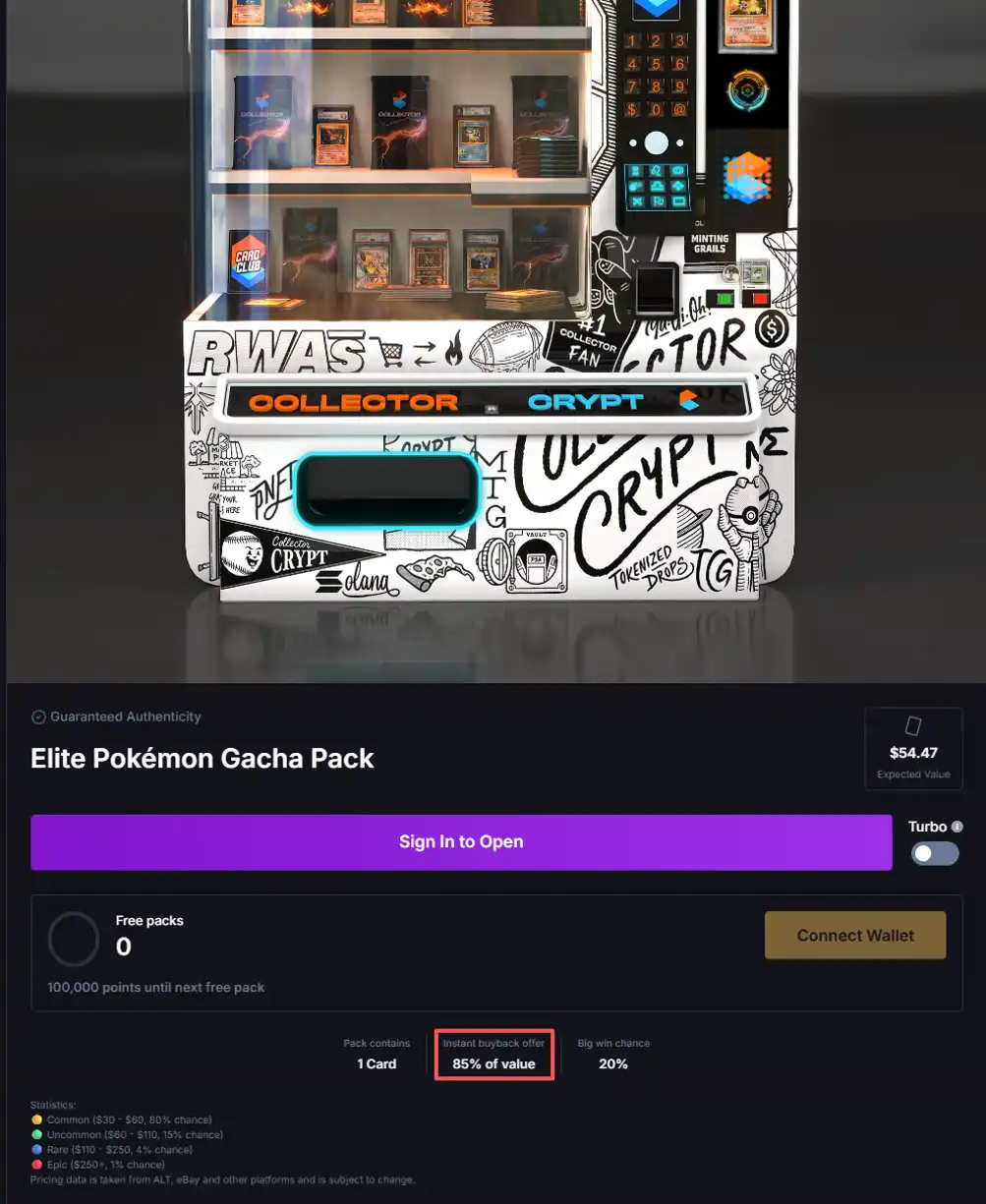
Although the total trading volume of card draws is substantial, there are also many players who immediately resell common and worthless cards to the platform after drawing. Overall, the remaining profit is the data level we presented at the beginning of this section.
One might wonder, are there really so many people playing this kind of card draw soft gambling on-chain?
Let's not draw conclusions yet; let's look at the data. So far, the number of unique users who have participated in card draws on Collector Cards is 23,733, with an average of $26,843.71 spent per wallet on card draws. The total number of card draws is over 4.87 million, with an average of over 205 draws per unique user.
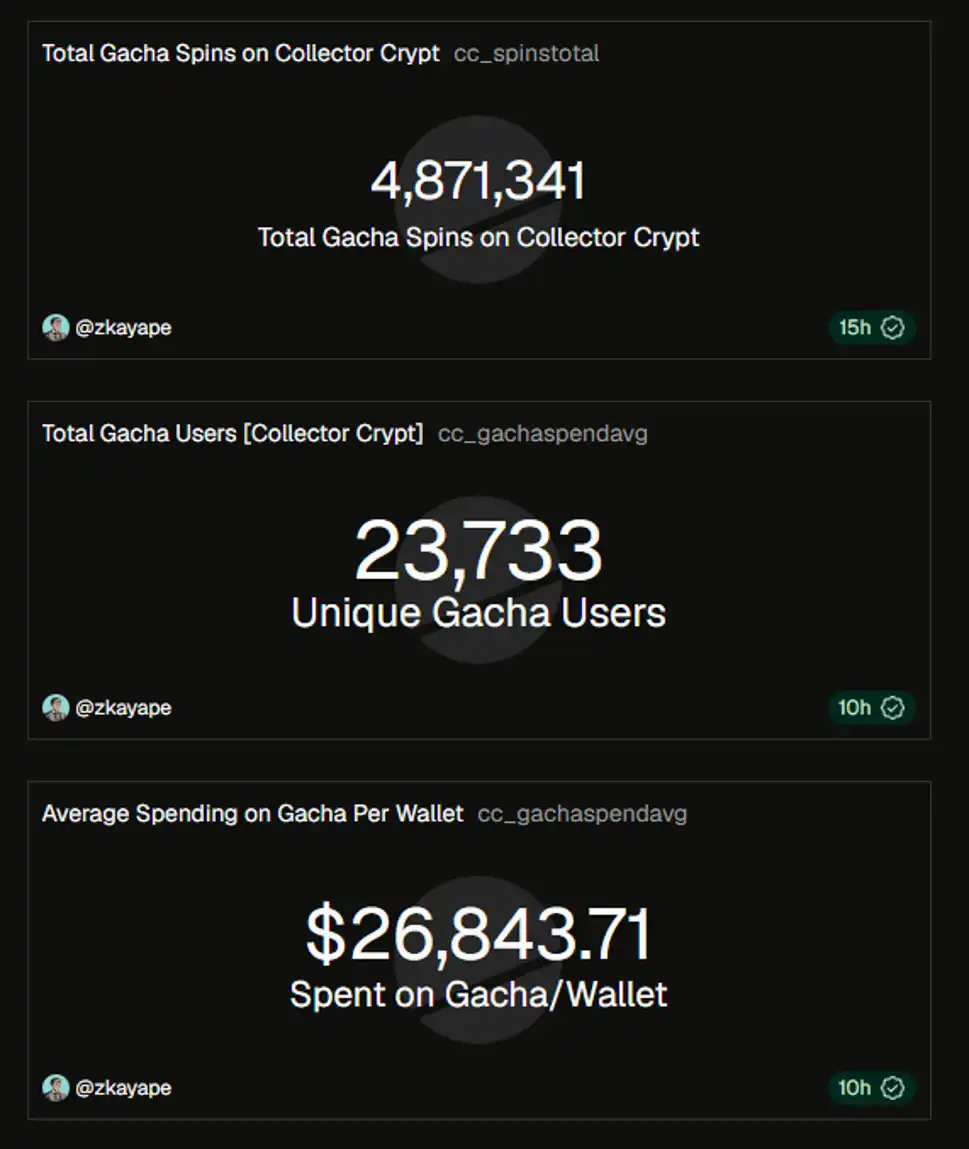
Nearly 60% of users have spent over $250 on card draws, and there are even 109 users who have crazily spent over $1 million.

Such data is impressive, but one cannot ignore that the points accumulated by players participating in card draws are a core indicator of how much $CARDS airdrop they can receive each quarter. And the official team has explicitly stated that the points for each new quarter are more important than the total accumulated points:
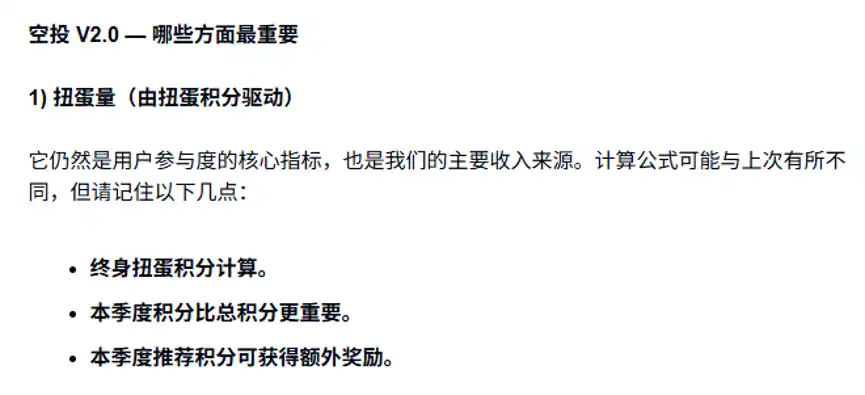
So far, the $CARDS quarterly airdrop has been completed three times, with each distribution totaling 0.75% of the tokens to players on the platform. This is similar to when Blur points were in demand for NFTs, and many engaged in trades despite wear and tear to obtain them.
Therefore, Collector Cards is indeed profitable, but this data is definitely magnified by the potential token airdrop returns. Of course, this amplification mentioned here is not pejorative and bearish from a long-term perspective; instead, it is an affirmation of its successful flywheel.
With this successful token incentive, Collector Cards has successfully dethroned the former track champion, Courtyard on Polygon. Its card draw market share has remained above 50%, reaching as high as 83.6% in the past week:
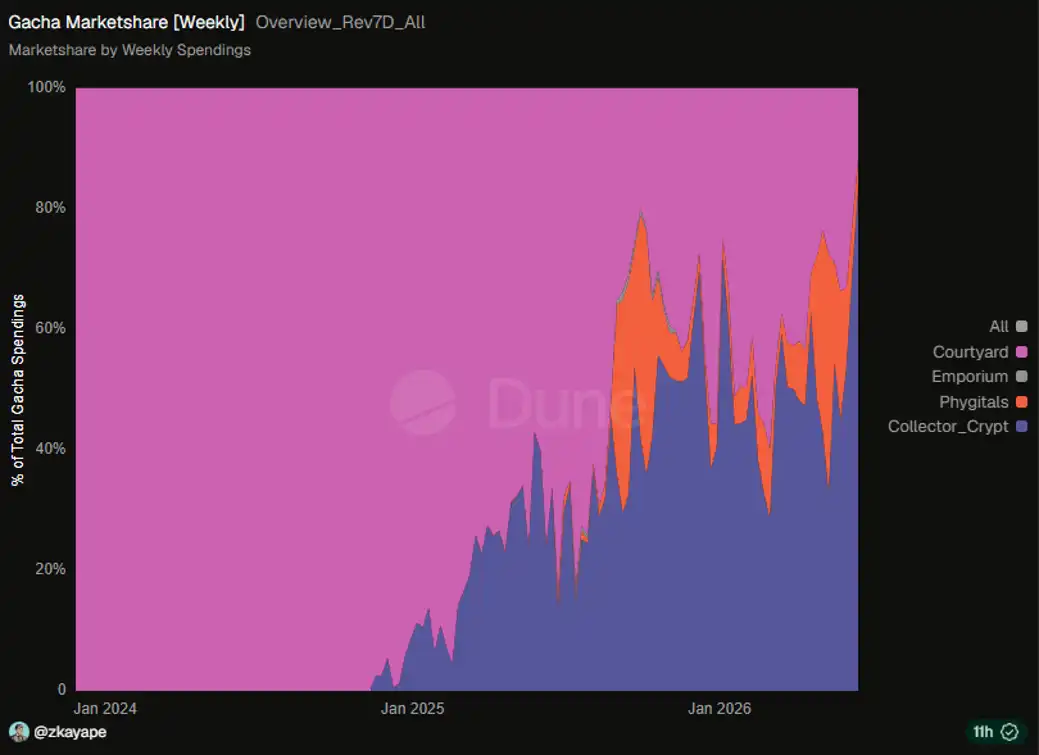
Looking at the revenue data, Courtyard has generated $1.14 million in revenue over the past 7 days and $6.99 million over the past 30 days. Considering that Courtyard has not issued a token nor provided token incentives, its revenue data actually proves that there is a genuine demand for on-chain card draws. The amplified competitive advantage through the token, if the pace is right and the timeline is long enough, will also help with long-term user retention.
Returning to the discussion on the strong performance of $CARDS price. Apart from being genuinely profitable, it is currently the only target in the same track that has a token for investment. Collector Cards' total trading volume has exceeded $1 billion, while other projects in the same track, Courtyard, has accumulated a total trading volume exceeding $1.1 billion, Phygitals over $336 million, and Beeize on Base has also surpassed $100 million in just 4 months.
The Pokémon card market is indeed massive enough to support the scale of these on-chain card draw platforms. According to pokeca-soken data over the past year, the single-card market price of Pokémon cards has shown a continuous upward trend.
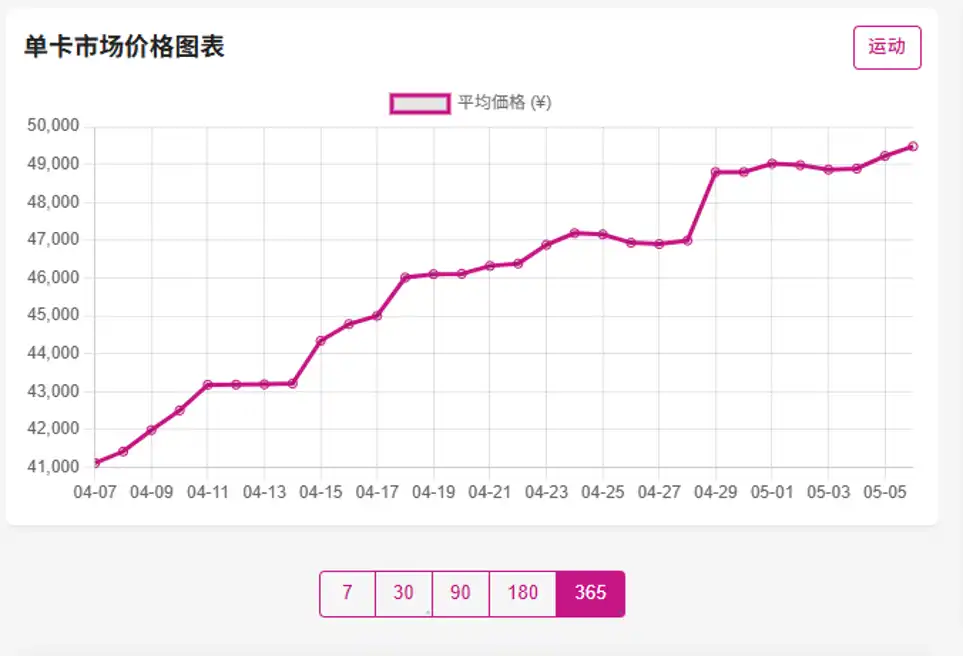
As of March 2025, over 75 billion Pokémon cards have been produced and sold to over 90 countries worldwide. The sales revenue for the fiscal year 2024-2025 amounted to a staggering ¥4.109 trillion, with a year-on-year growth of 38.1%. Their digital product, Pokémon TCG Pocket, broke $1.3 billion in revenue in its first year of operation.
Especially after the launch of the Pokémon Collectible Card Game Pocket Edition in the fall of 2024, the demand for physical cards surged, leading to widespread stockouts and scalping. The Pokémon Company is constructing a new printing plant covering 1.27 million square feet, expected to start operations by the end of 2028.
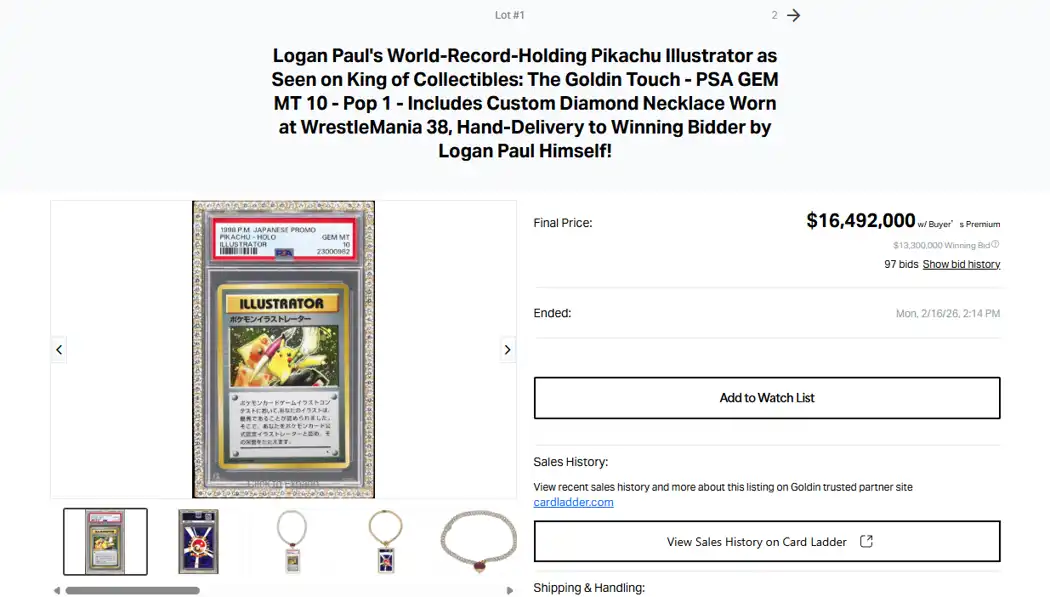
In February 2026, renowned YouTuber and WWE star Logan Paul auctioned off the only PSA GEM MT 10 perfect condition version of a Pokémon card he privately purchased for around $5.275 million in 2021. The card eventually sold for around $16.5 million at Goldin Auctions.
When drawing cards on-chain, there is no need to personally go offline to buy card packs. Unwanted common cards can be immediately sold back to the platform, while desired cards can be claimed from these platforms. This indeed can greatly facilitate many loyal Pokémon card players. Viewing the development trend of these platforms merely from a "gambling" perspective actually overlooks the huge young market size and demand for Pokémon cards.
Furthermore, the buyback of $CARDS is already in progress. However, the project team has indicated that they need to wait for the CLARITY Act to be implemented before providing detailed disclosure.
Other Types of TCG Card Projects
After analyzing $CARDS, we can see that card drawing is currently the most profitable business in the on-chain TCG card market segment. However, this gameplay is not the only option; there are some other directions to explore.
Card Fragmentation
This direction is different from the previous NFT fragmentation that focused on on-chain DeFi or speculation. Essentially, rare and expensive cards are indeed difficult to collect and invest in, with long-term, actual market demand and price support. However, this also means that the demand for this direction will not be as massive as card drawing; it targets a more hardcore player group and investors who are not inclined to rely on luck but rather seek to invest in rare cards to obtain excess returns.
Recently, projects of this type that have received more attention include Grail on Base and $SV151 launched on Solana by Sunrise and Meteora. The C-Ronaldo card token on Grail saw a nearly 100x increase in price since May 5th, and the Mbappe card token saw an increase of nearly 300x since May 5th.
As for $SV151, they chose to tokenize the legendary SV151 card set containing the original 151 Pokémon images, with a market cap surpassing $3 million at one point.
However, the biggest issue with projects of this kind is that the narrative imagination space is too limited. The token's market cap is tied to the actual card inventory value, making it difficult to convince on-chain players to speculate on a corresponding high market cap premium. Whether it's various tokenized fragmented card projects on Grail or $SV151, they face a situation where they quickly fall back to a price range linked to the actual card price after an initial hype. For example, $SV151 has announced the purchase of approximately $185,000 worth of corresponding card assets, but the coin's current market cap is around $600,000, which in itself is already a multiple-fold premium.
Gacha Lottery
If gacha is seen as a form of gambling, then this type of token adds another layer of gambling on top of gambling.
A typical example of this type of project is $GACHA, where all transaction fees are used for gacha draws. Every hour, a lucky holder is chosen to receive all the cards opened during that period. Alternatively, users can directly deposit US dollars via credit card, and all the deposited money is used to open cards. Then, based on the amount of USD each player has put in, a player is selected to take the entire jackpot based on a proportionate scale.
Meme Collectibles Vault
There are mainly two types of projects in this category.
One example is $PIKA, which is specifically focused on opening Pikachu-themed card packs on various blockchains. It has already accumulated Pikachu cards and related collectibles worth $85,000, giving off a "Pikachu Cultural Fund" vibe.
Another example is $KABUTO, which experienced a hype at the end of last year. It originated from a collector who aggressively bought first-edition Kabuto (a Pokémon known as "Kabuto Fossil") cards, leading to the creation of this meme coin. All the creator fees are used to purchase more Kabuto cards.
Card NFT Project
This direction suffered a blow earlier this year due to a rug pull incident involving Trove, which greatly undermined the confidence of on-chain players. However, there are still some small projects in progress, such as $POKE on Solana.
Overall, apart from the gacha direction, the on-chain TCG card sector has hardly shown any signs of development. However, if the profitability of on-chain TCG card games gains more recognition in the future, there may still be new opportunities in these areas.
Welcome to join the official BlockBeats community:
Telegram Subscription Group: https://t.me/theblockbeats
Telegram Discussion Group: https://t.me/BlockBeats_App
Official Twitter Account: https://twitter.com/BlockBeatsAsia