SpaceX's True Ambition: Sending AI Computing Power into Space
Original Title: SpaceX & the Sentient Sun
Original Authors: Marc Andreessen, Michael McGuiness (a16z)
Translation: Peggy, BlockBeats
Editor's Note: This article starts with SpaceX as an entry point and unfolds a grand deduction about the era of space industrialization. It discusses the core issue of how a company can break down a highly uncertain long-term mission into an executable industry system through organizational capability, technological roadmap, and capital narrative.
What sets SpaceX apart is its integration of rocket reusability, satellite internet, AI computing power, robotics, semiconductor manufacturing, and lunar industrialization into a single roadmap, forming a cross-industry, cross-cycle infrastructure layout.
The key assessment of the author is that SpaceX's long-term value depends on its ability to continuously reduce the marginal cost of accessing space and propel space from a scenario of scientific research and national defense to a new industrial space of energy, computing power, and manufacturing.
The article opens with Musk's extreme compensation plan at SpaceX: only when the company is valued at $7.5 trillion, has established a million-person permanent city on Mars, or operates a data center consuming 100 terawatts of power in space, can he receive a meaningful return. This design itself reveals the endgame narrative of SpaceX: launching satellites more affordably is just the beginning, and the real goal is to push energy, computing power, manufacturing, and human habitation space beyond Earth.
Currently, AI infrastructure is facing bottlenecks in electricity, land, approvals, and supply chains, and the marginal cost of traditional ground expansion is rising. If computing power expansion begins to seek energy and deployment space beyond Earth, the boundaries between aerospace companies, cloud providers, energy enterprises, and semiconductor manufacturers will be redefined.
Viewing SpaceX within this framework, the key may have shifted from how many rockets it has launched today to whether it can upgrade "space access" to a platform that carries energy, computing power, manufacturing, and civilization expansion.
Of course, this narrative heavily relies on Musk's judgment of technological progress, cost curves, and organizational execution, with a clear investor perspective. Readers are more suited to see it as a deduction about the future industry structure: its value lies in understanding how the space, AI, and energy, three originally separate topics, can be seen on the same cost curve and hint at where the next generation of industrial platforms may emerge.
The following is the original article:
Elon Musk's compensation plan at SpaceX is designed around two goals. The first reward will unlock when the company reaches a $7.5 trillion valuation and establishes a permanent human settlement of at least 1 million people on Mars. The second reward will unlock when SpaceX operates a data center in space consuming at least 100 terawatts of power—this is more than 1,000 times the total power consumption of all data centers on Earth. If neither goal is achieved, Musk will receive nothing apart from his $54,080 annual salary since 2019.
The board members who signed off on this compensation plan have witnessed Musk make one seemingly impossible prediction after another for SpaceX over the past two decades, only to see each one come true. He said SpaceX would put humans into orbit, something no private company had done before; today, SpaceX routinely flies NASA astronauts. He said SpaceX would land orbital-class rockets and re-fly them, while the entire industry saw boosters as expendable; since then, SpaceX has completed hundreds of such recoveries. He said that in a time when satellite internet was almost a graveyard business, it could be worth tens of billions of dollars; today, Starlink's revenue has grown from zero to $11.4 billion in just a few years. These predictions are often aggressive in timeline but almost never wrong in direction. The initial direction was set as early as 2002 in the company's mission: to make humans a multiplanetary species. Hence, the board tied his compensation to this mission itself.
If this mission sounds like science fiction, perhaps that's because it's meant to be.
Iain M. Banks spent twenty-five years crafting a civilization called "the Culture." By most reasonable standards, it might be the best utopian society human imagination has conceived. There, humans coexist with superintelligent AIs known as "Minds"; these AIs run vast orbital habitats akin to small worlds. The relationship between humans and AIs is neither servitude nor competition but partnership. No one has to work. No one goes hungry. Minds handle the immense computational load required to run the space cities. Humans are left to be human, and it turns out that's a full-time job in itself.
SpaceX's three autonomous drone ships, which are the floating platforms where Falcon 9 boosters land at sea, are named after conscious starships from Banks's novels: "Of Course I Still Love You," "Just Read the Instructions," and "A Shortfall of Gravitas." During an interview at the 2023 UK AI Safety Summit, Musk was asked what a good AI future would look like. He replied, "The 'Culture' series by Banks is probably the best description of AI future. There's no other work that even comes close to it in terms of describing a pretty good Utopian or semi-Utopian future with AI." In fact, he has been telling us all along what he aims to build through the names on the landing platforms of the ships.
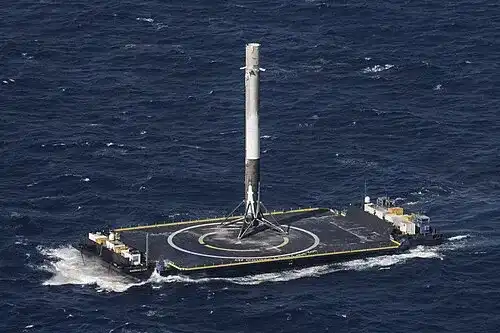
The Of Course I Still Love You droneship caught the Falcon 9 first stage on April 8, 2016. This marked the first successful unmanned ship landing in history, signifying the moment when reusable orbital-class spaceflight became a reality. The ship is named after a sentient starship from Iain M. Banks' Culture series of novels. (Image: SpaceX)
The "Culture" is not a frictionless utopia. Banks' novels are filled with war, intrigue, and moral complexity. It is a utopia because the civilization has resolved the basics of existence to a sufficient degree, enabling trillions of sentient beings to freely engage in what Banks calls "the things that really matter in life, such as games, sports, romance, studying dead languages, barbaric societies, impossible problems, and the sheer delight of climbing the unconquered mountain without a safety rope."
Such a future rests on four premises. First, the ability to access a significant fraction of a star's energy output, orders of magnitude beyond what today's human civilization generates. Second, vast physical intelligence: machines that can build, mine, smelt, and repair anything anywhere without human intervention. Third, cheap digital intelligence surpassing biological smarts. Fourth, a way to get mass off Earth at low cost, high frequency, and with reliability because none of the above can stay bound to Earth alone.
Reverse Engineering the Future
Most analyses of SpaceX work forward from today: rockets, satellites, contracts, revenue. But to see what's really happening, it's more useful to work backward from the destination.
Mars City. The operational goal is to establish a self-sustaining city of a million people on Mars within the lifetime of people living today. The challenge lies in this self-sustainability. It means that if Earth stops shipping supplies to Mars, the city must survive on its own, producing everything it needs—food, water, air, power, medicine, machines, and eventually more people. According to SpaceX's own calculations, delivering a million people and millions of tons of cargo in a few decades will require thousands of Starship flights happening every day during each transfer window, which open for a few weeks every 26 months due to Earth and Mars' orbital mechanics constraints.
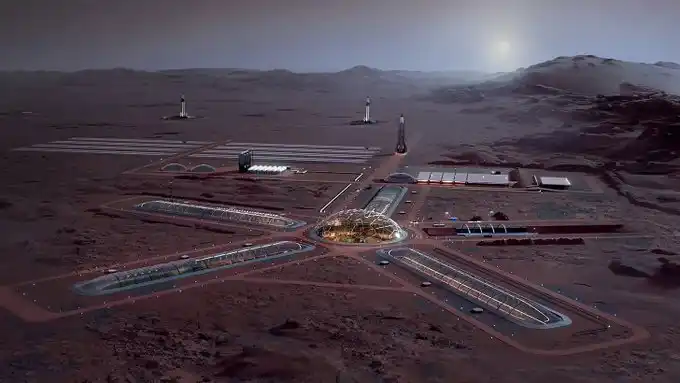
SpaceX's rendering of a Mars City. (Image: SpaceX)
Moon City. This is a closer and more achievable rehearsal site. Ice exists in permanently shadowed craters at the lunar south pole, while certain ridges receive continuous sunlight, making it naturally suitable as a base location. However, what Musk is talking about is not just a research outpost but something grander. He envisions building a factory on the moon to produce AI satellites and using a mass driver to launch them into space one by one. The mass driver is also a concept borrowed by Musk from science fiction, essentially an electromagnetic launch system that takes advantage of the moon's one-sixth gravity and lack of atmosphere to industrially catapult solar-powered satellites into deep space. If these satellites are built on the moon itself, there is also a material foundation: lunar regolith contains approximately 20% silicon and 10% aluminum by weight, which are the two main ingredients of solar panels and satellite structures. Musk explains, "If you want to exceed a terawatt per year, you have to go to the moon."
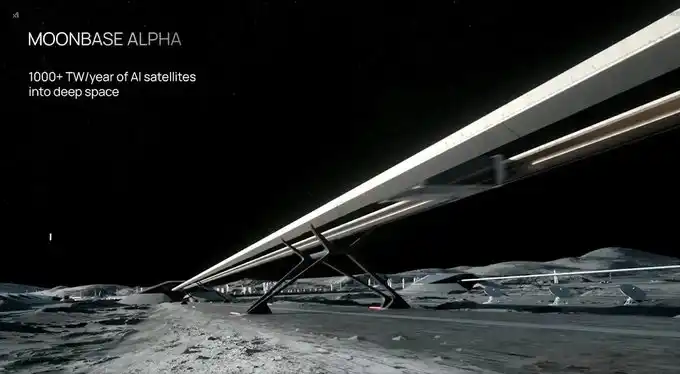
SpaceX uses a mass driver at the Alpha Moon Base to launch moon-manufactured AI satellites, aka data centers, into orbit. (Image: SpaceX)
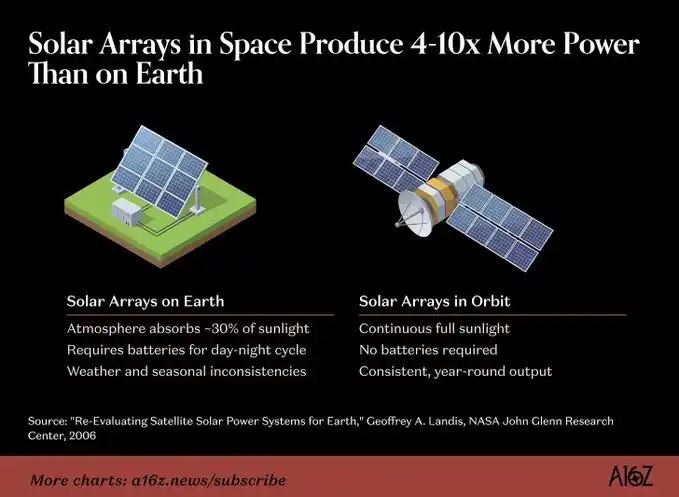
Orbital Data Centers. Musk is betting that, in a few years, space will become the most economically attractive place to deploy AI data centers. The bottleneck for AI is energy. Except in China, energy supply has hardly grown, while AI compute demand is growing exponentially. The power provided by solar panels in orbit is four to ten times that of equivalent panels on Earth, depending on the sunlight conditions at the ground location, as space lacks an atmosphere, day-night cycle, clouds, and seasonal variations. NASA did the math several decades ago, and now, finally, rockets are cheap enough to make it a reality. Musk expects that, in five years, SpaceX's annual launch of AI compute to orbit will exceed the cumulative installed AI compute capacity on Earth. That's why SpaceX merged with xAI in February. Rockets and intelligence are becoming the same question.
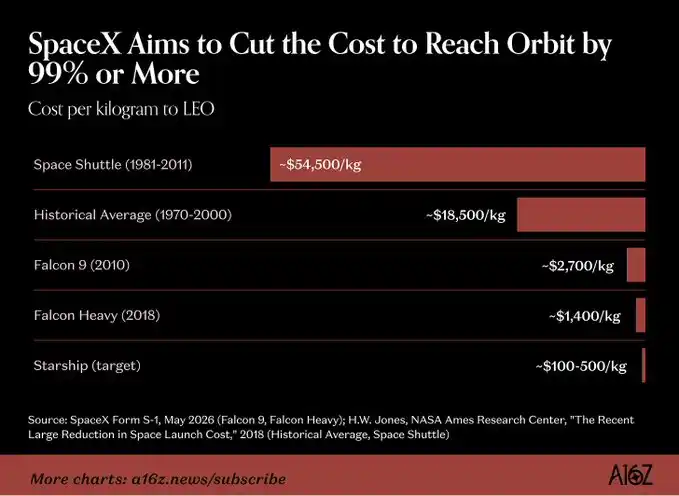
Starship is the vehicle that makes everything upstream possible. Starship V3 completed its first flight this year and is the largest and most powerful rocket ever built by humans—it is taller than a 40-story building and has twice the thrust of the Saturn V that sent astronauts to the moon. According to NASA, the cost to reach orbit has been approximately $18,500 per kilogram. In 2010, the first Falcon 9 reduced this cost by about 85% to around $2,700 per kilogram. In 2018, the Falcon Heavy further reduced it to around $1,400 per kilogram. The design goal of Starship is to become the world's first fully and rapidly reusable spacecraft and further lower the cost to $100 to $500 per kilogram. What used to cost billions of dollars for a single spaceflight now has costs in the tens of millions.
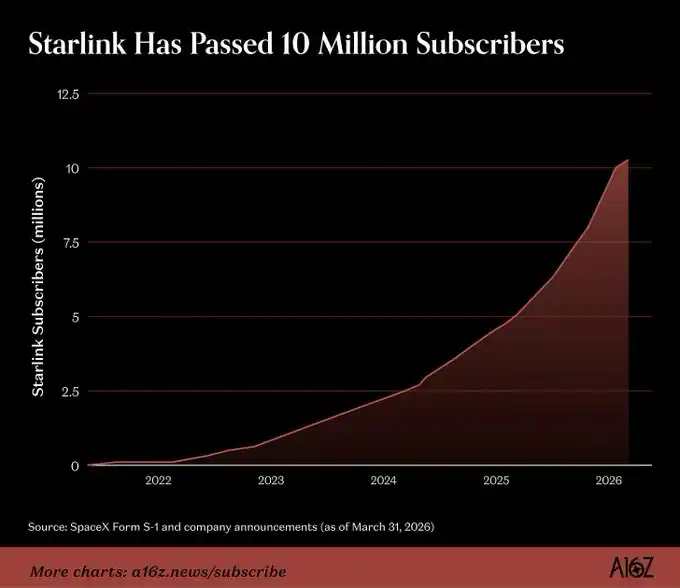
Starlink is the cash cow that fuels everything else. According to SpaceX's IPO filing, the connectivity business segment, which is almost entirely made up of Starlink, is projected to generate $11.4 billion in revenue by 2025, representing a nearly 50% year-over-year growth, with an adjusted EBITDA margin of over 60%. As of March 2026, Starlink has 10.3 million subscribers in 164 countries and operates with over 9,600 satellites. Initially just a side project to fill in the gaps of the company's launch capabilities, Starlink has now become one of the greatest consumer businesses in history. During a16z's due diligence on SpaceX in 2019, many were skeptical of the business model's viability. The technology required for user terminals had previously only been used in the F-22 fighter jet and Navy destroyers, never mass-produced for consumer use. SpaceX's early terminal manufacturing cost was around $3,000 but was sold for $499. However, they found ways to reduce manufacturing costs and proved the skeptics wrong.
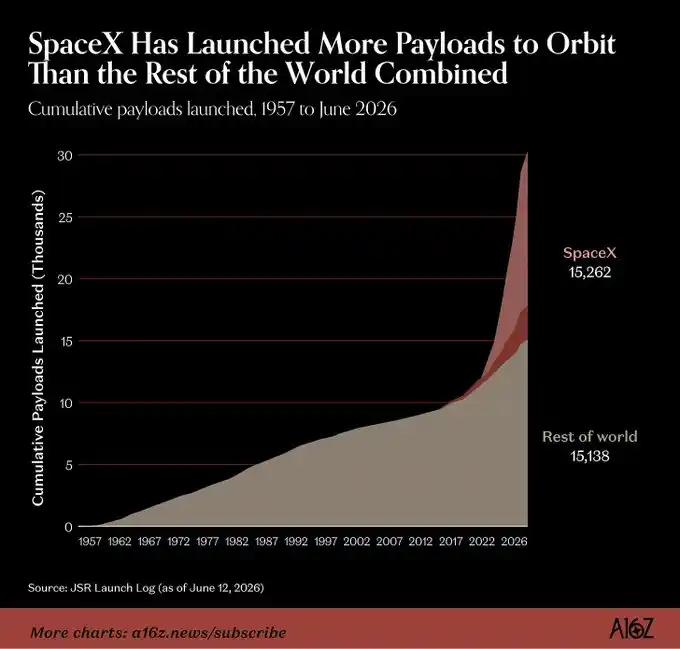
The Falcon 9 is the workhorse that buys time for everything else. It is the only orbital-class rocket in the world capable of large-scale reuse, with a single booster typically performing over twenty missions before retirement. In 2025, SpaceX launched 83% of the total global orbital mass. Despite other players having a half-century head start, SpaceX now puts more payload into orbit than all other countries and companies in the world combined.
This is the entire stack, top to bottom. Generations down the line, "civilization" is at the top. Falcon 9 and Starlink are at the bottom, paying the bills for today's everything. Each layer enables the layer above it.
SpaceX CFO Bret Johnsen described what this all looks like from inside the company:
"Musk has created a culture where you set some initially crazy-sounding goals, and then step by step, you realize you are moving towards something entirely achievable... like going to Mars. When I joined the company in 2011, anytime people talked about Mars and making humanity a multi-planetary species, eyes would roll. Today, when we talk about it, the response is really more like, 'Which year?'... I think one of the things Elon has done exceptionally well is set these goals and build a fantastic business model around each of the key technology assets needed to achieve the ultimate goal."
Foolishness Index and the "Algorithm"
Musk didn't originally intend to start a rocket company. In 2001, at the age of 30, Musk was contemplating his next move after PayPal. He had always been interested in space, and when he looked into NASA's plans for human Mars exploration, he was surprised to find that there were none. So, he devised a plan: to send a small greenhouse to Mars and transmit images back to Earth. His idea was that the sight of a green sprout on the desolate red planet might reignite public interest in space and inspire the political will to fund a real Mars mission. All he needed was a rocket to get this greenhouse there.
Later that year, he traveled to Moscow in an attempt to buy a refurbished intercontinental ballistic missile. This was his first of two trips to Russia. The conversations were said to be filled with vodka and a lot of bluster. "We would all go into a small room, and there would be an entire bottle of alcohol in front of each person," Musk's best friend from his time at the University of Pennsylvania, Adeo Ressi, who also joined the trip, recalled in a 2012 interview with Esquire. The Russians didn't take Musk seriously. At one point, a chief designer even spat at Musk and his team in disdain. The second trip was in February, with Musk asking how much for a rocket. The reply was $8 million per rocket. When Musk tried to negotiate for two rockets at $8 million each, Musk's space advisor Jim Cantrell remembers the other party saying something like, "Kid, no." and implying that Musk simply didn't have the money. Musk concluded they weren't serious about doing business and walked away.
Cantrell thought the trip was over. On the return flight, he and Mike Griffin raised a glass to celebrate finally leaving Moscow. Griffin would later become the NASA administrator and was an advisor on the second Russia trip. Musk sat in front of them, hunched over his laptop. Then, he turned around. "Hey guys," he said, "I think we can build this rocket ourselves." He showed them a spreadsheet listing the raw materials—aluminum, titanium, copper, carbon fiber—needed for the rocket and the cost of each. The raw materials accounted for only 2% of the quoted price. As Musk would later say, "You just need to figure out clever ways to take those materials and fashion them into the shape of a rocket."
Within months, Musk decided to take a $100 million gamble to start a rocket company. This was more than half of the approximately $180 million he made from selling PayPal. He then founded SpaceX in a warehouse in El Segundo, California. He extended invitations to five people to join the founding team. Three declined, including Cantrell and Griffin. The two who agreed to join were Tom Mueller and Chris Thompson. Mueller later became the Vice President of Propulsion Engineering and the company's first employee; Thompson was the second employee, in charge of operations and production.
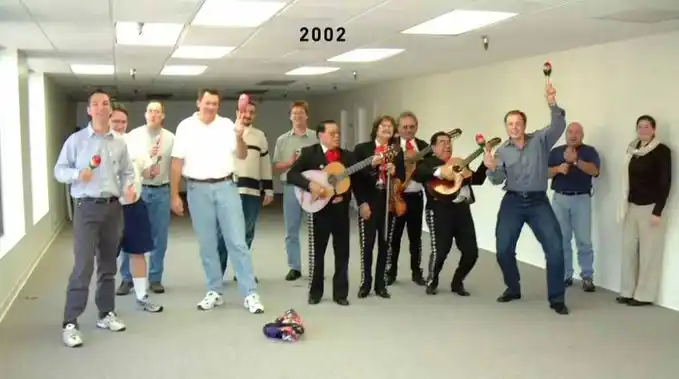
“In 2002, SpaceX basically had only a carpet and a mariachi band from Mexico. That’s it,” Musk later joked. “As you can see, I’m a dancing machine.”
Years later, Musk referred to the principles behind his spreadsheet diagnostic tool as the “idiot index.” If a part’s price-to-materials cost ratio was too high, either you were an idiot, or you were working with idiots. This may sound like a joke, but it was the foundation of SpaceX’s strategy.
Every part procured by SpaceX came with an idiot index calculation. The company had a legendary story in its early days featuring Steve Davis. After graduating from Stanford, Davis joined SpaceX as the 14th employee with the task of procuring an actuator for the upper stage of the Falcon 1 rocket. When he reported that a traditional aerospace supplier had quoted $120,000 for the part, Musk laughed, saying the complexity of the component was akin to a garage door opener. Musk gave Davis a $5,000 budget and asked him to build it from scratch. As recounted by biographer Ashlee Vance, Davis spent nine months refining his design and eventually created a functional actuator at a cost of only $3,900. When Davis dismantled the successful technology to send it to Musk, Musk replied with his typical brief email containing just two letters: “Ok.”
To drive the idiot index toward the theoretical lower bound, you must vertically integrate and have end-to-end control of the entire process. However, vertical integration leads to fixed costs that are only economical at high volumes; and in the rocket industry, high volume requires disrupting the industry’s typical operations.
Traditional launch service providers like ULA and Arianespace treat each mission as a bespoke project. Customers specify the orbit, payload, and integration requirements, and the launch service provider designs a custom mission around that satellite. This model inherently limits the number of launches per year to only a few, resulting in extremely high per-mission costs and making scalable manufacturing impossible.
SpaceX flipped the script. They published a Falcon User’s Guide that set out the rocket’s precise specifications and told customers: design your satellite according to these specifications. At the time, this was seen as a very radical approach and caused SpaceX to lose some early business. However, it unlocked the flywheel of manufacturing.
Standardization and reusability reinforce each other. Because each Falcon 9 is identical, a recovered booster can be refurbished to become a product ready for flight certification and reuse. The first Falcon 9 booster to fly twice achieved this milestone in 2017. By 2020, a single booster could fly five times. By 2021, ten times. Today, the record-holder has performed 35 missions. This reusability has transformed the economics of spaceflight, making it challenging to see how competitors can catch up. In 2021, Musk estimated the marginal launch cost for Falcon 9 to deliver 15 tons of payload to orbit under optimal conditions, excluding shared overhead costs, to be around $15 million. He stated that this was "about half to one-third the cost of other options." Today, SpaceX relies on reusable boosters to launch a rocket every two to three days, while competitors can only launch a few custom rockets per year.
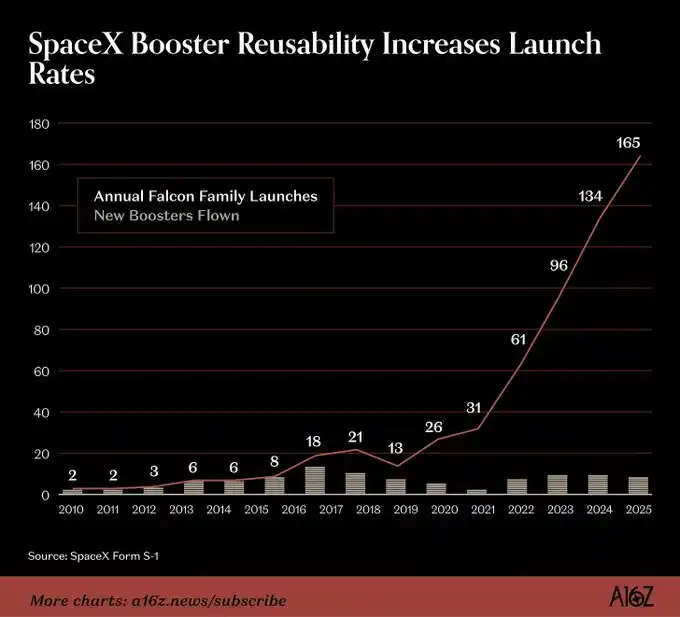
But SpaceX's advantage does not only come from economies of scale, vertical integration, and better strategies. It also comes from speed and culture.
Traditional aerospace companies seek to eliminate uncertainty through analysis. Using NASA's polite language, Boeing's Commercial Crew program "employs a mature systems engineering approach involving early emphasis on engineering research and analysis prior to constructing and testing to yield a mature system design." Measure twice, cut once. SpaceX, on the other hand, takes the opposite approach. The company manufactures a large number of cheap prototypes, pushes them to failure, learns from failure, and then iterates. The Starship testing program has produced the most spectacular series of explosions in spaceflight history, but each failure is a data point that tells the team where reality deviated from the model.
Anyone who has worked in both worlds at the same time can see this contrast. Garrett Reisman, a former NASA astronaut who flew two Space Shuttle missions, left NASA in 2011 to join SpaceX as a senior engineer. He once described the prevailing view of SpaceX within NASA: "They were a bunch of cowboys; they were dangerous; they were going to get people killed." What changed his mind was witnessing how SpaceX operates. "They could do in a month what might take a year at NASA. We were all just gobsmacked."
The clearest example is the Falcon 1 project. Between 2006 and 2008, SpaceX launched four Falcon 1 rockets from a small atoll in the Pacific called Kwajalein. The first three attempts failed, each in a different way, each with its own lessons. The first was a fuel leak. The second was an abnormal propellant sway. The third was residual engine thrust causing stage separation collision. By September 2008, the company had money left for only one more launch. It wasn't just SpaceX teetering on the brink. Musk's electric car company Tesla was also weeks away from bankruptcy. He had to decide whether to put the last of his PayPal cash into one company or split it between the two.
“That was really a very tough decision. Finally, I decided to split the remaining money in my hands, trying to keep both companies alive. But this could have been a terribly bad decision, and the result was both companies dying together,” Musk recalled. “I never thought I would have a nervous breakdown, but I was really close at that time.” He couldn't choose between the two because in his worldview, both missions were crucial: Tesla had to accelerate the world's transition to sustainable energy, and SpaceX had to make humanity a multi-planetary species. “All available resources had to be put into these companies,” Musk's then-fiancée Talulah Riley said in the BBC documentary series "The Elon Musk Show." “He gave me the opportunity to leave. He said, ‘The next part will be the hardest, and you don't have to stay to go through this with me.’”
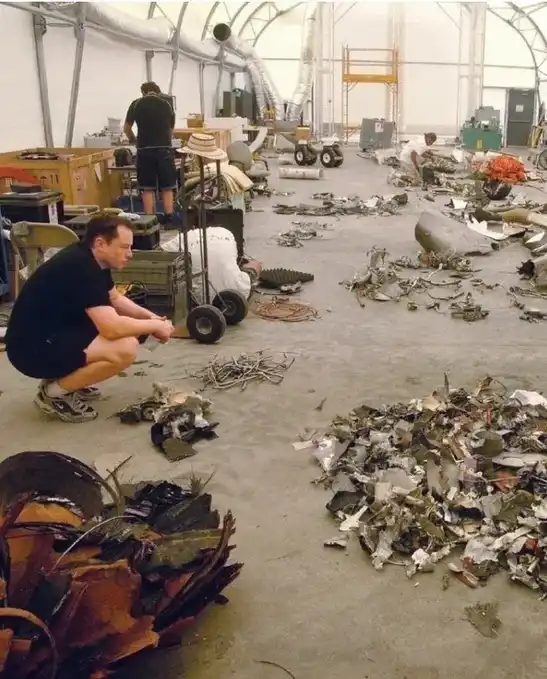
In 2006, Elon Musk surveys the wreckage of the first Falcon 1 on Omelek Island. (Image: Hans Koenigsmann)
The fourth launch attempt was a success. In December of that year, just a few weeks before SpaceX was about to run out of money, NASA awarded it a $1.6 billion cargo contract. When NASA called Musk to inform him, he was so overwhelmed with emotion that he blurted out, ‘I love you guys.’”
This pattern, formed from rapid failure and rapid correction, later became the culture of every project in the company. It is also the same pattern that allows SpaceX to iterate Starship between flights today, while traditional aerospace projects often take years to redesign the spacecraft from one flight anomaly.
The reason this approach is superior to alternative solutions is that when faced with problems you don't fully understand, you can't rely solely on thinking to find the perfect solution. Reality is the only sufficiently effective validator, and the key is to reduce the cost of consulting reality low enough so that you can consult frequently.
The above is the story-telling version of SpaceX's iterative cycle, but it also has a written version. Over the past two decades, Musk has encoded SpaceX's approach into a five-step operational process, which the company calls “the Algorithm.” Tim Berry, who worked at SpaceX for ten years leading the upper stage production teams for Falcon 9 and Falcon Heavy, said this method has been “injected into our brains.” Walter Isaacson published the standard version of this method in his Musk biography:
First, Question Every Requirement. Every requirement should come with the name of the person making that requirement. You should never accept a requirement from a department, such as Legal or Security. You need to know the specific individual who is actually making that requirement, and no matter how smart that person is, you should question the requirement. The most dangerous requests are those from smart people because they are less likely to be questioned. Then, make those requirements less stupid.
Second, Delete All Removable Parts or Processes. You may have to add them back later. In fact, if you don't end up adding back at least 10% of what was removed, you did not delete enough.
Third, Simplify and Optimize. This step should come after the second step. A common mistake is to simplify and optimize a part or process that shouldn't exist in the first place.
Fourth, Accelerate Cycle Time. Every process can be sped up. But this should only be done after the first three steps. Musk once said that in the Tesla factory, he made a mistake: he spent a lot of time speeding up a process only to realize later that it should have been deleted.
Fifth, Automate. Automation should come last. The mistake Tesla made in Nevada and Fremont factories was trying to automate from the beginning instead of questioning requirements, deleting parts and processes, and clearing out the bugs first.
Most engineering organizations jump straight to the fifth step. They take a process that shouldn't exist in the first place and try to automate it. SpaceX, on the other hand, goes through these steps sequentially every time, in every part of the company. When this "algorithm" has run on a piece of hardware enough times, it starts to look like nothing else in the industry.
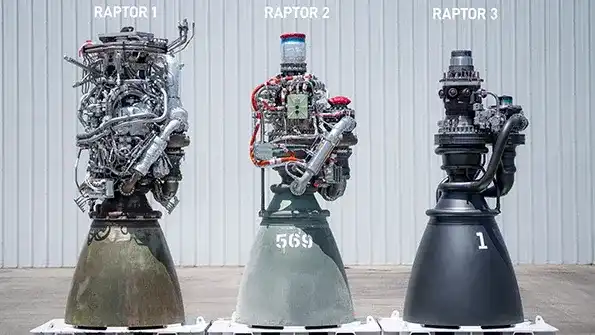
SpaceX's third-generation Raptor engine, from V1 to V3. (Image: SpaceX)
Raptor 3 is the result of a team iterating on the same engine for a decade. It has 22% more thrust and is 40% lighter than Raptor 2. It doesn't require a heat shield because the piping and wiring that used to hang outside the engine are now fused into the engine's metal structure through 3D printing. Musk has said, "Simplifying the Raptor engine, integrating the secondary flow paths, and adding regenerative cooling to the exposed components was mind-bogglingly hard. Nearly at the limits of known physics."
There is no known engine program in history that has iterated this quickly. The main engines for space shuttles have essentially been flying the same design for the last three decades. The RD-180 that powers the Atlas V is a derivative of a 1970s design. In less than a decade, SpaceX has gone through three entirely new designs of the Raptor engine, each significantly better than the last.
The same philosophy also applies to humans. By mid-2018, Falcon 9 reusability had reached a reliable cadence, and Musk turned his attention to the satellite internet constellation, a project that would later fund everything upstream. The Starlink team was based in Redmond, Washington, with many senior engineers coming from Microsoft, and the development pace there was slower than Musk desired. In June, he flew to Redmond and fired the senior leadership team. He then brought young star engineers from the rocket side of the business and gave them a year to launch the first batch of operational satellites. This management style was extremely brutal. From media reports at the time, the department seemed to be imploding. But 11 months later, in May 2019, the first batch of satellites launched. Musk cleared the bottleneck and moved on to tackle the next issue.
This is how he runs everything. In 2018, when Tesla was in "production hell," trying to ramp up Model 3 production capacity and burning cash at a life-threatening rate, Musk literally moved into the factory. Years later, he recalled in an interview, "I slept on the floor in the Fremont factory and the Gigafactory. I stayed there for [sic] years. I worked so hard I could sleep on the floor. And I was so visible that people could see I was there. That is super motivating for the team, to see the CEO sleeping on the floor. They’re going to give it everything.” Later, he turned this into a company-wide rule: the higher your rank, the more visible you must be.
To find a historical parallel to Musk's CEO modus operandi, you have to go back to the late 19th and early 20th centuries, the era of industrialists: Henry Ford, Andrew Carnegie, Thomas Watson, Andrew Mellon, Cornelius Vanderbilt. What makes Musk’s operational style unique is his relationship to the specific work at hand. It is said that he shows up at each of his companies every week, identifies the biggest problem, and solves it. He does this for 52 weeks straight, and then each company has probably addressed the 52 most crucial issues of that year.
An engineer who joined SpaceX from another aerospace company described his experience as follows: "It’s like being airdropped into an amazing ability zone. Everyone around you is absolutely at the top of their game."
Star Cluster
SpaceX may look like one company, but a more useful way to understand it is: it is a hub in a company star cluster. These companies, all run by the same person, operate toward the same long-term mission, and are almost inseparable from each other. For over two decades, Musk has been assembling a set of companies, each of which solves a bottleneck that would otherwise hold the others back. And now, they are starting to compound.
The February merger with xAI was a snapshot of what SpaceX is becoming. If compute eventually goes to orbit — Musk’s bet — then SpaceX has the most credible path to deploying it at the scale AI needs. Sending mass to space and manufacturing intelligence at scale may prove to be the two most decisive capabilities over the next few decades, and now they reinforce each other under one roof.
xAI brought Grok, a cutting-edge model that, due to its access to X’s real-time data firehose, is uniquely positioned for real-time information. xAI also brought the engineers who rapidly built Colossus 1 and Colossus 2 supercomputers at speeds many thought impossible.
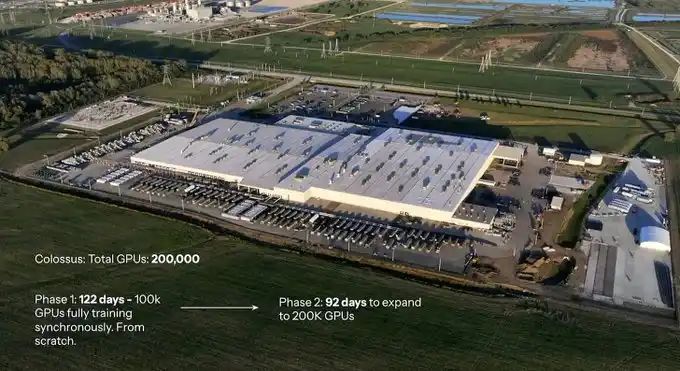
Colossus 1. (Image: xAI)
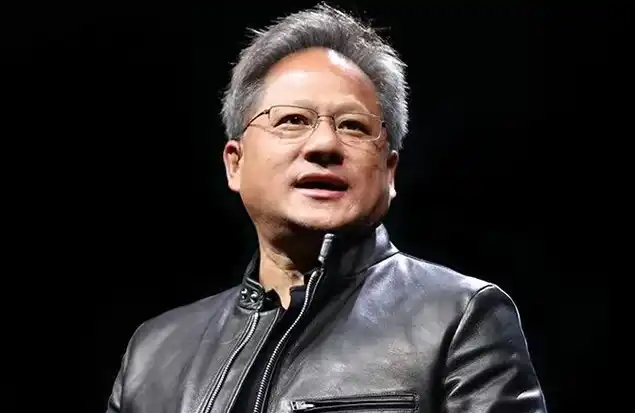
The construction of Colossus is worth pausing to consider. xAI took over an old factory in Memphis and had 100,000 GPUs training within 122 days. Once the racks started coming in, they had the cluster up and running in just 19 days. Nvidia CEO Jensen Huang, in praising Musk, said, “From a concept to building a large factory, liquid-cooling, powering, permitting, and getting it done in that kind of time is superhuman. To my knowledge, there’s only one person in the world that could have done that. What they've accomplished is unique. Nobody has ever done this before. 100,000 GPUs as a cluster was easily the fastest supercomputer on Earth at the time. Typically, such a supercomputer takes three years to plan, then the equipment gets delivered, and it takes another year to get everything running.”
A project that would take other industry companies at least four years was accomplished by Musk and the xAI team in four months.
In May, Anthropic agreed to pay SpaceX $1.25 billion per month for the entire compute of Colossus 1. Weeks later, in a revision to its IPO filing, SpaceX disclosed that Google would pay $920 million per month for the right to use 110,000 GPUs, roughly half of what Anthropic is getting. The two deals total approximately $26 billion in annual revenue, all from just two customers, a business that did not exist until earlier this year when SpaceX absorbed xAI. Chips, power, and land are all scarce, and SpaceX is becoming one of the few companies with enough AI infrastructure to both rent out compute and pursue ambitions of building cutting-edge models of its own.
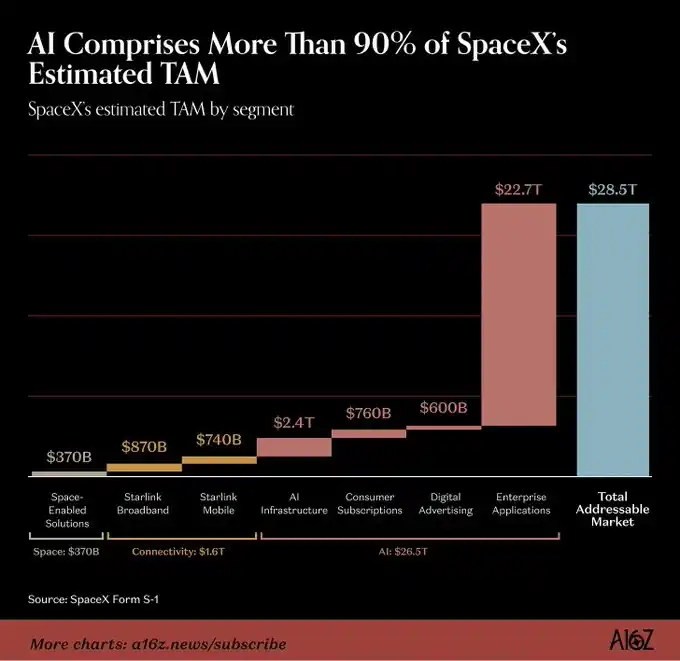
xAI, obtained from SpaceX, is a longer-lasting solution to address power constraints. Musk believes that in the coming years, power will be the bottleneck for AI. To generate enough power to meet his anticipated intelligence needs, extensive development of the electricity grid, new power plants, and industry fundamentals that can't wait are required, involving years of approval processes. In his view, orbital solar power is the way out because it is essentially limitless. SpaceX is the only company with a scalable means to send computing power into space. Whether he is correct is one of the most important open questions in the tech sector. However, SpaceX's IPO filing reveals that the company is taking this bet extremely seriously: it anticipates AI to become the company's largest market to date. Compared to these ambitions, the space business that founded the company seems almost like an afterthought.
Tesla is another crucial piece in this constellation and the integration of the two unfolds in a different way. Tesla and SpaceX share the same founder, the same talent pool, the same operating culture, and a set of increasingly overlapping technology roadmaps.
Tesla provides three things for this side of the constellation with SpaceX-xAI. First is chips: AI5, AI6, and Dojo3, all designed in-house by Tesla. Musk has made it clear that these chips are not just for cars but are components of a larger constellation computing stack. AI5 is responsible for autonomous driving inference, AI6 is aimed at Optimus and AI data centers, while Dojo3 is designed to pair with the planned AI7 for orbital computing. Second is robotics. Tesla's bet is that Optimus will become the physical AI layer for factories, warehouses, and homes, enabling these scenarios to operate without human labor and ultimately serve Musk's envisioned cities on the moon and Mars. Third is solar power. Musk has said that Tesla and SpaceX are each moving toward building 100 gigawatts of solar battery capacity per year to support AI development on Earth and in orbit.
Next is TeraFab. In April, Tesla disclosed that the company had begun ordering equipment for a research semiconductor fab located at the Giga Texas site. Musk told investors on Tesla's Q1 2026 earnings call, "We expect it to be about a $3 billion project that can produce thousands of wafers per month." SpaceX, on the other hand, is separately investing in a significantly larger facility because no existing wafer fab can scale up to Musk's envisioned pace. Once mature, this facility is designed to have a production capacity of approximately 1 million wafers per month. Musk envisions the scale in gigawatts. "This is not something we're committing to doing," Musk said last week. "This is something we're going to try to do and see if we can do it: get to about 1 gigawatt annualized rate in space AI computing by the end of next year. Then, ideally, increase by an order of magnitude every year. So, two and a half years in, reach an annualized rate of 10 gigawatts per year. Three and a half years in, maybe reach 100 gigawatts. And then, depending on chip manufacturing elsewhere in the world and progress with TeraFab, expand further to a terawatt per year, which is a thousand gigawatts. That's twice the U.S. power consumption."
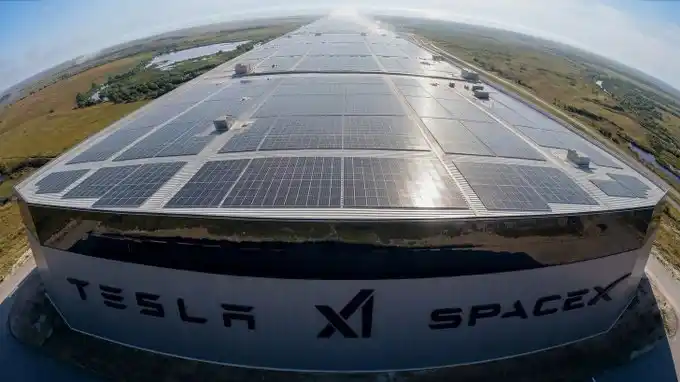
SpaceX's TeraFab is designed to achieve a 1 terawatt output per year, roughly equivalent to twice the current electricity consumption of the United States. (Image: terafab.ai)
Comparing Musk to the Gilded Age does touch on some truths while also pointing out the differences. Carnegie built a steel empire; Vanderbilt built a railroad empire. Each dominated a sector of the industrial foundation of their time. Musk, on the other hand, is attempting to advance multiple fields simultaneously—space, energy, artificial intelligence, robotics, tunnels, brain-machine interfaces, autonomous vehicles—and bend them all toward a singular goal that most consider far-fetched. Whether it will all ultimately succeed is truly unknown, and many parts of it may not. But the attempt itself has no historical precedent and could be a preparation for a different century.
The World Unveiled by SpaceX
Before the retirement of the space shuttle in 2011, the cost to send one kilogram of cargo into orbit was approximately $54,500. Musk expects this cost to decrease to $100 per kilogram with the maturity of Starship. When the cost of reaching space drops by over 500 times, all industries theoretically viable in space will begin to be economically feasible. There are many such industries.
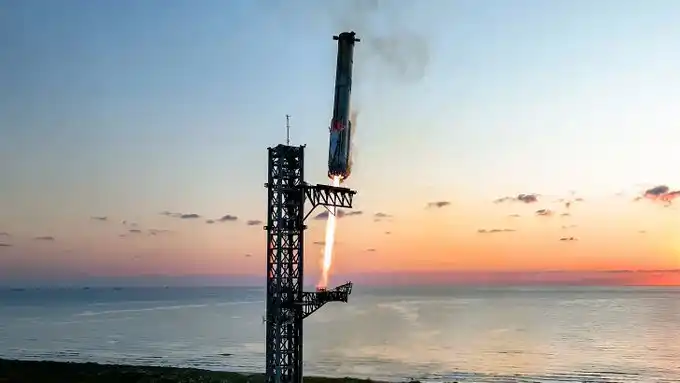
The design goal of Starship and Super Heavy is to return to the launch site after flight and be captured by the launch tower, enabling rapid turnaround and relaunch without refurbishment. (Image: SpaceX)
The closest historical analogy might be the transcontinental railroad. Before 1869, traveling from New York to San Francisco took six months by stagecoach, costing roughly equivalent to a year's salary, with a very real risk of death. After 1869, this journey took just one week. The railroad itself was an incredible engineering feat, but the real story is what it opened up: meatpacking titans like Sears Roebuck, Swift, and Armour, Standard Oil, and eventually U.S. Steel, which consolidated the industrial empires born during the railroad boom.
If the Falcon 9 is equivalent to the transcontinental railroad of the space age, then Starship might be akin to the airplane's upgrade. The railroad opened up an entire continent. The jet age opened up the entire planet. Starship will open up the solar system.
Industrializing the Moon
Since humans first looked up at the Moon, it has held scientific significance. Now, it is beginning to hold economic significance as well, as it is an entire world made up of industrial materials.
Let's start with how things can be taken off the Moon. As mentioned earlier, the Moon only has one-sixth of Earth's gravity and no atmosphere, making mass drivers, not rockets, the natural way to launch goods off the lunar surface. This will fundamentally change the economics of transportation. Once the infrastructure is in place, the marginal cost of delivering finished goods is primarily determined by electricity, not fuel; and on the Moon, the electricity is sunlight. A package is launched off the lunar surface, reenters Earth's atmosphere with a heat shield, deploys a parachute, and lands at a recovery site. When the throughput is large enough, the marginal cost starts to resemble shipping more than spaceflight.
Next is what can be manufactured there. The same regolith that can provide the silicon and aluminum needed for solar panels and satellites is also the raw material for the entire industrial base. The 2030s and 2040s could see a vision of a space revolution: automated mining vehicles processing regolith around the clock, smelters producing aluminum and silicon, and factories assembling satellites, solar panels, and the chips that power them. Most industries on Earth have a lunar version waiting to be built, and SpaceX cannot build all of these alone. Those who build the "Lunar Alcoa," "Lunar Caterpillar," and "Lunar Union Pacific" will be the titans of the 21st century.
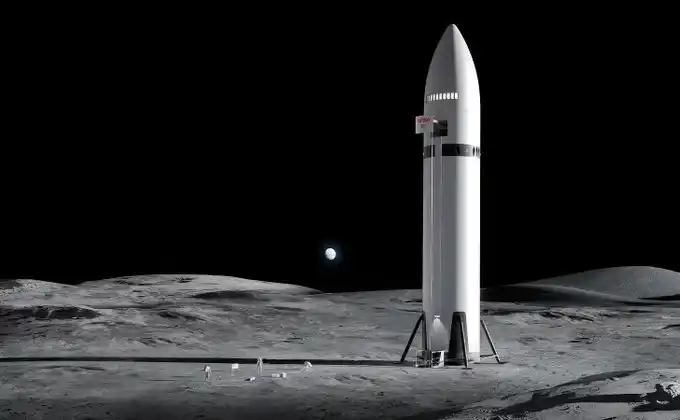
Starship HLS is the lunar lander designed by SpaceX for NASA's Artemis program, aiming to return humans to the lunar surface for the first time in over 50 years and deliver foundational modules for a sustained presence near the lunar South Pole. (Image: SpaceX)
Compute Power in the Sky
By 2030, the bottleneck for artificial intelligence is likely to be power, not chips. The obvious response would be to build more solar in Texas or Nevada, but this will hit a wall faster than people imagine. 1 terawatt of continuous solar power requires about 1% of the U.S. land area, and new utility interconnections take a year or more. Building Colossus in Memphis for xAI requires deploying an entire fleet of temporary gas turbines, clashing with state permit approvals, and establishing an independent power nexus across the state line in Mississippi just to bring 1 gigawatt online. Scaling this to the hundreds of gigawatts needed for AI construction is simply impractical. Even the orders for the internal vanes and blades for gas turbines providing backup power for solar are already scheduled beyond 2030.
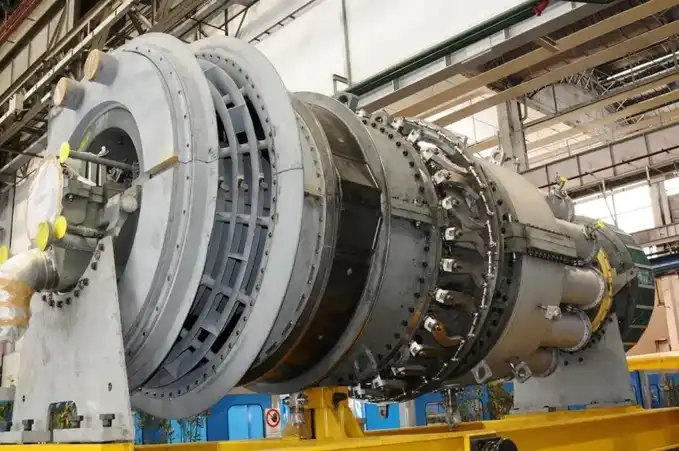
Baker Hughes Frame 5/2C Gas Turbine Generator. The casted stator vanes and blades inside such turbines are produced by a few specialized foundries, and these foundries are booked out until beyond 2030. A hyperscale cloud provider's data center would require dozens of such units. (Image: Baker Hughes)
The solution is to move computing power where the sunlight is already. As Starship achieves daily flights and orbital deployment becomes routine, this will become easier. With the cost curves of rocket launches, solar panels, and chips continuing to drop, the economics will further improve. SpaceX CFO Bret Johnsen explained, "We're ramping factory capacity and benefiting from the decline in silicon costs, so our costs will go down over the next few years. If you look at ground-based solutions, the curve is going in the opposite direction. Everything is getting more expensive: cooling, power costs won't come down, land and regulations are getting more challenging."
A common objection comes from those who, upon hearing "space data center," imagine launching a Colossus-sized building into orbit, but that's not the case. "It's probably the size of a Blackwell rack with maybe 500-foot solar wings on each side. You put it in a sun-synchronous orbit so the solar panels are always in sunlight," said SpaceX early investor Gavin Baker. "Over the years, I've spent a lot of time in Starbase and talked to a lot of SpaceX engineers. I genuinely believe this is the most talented group of engineers on the planet, and they are very confident they've cracked this."
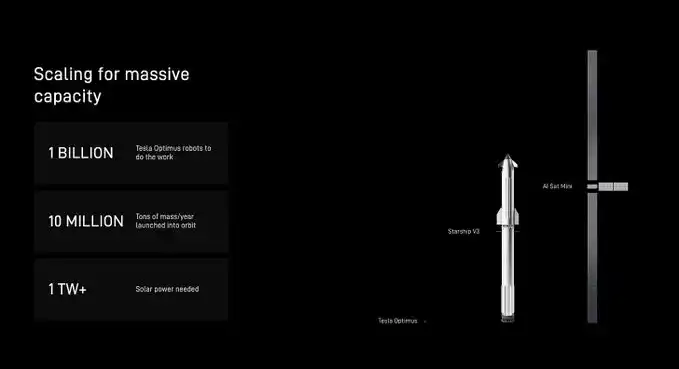
AI Sat Mini is built for solar power utilization. (Image: terafab.ai)
In fact, Musk believes that AI Sat Mini would be easier to build than Starlink satellites. "You still need some laser links, but you don't need those incredibly complex phased-array antennas on Starlink satellites," Musk explained. "Compared to that, the AI satellite is easier to design...the AI satellite doesn’t need any magic. A lot of the tech we’ve already designed for Starlink V3 satellites. We don’t think it’s a particularly hard problem compared to what we’ve already done."
He predicts that within five years, SpaceX's annual orbital AI computing power launched will surpass the total installed computing power on Earth. A rough estimate is 10,000 Starship launches per year, meaning more than one launch per hour around the clock. By the end of the 2030s, with the Mass Driver on the Moon coming online, the petawatt threshold will come into view: the equivalent of 1,000 times the 2030 deployed computing power, launched into deep space at a pace of one satellite every few minutes.
Mars
The Mars trajectory was originally supposed to begin this year. Musk had announced in September 2024 that SpaceX would launch five unmanned Starships to Mars in November 2026's transfer window, carrying the Optimus robot to test the landing system, search for ice, and begin building infrastructure for future manned missions. In May 2025, he said the likelihood of meeting this timetable was 50-50, but earlier this year, the situation changed.
In a February 8th X post, Musk announced that SpaceX would postpone the Mars timetable and shift short-term focus to building a self-sustaining city on the Moon. The reason is that the Mars launch window opens only every 26 months and requires six months of flight time; in contrast, the Moon has a reachable window every ten days, with a flight time of only two days. "This means that, instead of a Mars city, we can iterate and complete a Moon city much faster," he wrote. "That said, SpaceX will also work on building a Mars city and will start doing so in about five to seven years, but the top priority is to ensure the future of civilization, and the Moon is quicker."
Superficially, this appears to be a pivot, but it is actually a moment when the path to a million-person Mars city becomes clearer.
The orbital data center theme gradually became clear from late 2025 to early 2026, giving the Moon a new role. Achieving petawatt-level orbital computing power requires mining, smelting, and manufacturing solar panels, radiators, and satellite structures on the Moon and launching them into orbit using a Mass Driver powered by lunar resources. An industrial base of this scale requires a permanent population, and a permanent population requires a city. This city can be fully funded by the orbital computing industry while also serving as a rehearsal for Mars. Every issue that SpaceX must address to build a self-sustaining Mars city—radiation shielding, life support, in-situ resource utilization, extraterrestrial governance, a supply chain spanning gravity wells—is also a problem that must be solved first when building a Moon city. Building a Moon city will allow SpaceX to learn how to build a Mars city through much faster iterative cycles.
According to Musk's proposed timeline, the first unmanned lunar landing demonstration is targeted to take place as early as 2027, with a lunar city to follow within less than a decade. Mass driv...
By the time the first child born on Mars asks their parents why their family is there, the Starship will have been flying daily for thirty years. At the end of the block, a factory operated by Optimus robots, running on Grok's descendant model, has been self-improving for twenty years. The computing power that sustains the city she is in comes from space-based data centers; these data centers are built using lunar regolith by other robots and launched into space by a mass driver. For almost a generation, this mass driver has been hurling them into deep space at a rate of one satellite every few minutes. Her parents arrived on Mars aboard a spacecraft named after a starship in Iain M. Banks' novels because, at some point in the early 21st century, someone who had read those books in their youth decided to spend a lifetime turning them into reality.
Banks understood those who would choose to go to Mars. *The Culture* is paradise, but the most interesting characters in his stories are those who leave paradise. This civilization has solved the scarcity issue, leaving behind only humanity's desire for a challenging journey. Even though paradise is next door, the meaning lies in the frontier.
Musk once said that the recruitment pitch for early Mars colonists would be "Shackleton's ad," originating from the famous recruitment notice for the 1914 Antarctic expedition: "Men wanted for hazardous journey. Low wages, bitter cold, long months of complete darkness, constant danger, safe return doubtful. Honour and recognition in case of success." This ad is almost certainly apocryphal, but it has been retold for a century because it captures something true about volunteers.
What makes this attractive to some people?
Musk said, "Life cannot just be about solving one miserable problem after another. There must be things that inspire you, that make you glad to wake up in the morning and be part of humanity. Earth is the cradle of humanity, but you cannot stay in the cradle forever. It is time to go forth, become a space-faring civilization, be out there among the stars, expand the scope and scale of human consciousness. I find that incredibly exciting. That makes me glad to be alive. I hope you feel the same."
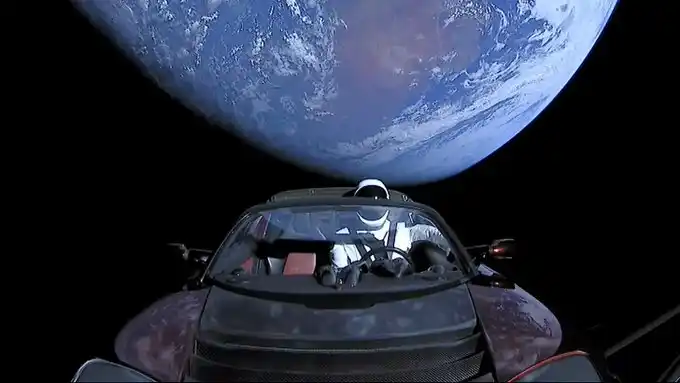
Starman, a mannequin dressed in a SpaceX spacesuit, sits at the wheel of Elon Musk's personal Tesla Roadster, orbiting the Sun. This car was the payload for the first test flight of the Falcon Heavy on February 8, 2018. In its current orbit, it will pass near Mars approximately every Earth year for about the next million years. (Image: SpaceX)
Welcome to join the official BlockBeats community:
Telegram Subscription Group: https://t.me/theblockbeats
Telegram Discussion Group: https://t.me/BlockBeats_App
Official Twitter Account: https://twitter.com/BlockBeatsAsia
 Related Articles