Anthropic's Top Model Locked Up in 24-Hour Period: 3 Phone Calls, Betrayal by Majority Shareholder, and Loss of Narrative Control
On June 13, Anthropic's two most advanced models were paused by the U.S. government.
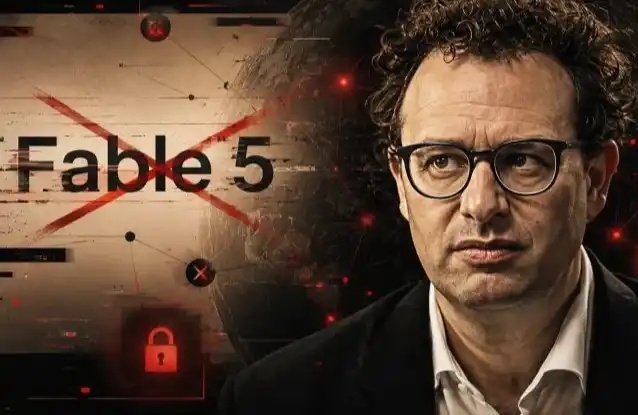
One was Fable 5, and the other was Mythos 5. The former had just been publicly released, while the latter was geared towards more restricted cybersecurity clients. The ban came from the U.S. Department of Commerce, covering overseas clients as well as foreign nationals within the U.S. Anthropic's final decision was straightforward: take everything offline.
After reviewing all the details surrounding this incident, we have roughly outlined the 24-hour timeline.
On Thursday, June 11, just two days after the public release of Fable 5, Amazon CEO Andy Jassy raised concerns to the White House. He was worried that Fable 5's security guardrails could be circumvented. Amazon researchers allegedly guided Fable 5 to disclose information that should have been restricted, information that could be exploited in cyberattacks.
By the morning of Friday, June 12, the issue had reached a top-level meeting at the White House. Treasury Secretary Scott Bessent, White House Cybersecurity Director Sean Cairncross, White House Chief of Staff Susie Wiles, and other senior officials participated in the discussion. Bessent, who was en route to Houston at the time, joined the meeting remotely.
Then came the three-way call.
When Anthropic CEO Dario Amodei joined the call, he was facing roughly half a dozen senior officials. In addition to Bessent and Cairncross, Commerce Secretary Howard Lutnick was also present. Other participants included Commerce Deputy Secretary for Industry and Security Jeffrey Kessler, Chief of Staff to the President Will Scharf, Deputy Chief of Staff Richard Walters, and Presidential Assistant for Policy Walker Barrett.
Amodei tried to explain the situation as a misunderstanding. He believed that what Amazon had discovered was a specific circumvention method, not a general tip that could widely dismantle the security guardrails. Anthropic later publicly stated that testers had not found a method to broadly bypass the model's security systems.
However, the White House was not convinced.
Amazon CEO's findings were sent for assessment to the National Security Agency, and the White House felt they had sufficient evidence. The government requested Anthropic to voluntarily take the models offline and collaborate with them to address the vulnerabilities. Amodei wanted more time and information but did not commit to taking the models down. Bessent directly stated over the phone that he had made a "mistake."
Subsequently, export controls were imposed.
On the other hand, the Anthropic side presented a different narrative. They claimed that the White House only provided a 90-minute notice to take the model offline and did not specify actual threat details. The White House, on the other hand, stated that the export control was a last resort after Anthropic failed to cooperate for hours.
Another key point of this incident is Amazon's delicate position.
By the end of 2024, Amazon had made an additional $4 billion investment in Anthropic, bringing the total investment to $8 billion. Anthropic also designated AWS as its primary training partner, indicating that future model training and deployment would use AWS chips. Claude has consistently been one of the most critical models on Amazon Bedrock.
Microsoft and OpenAI's alliance has been public, so Amazon's backing of Anthropic was originally a way around this situation.
Microsoft has OpenAI. Google has Gemini and has also invested in Anthropic. Amazon lacks a sufficiently strong in-house cutting-edge model, so it can only leverage AWS's computing power, Trainium chips, and the Bedrock platform by tying them to external model companies.
However, a year and a half later, Amazon also established a connection with OpenAI.
This year, Amazon was in talks to invest up to $50 billion in OpenAI. At that time, OpenAI was seeking up to $100 billion in new financing, and potential deals might include OpenAI purchasing Amazon AI chips. Axios also mentioned that OpenAI's 2025 annualized revenue exceeded $20 billion, but the spending commitment reached $1.4 trillion.
Amazon needs cutting-edge model companies to consume AWS computing power, validate their in-house chips, fill data centers, and also place the most powerful models on their corporate cloud shelves. This is no longer just a financial investment.
Therefore, Amazon both invested in Anthropic and approached OpenAI. They are not only benefactors of model companies but also suppliers. They need to help sell their models and explain to the government how dangerous these models can be.
In the end, Amazon found itself on the opposite side of Anthropic this time. In Anthropic's view, a partner that provides money, cloud services, chips, and distribution channels offered a security signal significant enough to trigger a ban. Of course, Amazon's stance is, "The White House asked me, and I simply responded to their questions."
Over the past two years, AI companies have liked to package themselves as national assets. The stronger the capability, the higher the valuation, the smoother the financing, and the more imaginative the government procurement. Anthropic is particularly good at this narrative. It uses more cautious security language to differentiate itself from OpenAI, and it also uses the rhetoric of "frontier risks" to convince regulators that it should be taken seriously.
Now, the U.S. government has truly treated models as national security assets.
The confusion of White House officials also stems from this. Politico reported that on one occasion, Amodei likened the dangers of Anthropic's technology to a nuclear bomb. When he refused to take a model offline due to a known security vulnerability, government officials did not see this as a technical disagreement, but rather an attitude issue.
This is not the first clash between the two sides. On March 3, the Pentagon listed Anthropic as a supply chain risk because Anthropic refused to allow its AI tools to be used for large-scale domestic surveillance and autonomous weapons.
Anthropic and U.S. officials have had conflicts before.
And this time, Anthropic stated that the government directive did not specify specific national security concerns, and criticized this action for lacking transparency, clarity, and a legally established process based on technical facts. Anthropic believes that this issue is more like a narrow bypass method that is not sufficient to support such a broad ban.
But from the government's perspective, model security is no longer the company's internal process of writing white papers, conducting red team tests, and releasing system cards on its own. Who can access the model, who can train the model, whether foreign employees can view the model weights, all will be brought into the language of export controls.
When Anthropic announced in April that Mythos was only open to a limited number of tech and cybersecurity companies, it had already held multiple rounds of meetings with the White House. Prior to the launch of Fable 5, it also underwent reviews by the U.S. government and the U.K. AI Security Institute. On the side of Anthropic, it is believed that the government did not raise objections before the model release.
This has made the conflict more unsightly.
Prior to model release, it was about security collaboration. After model release, it becomes about national security.
OpenAI is watching this incident from the sidelines.
Anthropic was forced to take down its most powerful model, making OpenAI's relative position more comfortable. The more Anthropic is entangled in regulatory issues, the easier it is for OpenAI to become the option that "can collaborate." If Amazon indeed continues to get closer to OpenAI, it will also add another layer of hedge.
Of course, there is no public evidence to suggest that Amazon's involvement was to assist OpenAI in combating Anthropic.
The sharper reality is that as current-gen models enter the trillion-dollar capital expenditure cycle, partnerships are no longer clean-cut. Cloud providers invest in model companies, model companies purchase cloud compute, governments approach cloud providers for security risks, and competitors red team each other in the same regulatory arena.
Patron, vendor, distributor, auditor—all now played by the same set of companies.
This is more critical than a certain jailbreak hint.
On the night Fable 5 and Mythos 5 were shut down, Anthropic lost more than just two models' access points. It lost a bit of control over its own narrative.
Amazon's hand still rests on the AWS console. The OpenAI funding table has not yet dispersed. The U.S. government is already seated in the front row of the model launch event.
Welcome to join the official BlockBeats community:
Telegram Subscription Group: https://t.me/theblockbeats
Telegram Discussion Group: https://t.me/BlockBeats_App
Official Twitter Account: https://twitter.com/BlockBeatsAsia
 Related Articles