Why Does Capital Flow into Storage First During an AI Market Rebound?

TL;DR
· After a significant derisking of the U.S. chip stocks on June 5, Micron rebounded nearly 10% on June 8, and on June 9, the Korean market followed suit with SK Hynix and Samsung Electronics seeing notable gains.
· Combining earnings reports, DRAM/NAND price increases, and Korean chip export data, the current focus is on storage being more easily revalued by the market based on EPS upgrades.
· Related assets: Micron, SK Hynix, Samsung Electronics, Western Digital, SanDisk, NVIDIA, Broadcom, Marvell, Coherent, Credo, SOXX Semiconductor ETF, SMH Semiconductor ETF.
After the semiconductor plunge on June 5, the market's attention quickly shifted from "why did it fall" to another question: who will be the first to rise after the fall.
The answer was not uniform. According to Reuters, the market capitalization of U.S. listed chip stocks evaporated by over $1 trillion at one point, with the Philadelphia Semiconductor Index dropping nearly 8.5% intraday. At the individual stock level, Micron fell by about 13.25%, NVIDIA by about 6.2%, AMD by about 10.86%, and Broadcom by about 7.92%. However, by June 8, Micron quickly rebounded nearly 10%; on June 9, SK Hynix and Samsung Electronics in the Korean market also strengthened simultaneously.
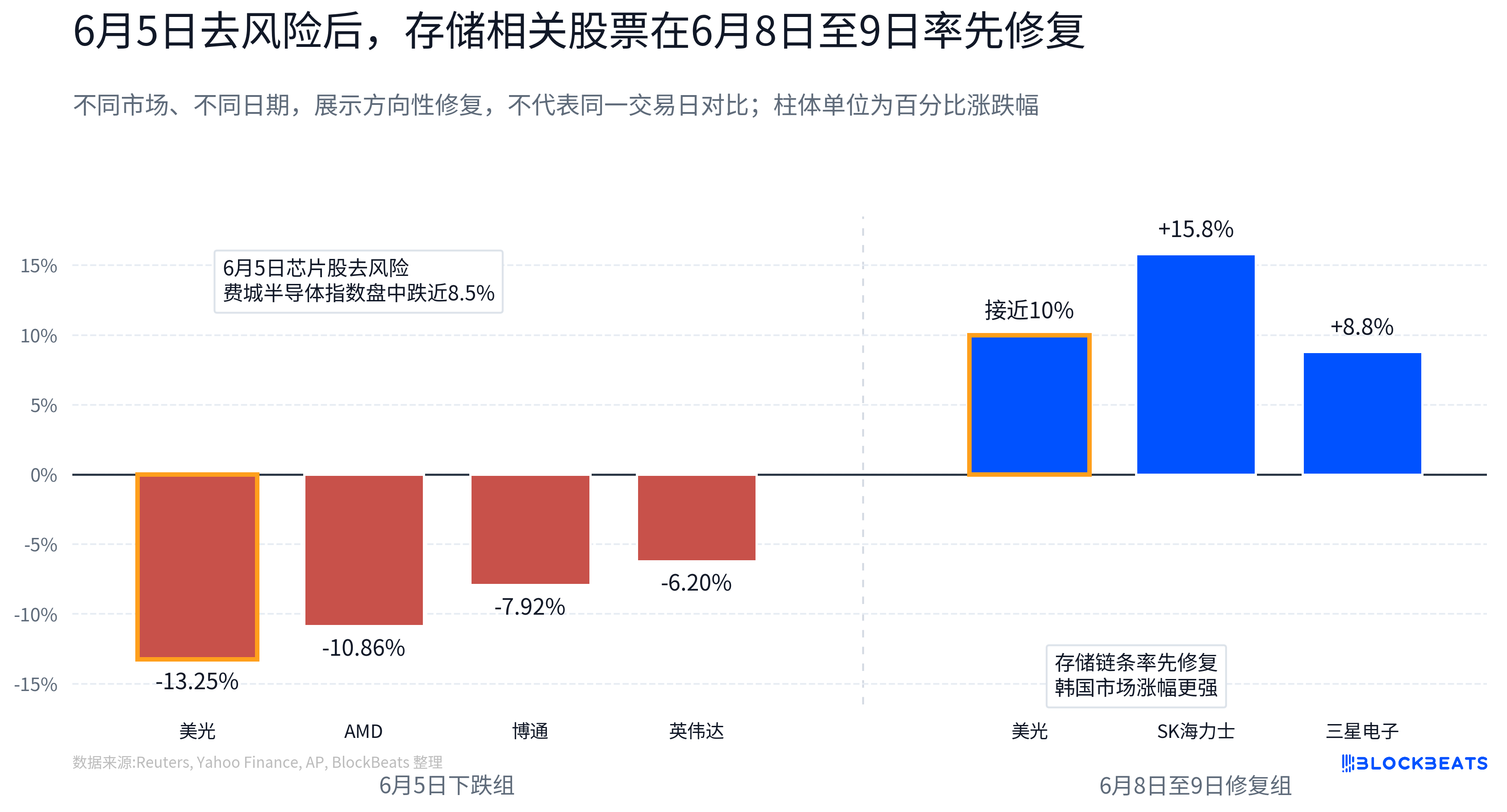
Money did not leave the AI semiconductor space but rather underwent internal sector rotation. As valuations began to undergo scrutiny, the market's focus also shifted from "who has the AI story" to "who can most quickly convert AI demand into profit." Compared to parts of the AI hardware chain still trading on future product cycles, customer adoption, and capital expenditure expansion expectations, storage demand growth has already been more directly reflected in orders, prices, and earnings reports.
This is also why storage was the first to receive a flow of funds back. What the market bought back was not just storage itself but the more easily validated EPS growth logic behind it.
The Plunge Implies a Reassessment of High Expectation Trades
One of the trigger points for this derisking was the expectation miss after Broadcom's earnings.
In absolute terms, Broadcom's fundamentals are not weak. According to the company's announcement, FY2026 Q2 revenue was $22.2 billion, a 48% year-over-year growth. The company expects total revenue of around $29.4 billion in FY2026 Q3, with AI semiconductor revenue expected to reach $16 billion, a growth of over 200% year-over-year.
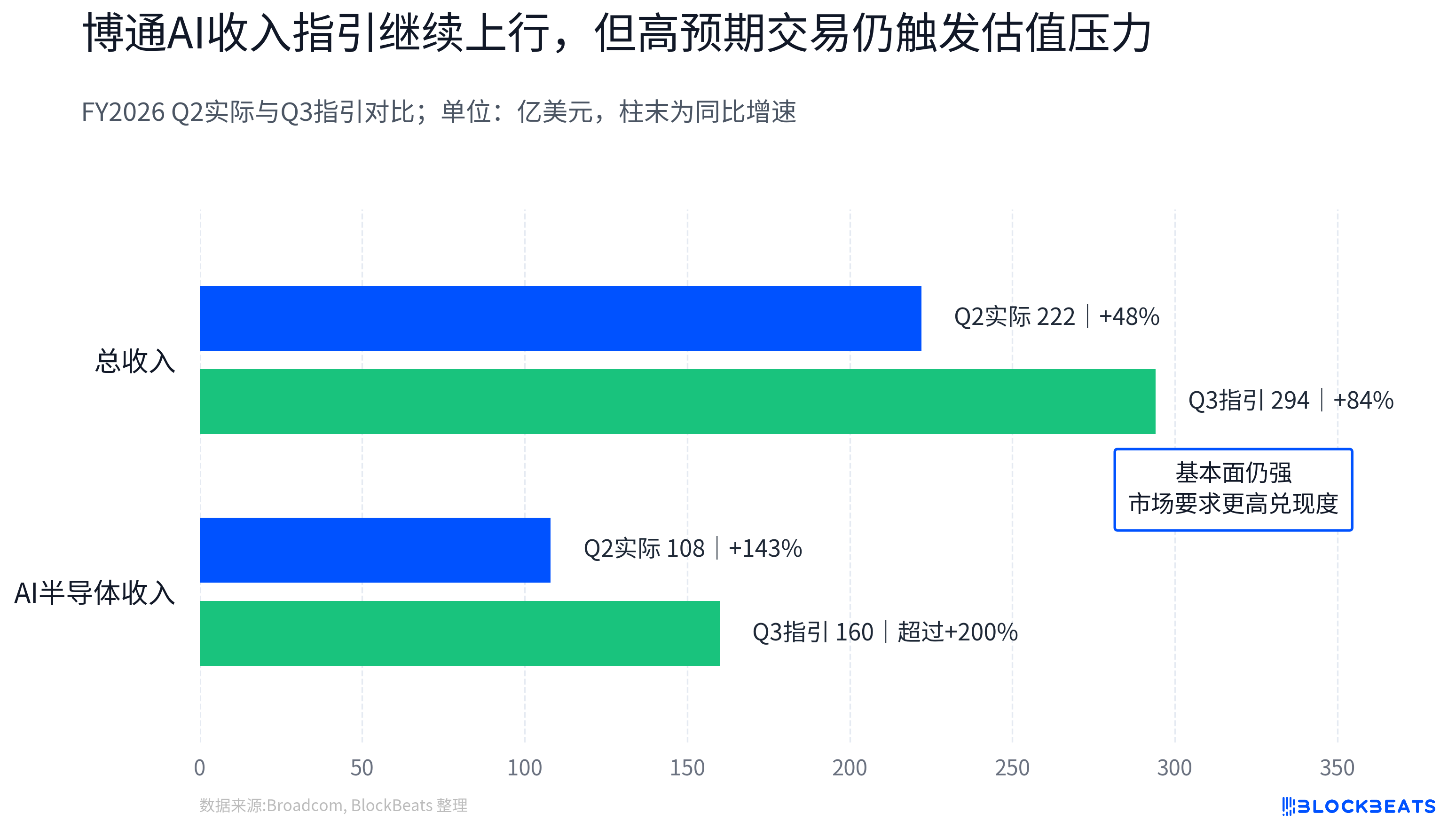
However, the market chose to sell. The reason was not a sudden disappearance of AI demand, but rather that AI semiconductor assets had already built up high expectations over the past year. Even a fundamentally strong company can experience selling pressure if its AI revenue guidance falls below some expectations, indicating a shift in the market's pricing threshold. Simply belonging to the AI ecosystem is no longer sufficient; growth trajectory, profit realization, and next-quarter guidance all need to align with valuation.
This is the significance of the sharp drop on June 5th. It was not a demand collapse stress test, but a pressure test on high-expectation trades.
Previously, the main theme of AI semiconductors was more like "who is closer to AI CAPEX." Whether it was GPU, ASIC, high-speed optical modules, copper interconnects, or material equipment that could be integrated into the AI cluster expansion chain, valuation premiums could be obtained. However, when the market began to worry about crowded trades, overvaluation, and the pace of guidance realization, the question shifted from "who has an AI story" to "who can quickly turn AI demand into financial reports."
For the stock market, what ultimately determines valuation is not the orders themselves, but whether the orders can be converted into earnings per share (EPS). Because, in the long run, stock prices are fundamentally a pricing of a company's profitability. When the market starts focusing on next-quarter profits rather than a story three years out, changes in EPS are often more important than the narrative itself.
Therefore, Broadcom's role also carries a signaling significance. It is one of the core assets in the AI ASIC and network chip chain. Because of its strength, the stock price reaction after the earnings report indicates that the AI semiconductor chain is undergoing a higher validation standard.
Why Storage: Price and Profit are Already in the Model
The advantage of storage is that the EPS transmission chain is shorter.
What AI server demand first changed was the supply-demand relationship of high-value-added products such as HBM, server DRAM, and enterprise SSD. Cloud providers and AI system manufacturers need more computing power, which means they require more GPU-attached memory, higher-capacity server memory, and larger-scale data center storage.
After storage manufacturers shifted their capacity to HBM and high-end server products, the supply of traditional DRAM and NAND will be further squeezed, and contract prices will rise. This chain does not entirely depend on long-term imagination but rather quickly enters revenue, gross margin, and EPS.
Micron's financial report has already reflected this change. According to the company's announcement, FY2026 Q2 set multiple records for revenue, gross margin, EPS, free cash flow, etc. Data center-related revenue saw a significant year-over-year growth, and FY2026 Q3 guidance continues to significantly hit new highs. For Micron, AI storage is no longer a long-term vision but a revenue source entering the quarterly financial statements.
SK Hynix's report is more straightforward. According to the company's announcement, the 1Q26 revenue was 52.5763 trillion South Korean won, operating profit was 37.6103 trillion South Korean won, and the operating profit margin reached 72%. The company attributed the growth to high-value-added products such as HBM, high-capacity server DRAM modules, and eSSDs. For investors, this profit margin reflects the product mix, supply-demand dynamics, and pricing power all entering the financial statements.
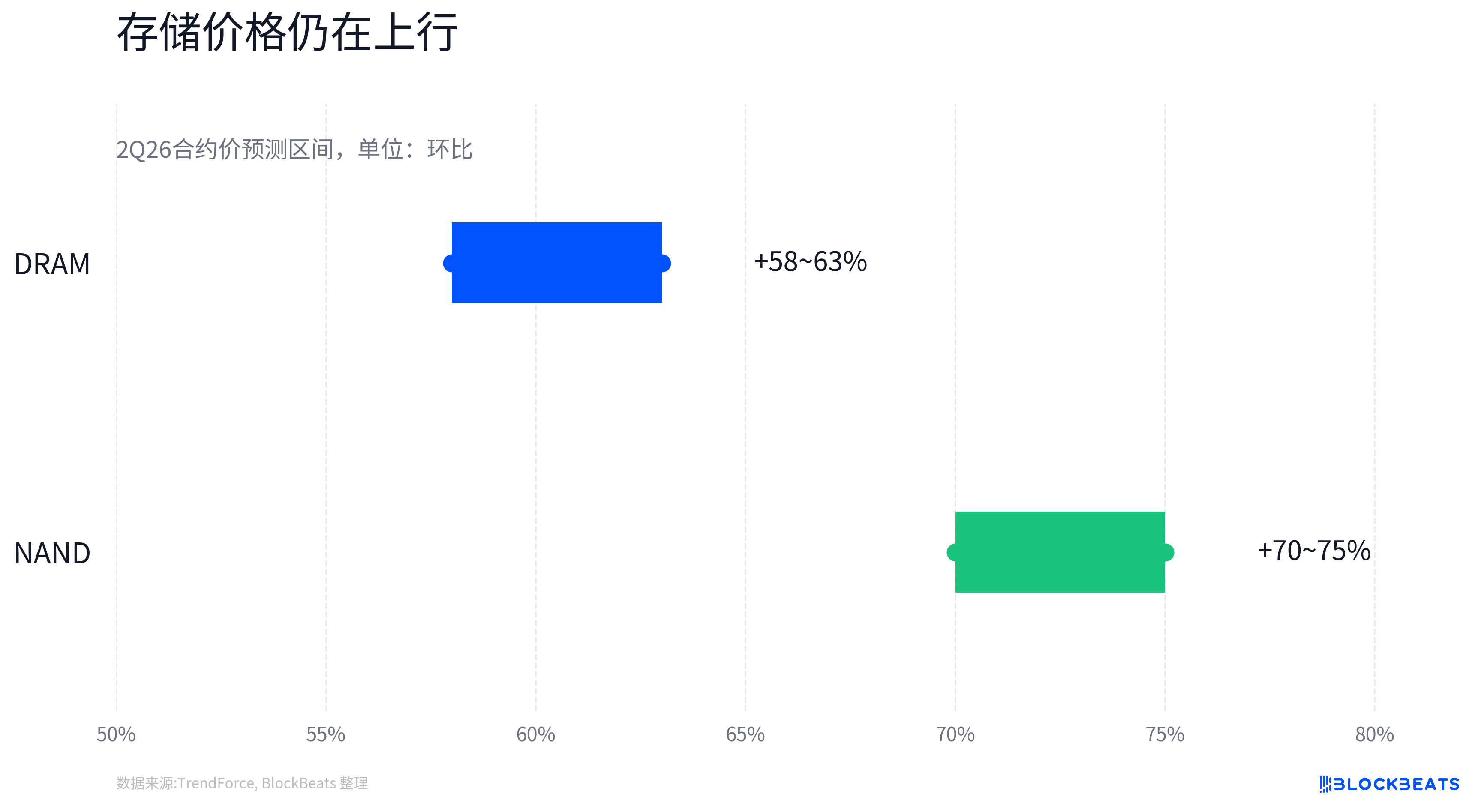
Industry price data also supports the same logic. TrendForce expects a 58%-63% quarter-on-quarter increase in the 2Q26 conventional DRAM contract prices and a 70%-75% quarter-on-quarter increase in NAND Flash contract prices. Its report also indicates an 81% quarter-on-quarter growth in 1Q26 DRAM industry revenue.
Price does not equal profit, but in a stage of supply tightness, product mix shift, and strong demand, price increases will enhance the market's modeling of EPS for the coming quarters. South Korean export data also provides early validation at an industry level. According to Reuters and Korean media reports, South Korea achieved a record export in May 2026, with semiconductor exports growing by 169.4% year-on-year to approximately $37.16 billion, with chips accounting for over 40% of total exports for the first time.
This does not directly equate to SK Hynix's or Samsung Electronics' earnings per share, but it indicates that the prosperity of the storage industry has manifested in the accelerating income at the national export level.
Storage is not a stronger narrative but a quicker validation
In this round of revaluation, the difference between storage and other AI semiconductor directions is not about whether there is growth, but how growth is validated.
Nvidia remains the gateway for AI demand. The GPU platform iteration determines AI server architecture, HBM capacity requirements, and supply chain qualifications. However, the market is already highly familiar with Nvidia's growth and profitability, with valuation long concentrated in the strongest AI assets. In the short term, it is more susceptible to export controls, supply chain constraints, platform transition pace, and expectation gaps.
The ASIC direction also has valid logic. Cloud providers' self-developed chips, custom accelerators, and rising AI inference demand are all driving the long-term space for assets like Broadcom and Marvell. But ASIC is more like project-based business. Customer concentration, single-project adoption pace, mass production windows, and next-generation platform transitions all affect the market's visibility into revenue.
Optical modules and copper interconnects also have an EPS realization path. Companies like Coherent and Credo benefit from AI cluster internal bandwidth upgrades, where 1.6T, 3.2T optical modules, and cluster interconnect architecture changes bring demand. However, the pricing of these directions depends more on future architecture roadmaps, customer certifications, shipping pace, and capital expenditure cycles. When the market is willing to pay a premium, they exhibit high resilience. When the market begins to seek validation, they are also more prone to inquiries about when orders will translate into revenue.
In contrast, the pricing mechanism for storage is now more direct. HBM demand is driving high-end products, capacity shifts are squeezing traditional DRAM/NAND supply, contract price increases are improving revenue, a shift in product mix is raising gross margins, ultimately leading to EPS.
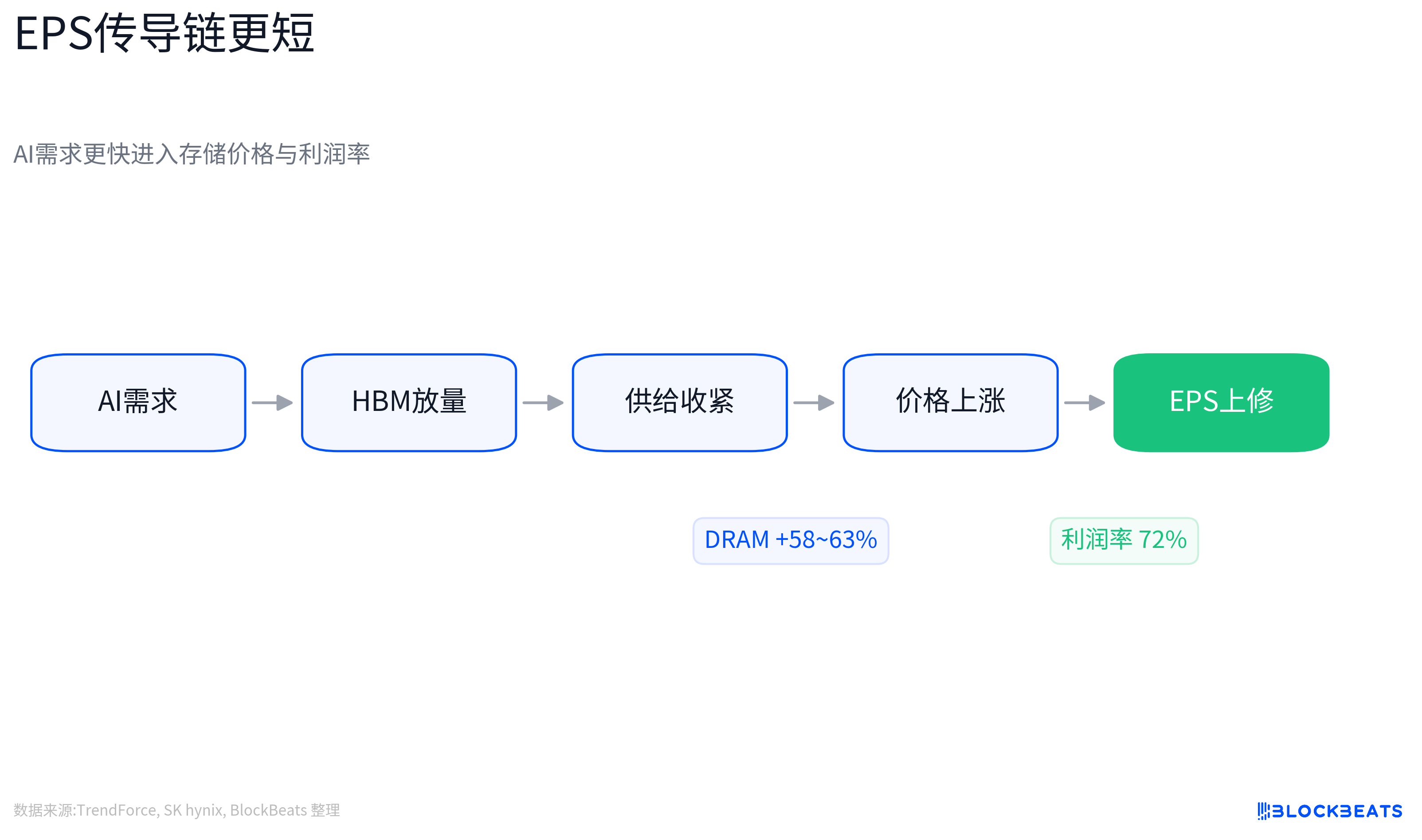
This chain of events does not mean there is no risk, but it is easier to validate in the next quarter's financial report compared to the belief that "some future generation architecture will bring massive orders." This is what is meant by storage being more easily modelled. It is not to say that storage is more important than GPUs, ASICs, or optical modules, but rather that after the AI semiconductor bubble, the market now prefers assets that can be collectively validated through price, orders, profit margins, and export data.
EPS Logic Strengthening, But Not Yet a Consensus
A one- or two-day rebound does not prove that AI semiconductor trading has entirely shifted from P/E expansion to EPS validation.
Micron's nearly 13% drop on June 5th and close to 10% rebound on June 8th may include technical repairs, short covering, and a return of risk appetite. SK hynix's rise was also catalyzed by news related to data center cooperation with NVIDIA. In short-term trends, news, positions, and fundamentals are often overlapping, and not all price increases can be attributed to EPS certainty.
Storage itself remains a cyclical industry. Rapid increases in DRAM and NAND prices will improve supplier margins but could also stimulate supply expansion or suppress the purchasing intentions of some end customers. The annual contract for HBM, yield improvements, customer qualifications, and market share allocation are all still evolving, so it is not safe to assume that all price increases will seamlessly flow into the profit statement.
SK hynix and Micron are already highly-watched AI storage targets in the market, but stock price resilience and fundamental resilience do not always sync. If the future slowdown in DRAM/NAND price hikes, lower-than-expected HBM market share, or instances of repeated customer orders being disproved occur, the logic of EPS upgrades will also face challenges.
Similarly, one cannot discount ASICs, optical modules, copper interconnects, and equipment materials. If these sectors provide stronger orders, clearer customer onboarding, or better-than-expected guidance, the market may still revalue them with a premium. AI semiconductors do not hinge solely on storage; at this stage, storage is simply easier to justify through financial reports as a reason for repurchase.
A more cautious assessment of this market trend is that the sharp drop on June 5th raised the market's validation threshold for AI assets. The recovery from June 8th to 9th indicates that funds within the AI chain prefer segments with a shorter path to EPS realization. Storage is currently in a position where orders, prices, capacity, and profit margins are all simultaneously visible.
Welcome to join the official BlockBeats community:
Telegram Subscription Group: https://t.me/theblockbeats
Telegram Discussion Group: https://t.me/BlockBeats_App
Official Twitter Account: https://twitter.com/BlockBeatsAsia

 Related Articles