BofA's Hartnett: Brace for 'June Storm,' US CPI to 'Pop the Bubble'
Original Title: "BofA's Hartnett: Brace for 'June Storm,' U.S. CPI to 'Puncture the Bubble'"
Original Author: Ye Zhen, Wall Street News
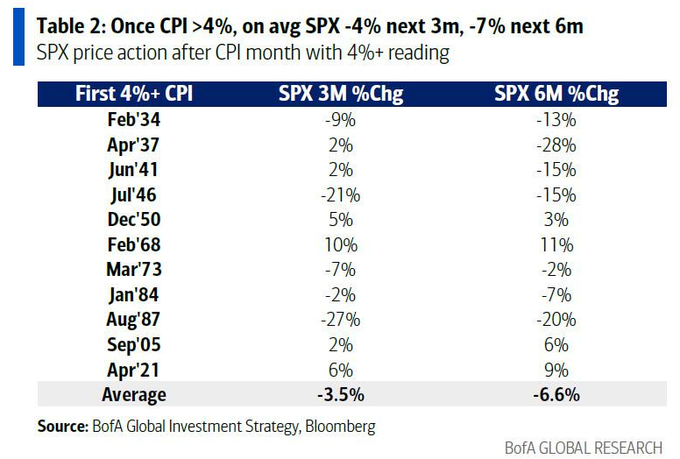
BofA strategist Hartnett issued a warning: if upcoming inflation data exceeds expectations, it will directly trigger a risk asset sell-off. Historical data shows that in the past 100 years, once CPI exceeds 4%, the S&P 500 index has averaged a 4% decline in the following 3 months and a 7% decline in the following 6 months.
Furthermore, the market's "sell signal" continues to strengthen, mega IPOs like SpaceX will drain record liquidity, combined with a global central bank hawkish shift in risk, the tech bubble is facing an extremely fragile moment.
In June, the U.S. stock market is facing a severe stress test. Bank of America strategist Michael Hartnett warned that a series of intense macro event risks and a sharp withdrawal of market liquidity could drive global bond yields significantly higher, thus bursting the current tech asset bubble.
According to Windcatcher Trading Desk, Hartnett stated in a recent research report that the upcoming U.S. CPI data is the core catalyst of this "June Storm." If the latest inflation data exceeds expectations, it will directly trigger a risk asset sell-off mechanism. Historical data shows that when inflation surpasses a key threshold, it often triggers a deep retracement of the U.S. benchmark stock index in the following months.
At the same time, the dense resolutions and statements of global central banks are dictating the market's direction. In particular, the upcoming Federal Open Market Committee (FOMC) meeting, led by newly appointed Fed Chair Wash, whose hawkish or dovish policy stance will determine the fate of U.S. stocks and long-term bond yields, any unexpectedly tight signals will deal a heavy blow to investors.
Against the backdrop of an extremely euphoric market sentiment, Bank of America's internal sentiment indicator has issued a strong "sell signal." Combined with the unprecedented withdrawal of liquidity due to the upcoming mega-tech company IPOs, current risk assets are in an extremely vulnerable exposed position.
Key Inflation Data Approaching, U.S. Stocks Face Historic Retraction Risk
The upcoming U.S. CPI data to be released on June 10 is the market's primary test.
In the past three months, this data has increased on average by 0.6% month-over-month, and on average by 0.4% in the past six months. If the May CPI month-over-month growth rate exceeds 0.4% (current market expectation is 0.5%), it means that the U.S. CPI year-over-year growth rate will surpass 4% and may move towards 5% before the U.S. midterm elections. This trend will leave risk assets extremely uneasy.
Historical data shows that in the past 100 years, once the CPI exceeds 4%, the S&P 500 Index has averaged a 4% decline in the following 3 months and a 7% decline in the following 6 months.
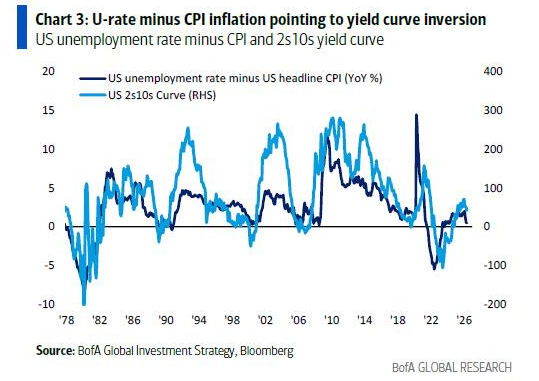
Another key inflation indicator is the intersection of the unemployment rate with the CPI.
In May, there is a "low-probability high-impact event" where the U.S. unemployment rate (consensus expectation 4.3%) equals or falls below the inflation rate (consensus expectation 4.2%), marking the 7th such occurrence since 1960. In years where inflation is near or higher than the unemployment rate, such as 1966, 1973, 2008, and 2021, the Fed typically takes tightening actions, evoking painful memories on Wall Street.
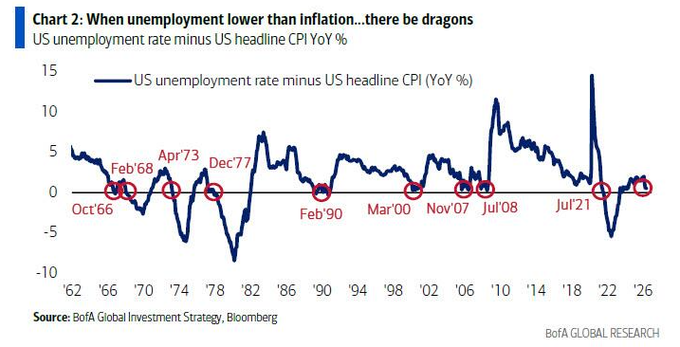
Additionally, the difference between the unemployment rate and CPI is highly correlated with the U.S. yield curve, currently signaling a recent inversion, which is another negative signal for risk assets.
Global Central Bank Intensive Resolutions, Bond Yields May End the Boom
"Booms and bubbles ultimately end with bond yields." Michael Hartnett reiterated this logic in the report.
He warned that a series of events in June could lead to the UK 30-year bond yield breaking 6%, the U.S. breaking 5%, and Japan breaking 4%. Given the current market's bullish positioning and optimistic earnings expectations, a surge in yields would undoubtedly be bearish for risk assets.
Global central banks are currently significantly behind the inflation curve. Out of 68 global central banks, 46 currently have inflation levels above the absolute mid-point of their target or target range. In this context, there is a 98% probability that the European Central Bank (ECB) will raise rates by 25 basis points, and the Bank of Japan (BoJ) also has an 83% probability of a 25 basis points hike, with the latter urgently needing to prevent the yen from breaking the "Maginot Line" of 1 to 160 against the U.S. dollar.
The June 17 FOMC meeting, led by Powell, is seen as one of the two most important events of the month.
The market is currently facing a policy dilemma: if Powell is too dovish, long-term yields will head towards 6%; if too hawkish, the S&P 500 Index will face the risk of retracing towards the 7000 level; and a "Goldilocks" moderate stance could potentially propel the New York Stock Exchange Composite Index (NYA) to a historic high above 24000.
As Wash stated back in 2024, global central banks seem complacent with a near 3% inflation rate, and the 2% inflation target is no longer taken seriously, posing a significant danger.
Wealth Effect Drives Inflation, Extreme Sentiment Triggers 'Sell Signal'
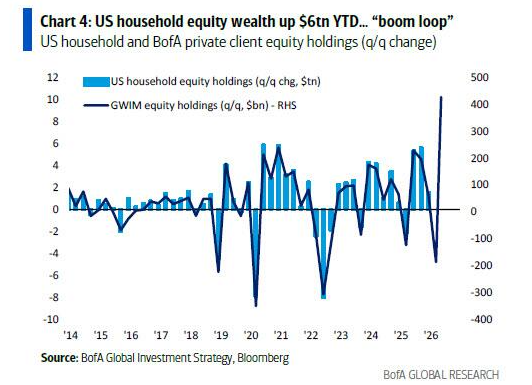
From a macroeconomic perspective, the U.S. is undergoing a K-shaped recovery driven by a wealth and stock market "prosperity cycle."
Americans' stock market wealth has increased by $6 trillion since the beginning of the year, and this "wealth-price spiral" directly intensifies inflationary pressures. Despite the economic prosperity, voters' sentiments are not uniform, with Trump's inflation approval rating now below Biden's lowest level.
In terms of fund flows, investors have recently shown an extreme inclination to chase the technology bubble. Last week's data shows a staggering $122 billion inflow into cash, $390 billion into bonds (setting a record), and $231 billion into stocks. Meanwhile, cryptocurrency saw an outflow of $20 billion, and gold saw an outflow of $31 billion, indicating investors are selling off other assets to chase the technology and semiconductor sectors.
The extreme fund flows have pushed the U.S. Bank Bull/Bear indicator from 8.5 to 8.7, strengthening the "sell signal" triggered two weeks ago.
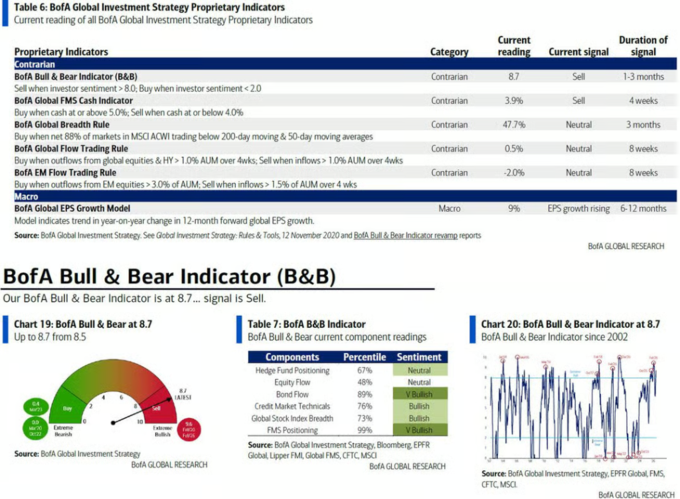
Historical data shows that out of the 17 "sell signals" since 2002, global stock markets have on average lost 2% to 3% in the following 2 to 3 months, with the maximum drawdown reaching 15% to 20%. Additionally, the global breadth indicator shows that 48% of global stocks are in overbought territory.
Giant IPO Drains Liquidity, Non-Economic Events Compound Market Turbulence
Beyond macroeconomic data, the biggest non-economic event risk in June comes from the capital markets' massive supply.
SpaceX's inaugural Initial Public Offering (IPO) will kick off trading next Friday, along with the issuance of Anthropic, OpenAI, and the end of related lock-up periods, withdrawing record liquidity from the market. This level of liquidity tightening, serving as a market catalyst, might even surpass the decisions of various central banks.
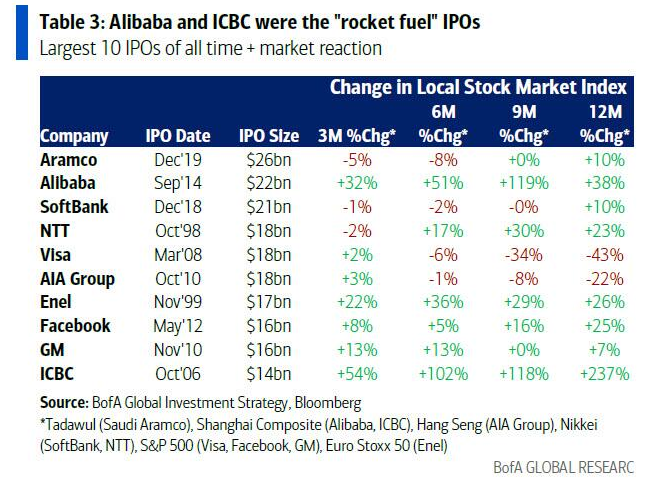
The market impact of past giant IPOs has shown mixed results.
While Alibaba and ICBC's IPOs were once a market booster, the listings of Visa and AIA have become a "topping" sign for the market, with the S&P 500 Index and Hang Seng Index both seeing significant declines in the 9 to 12 months following these IPOs.
Hartnett believes that this political shift is a core reason for the current historically low Latin American bond yields and spreads (falling to a record low of 217 basis points since November 2007), a similar trend of political shift to the right is also evident in Europe.
For investors, this means that there is a profound substantive reassessment of the recent global economic policy preferences.
Original Article Link
Welcome to join the official BlockBeats community:
Telegram Subscription Group: https://t.me/theblockbeats
Telegram Discussion Group: https://t.me/BlockBeats_App
Official Twitter Account: https://twitter.com/BlockBeatsAsia

 Related Articles