As HYPE Reaches New Heights, the Community Engages in a Heated Debate around "HYPE vs SOL"

Original Title: "The Most Loyal Guardian of Solana and Hyperliquid Start Quarreling with Each Other"
As HYPE continues to rewrite its all-time high, a debate around "HYPE vs SOL" has broken out.
At the center of this war of words is Kyle Samani, former co-founder and managing partner of Multicoin Capital, a prominent figure in the Solana community (refer to "The Man Who Shills SOL the Most Exits the Crypto World"), while on the opposing side, representing Hyperliquid faithful "believers," is Arthur Hayes, co-founder of BitMEX.
Clash Between the S Guard and H Guard
During this past weekend, Samani himself posted a large number of updates on X, taking the initiative to launch a high-intensity "attack" on Hyperliquid, criticizing the project for still being highly centralized at its core and facing serious regulatory issues.
On May 30, at 6:30, Samani wrote: "Hyperliquid is fundamentally nothing more than a Binance 2.0 without a marketing team (Binance is innocent...). It has made thousands of architecture decisions designed only for a centralized environment, completely unsuitable for the permissionless decentralized environment."
Now they are already lagging far behind on this path. Besides, no truly American company will collaborate with them in the future."
On May 31, at 10:53, Samani further stated: "Hyperliquid is as suspicious as Binance (once again, innocent Binance...). All the charges made by the US Department of Justice against Binance apply to Hyperliquid, and all evidence of each crime is on record. The so-called 'communication with regulatory agencies' is pure fiction, as Binance has been communicating with regulatory agencies for many years..."
Amid his attack on Hyperliquid, Samani also didn't forget to continue taking a jab at his old rival ETH, calling it "reputationally neutral but technically deficient," in other words, "useless"...
Finally, when answering a question from the well-known Bitcoin developer Udi Wertheimer about "which token in your mind can be considered a success story," Samani gave the unequivocal answer—Solana.
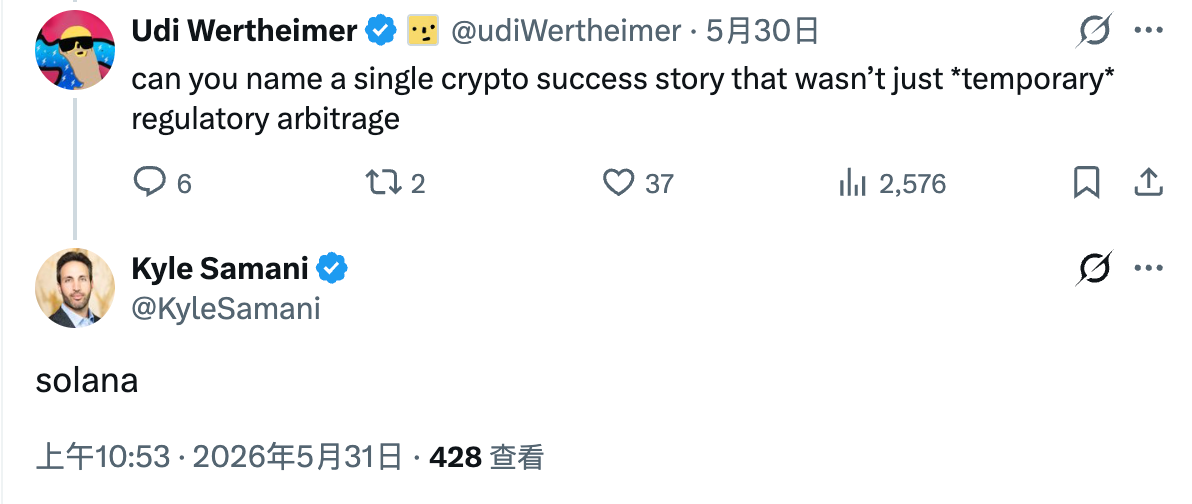
Unsurprisingly, Samani's comments drew fierce criticism from the community, especially in the midst of such strong HYPE. Investors like Hayes, developers like Wertheimer, and traders like Ansem all pushed back against Samani's views to varying degrees.
Among them, Hayes' rebuttal was the most direct. On May 31, Hayes tweeted, "Before this bull run ends, HYPE should at least surpass SOL."
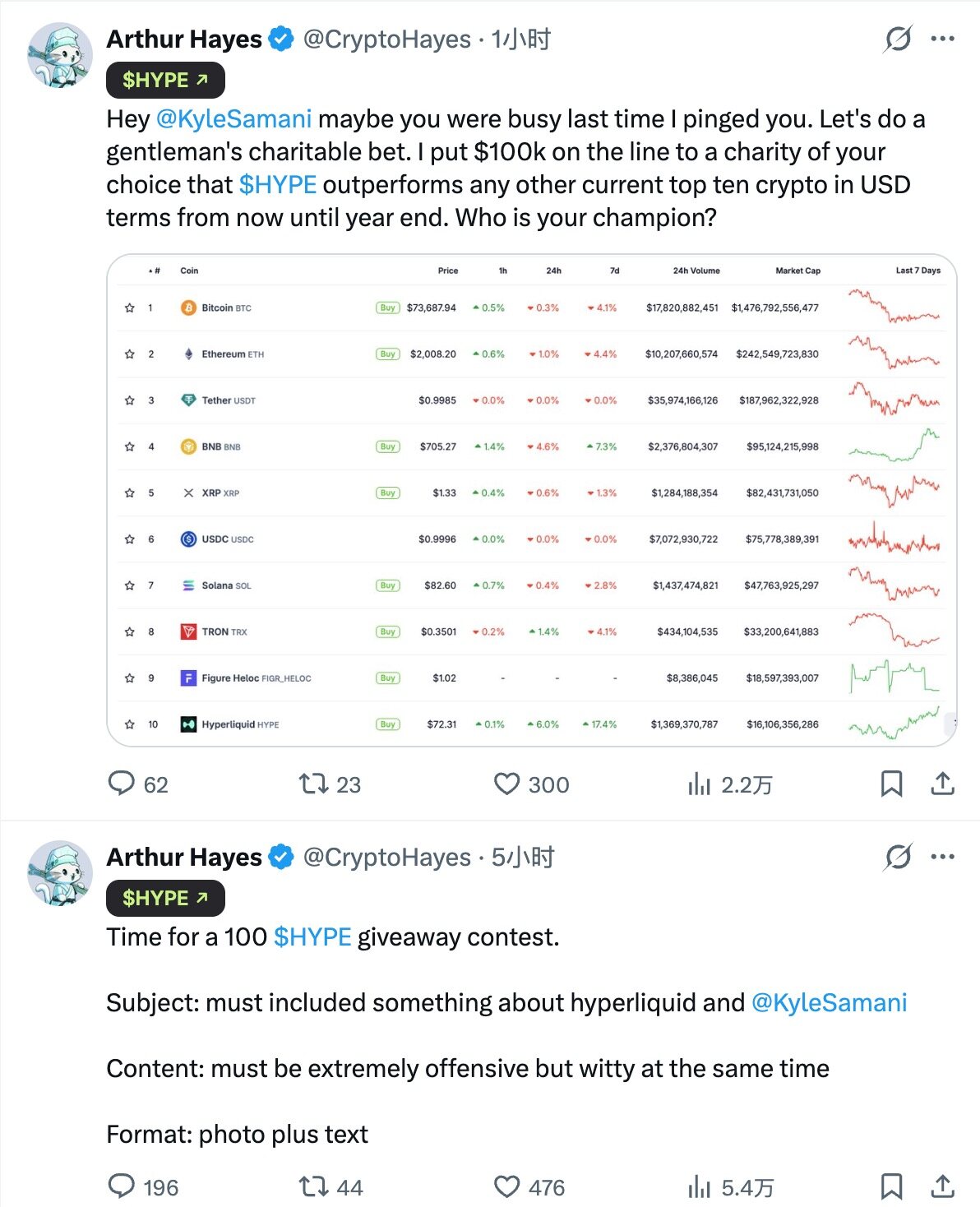
Earlier today, Hayes tweeted again, proposing a 100 HYPE prize pool content competition, challenging participants to humorously and provocatively counter Samani's remarks... Meanwhile, Hayes directly called out Samani, stating he was willing to bet $100,000 that HYPE would outperform the top ten other tokens on the cryptocurrency leaderboard in the remaining seven months of the year.
The Narrative Clash Between Solana and Hyperliquid
Over the past few years, Solana's most successful area has been in building a high-speed, low-cost on-chain financial infrastructure. From Memes and DeFi to AI Agents, various assets and applications have chosen to launch and trade on Solana, with the core logic being that liquidity will converge toward the most efficient market.
Unlike Solana, which provides infrastructure and waits for applications and liquidity to naturally grow, Hyperliquid directly tackles the most core need of the crypto industry—trading. By building a perpetual contract market, it has accumulated users, fee revenue, and liquidity, and is gradually expanding to spot, tokenized stocks, prediction markets, and more financial products.
In terms of outcomes, Hyperliquid has already created an extremely rare positive flywheel—more traders bring more fee revenue; more revenue feeds into HYPE buybacks and ecosystem incentives; HYPE price increases attract more capital; more capital further enhances platform liquidity and trading depth. The cash flow capability generated by this flywheel has even surpassed that of the public chain ecosystems, including Solana.
In recent years, Solana's core narrative slogan has been "The Internet of Capital Markets," but as users, assets, liquidity, and pricing power continue to shift towards Hyperliquid, the latter now seems to embody this narrative far more than Solana. In other words, Hyperliquid appears to have lived up to Solana's most yearned-for image.
As the most loyal advocate of Solana, Samani clearly does not want to see this situation.
Samani's Tactic: Using Solana's Formerly Criticized Rhetoric to Turn Around and Criticize Hyperliquid
A careful observation of Samani's recent attack on Hyperliquid reveals a rather dramatic phenomenon.
Over the past few years, in the debate between Ethereum and Solana, the most common attack method from the Ethereum camp has been to question Solana's level of decentralization. The high barrier to entry for validation nodes, excessive hardware requirements, frequent network outages, heavy reliance on a few core institutions... In the eyes of many Ethereum supporters, although Solana is fast, it is fundamentally sacrificing decentralization for performance.
The Solana camp's response to this has been quite simple—users do not care about these issues. For the vast majority of users, what they need is faster confirmation speeds, lower fees, and a better user experience, rather than a research report on node distribution.
In a sense, Solana's rise itself was a huge victory for the "efficiency-first" approach. However, now, as Hyperliquid begins to grab market attention, Samani has raised the flag that the Ethereum camp used to love waving around.
Centralization, regulatory risks, censorship resistance... These accusations sound somewhat familiar, except that the "defendant" was Solana in the past, and has now become Hyperliquid.
This may seem somewhat hypocritical, but perhaps in Samani's eyes, Solana represents precisely that optimal balance—Ethereum is decentralized enough but too clumsy, Hyperliquid is extremely sleek but fundamentally resembles a centralized exchange, whereas Solana, no matter how you look at it, is just so "big-eyed and bushy-tailed"...
In a sense, the essence of this debate is not so much the competition between HYPE and SOL, but the age-old question in the crypto industry that has persisted for over a decade—whether we should prioritize decentralization or prioritize product and growth?
Back then, Ethereum and Solana argued over this issue. Now, Solana and Hyperliquid find themselves in the same position.
Only this time, faced with a more radical opponent, Solana's believers have become the ones hoisting the flag of "decentralization" high.
Original Article Link
Welcome to join the official BlockBeats community:
Telegram Subscription Group: https://t.me/theblockbeats
Telegram Discussion Group: https://t.me/BlockBeats_App
Official Twitter Account: https://twitter.com/BlockBeatsAsia