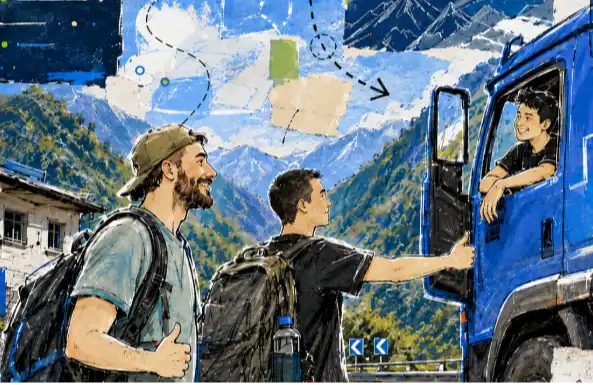
On a mountain road in Shaanxi, China, Lex Fridman, who has tens of millions of fans, hitched a ride on a truck

Article by Sleepy
Editor: Cozzy
Along a mountain road in southern Shaanxi, two foreigners were trying to hitch a ride.
One of them was Lex Fridman, and the other was Mike Okay. Lex hosts one of the most influential English-language technology podcasts in the world, interviewing top AI experts in the industry. Guests on his show have included Trump, Musk, and Huang Renxun. Many people's understanding of Silicon Valley, AI, and grand visions of the future of humanity started with his program. Mike is a travel blogger with over one million subscribers on YouTube, who adventures, travels, and hitchhikes around the world, drawing attention from many netizens with his unique experience of backpacking in China.
In recent years, many foreign bloggers coming to China to film videos have almost followed the same routine. First, they present a stereotyped image shaped by Western media, and then they use scenes of "technology changing life," such as mobile payments, high-speed trains, food delivery, drones, and electric vehicles, to reverse the audience's perceptions.
Of course, this type of video has its significance. It allows many foreign viewers to realize for the first time that the real China is not what they have long imagined. The clean, safe, convenient, and technologically advanced urban landscape will make many foreign viewers feel like their preconceptions have been overturned by reality.
If a country is always shown in stark contrast, it will once again become a spectacle. In the past, it was a demonized spectacle, and now it is a spectacle of astonishing consumption. Spectacles always hinder people from seeing the truth and reaching understanding.
Lex and Mike did not follow the crowd, did not film the high-speed train pulling into the station, did not film the night view of Chongqing's river, did not film drones forming Chinese characters in the sky, and did not film food delivery arriving at the doorstep in 15 minutes.
In their shots, there were only mountains, roads, and a small two-story white building. Farther away, there were the continuous greens of southern Shaanxi, with mountains against mountains and roads lined with mountains.
Mike wore a duckbill cap with tattoos visible on his arms, giving off a carefree vibe. Lex wore a black short-sleeved shirt, looking serious, as focused as when he listens to a scientist explain consciousness, robotics, or war during an interview.
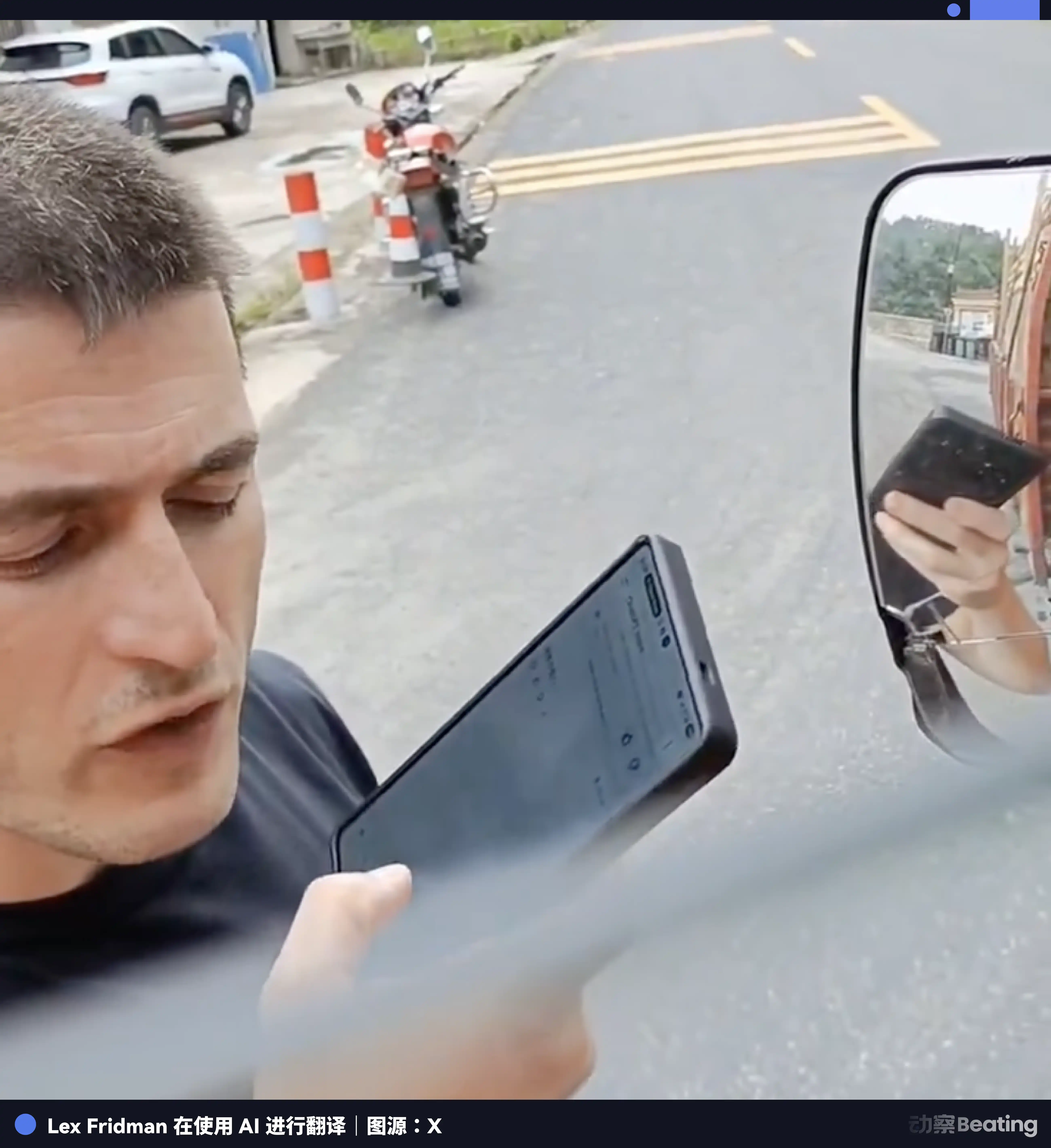
They flagged down a heavy-duty truck.
Unable to communicate verbally, they pulled out their phones and used translation apps and AI to display a sentence: "Can you give us a ride?"
The driver looked at them and said, "Sure, hop in."
And that's how the door opened.
They shook hands with the driver and squeezed into the car with their backpacks. The engine roared to life as the vehicle headed down the mountain road in southern Shaanxi.
Chinese Love Story
The driver was wearing a black T-shirt, smoking while holding the steering wheel, and the mountains outside the window were retreating along with the vehicle.
He said he had been driving for over twenty years. Afraid that the two foreigners would be nervous, he repeatedly reassured them, saying he was an experienced driver and "absolutely safe." After they got in the car, he even said in English, "Welcome to China."
Lex asked him, "What makes you happy?"
The driver's answer was the ability to provide for his family.
This was not the typical happiness narrative that Lex often heard in the Silicon Valley context. There was no self-fulfillment, no sense of mission, and no carefully packaged vision of life.
This was a Chinese father's response. For them, happiness is not an emotion but an ability: the ability to earn money, to support the family, and to ensure the well-being of those around them.
Such an answer is actually hard to translate accurately because of the significant differences in their life backgrounds.
For someone who emerged from the mountains, when he says he has the ability to support his family, he is talking about the rugged mountain roads, the calculation of fuel costs, driving overnight, and the expenses that were just deducted from the family budget last month.
Lex then asked him, "What gives you strength?"
The driver said he came out of the mountains. He had nothing when he was young, "Nobody looked up to me." This situation forced him to rely on himself, "In this life, either I live with dignity, or it doesn't matter if I die."
Later on, he went to work in a coal mine with a high gas content. It was a job where his life was hanging by a thread underground, and safety accidents occurred frequently. He said he was "all in" at that time. After that, he saved money to buy a car and started transportation work.
For many people, a car is just a means of transportation, or even just a consumer good. But for this driver, this car was different. Before buying it, he risked his life in the mine for money; after buying it, he took himself from underground to the road, gaining a bit more control over his life.
Many stories of China's past few decades are hidden in objects like this. Some people changed the trajectory of their lives with a college acceptance letter, a sewing machine, a motorcycle, a small shop, a cell phone, allowing themselves and their families to have a bit more of a chance at destiny.
When talking about his child, the driver said he would work hard to earn money, ensure his son receives a good education, has a bright future, and can contribute to the country.
A person has been driving on a mountain road for half of his life, doing physical labor for the other half, but still hopes that his child will study hard. To him, "knowledge changes destiny" is not just a pretty phrase, but the foundation for the next part of this family's journey. The father sacrifices his own body on the road, hoping that his child will not have to rely on manual labor in the future.
Lex, using his familiar philosophical questioning, asks about happiness, strength, and destiny; the driver, using his life as an answer, emerged from the mountains, first looked down upon, then bought his own car, drove for over 20 years, supported his family, put his child through school, and still believes that one can control their destiny through hard work.
The Belief in "Moving Forward"
In recent years, Silicon Valley has been reexamining China, and the first thing it sees is technology.
In a conversation with Huang Renxun, Lex asks why China has been able to establish so many world-class companies, engineering teams, and technological ecosystems in the past decade. Huang Renxun provides a more typical Silicon Valley answer: talent, education, engineering culture, local competition, and the supply chain.
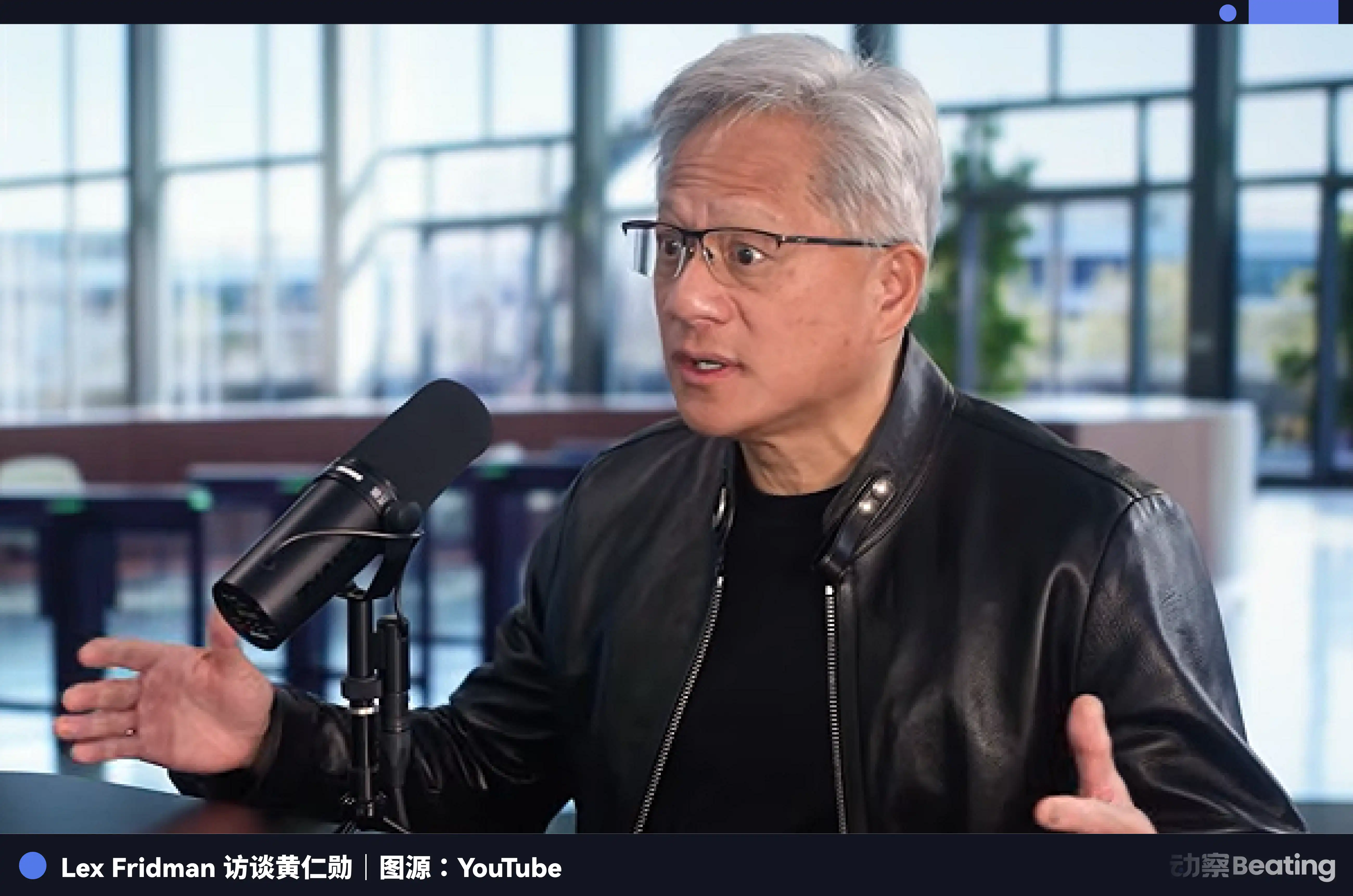
All of these factors are, of course, important. But the driver on the mountain road in Shaanxi offers another perspective on understanding China.
China's rapid progress certainly requires engineers and capital, but it also relies on the entire society's obsession with the belief in "moving forward." Engineers are coding, local governments are attracting investment, startups are raising funds, factories are rushing orders, logistics vehicles are speeding through the night, parents are saving for their children's education, and young people are migrating between county towns, provincial capitals, and major cities. Within this system, there is craftsmanship, connections, endurance, courage, local competition, and family ethics.
External perspectives often only see the results, wondering why things are so cheap, why delivery is so fast, why the infrastructure is so dense, and how a technology can quickly spread into real life.
But behind these results is a societal habit formed over the long term. People don't quite believe that staying still can solve problems; they always feel that they can work harder and go a little further on the road.
This set of values is not light; it is always intertwined with competition and fatigue, rough but also realistic. It does not like to romanticize wishes. Many Chinese fathers do not speak of love but show it through actions, they talk about the future without mentioning ideals. They say "live your own life," which is the lowest requirement many ordinary people in China give themselves in the process of modernization. They cannot stay in the same place forever, allow themselves to be looked down upon, or let their children repeat their own path.
China's AI, EV, instant delivery, high-speed rail, and manufacturing capabilities, of course, require engineers, scientists, and entrepreneurs. However, the rapid implementation of these technologies in Chinese society is also due to the large number of people willing to learn, experiment, compete, and never be content with their situation.
This Truck Carries Multiple Worlds Inside
In today's world, it's hard to find a single storyline. It's not about cities replacing the countryside, not about the future replacing the past, and not about technology replacing humans. It's more like the various things packed inside this truck.
A screen connects to AI, a cargo container connects to logistics and highways, a driver's life connects to mountains, coal mines, and family; sitting next to them is Lex Fridman, connecting to Silicon Valley's questioning about AI, destiny, and the future; Mike Okay threads the needle, temporarily stitching these different worlds together.
Big cities have their own technological wonders, and the mountain roads of southern Shaanxi have their own texture. Chinese AI engineers have strong technical capabilities, while truck drivers have over twenty years of experience on the road.
The space inside the cabin is quite interesting. It's small, a bit crowded, the engine roars, smoke comes out of people's mouths, the mountain road twists and turns, and there isn't much dignity in the distance between people.
It is in this somewhat rough space that many grand questions become more accessible.
What is AI? It's a Chinese sentence translated on a mobile phone screen.
What is globalization? It's two foreigners standing on the side of a Shaanxi mountain road, asking a Chinese driver for a ride.
What is China's speed? It's high-speed rail, algorithms, supply chains, and also a driver who has been driving for over twenty years, traveling on one mountain road after another, slowly leading a family and a child towards the future.
The modernization of the world is a big project, a large industry, big cities, and large models, but it is also how ordinary people turn tools into the roads beneath their feet.
Technology has never been something hovering in the sky. It must pass through these people's hands, through their work, life, desires, and difficulties, before it can truly become part of society.
The video ends with a selfie of three people. This photo has no technology, no futurism; it's a bit rustic, unlike the "Chinese wonders" we often see.
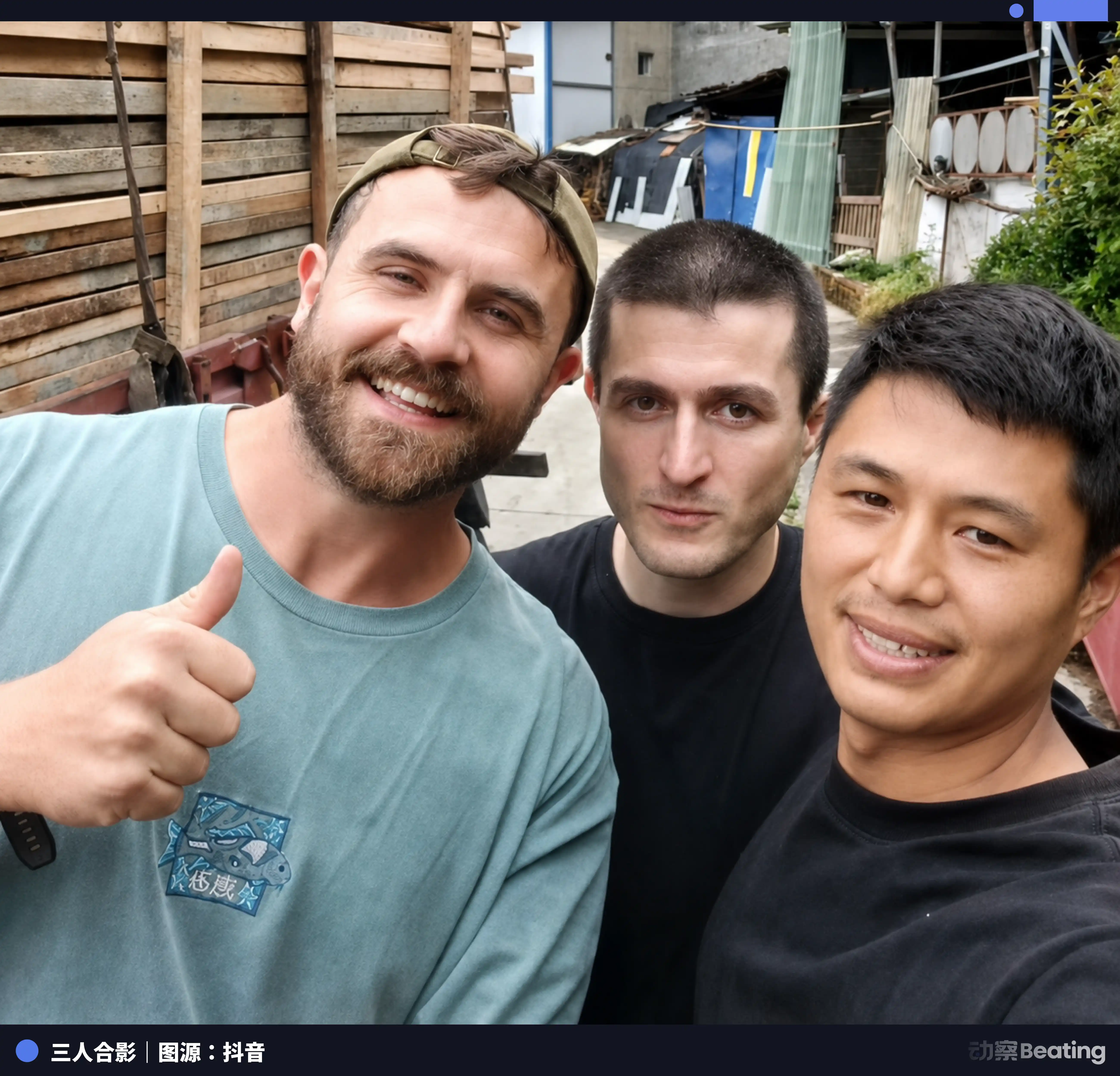
The most interesting part of Lex's trip to China this time was when a person researching AI, discussing the future with tech elites in the long run, saw another use of AI on a Chinese mountain road. AI didn't extract or distill people from the world but instead brought people together.
If technology can allow a Silicon Valley elite and a Chinese truck driver to sit in the same truck and discuss happiness, destiny, family, and children, then it hasn't been completely co-opted by accelerationism.
The world is already fast enough. If technology only speeds up the world without bringing people together, it is just a more expensive loneliness.
Welcome to join the official BlockBeats community:
Telegram Subscription Group: https://t.me/theblockbeats
Telegram Discussion Group: https://t.me/BlockBeats_App
Official Twitter Account: https://twitter.com/BlockBeatsAsia