error

Original Title: "NFT + AI Agent: Is There a Future? Exploring OpenSea's New ERC-8257 Protocol Strategic Intent"
Original Author: KarenZ, Foresight News
This time, OpenSea's narrative focus was not on NFT transactions. It has set its sights on another entry point: when AI Agents begin autonomous discovery, gain permissions, and pay fees, whoever organizes these tools may occupy the starting point of the next round of on-chain distribution.
OpenSea borrowed a familiar analogy: the App Store allows developers to publish apps, users to discover apps, and complete payments; Agent tools also need a similar entry point. The difference is that this time, the entity browsing the store, assessing permissions, preparing for payment, and invoking services may be an Agent holding a wallet.
OpenSea's Focus: Transforming NFTs from Assets to Permissions
On the evening of May 26, OpenSea released "ERC-8257: Agent Tool Registry." In the scenario presented by OpenSea, an AI Agent is attempting to value an NFT. It was rejected when it called a professional pricing tool, but then discovered that the address holding the specified NFT could use a discount interface. The Agent then purchased the NFT on-chain, made another request, and reduced the single-call fee from $0.05 to $0.01.
This example illustrates OpenSea's new strategy. In the concept of ERC-8257, NFTs can also become access credentials that machines can read and immediately use.
Research data sources, pricing tools, transaction signals, partner APIs, all can have on-chain thresholds. For example, holding a certain NFT may be required to access a discount interface, holding a subscription-type NFT may be needed to call advanced services, or entry may be determined through a whitelist, staking balance, or zero-knowledge proofs.
For OpenSea, the change is very specific. The utility of an NFT can expand from avatars, collectibles, and community identities to a discount card, membership certificate, or limited seat when an Agent calls a service. The tradable objects in the market also expand to include access rights that can be directly executed by software.
OpenSea CTO Chris Maddern later summarized this direction as a more comprehensive on-chain path: stablecoins for Agent payments, NFTs for identity and subscriptions, and the Agent Tool Registry driving this vision closer to practical operation.
ERC-8257 is Narrow: Registry Tool, Qualification Check
ERC-8257 was created on April 17, 2026, and is currently marked as Draft in the ethereum/ERCs repository. Its title is Agent Tool Registry, aiming to provide a permissionless on-chain tool registry, rather than building a full-fledged app store with curation, ranking, and refund mechanisms.
The technical design of ERC-8257 is not complex. When developers register a tool, several key elements are recorded on-chain: the tool creator's address, a metadataURI pointing to the tool's description file, a manifestHash to prove the file's integrity, and an accessPredicate determining who can access the tool.
In plain terms, the on-chain registry is like a verifiable tool directory: what the tool can do, how to invoke it, pricing hints are in the off-chain manifest file; the hash of this file is written on-chain, and an Agent can verify the content once fetched; whether a wallet is qualified to invoke the tool is left to an independent predicate contract.
If the accessPredicate is an empty address, the tool is open to all callers; if a contract is specified, it can validate conditions such as NFT holdings, subscription status, whitelists, staking thresholds, DAO voting outcomes, or zero-knowledge proofs.
It is worth noting that ERC-8257 does not handle funds. The proposal clearly states that pricing information is included in the manifest, and actual payments are handled by x402 or other payment protocols. The registry is responsible for discovery and permissions, while settlement is left to external systems. This separation keeps the standard lightweight and implies that what OpenSea launches is more like a distribution and access infrastructure layer, rather than a new payment protocol.
This is also why the author of ERC-8257 refers to it as "the 403 to x402's 402". In the HTTP context, 402 points to a payment required status; 403 points to forbidden status. x402 answers "how to pay for this call," while ERC-8257 aims to address "is this address qualified to enter."
Strictly speaking, 403 is an analogy for product positioning clarity. The ERC-8257 draft specifies the registration and permission-checking mechanism without requiring all tools to respond to an Agent through a fixed HTTP 403 process.
The Concept of an Agent App Store Focuses on Distribution Starting Point
The term "App Store" easily brings to mind a closed market controlled by platform review, ranking, and entrance. However, the core design of ERC-8257 leans towards openness: any developer can register a tool, Agents can read on-chain registration information, and access conditions can be extended through external contracts.
What OpenSea really aims to compete for is tool discovery and asset trading scenarios built on open protocols. In the past, Agents searching for tools often relied on documentation, GitHub repositories, centralized directories, or manual configurations; ERC-8257 attempts to provide a verifiable on-chain entry point, allowing Agents to find valuation APIs, research subscriptions, trade signals, or data services, read usage conditions, and then purchase permissions or make payments based on their wallet state.
In the Ethereum Magicians forum, the proposers stated that a reference implementation has been deployed to the Base mainnet and validated through CLI, SDKs, as well as ERC-721, ERC-1155, subscription, and composite predicate examples.
This opens up a broader path for OpenSea than just competing for NFT aggregation trading. As long as Agents in the economy need on-chain memberships, tradable seats, or token-gated APIs, OpenSea can continue to act as an asset discovery and purchasing venue. The objects the platform matches can expand from cultural assets to the access rights needed for machine-executed tasks.
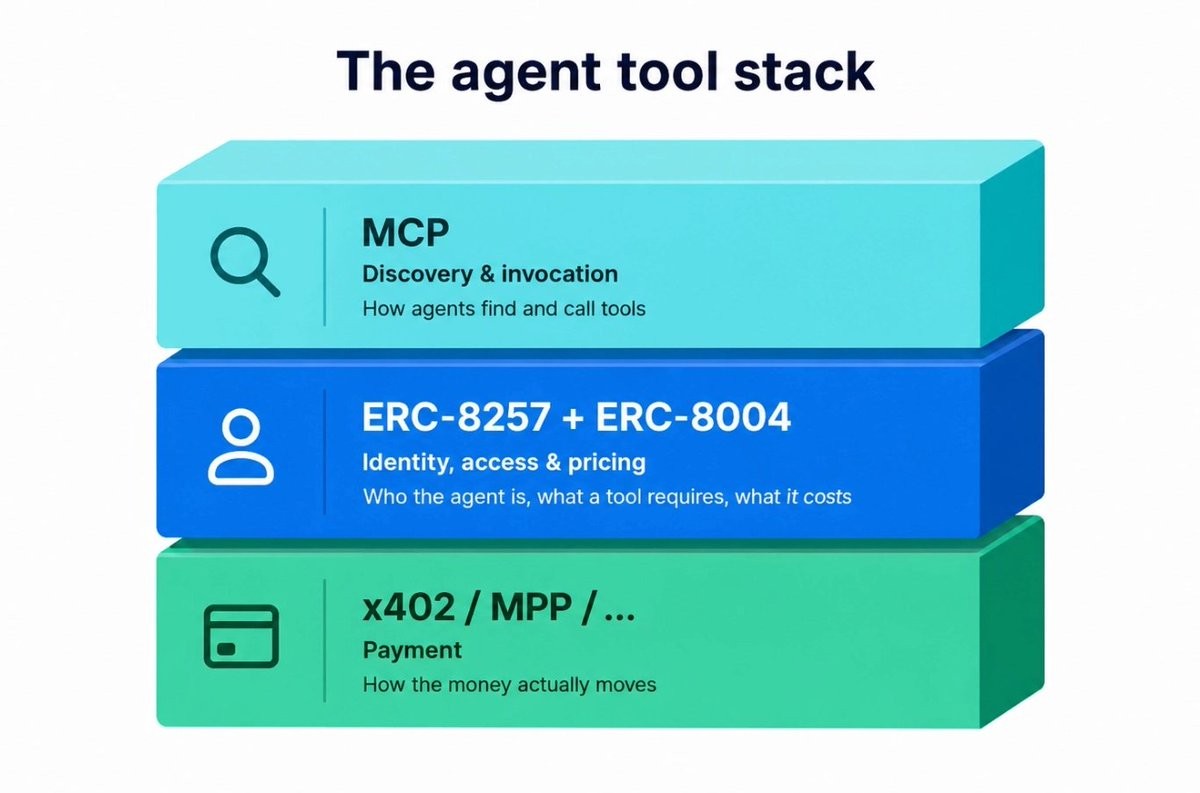
If we break down an Agent's call to use a paid on-chain tool, the current protocol division of labor roughly appears as follows:
MCP handles communication between tools and AI applications. The server can expose tools, resources, and prompts, and the client initiates the call upon discovering the capability of the connected service. It deals with capability descriptions and invocation interfaces, without inherently providing a public, on-chain, verifiable global tool directory.
ERC-8004 focuses on the identity, reputation, and verification records of Agents, enabling different entities to identify a specific Agent and its past behavioral cues.
x402 is oriented towards payments, allowing humans or Agents to make programmatic payments for APIs and digital content using stablecoins.
ERC-8257, on the other hand, attempts to add the layer of tool discovery and admission: how an Agent finds a tool, verifies that the manifest has not been tampered with, and determines if their wallet meets the usage conditions.
What Are the Challenges?
ERC-8257 gave the Agent a tool catalog and a set of access control rules, but did not automatically address issues of service quality and security.
The on-chain manifest hash can only prove that the Agent has read the instruction file consistent with the registration, but cannot prove that the tool's output is reliable, the interface will not leak data, or the developer will provide long-term service. The predicate contract may also be misconfigured, become invalid, or introduce complex risks.
An Agent's ability to automatically purchase a ticket does not guarantee that the room it enters is safe.
Several issues requiring further refinement have already appeared in the Ethereum Magicians discussion forum: how to prove the cross-chain wallet state; whether ENS is suitable as an additional discovery entry point; whether a unified agreement is needed for fee protocol naming; and whether there is overlap between ERC-8257 and another ERC-8239: Agent Skill Registry.
The proposal's author also confirmed in the discussion that there is still room for integration between tool definitions, price prompts, and different registry concepts.
Therefore, the significance of ERC-8257 lies not in its becoming the unified answer in the Agent tool market. It is more like a table set in advance by OpenSea: Agents come to find tools, developers register capabilities, NFTs take on permissions, payment protocols handle settlement, and OpenSea hopes to sit closest to where the transactions occur.
What the NFT market used to care most about was who was willing to bid for an on-chain asset. The new issue raised by ERC-8257 is: when a piece of software needs permission to continue working, what will it buy, and where will it buy it from?
Original Article Link
Welcome to join the official BlockBeats community:
Telegram Subscription Group: https://t.me/theblockbeats
Telegram Discussion Group: https://t.me/BlockBeats_App
Official Twitter Account: https://twitter.com/BlockBeatsAsia

 Related Articles