US Old Money's Crypto ETF Position Differentiation: Who's Selling, Who's Hodling, Who's Continuing to Buy?

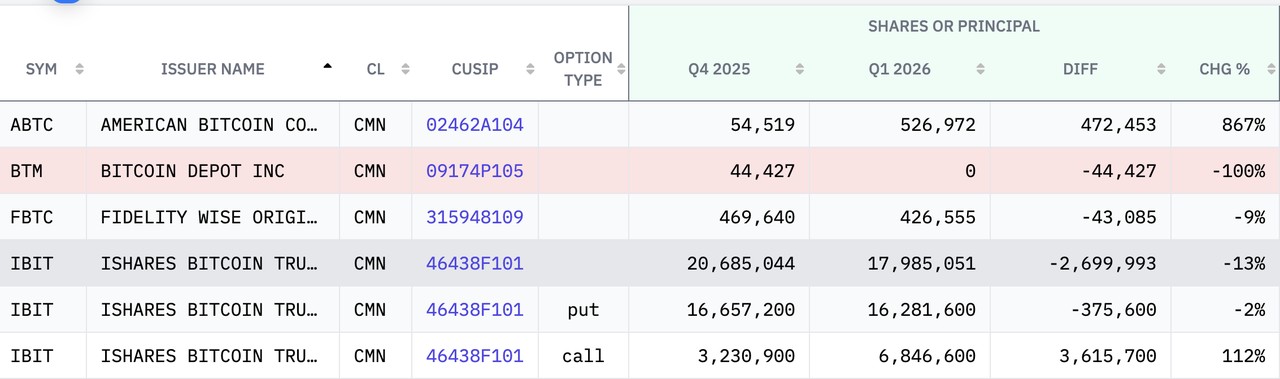
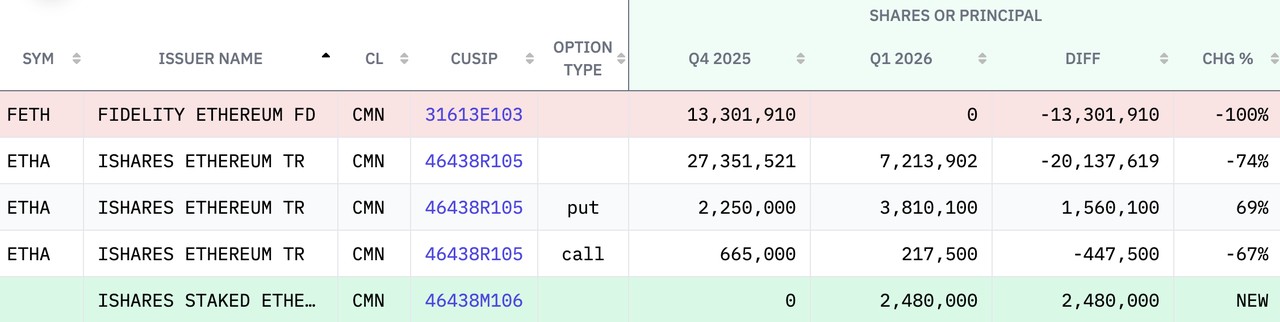
Goldman Sachs has taken a more aggressive approach to Ethereum, not only liquidating its position in the Fidelity Ethereum Fund (with a position value of $394 million at the end of Q4 2025); it has also significantly reduced its exposure to the iShares Ethereum Trust (ETHA) spot, with a reduction of about 74%, leaving a remaining position of approximately $114 million. Additionally, it has added a $66.885 million position in the iShares Staked Ethereum Trust ETF.
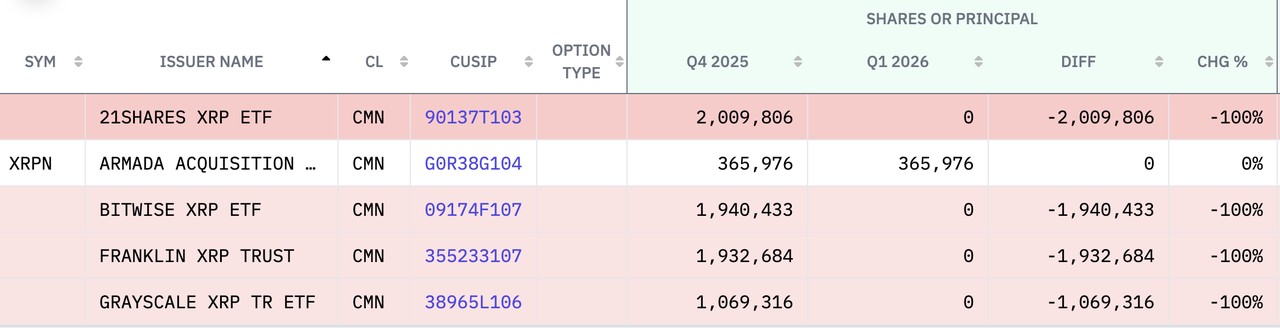
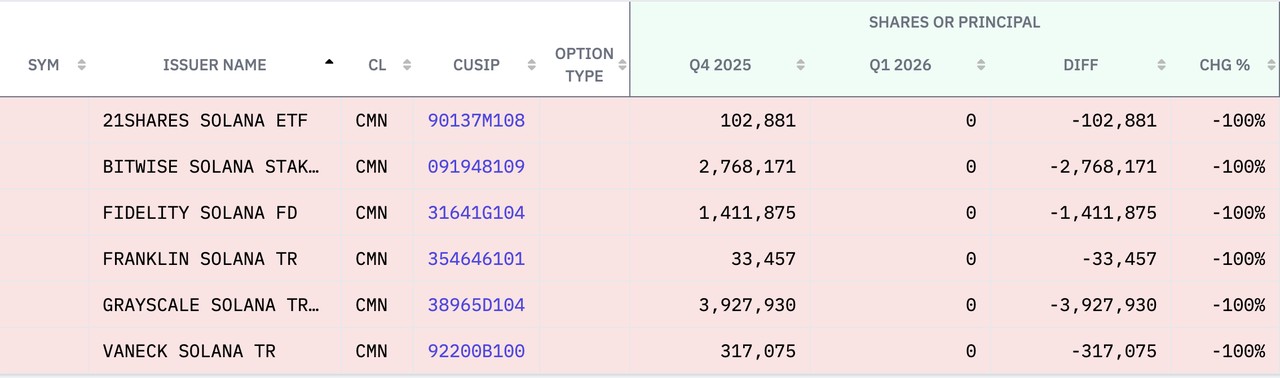
Meanwhile, Goldman Sachs has completely divested from all XRP and Solana-related ETFs. It held a total of approximately $152 million in XRP ETFs from Bitwise, Franklin Templeton, Grayscale, and 21shares as of the end of Q4 2025, and also liquidated all holdings of Solana ETFs/trusts from Grayscale, Bitwise, and Fidelity (valued at $109 million at the end of Q4 2025).
On the crypto stock side, Goldman Sachs increased its position in Circle by 249%, reaching around $140 million, and saw a 205% increase in its position in Galaxy Digital (reaching $414.8 million). Positions in Coinbase (+65%), Robinhood (+35%), and PayPal also increased; meanwhile, positions in Strategy and Riot Platforms were decreased. Overall, this looks more like an internal rotation from ETF risk to selected individual stocks.
Within hedge funds, Millennium Management has also signaled a similar move. Public records show that its IBIT position decreased from 34.334 million shares to 19.287 million shares, a reduction of approximately 43.8%; the ETHA position also decreased in sync (by about 34.3%), indicating a significant reduction in exposure to Bitcoin and Ethereum spot ETFs.
Capula Management Ltd, a hedge fund management company based in London, United Kingdom, went even further. As of December 30, 2025, it held $470 million worth of IBIT, $160 million worth of FBTC, $207 million worth of ETHA, and $61.43 million worth of FETH. However, the latest 13F report shows that these ETFs have been completely liquidated. At the same time, Capula Management Ltd has fully divested from Coinbase (with a small remaining position in options).
Sitting Tight Can Be an Attitude
The second category consists of those who sit tight.
Brown University's IBIT holdings remain at 212,500 shares, with no change. Based on disclosed market values, this position decreased from around $10.55 million at the end of 2025 to around $8.164 million at the end of the first quarter of 2026. Such university endowments do not directly translate quarterly price fluctuations into trading orders but instead emphasize portfolio discipline and long-term allocation pacing.
Dartmouth College's treatment of crypto assets in the first quarter of 2026 resembled a mild expansion rather than a radical reshuffle. In comparison with the previous quarter's 13F, the college continued to hold its underlying Bitcoin ETF position, with the IBIT holdings remaining almost unchanged. However, due to the first-quarter price retreat, the book value decreased from over $10 million to around $7.7 million;
The Ethereum exposure undertook a product switch, replacing the original Grayscale Ethereum Mini Trust with the staking-oriented Grayscale Ethereum Staking ETF, holding around 178,100 shares; concurrently establishing a position in the Bitwise Solana Staking ETF, holding around 304,803 shares, with a book value of around $3.3 million.
Another Strategy: Buying the Dip
The third category consists of those who increase their holdings against the trend.
Abu Dhabi Sovereign Wealth Fund Mubadala is one of the most notable names in this category. Its IBIT holdings increased from 12,702,323 shares to 14,721,917 shares, a growth of approximately 15.9%. However, even with the increase in the number of shares, the end-of-quarter holding value dropped from around $631 million to around $566 million. These figures vividly illustrate a point. Adding to a position does not automatically lead to profitability, especially when the market is still in a downtrend; increased allocation primarily brings about a larger exposure and potentially higher resilience in the future.
JPMorgan's actions can also be understood within this logic. The latest 13F data shows that JPMorgan increased its IBIT holdings from around 3.028 million shares to around 8.3 million shares, a growth of 174%, while also adding to its exposure to FBTC, BITB, and Ethereum ETF.
Looking at the change in holdings, it has clearly become more positive; however, this does not mean that it has locked in excess returns in this round of volatility. For large banks, increasing ETF positions is often done to expand product offerings, meet client allocations, balance liquidity and book risk, rather than just being bullish.
Wells Fargo's position change is also worth noting. Upon comparison, this bank maintained its IBIT core position while increasing its allocation to BITB and products such as the Grayscale Bitcoin Mini Trust.
More notably, it significantly increased its Ethereum ETF holdings, with ETHA holdings rising from approximately 672,600 shares to around 1.1 million shares, and ETHW holdings also increasing simultaneously. In other words, Wells Fargo has adopted a strategy of "maintaining a Bitcoin base position while increasing Ethereum weight."
Market maker Jane Street has shown a different typical style. Comparing two 13Fs, it drastically reduced its Bitcoin spot ETF exposure in the first quarter, with IBIT holdings decreasing from around 20.3 million to about 5.9 million shares, and FBTC also seeing a significant decline; however, at the same time, it added approximately $820 million in Ethereum ETF exposure.
On the crypto stock side, Jane Street increased its positions in Galaxy Digital (8746%), Circle (1162%), Coinbase (+14%), BitMine (+47%), and other targets. This kind of portfolio adjustment resembles a typical trade-based rebalancing: reducing Bitcoin ETF exposure, increasing Ethereum ETF exposure, and seeking higher resilience at the individual stock level.
Bitcoin, Ethereum, and Solana: Institutions Fine-Tuning Risk Allocation
Another signal worth separately discussing from this round of 13Fs is that institutions' attitudes toward BTC ETFs, ETH ETFs, and even Solana ETFs are no longer uniform. The more pressing question now is which type of crypto asset institutions are prepared to keep in their core positions, which to place in more flexible positions, and which to remove altogether.
Take Harvard Management, for example; while reducing its IBIT position, it completely exited ETHA, signifying a form of risk ranking. Bitcoin ETFs still maintain a relatively core position, while Ethereum ETFs have been prioritized for removal in portfolio rebalancing.
Goldman Sachs' approach also illustrates that large financial institutions are taking this sorting system to a more extreme level. It maintained a significant Bitcoin ETF exposure in the first quarter, but significantly reduced its exposure to Ethereum-related products, while essentially liquidating XRP and Solana-related ETFs.
Putting it all together, Goldman Sachs is consolidating its positions into the layer of assets it considers to be the most liquid, easiest to hedge, and most easily incorporated into institutional risk models. Bitcoin here is more like a "core position," Ethereum belongs to a compressible position, and products like Solana and XRP are closer to the edge as experimental positions, often the first to be cut when market volatility rises.
On the other hand, Wells Fargo and Dartmouth College have shown completely different answers. Wells Fargo actively increased the weight of its Ethereum ETF, indicating that within its framework, Ethereum is more like a secondary position worth increasing allocation during pullbacks to seek resilience.
Dartmouth College's strategy is more representative: it did not touch its Bitcoin ETF core holdings but added flexibility to Solana-related ETFs, especially those with staking attributes.
13F Provided a Snapshot to the Market, Yet Left Gaps
This is also the most restrained aspect when looking at institutional holdings.
13F allows the outside world to see how mainstream institutions are allocating to crypto ETFs in a uniform manner. However, it also has very clear boundaries. First, it has a time lag. What investors see in May is just a snapshot of institutional holdings as of March 31. If there were significant changes in the second quarter, they will not be reflected in the form in advance.
Second, 13F only shows holdings, not the actual cost basis. A decrease in the value of an institution's holdings in one quarter does not necessarily mean an overall loss because it may have bought in at an earlier position and may have trimmed and added positions during the quarter.
Furthermore, for institutions like Goldman Sachs, there may often be options, hedges, and market-making positions in addition to spot ETFs, making it easy to misinterpret trading activity as a long-term stance based solely on the table.
Yet precisely because it is incomplete, 13F is more like a window to observe institutional sentiment rather than a concluding table.
Seeing Abu Dhabi's sovereign wealth fund Mubadala increase holdings while book value falls reveals sovereign funds' patience; seeing Brown University stay put and withstand drawdowns shows long-term allocation discipline; observing Harvard University reduce Bitcoin and exit Ethereum ETFs shows the university endowment's true sensitivity to volatility; and observing JPMorgan Chase, Wells Fargo, and Jane Street continue to adjust exposures on certain products shows that Wall Street still views crypto ETFs as a category that needs to be continuously placed on the shelf and repriced.
Original Article Link
Welcome to join the official BlockBeats community:
Telegram Subscription Group: https://t.me/theblockbeats
Telegram Discussion Group: https://t.me/BlockBeats_App
Official Twitter Account: https://twitter.com/BlockBeatsAsia