Before the Tech IPO Frenzy, Polymarket Gears Up for a Comeback

In the midst of this wave of tech IPO frenzy, everyone wants to "get on board," including Polymarket.
With SpaceX's Nasdaq listing just 23 days away at the earliest, this is an IPO that is set to break all records in human IPO history.
OpenAI was valued at $500 billion in its last round, Anthropic is rumored to be valued at $400 billion, and SpaceX at $1.75 trillion. There are a total of 1600 unicorns globally, with a combined valuation of $50 trillion. Historically, returns in this area have only been open to institutions and accredited investors. To directly purchase shares of these companies, a six-figure threshold, one-year lock-up period, accredited investor certification, and a network of connections are required. The average person cannot access this.
Furthermore, private companies are not obligated to disclose their valuation. Valuations in funding rounds lag behind, secondary market quotes are dispersed, and the actual transaction price of employee holdings is highly sensitive internal information. This is precisely the best entry point for the prediction market.
On May 19, Polymarket launched an exclusive partnership with Nasdaq, introducing a batch of prediction contracts for pre-IPO company valuations. Users can bet on whether OpenAI's year-end valuation will surpass $1 trillion, whether Anthropic will reach $1.1 trillion by December 31, and whether SpaceX can reach $1.5 trillion by June 30. Nasdaq serves as the data source and is responsible for the final settlement of the contracts.
Prior to this, Polymarket already had a market for OpenAI's first-day closing market cap, with Bloomberg reporting an accumulated trading volume of $1.6 million since September of last year. Ready-made IPO contracts are more prevalent on Kalshi, with probabilities set for Cerebras Systems to IPO before 2027 at 95%, Kraken at 83%, Databricks at 70%, and Discord at 70%. There are also contracts for OpenAI and Anthropic.
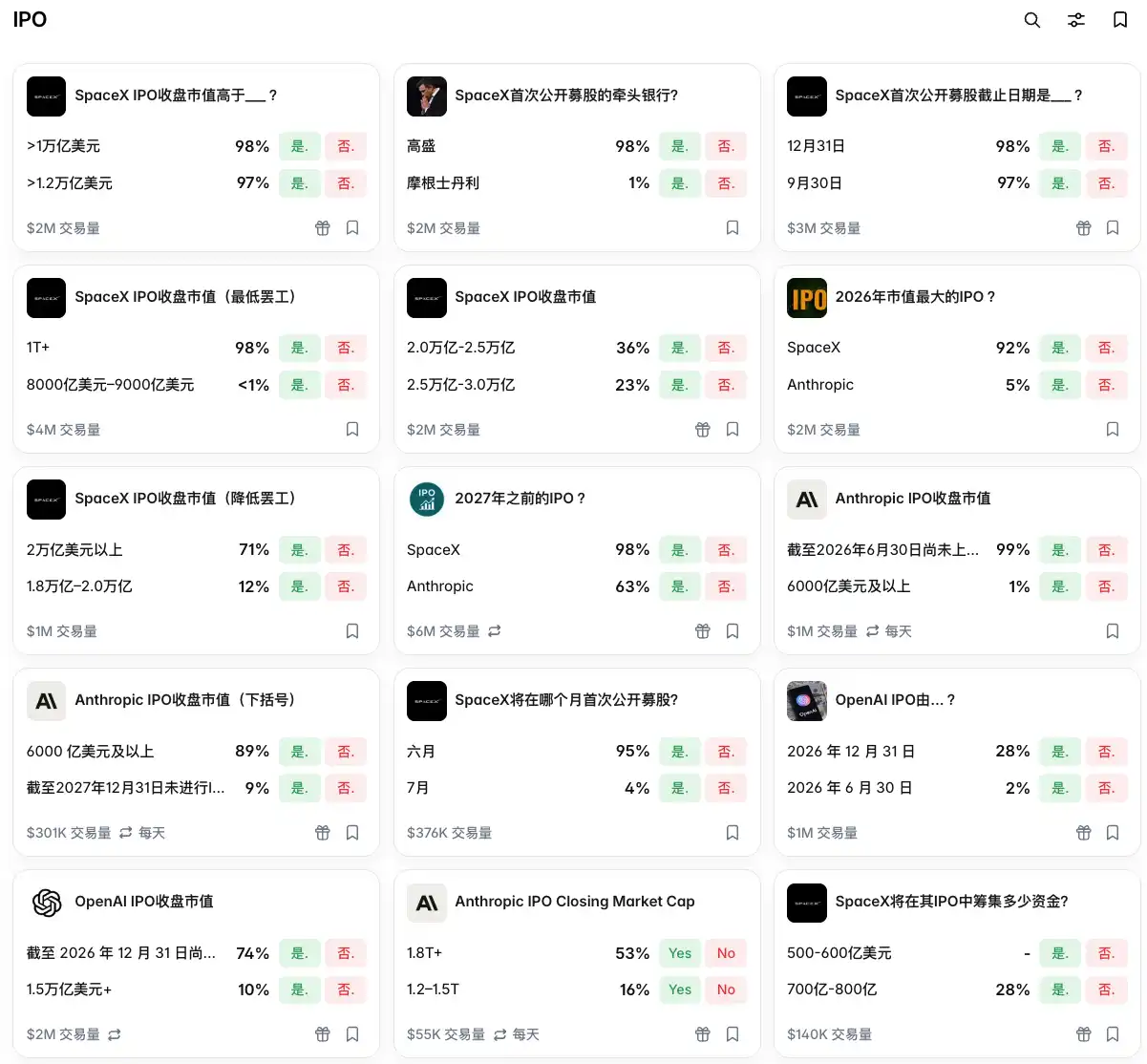
Both competing platforms are highly focused on this pre-IPO frenzy.
Polymarket's Comeback Battle
Over the past eight months, Kalshi has almost overtaken Polymarket in all visible metrics.
In April, Kalshi's monthly trading volume was $14.8 billion, up 13% month-over-month. The total for Polymarket globally plus the U.S. app was $10.2 billion, down 8.9% month-over-month. The number of active traders dropped from 733,000 in March to 643,000 in April, a 12% decrease. In terms of valuation, Kalshi's latest round was at $22 billion, while Polymarket is reported to be in discussions at $15 billion.
In its April report, Bank of America noted that in the U.S. domestic prediction market, Kalshi captured approximately 89% of the market share.
Over the past few years, Kalshi has had a smoother journey compared to Polymarket. In 2020, it received the first-ever Designated Contract Market license from the CFTC in the U.S., specifically granted to an event contract platform. This means that Kalshi can transact in USD, issue 1099 tax forms, integrate with Robinhood via SDK, and have its probability data referenced by CNN and CNBC. In February of this year, Kalshi was named to the TIME100 list of most influential companies, and its app briefly approached ChatGPT in the App Store popularity rankings.
Meanwhile, Polymarket exited the U.S. market in 2022 after being fined $1.4 million by the CFTC. It wasn't until July 2025 that the CFTC and the Department of Justice concluded a new round of investigations into Polymarket, allowing it to obtain a compliance trading license through the acquisition of QCEX.
However, the collaboration between Polymarket and Nasdaq is likely a signal of its comeback.
The specific entity that Polymarket is partnering with is Nasdaq Private Market (referred to as NPM), a company incubated by Nasdaq that focuses on serving non-public companies. Its primary businesses include two main functions:
First, organizing employee stock secondary market liquidity programs. Companies like OpenAI, SpaceX, and Anthropic have employees holding a significant amount of options or restricted stocks. As these companies are not public and cannot sell on the open market, NPM helps organize rounds of tender offers, allowing employees to sell their stock to approved external investors. NPM has disclosed that it has facilitated nearly $80 billion in such transactions, covering over 1,000 company-led liquidity plans and serving over 200,000 employee shareholders.
Second, creating a valuation database for private companies. NPM can see daily transactions of employee shares of companies like OpenAI, Anthropic, and SpaceX in the secondary market. Initially, this data was only sold to institutional clients at a high annual fee.
A crucial step in this collaboration is NPM's agreement to share this valuation data with Polymarket for the first time.
Rodolfo Sanchez, Vice President of Data at NPM, mentioned a key point in the press release: "The data flows in both directions." NPM provides data to Polymarket for contract settlement, and Polymarket's contract price curve, in turn, becomes an "institutional signal" that NPM clients can use. When institutional clients purchase NPM data, they also receive a probability curve priced in real-time by hundreds of thousands of retail traders.
Selling Data, Fighting Over Adjudication, Grabbing Retail
This is not the first time Polymarket has sold its own data.
In October 2025, ICE announced an investment of up to $20 billion, valuing it at $80 billion pre-money. The focus of this money was not on the valuation, but on the terms. ICE obtained global exclusive distribution rights to Polymarket's data. The sales channels of NYSE's parent company started selling probability data to global institutional clients on behalf of Polymarket.
In January 2026, an exclusive partnership with Dow Jones. Polymarket's prediction data was integrated into the Wall Street Journal, Barron's, MarketWatch, and Investor's Business Daily. The financial media matrix under News Corp began embedding Polymarket's probability signals as standard modules similar to the Dow Jones Industrial Average and VIX.
In February 2026, ICE officially launched the Polymarket Signals and Sentiment product. Real-time quotes for several thousand contracts on Polymarket were structured into a data feed and distributed to institutional clients through the ICE Consolidated Feed, alongside NYSE stock data, bond prices, and company announcements. ICE CEO Ben Jackson, during the Q1 earnings call, listed this product alongside Reddit and Dow Jones, calling it one of the three pillars of ICE's alternative data services.
And this collaboration was to seize the adjudication power over this year's hottest private market valuations.
We speculate that Kalshi will not sit idly by on the sidelines. Its next likely move is to negotiate a partnership with a certain private market data provider and implement this structure. However, mainstream private market data providers like Forge and PitchBook are smaller in size compared to NPM, and they cover fewer companies. NPM has already been exclusively taken by Polymarket. The cost for Kalshi to enter this race will be higher.
Welcome to join the official BlockBeats community:
Telegram Subscription Group: https://t.me/theblockbeats
Telegram Discussion Group: https://t.me/BlockBeats_App
Official Twitter Account: https://twitter.com/BlockBeatsAsia