「Stock Market Wizard」 Trump Publicly Reveals 3,000 US Stock Trading Transactions - What Can We Learn?

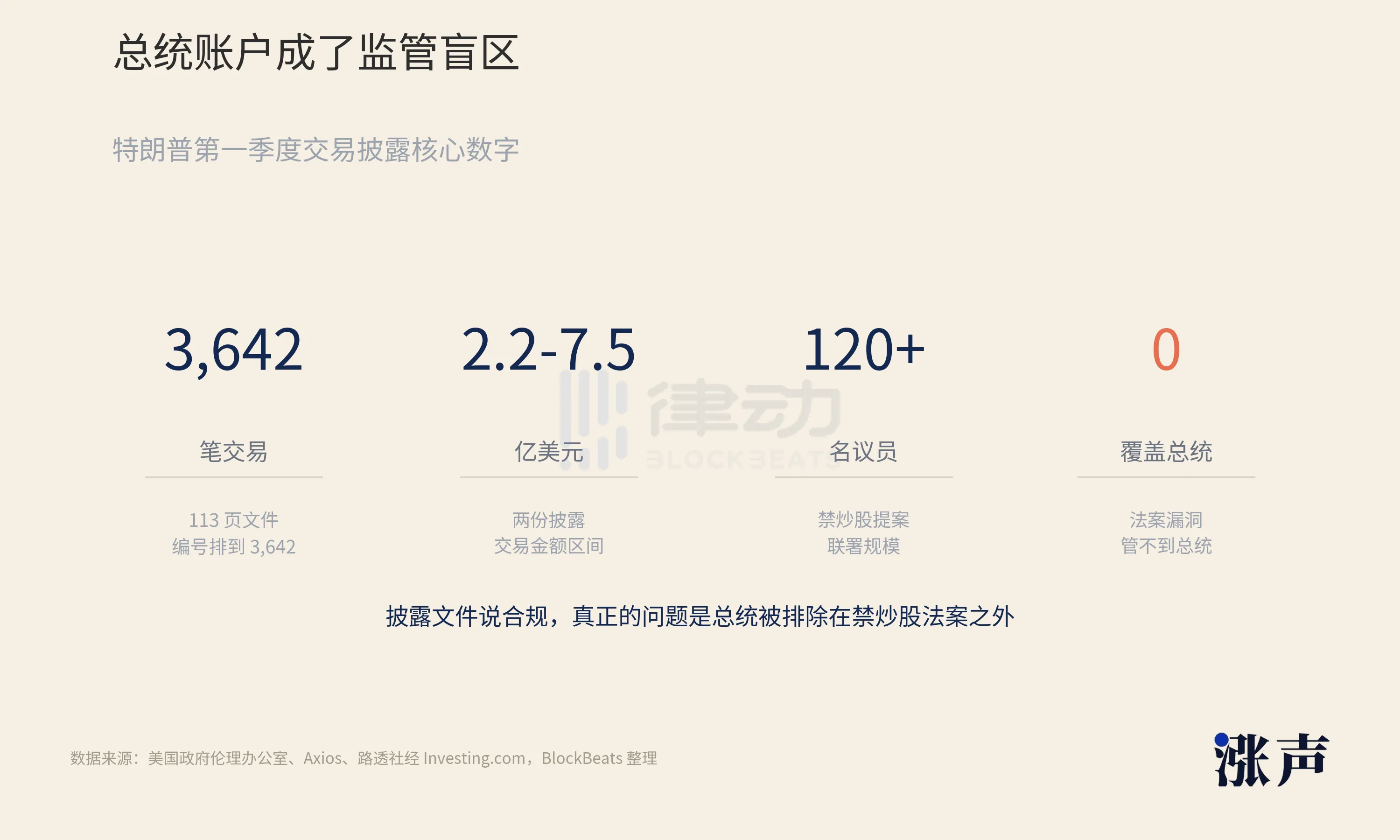
While dealing with the Iran war, placing 3,642 orders in his US stock account.
This was Trump's Q1.
Meanwhile, he was also handling tariffs, negotiating trade deals, and signing executive orders. Last Thursday, the US Office of Government Ethics website released a 113-page document. On the cover was a handwritten line stating that the filer had paid a late fee. The world's most anticipated transaction disclosure was finally made public.
During the same week, the US Congress was advancing a bill to prohibit officials from trading stocks. According to Axios, the related proposal has been co-signed by over 120 members of Congress, with versions in both the House and the Senate, and a public support rate of over 70%.
But the biggest loophole in this bill is that it does not cover the President.
The White House's response is also very familiar. The President's assets are managed by his children, trades are executed by an account manager, fully complying with the US official stock trading disclosure law, and there is no conflict of interest. This sentence has been repeated many times in the past year. Every time new details emerge, it is repeated. With each repetition, it has become a form of information itself.
One person who can influence tariffs, trade, industrial subsidies, crypto regulation, and market sentiment, while holding a significant US stock account.
The disclosure document states that the trades were compliant. What the market really wants to see is what he actually bought, how much he made, and whether these stocks align with his policy direction.
Money coming out of Big Tech, moving closer to policy
Federal disclosure rules only require an amount range, not exact prices and actual gains or losses.
After Benzinga cross-referenced Trump's scanned document page by page, they estimated that he bought around $2.4 million to $6.6 million of NVIDIA, $2.4 million to $8.1 million of Microsoft, $2.5 million to $8.3 million of Amazon, and $2.2 million to $10.6 million of Oracle.
There was a different set of actions in Big Tech.
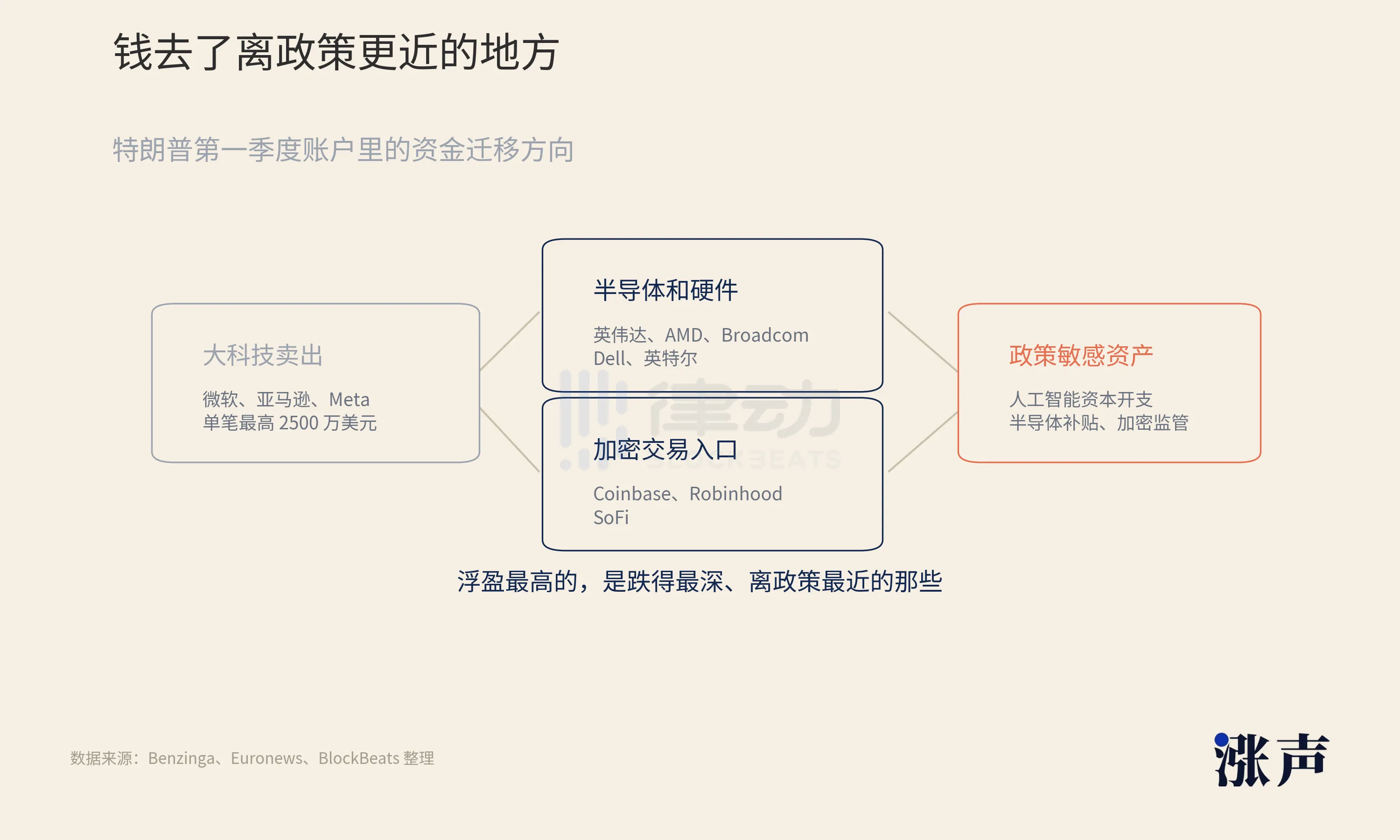
Microsoft, Amazon, and Meta had the largest sell orders, with single transactions as high as $25 million. In the same group of companies, holdings in the first quarter were followed by sales, with buy and sell transactions alternating on the bill. Money came out of Big Tech and went into the semiconductor and AI hardware chain.
NVIDIA, AMD, Broadcom, Dell, Intel were the most frequently mentioned names in this line. There were also Coinbase, Robinhood, and SoFi. The positions were opened during the window of the Federal Bitcoin Reserve discussion and the rollout of the "Trump Account" retirement plan.
Euronews calculates that if the position is held until the disclosure date, the unrealized gains exceeding 100% include holdings in AMD, Intel, Marvell, SanDisk, Seagate, and others.
The highest unrealized gains are found in those that have fallen the most and are closest to the policy.
In this group of trades, big tech remains the core position. Microsoft offers enterprise software and cloud services, Amazon provides cloud computing and advertising, Meta has advertising cash flow and AI recommendation efficiency, and Oracle offers databases and cloud infrastructure. They are the go-to names when U.S. stock funds return to risk assets.
The increment is in the hardware chain.
NVIDIA is the center of the GPU supply chain, AMD is the second option, Broadcom specializes in custom chips and data center networks, and Dell delivers AI servers as a complete machine. Every time a cloud provider buys an additional GPU, companies in this chain receive more orders. While big tech's money is based on the valuation logic of platform companies, the hardware chain's money relies on being among the first to receive payments when AI capital expenditures are implemented.
In comparison, Dell presents the cleanest timeline in this context.
On February 10, 2026, the Trump account initiated a position in Dell, with an amount ranging from $1 million to $5 million. On May 8, Trump publicly praised Dell's hardware products at a White House event, causing Dell to rise by approximately 12% that day. Six days later, the trades were disclosed.
There is another background story along the same line. The Dell family had previously committed to allocating $6.25 billion to the "Trump account" retirement plan. Each individual link appears legal, as confirmed by the U.S. officials' stock trading disclosure act.
Moreover, no one was investigated.
This is also where the Trump account differs from regular politicians in trading. While the stock disclosures of ordinary officials are scrutinized to see if they have benefited from a policy direction, Trump's disclosures add another layer. He is not just betting on the market sidelines; his public activities, policy initiatives, and industry ties themselves become part of the market pricing.
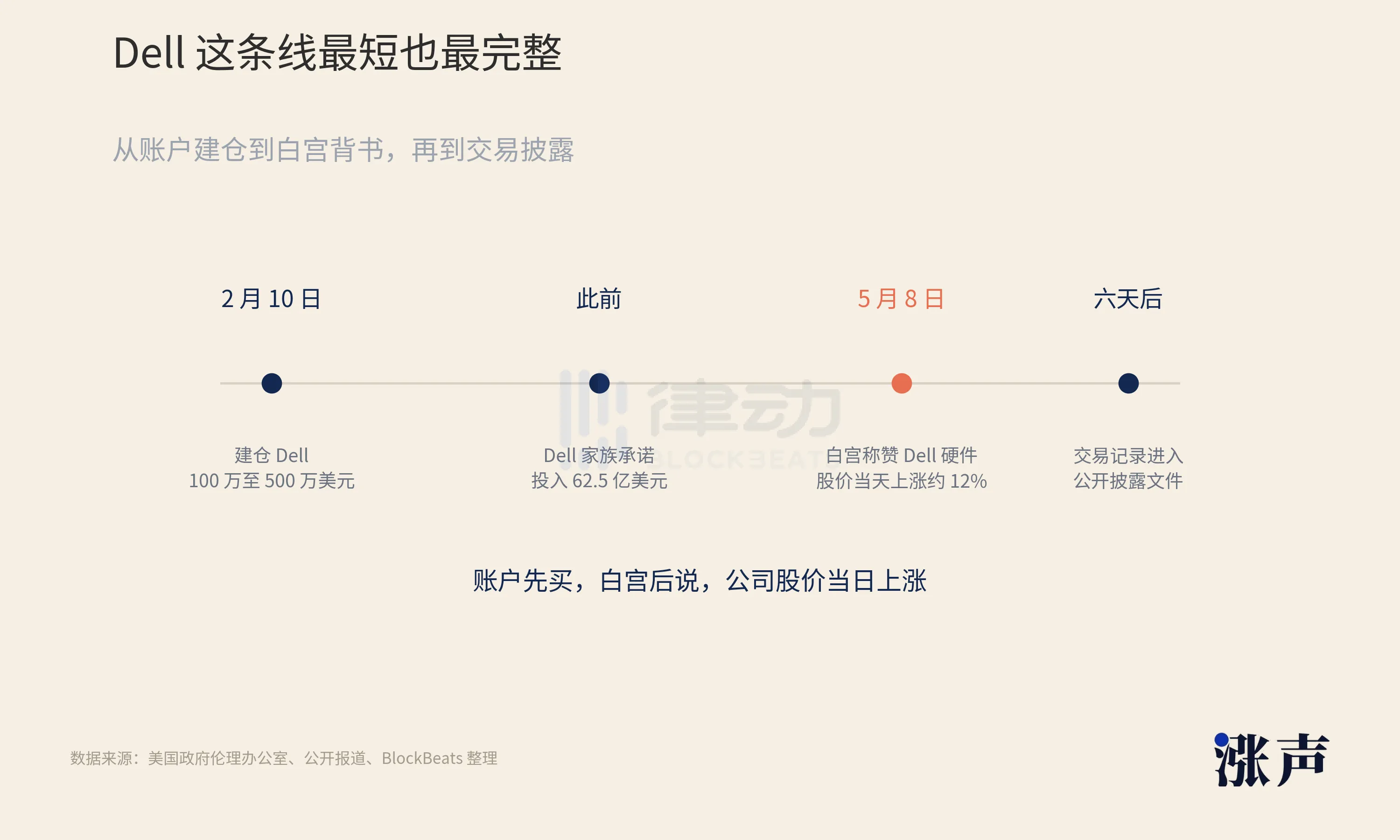
The Dell line is both short and complete.
The account buys first, the White House speaks later, the company's stock price rises on the day, and family funds flow into Trump's policy projects. Without needing to prove any illegality at any point, this sequence is sufficient for the market to consider it a template of a politician's transaction.
Intel Acquired as "US State-Owned Enterprise"
A stock transaction is in a US stock account, not in Trump's personal account.
In August 2025, the "Chip and Science Act" has $5.7 billion in subsidies yet to be disbursed to Intel, plus $3.2 billion for the "Security Enclave" project, totaling $8.9 billion.
The Trump administration converted this subsidy into equity. 4.333 billion shares of Intel common stock at $20.47 per share, acquiring approximately 9.9% ownership. The US government became Intel's largest shareholder, officially classified as a "passive investor" with no board seat requirements.
This provision was not part of the original "Chip and Science Act" design. The subsidy was intentionally structured as non-equity for a clear reason. The government provided the money but did not interfere with corporate governance. Taking money is fine, but holding shares is not allowed. This is because after acquiring shares, the government has a financial interest in the company, making it difficult to remain detached from the company's future.
Trump changed the rules.
Prior to this transaction, Intel's stock price had been trading below $20 for almost a year, with declining revenue and outdated processes, leading the market to view it as a non-competitive company. After the government intervention, a new variable was added to Intel's valuation, indicating that the US government would not let this company fail.
This assessment does not fit into a cash flow discount model, but the market will price it in.
Chip manufacturing is a national strategy, and the largest shareholder will not stand idly by. From this moment on, Intel's tail risk was cut off by policy. Trump's personal Intel position appeared in early March 2026, six months after the government's settlement.
By this time, Intel had exceeded earnings expectations for six consecutive quarters, driven by AI inference demand leading to CPU order recovery, Apple's OEM rumors continued to ferment, and the fundamental recovery story began to make sense. On May 15, 2026, Intel closed at $108.77. Starting from the government's entry price of $20.47, it rose by approximately 431%, with the government's holding gaining book value of around $38.2 billion.
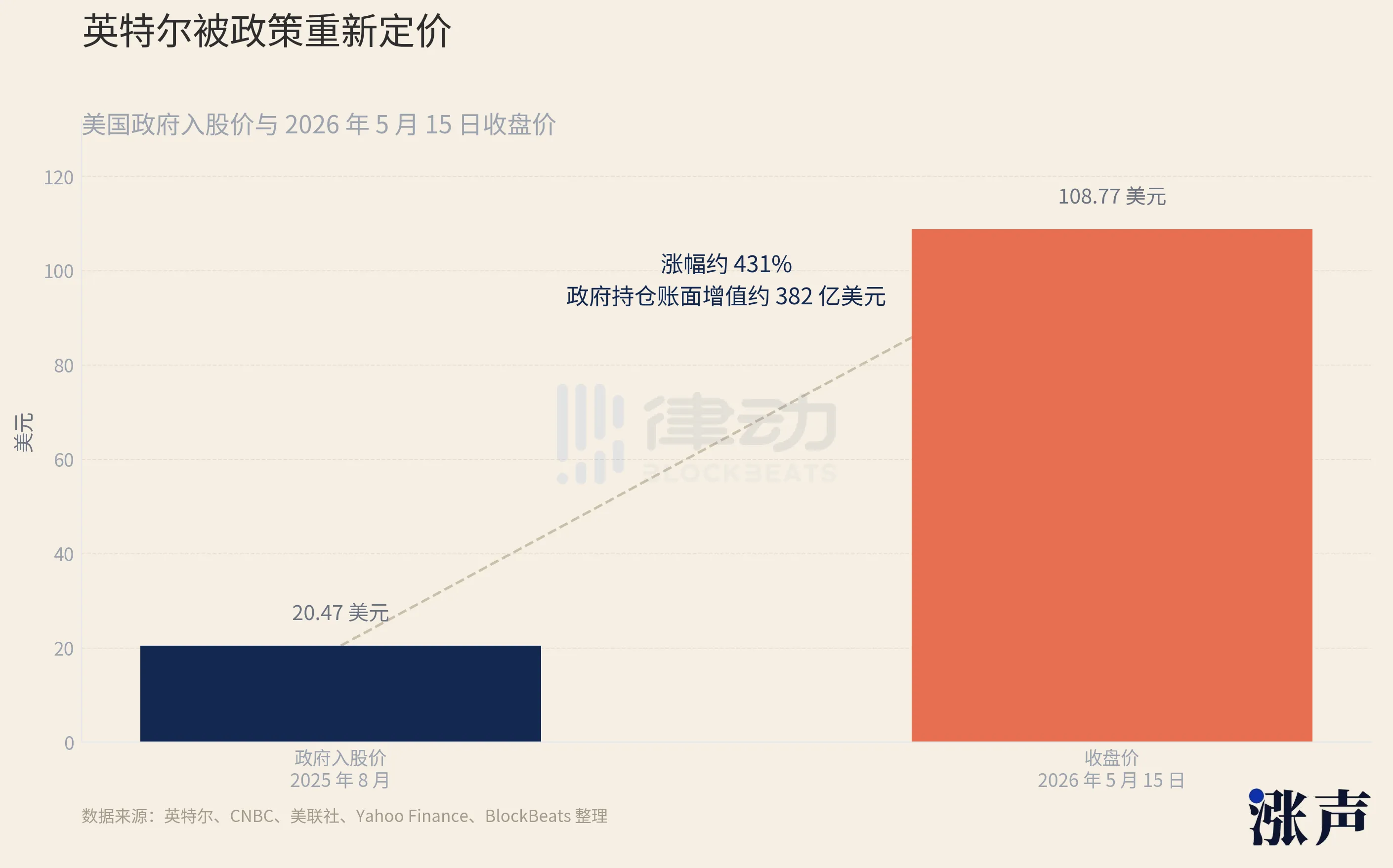
First, use taxpayers' money as a bottom line, then follow up with your own money. This statement may sound harsh, but the sensitivity of the Intel case lies here.
The public information is already available, and Trump's personal account's purchase of Intel may not necessarily involve non-public information. The issue arises when the government has already positioned a company at the heart of national strategy, and the President's personal account appears alongside the same company, making it challenging for the market to view it as just an ordinary investment.
The community refers to Intel as the "American SOE," a joke with a very realistic undertone.
Unlike traditional state-owned enterprises, when the government becomes a major shareholder by investing $8.9 billion, Intel is placed within the policy framework of U.S. manufacturing, supply chain security, AI computing power sovereignty, and semiconductor subsidies. What investors are buying into is not just Intel's next quarter's profit, but also the expectation that the U.S. government will not let it fail.
This is also why Intel is more important than Dell.
Dell follows a clear stock timeline.
Intel follows an institutional timeline. It started with subsidies and transitioned to equity, linking industrial policy, government financial interests, individual holdings, and market pricing together.
Over the past few years, the market has been tracking Pelosi family trades, and the logic has always been the same. Policymakers knew what was coming, so they bought early. It was a one-way causality: policy led to information, information brought trading opportunities, and officials front-ran the market.
Intel is different. Here, the key point goes beyond knowing about a policy in advance; the government itself becomes directly involved in the trades. Subsidies, equity, reshoring manufacturing, AI computing power, individual accounts—all concentrated in one company.
This case explains why the batch of AI hardware and semiconductor assets in the Trump account is crucial.
NVIDIA and AMD are AI chips, Broadcom is into networking and custom chips, Dell deals with server systems, and Intel represents onshore manufacturing supported directly by the U.S. government.
These targets may appear diverse but point in the same direction. The U.S. market is acquiring AI capital expenditures, the U.S. government is acquiring onshore semiconductor capabilities, and the Trump account is seen alongside these assets.
Closed Loop: Positions and Policies Driving Each Other
Chasing after politicians' U.S. stock accounts has been happening for many years.
The Pelosi family trades have been tracked for years, and the logic has always been simple. Policymakers knew in advance what was coming, so they bought early. Policy led to information, information brought trading opportunities, and officials profited from the time difference.
This logic has a legal framework to address it, such as the U.S. Stock Trading Disclosure Act.
Trump's U.S. stock account adds another layer to this and is even harder to deal with.
By holding Intel, he has a financial incentive to maintain semiconductor subsidies. By holding Coinbase and Robinhood, he has a motive to advance crypto legalization. By holding AI hardware chains, he has an incentive to continue expanding data center capital spending. By holding broad-based index funds and big tech, he has a motive to keep overall U.S. stocks in a risk-on mode.
When it comes to accounts and policies, they are aligned and reinforce each other. Over time, it becomes difficult for outsiders to determine who is driving whom.
Policies influence holdings, which in turn influence policy preferences, and then the policy drives up the value of the holdings. Once this cycle is set in motion, it is challenging for outsiders to assess whether financial interests have played a role in any specific decision, and to what extent.
Previous presidents have adhered to the use of blind trusts, and the core significance lies here. By putting money in, they remain unaware of what is held, ensuring no financial bias when making policy decisions. Cutting off this feedback loop is a fundamental premise of institutional design.
Trump did not follow this practice.
The "Chip and Science Act" initially designed subsidies to be non-equity to prevent the government from losing its detachment by becoming a shareholder. Trump modified it to include equity, with the government holding 9.9% stakes. Six months later, his personal account also invested in Intel. Now, the direction of semiconductor subsidy policy and the market value of his two accounts are pointing in the same direction.
The U.S. Official Stock Trading Disclosure Act governs officials from trading on undisclosed insider information.
Most information here is public. The issue is that decision-making power and financial interests are tied to the same person. Current rules have no means to regulate this binding, only requiring them to disclose the results.
On April 9, 2025, he posted that it was a great time to buy. Less than four hours later, Trump announced a tariff suspension, and the S&P 500 surged by 9.5%. Kathleen Clark, a law professor at the University of Washington, later said, "He was sending a signal that he can manipulate the market with impunity."
A year later, the accounts were disclosed.
The Dell family invested $6.25 billion in the "Trump Account." Trump accumulated Dell shares in the first quarter and publicly endorsed Dell at the White House in the second quarter. Dell surged by about 12% that day, and six days later, the trading records were disclosed.
Everyone in this chain got what they wanted.
The market received a narrative to explain the stock price. The company gained exposure from the White House. The Trump Account realized paper gains. The policy initiative received funding from the entrepreneurial family.
The 113-page disclosure could tell you what he bought, but what it didn't reveal is how policy influences holdings, and how holdings, in turn, influence policy.
Welcome to join the official BlockBeats community:
Telegram Subscription Group: https://t.me/theblockbeats
Telegram Discussion Group: https://t.me/BlockBeats_App
Official Twitter Account: https://twitter.com/BlockBeatsAsia