Silicon Valley's Most Expensive Breakup: Unpacking Musk and Altman's $134 Billion Feud
This is a showdown between the world's richest person and the CEO of the most influential artificial intelligence company globally.
SpaceX is about to go public in a record-breaking IPO, while OpenAI is reportedly planning to IPO later this year. The combined valuation of the two companies in the private market exceeds $2 trillion. A Wall Street analyst called it the "Case of the AI Century."
Musk's story goes like this: He funded a charity, believed in the founder's promise, and then discovered he had been deceived. They took away something that originally belonged to the public.
From OpenAI's perspective: Musk knew the company needed to commercialize, he was part of the discussions himself; he wanted to lead, didn't get it, left, and then watched the company achieve historic success without him. He decided to destroy it through litigation because he had his own AI company competing with it.
But who remembers 11 years ago when Elon Musk and Sam Altman sat on the same side of the table, co-founded a non-profit organization called OpenAI, and wanted to benefit all of humanity?
Love-Hate Relationship
In December 2015, OpenAI was established as a non-profit organization registered in Delaware. The list of co-founders was long: Altman, Musk, Ilya Sutskever, Greg Brockman, Andrej Karpathy, and many more. Musk and Altman were co-chairs. Sam Altman, Greg Brockman, Elon Musk, Reid Hoffman, Jessica Livingston, Peter Thiel, along with Amazon Web Services and Infosys, collectively pledged $1 billion.
At that time, both Musk and Altman openly discussed the existential risk of AI. They didn't want another startup; they wanted a hedge. A hedge against Google's DeepMind, a hedge against profit motives themselves. The founding document of OpenAI stated, in black and white, that it aimed to "ensure that leading research institutions can place the pursuit of aligned outcomes above their own self-interest."
Musk contributed $38 million (as per court documents cited by CBS, the final figure was $44 million; Wikipedia's figure is "less than $45 million"), recruited key talent, and shared everything he knew about startups with them. Before the court hearing, he wrote on X: "But I chose to start, fund, hire for the public benefit, and then they stole the charity."
The First Showdown
The honeymoon period did not last into the third year.
In February 2018, Musk resigned from the OpenAI board.
The official reason given was quite pure: due to a "potential future conflict of interest," Tesla's autopilot team is also working on AI, but he promised to continue donating.
The unofficial version is more interesting. Several analysts later pointed out that there was a showdown between Altman and Musk about who would lead the company, and Musk lost. The version cited by NPR is much more direct: "Altman and Musk had a dispute over who would lead the company, and Musk lost."
Subsequently, in the emails submitted in the counterclaim by OpenAI, it also seems to reflect this point: Musk himself was deeply involved in commercialization discussions at the end of 2017; he even wanted OpenAI to merge with Tesla or to obtain a majority control in any profit structure. OpenAI rejected his terms.
The email from 2018 was later repeatedly cited: OpenAI "immediately needs billions of dollars a year" to compete with Google, "otherwise forget it." Signed: Musk.
This is the best evidence Altman now holds in the defendant's seat.
When Musk left, he reportedly left behind a judgment: this company is "on a path to certain failure compared to Google," and Tesla is "the only path that can compete with Google."
This seems to be the true starting point of all later grievances.
In 2019, OpenAI created a "profit cap" for-profit subsidiary as a subsidiary of the nonprofit parent entity. Microsoft promptly invested $1 billion. The structure of a nonprofit organization holding a for-profit subsidiary is itself the root of all subsequent litigation.
In November 2022, ChatGPT went live.
What happened next is unnecessary to detail. A research lab turned into a general consumer product company within 18 months. As of the trial date, OpenAI was valued at approximately $852 billion; according to data cited by crypto.news, the company surpassed $10 billion in annual revenue in 2025 and is expected to approach $30 billion by 2026.
For Musk, this was a specific form of humiliation. He put in money, people, taught methodology, and then left, all because "it wouldn't work." As a result, not only did it work, it became the most successful company of the past decade, partially controlled by a large tech company he openly disparaged.
In 2023, he founded xAI. From that moment on, he was no longer just a disgruntled former board member of OpenAI; he was its direct competitor.
Rift
In February 2024, Musk sued OpenAI, Altman, and Brockman in a California state court, alleging they had betrayed the nonprofit mission. OpenAI dismissed the lawsuit as "incoherent" and "boring." Musk withdrew the suit in June. In August, he refiled in federal court. The language escalated, with his lawyers stating in the complaint, "This deceit and fraud reach Shakespearean proportions."
On April 9, OpenAI countersued, accusing Musk of using "malicious tactics" to impede the company's progress and hijack its innovation for his own benefit. The countersuit emphasized a key detail: Musk himself had previously supported a for-profit structure and had attempted to take control of the company.
On February 10, 2025, the narrative took an almost ironic turn. A consortium led by Musk made an unsolicited $97.4 billion acquisition offer to the nonprofit organization controlling OpenAI. Four days later, the offer was rejected. OpenAI stated the company was "not for sale," but the offer quietly set a benchmark for valuing the nonprofit portion.
By the end of 2025, OpenAI completed its transition to a public-benefit corporation, with a nonprofit foundation focused on "health, disease treatment," and "AI resilience solutions" holding around $130 billion in equity, second only to Microsoft's $135 billion (approximately 27% ownership). California Attorney General Rob Bonta stated that his office had engaged in "extensive negotiations" with OpenAI and had "obtained concessions" to ensure charitable assets were used for their intended purposes.
But Musk did not back down. He no longer wanted money; he wanted the company itself.
Pretrial Sparring
The atmosphere outside the courtroom was more charged than inside.
On Monday morning, the official OpenAI account fired the first shots on X. "We can't wait to present our evidence in court; the truth and the law are on our side," the post read. "This lawsuit has always been a baseless, jealousy-driven competitive suppression. We finally have the opportunity to have Musk testify under oath before a California jury."
Musk's counterattacks came in a flurry within hours.
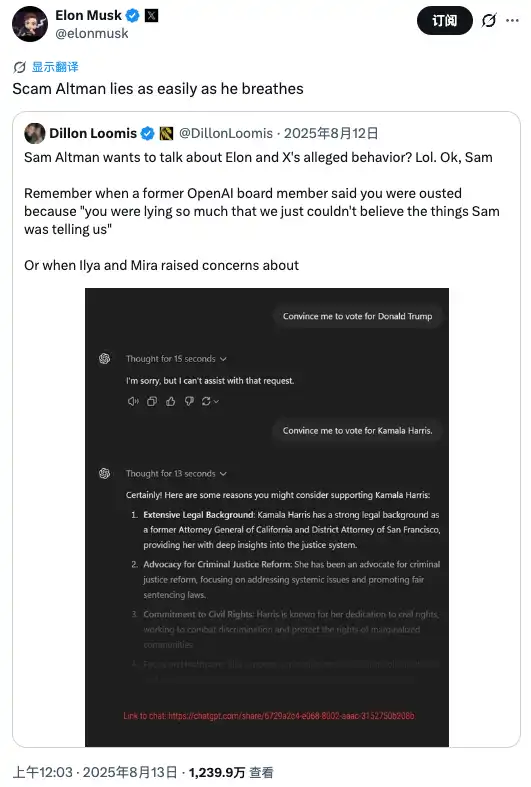
He gave Altman the nickname "Scam Altman." He accused Brockman of receiving billions of dollars worth of stock, while Altman allegedly profited for himself through dozens of OpenAI side deals. He claimed Altman did not disclose his ownership of the OpenAI Startup Fund to the board and lied under oath to Congress about not benefiting from OpenAI. He retweeted a video clip of former OpenAI board member Helen Toner calling Altman a "scammer."
He wrote, "Do you want to set a legal precedent in the United States that looting a charity is okay?"
Then came the now-infamous line that has spread across X: "Scam Altman and Greg Stockman stole from a charity. Full stop."
Beneath the personal vendetta between the two, the case is not actually complex.
In 2024, Musk filed 26 litigation requests. By the start of the trial, only two remained: breach of charitable trust and unjust enrichment. Last week, his legal team voluntarily withdrew the fraud allegations.
The accusation against Microsoft is aiding and abetting the breach of charitable trust. Musk's lawyers reportedly hold a March 2018 internal Microsoft email where CTO Kevin Scott wrote to Nadella before speaking with Altman, saying, "I wonder if OpenAI's major donors are aware of these plans? Ideologically, I can't imagine they fund an open effort just to corral talent and then build something closed and for-profit."
Microsoft then made a multi-billion-dollar investment.
However, Microsoft has its own counterpoint: In September 2020, Musk publicly tweeted, "OpenAI is actually captivated by Microsoft." If Microsoft can convince the jury that Musk was aware three years ago, any multi-billion-dollar risk exposure to Microsoft will disappear due to statute of limitations.
Judge Gonzalez Rogers divided the trial into two phases. The first phase is for liability determination, with a 9-person jury providing advisory opinions, but the final decision lies with the judge. If liability is established, the second phase is for remedies and is scheduled for May 18.
Musk's claimed range is between $79 billion and $134 billion. In an amended filing submitted earlier this year, he requested that all damages be returned to OpenAI's nonprofit arm rather than paid to him personally. In addition to monetary compensation, he also asked the court to reverse the company's for-profit conversion, restore OpenAI to its status as a "true public charity," and remove Altman and Brockman from their positions.
Wedbush Securities analyst Dan Ives wrote in a research note on Monday, "We believe any significant damage to OpenAI and Altman would be a bruise rather than a true consequence." He added, "That being said, this is Elon, and in these situations, do not doubt him."
In the end, this case is not about a charitable trust or for-profit conversion. It is about a more difficult question: what does a person truly believe when they think they are acting 'for all humanity'?
When Musk made his initial contribution, he may not have believed in charity itself. He believed in his position as the instigator, leader, and ultimate decision-maker in this matter. When Altman signed the charter of 'benefiting all humanity,' he may not have believed in literal nonprofit. He believed it was the only narrative at the time that could bring the best people together.
These two beliefs were the same on that table in 2015. They first diverged in the 2018 power struggle. They completely diverged at the moment ChatGPT went online.
Eleven years later, they sat at opposite ends of the same courtroom, each accusing the other of betraying that afternoon.
But perhaps that afternoon never had the consensus they believed in.
The commitments in human memory are often more generous than the commitments themselves.
Welcome to join the official BlockBeats community:
Telegram Subscription Group: https://t.me/theblockbeats
Telegram Discussion Group: https://t.me/BlockBeats_App
Official Twitter Account: https://twitter.com/BlockBeatsAsia