a16z AI Partner's Eight-Year Entrepreneurship Notes
Original Title: Notes From 8 Years as a Founder in Generative AI
Original Author: @lishali88
Translation: Peggy, BlockBeats
Editor's Note: This article is a retrospective from an early Generative AI entrepreneur. In 2018, before the emergence of GPT, he founded Rosebud AI with the mission of making creation as easy as playing a game. The company launched multiple AI creative tools, including TokkingHeads. During a time when the models were not yet mature, these products emphasized a "good-enough-but-usable" experience through design processes and interactions, achieving early user growth and product validation.
This experience almost entirely covers the complete evolution cycle of Generative AI from "synthetic media" to a general-purpose infrastructure. From the experimental explorations of CycleGAN and StyleGAN to GPT-4 opening up the boundaries of code generation and interactive creation, technological advancements continuously reshaped product logic and entrepreneurial rhythms. The author's journey also reflects a more distinct structural shift—when the model became a variable, the true watershed was no longer just the technology itself but how to build products around it, distribute them, and commercialize.
After stepping down as CEO and joining a16z, the author will shift focus to investing in cutting-edge model stacks and related infrastructures. However, more critical than individual trajectories is the trend that these eight years point to: the first stage of Generative AI (proving what can be done) is ending, and the upcoming longer competition will revolve around how capabilities are organized, productized, and eventually deployed in the real world.
The following is the original text:
I have joined a16z as a partner, focusing on investments in infrastructure and AI. Meanwhile, after eight years at the helm of Rosebud AI, I will also step down as CEO.
Below are some reflections on these 8 years. For those who are still on the front lines building, I have great respect. The release of a single model can either derail your original product roadmap or leapfrog it by years. Design, product, engineering—these functions have all evolved compared to three months ago, not to mention eight years ago. The pace of technological progress has made this era the most exciting entrepreneurial moment and the most challenging.
At a16z, I will focus on the frontier model stack, including the models themselves and the infrastructure and development tools built around them. I am excited about the rapid evolution of model capabilities, with more and more advancements being driven by AI itself. Additionally, I am optimistic about the breakthroughs AI is making in mathematics and science. Furthermore, having spent the last 8 years building AI creative tools, I have always had a particular interest in this direction.
Prior to this, I have also made angel investments in some seed-stage startups, including @fal, @periodiclabs, @SakanaAILabs, and @ExaAILabs. Next, I am looking forward to dedicating all my energy to supporting founders who are building in this tech stack.
2018: Betting on Generative AI Before GPT Emerged

In November 2018, I used CycleGAN to process visuals from the game "Myst," attempting to transform a forest into a tropical jungle in an experimental video.
Building a startup in the generative AI field, eight years is quite a long time.
I started in late 2018, almost in what could be considered an "ancient era," when this field was still referred to as "synthetic media." I was tinkering with CycleGAN and StyleGAN, and the content they generated was both strange and fascinating, making me believe that one day, creation would be as effortless as building in a game ("rosebud" even takes its name from The Sims life simulation game).
Creation should ideally be a form of play. The faint glimmer of generative AI early on convinced me that this "playful creation experience" could expand to more forms of creation. I began to imagine how generative AI would reshape video games (such as the CycleGAN video I trained based on "Myst" visuals in 2018).
Fast forward eight years, and now we can generate videos, games, and even music based on a single prompt. The once-imagined future has finally arrived—and this is just the beginning.
Looking back, my ability to form such a strong belief at such an early stage may be because my life has always been at the intersection of technology and art: on one side, a background in mathematics and deep learning, on the other, a passion for dance and music. Entrepreneurship in generative AI requires a combination of both: a technical background allowed me to see what was coming, while an artistic inclination made me eager to bring it to life.
The entrepreneurial journey is always longer and harder than imagined. Finding something you believe in almost irrationally is what maximizes the probability of persevering.
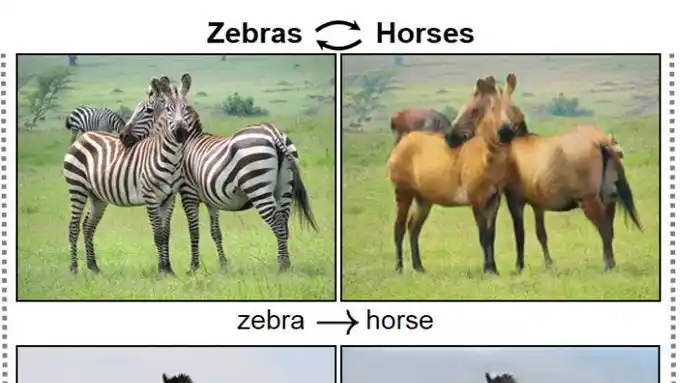
In 2017, CycleGAN, we had come a long way
2018–2023: Delighting Users with "It's Good Enough"
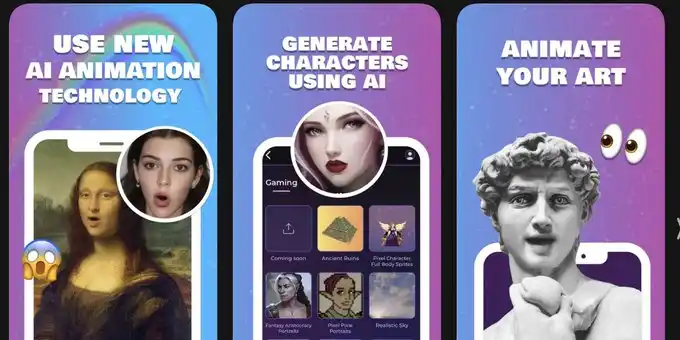
The third iOS app Tokkingheads interface screenshot. The core of early generative AI is to design a simple process and actively embrace the roughness of the product.
Along the way, we have released numerous products aimed at honing our intuition for cutting-edge model capabilities and learning to package them into magical experiences that hide early flaws. At that stage, I realized that when the model output is far from perfect, you can design a consumer-level experience that enables users to iterate quickly and provide fast feedback. Users are discerning but not fragile—satisfying them with something functional is enough.
By the time of the third mobile app, we had accumulated enough knowledge to enable Tokkingheads to achieve organic viral growth, surpassing 2 million users within weeks. The next key lesson followed: as a founder, you must be clear on what product form can keep you motivated in the long run. Tokkingheads could have taken the path to becoming an overnight sensation, but I was unsure if that was the right foundation for developing this creative magic into a more complete product, which was what I truly desired.
So we continued to iterate. We worked on AI-generated stock photos, AI art paired with NFTs (yes... I naively thought that artwork quality was key, only to discover that the real skill was in hype and speculation), and an AI game asset generation tool. Each product taught me something specific: why users are willing to pay, and how quickly the models are improving. In between these projects, there was a global pandemic and the Silicon Valley Bank and First Republic Bank run crisis—which reminded me to be grateful. Being able to continue building is a privilege in itself.
2023: Code Generation Matures
Code generation has finally become user-friendly enough, and the time is right to create gaming tools for non-technical creators. After the release of GPT-4, that future became tangible. In March 2023, I shared a memo with the team and pieced together the initial version of the Rosebud text-to-game feature using the prototype below.
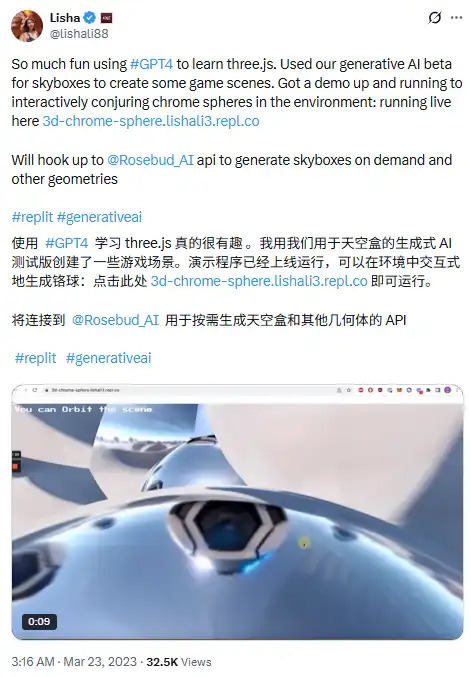
Twitter screenshot from March 23, 2023. I used GPT-4 to learn Three.js, combined with Rosebud generative AI to generate a skybox, demonstrating an early prototype of summoning a 3D scene through text.
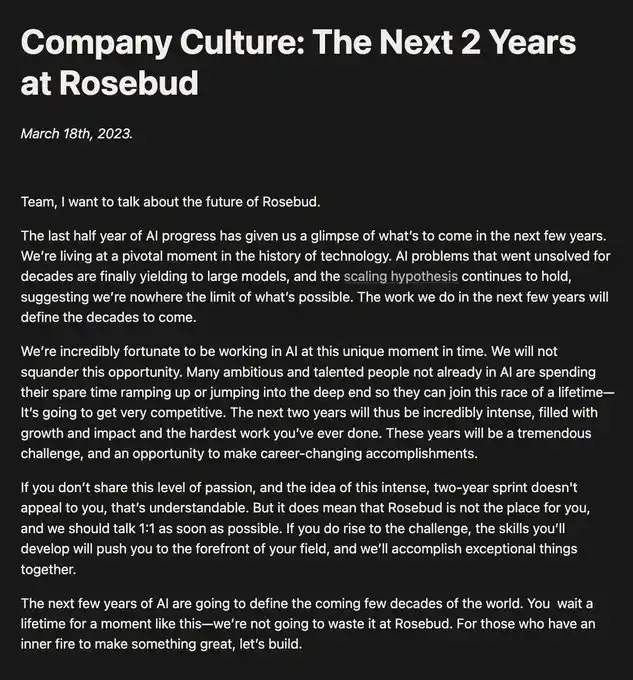
Early 2023, an internal memo from the author to the team, documenting product decisions following the breakthrough in code generation capability. The core assessment of this internal memo was: AI is at a critical juncture that will define the next few decades, and the next two years will be a highly competitive stage with a fast pace, high intensity, and clear eliminations. The company will fully commit to this "sprint," which is only suitable for those with a strong internal drive, willing to withstand pressure and make long-term commitments—because this is not just a work experience, but a historic opportunity that could potentially alter an individual's career trajectory.
2026 and Beyond: What Can You Build That Lab Won't?
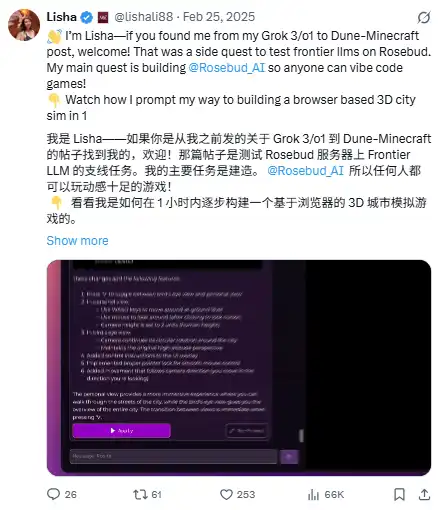
Image: Demo Video - The author builds a 3D city simulation game on the browser side using prompt words
Creating games requires tapping into both creative intuition and technical prowess simultaneously. Generative AI is the key to making game creation itself a form of play—any advancements in image, video, world modeling, or code models are immediately absorbed and transformed. The business model of games is also most likely to stay outside the field of view of cutting-edge labs: the core monetization path still relies on player payments, and establishing a player-side distribution system seems like a detour task for labs sprinting towards AGI at full speed. For founders, choosing what to build is always a continuous game of finding space outside the lab's critical path.
The Rosebud momentum is strong. We have organically built up a large-scale, highly engaged creator community. I will miss the chats with creators on Discord and the days of handling user support emails every day (a user willing to complain must really care about your product). The next phase is to expand the distribution scale on the player side, so now is a good time to pass the baton to the teammates who have always fought side by side.
Congratulations to @glazworks on becoming the new CEO of Rosebud! He uniquely combines machine learning talent with product aesthetics.
Martin Casado and the a16z team have been with Rosebud throughout its growth. Martin and I had a crucial conversation discussing whether JavaScript was the right tech stack for Rosebud's game—choosing Unity or Roblox might be more popular, but JavaScript's code generation improvement speed is much faster due to higher availability of training data. This team pursues the truth and is willing to bet on stakes that can attract more builders. This is the path to an ideal future: we must build, we must innovate.
Looking forward to continuing to work with everyone from the other side of the table. My DMs are always open.
Welcome to join the official BlockBeats community:
Telegram Subscription Group: https://t.me/theblockbeats
Telegram Discussion Group: https://t.me/BlockBeats_App
Official Twitter Account: https://twitter.com/BlockBeatsAsia