Experience Musk's WeChat of the West, indescribable

XChat finally opened for App Store download this morning. After the announcement and media coverage two weeks ago, the community widely referred to this app as the "Western WeChat," highlighting features such as disappearing messages, screenshot prevention, 481-person groups, Grok integration, and no need for phone number registration. BlockBeats was quick to conduct a hands-on experience review to see how Elon Musk's chat app really performs.
Recommended Reading: "Before Using Musk's 'Western WeChat' XChat, Understand These Three Issues First"
Breaking Down X Chat Functionality into an App, Actual Features Are Limited
Firstly, the "no need for phone number registration" claim is indeed true, as the registration process has already been completed on the X platform... Upon opening XChat, the homepage prompts you to "Log in with X," and once inside the app, the messaging interface is almost identical to the X platform's chat page. Therefore, it is evident that the main part of XChat is an App that extracts the X chat function.
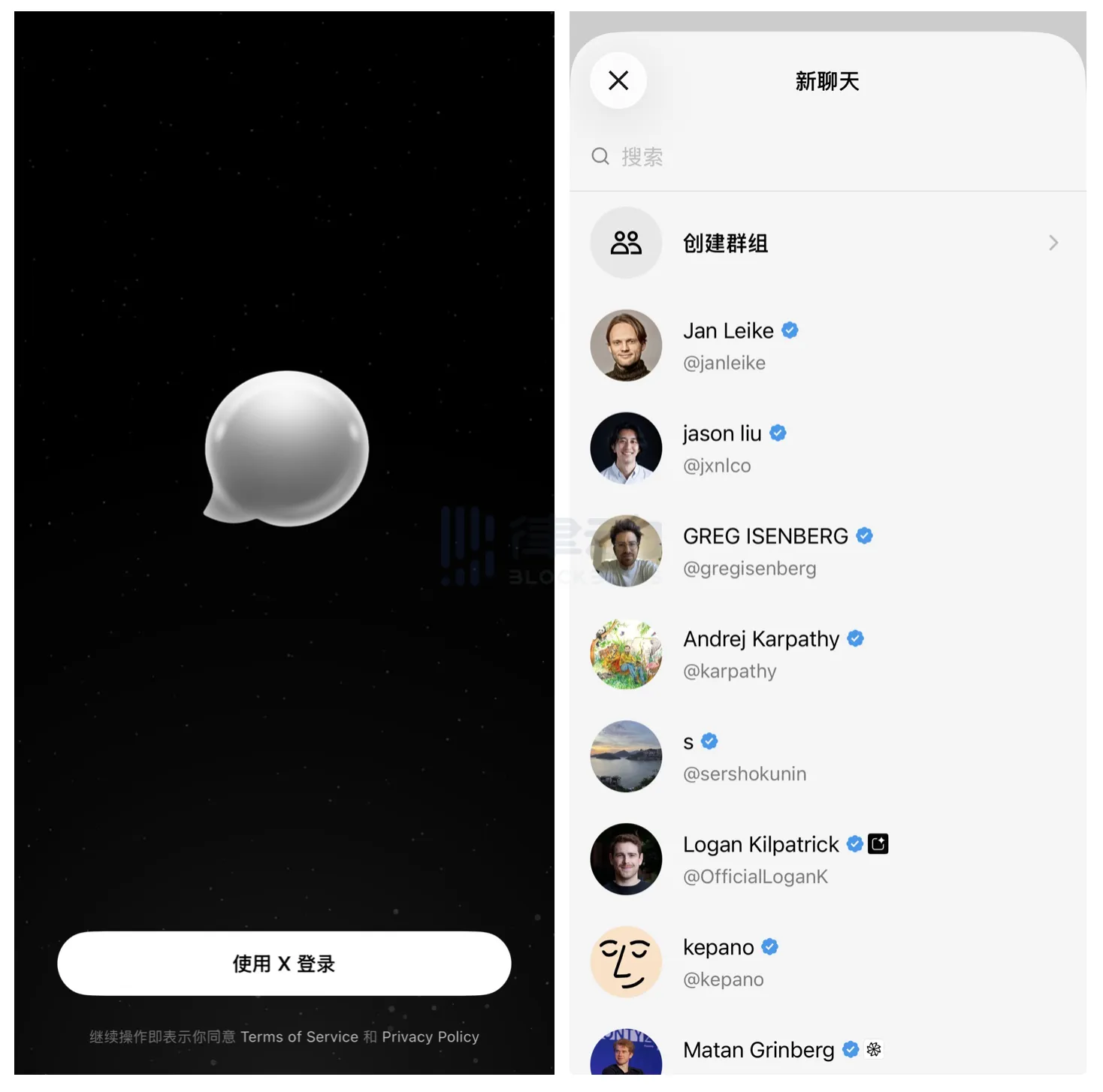
At the bottom is a search bar, clicking the "X" icon on the left takes you directly to the X application, and the pencil icon on the right starts a new chat. The options available in the settings page are also quite limited.

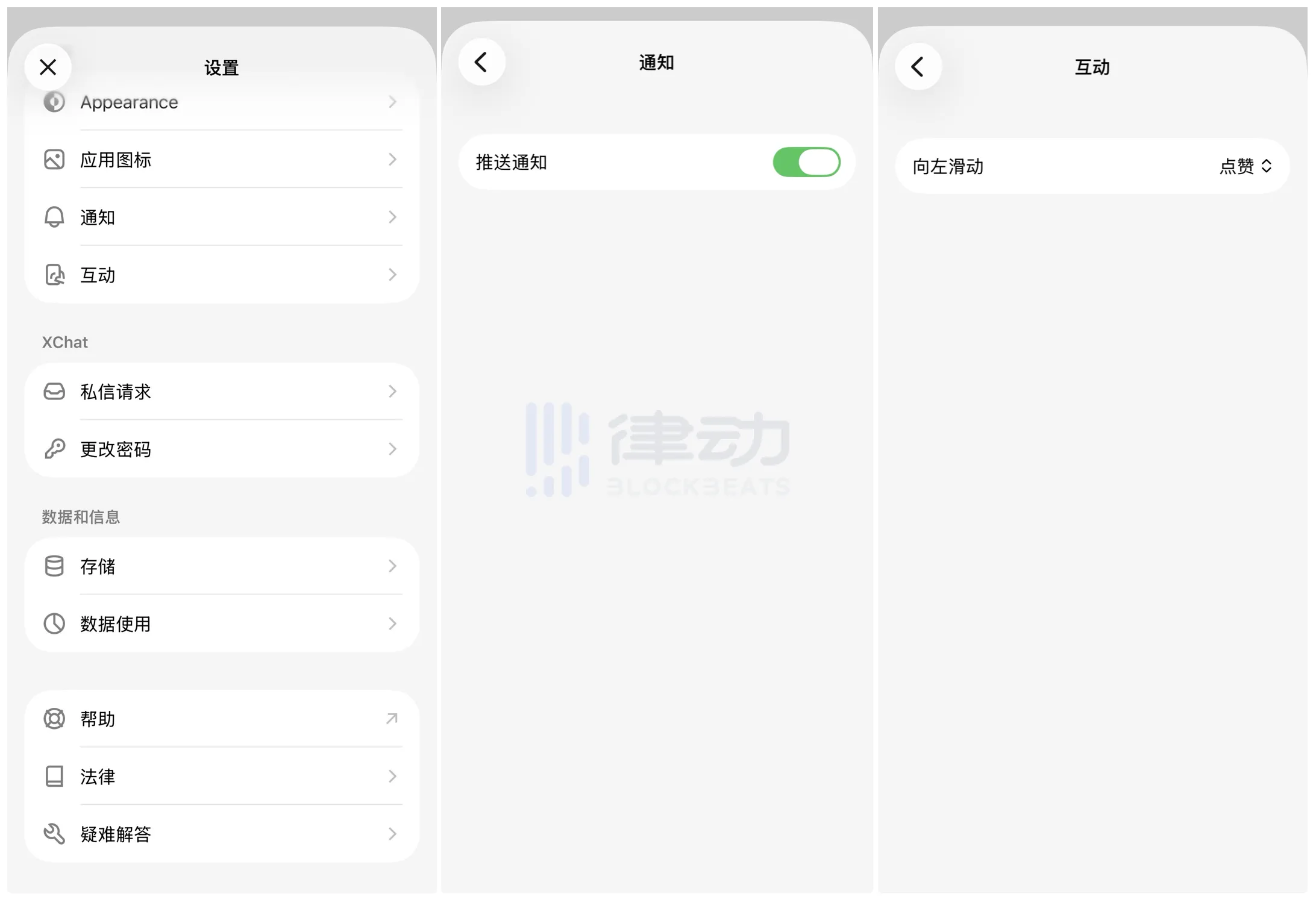
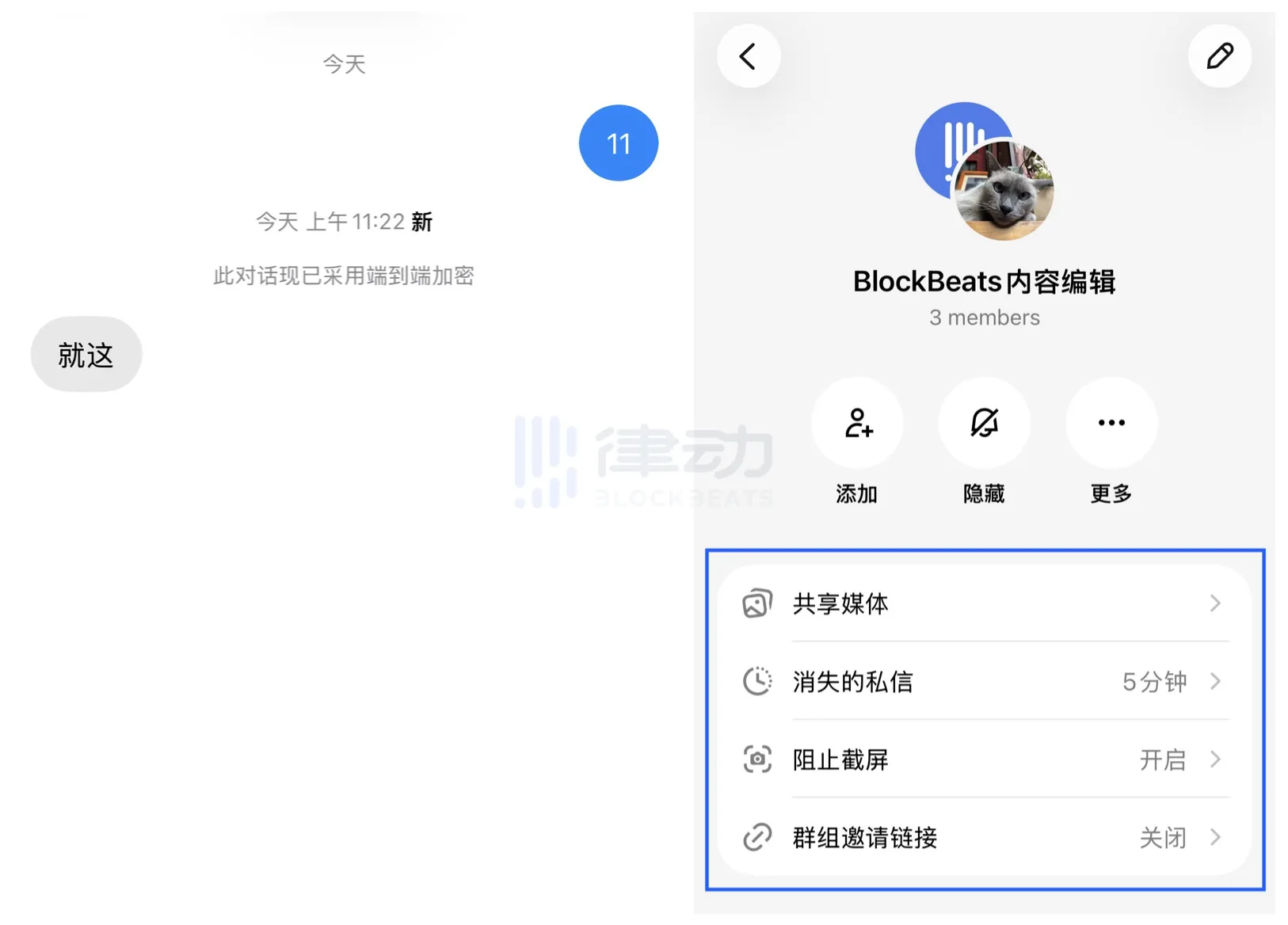
Features like disappearing messages (vanishing private messages) and screenshot prevention (screen capture prevention) are set individually for each chat or group chat and cannot be uniformly adjusted in the general settings page. Once a new chat is initiated, the chat content is automatically displayed as encrypted.
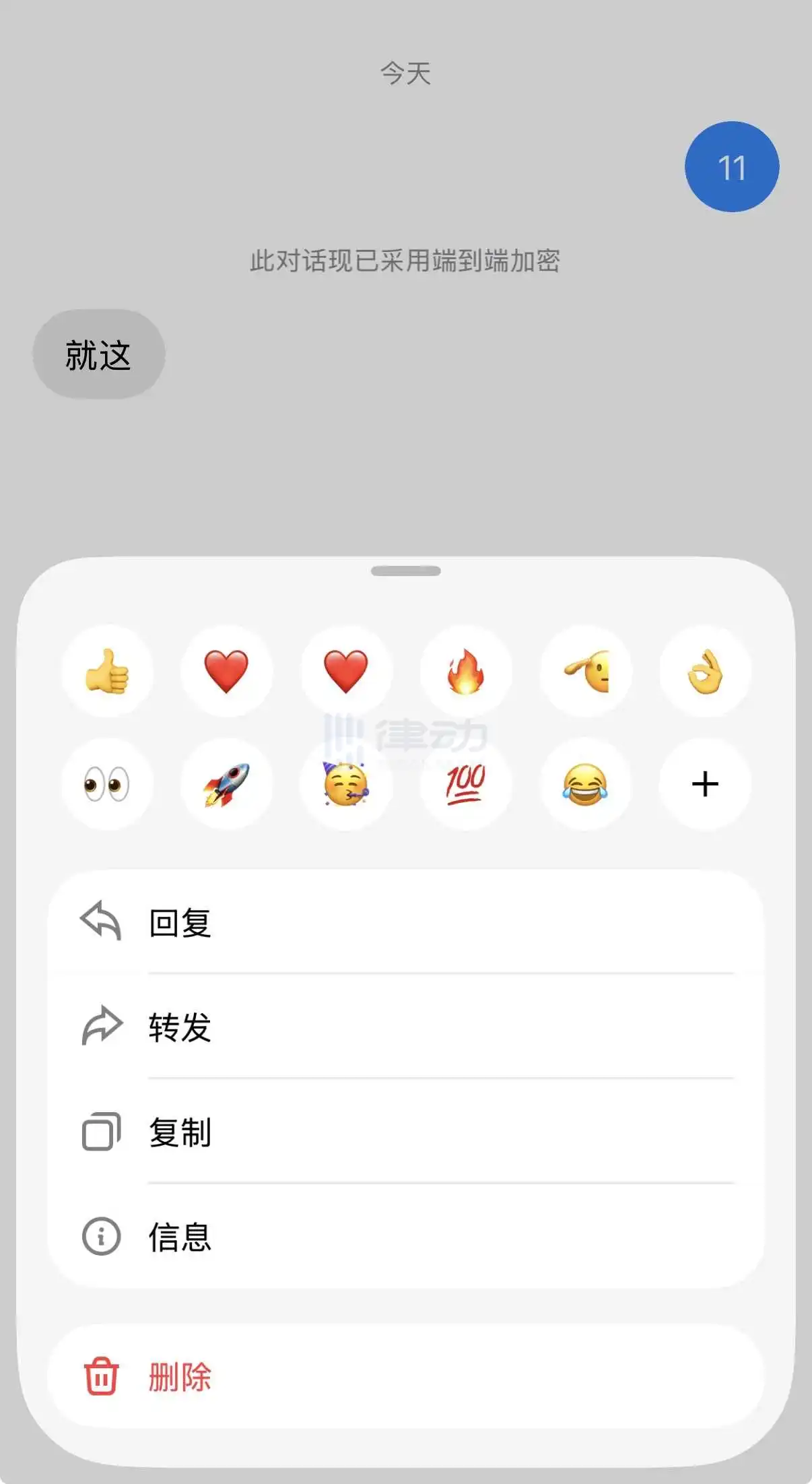
The highly anticipated Grok integration that the community was looking forward to does not seem to be configured in the current version. Currently, long-pressing on chat content only allows for emoji replies or content copying, similar to Telegram, Signal, and other apps.
Is End-to-End Encryption the Same as Signal?
No, the difference lies in where the key is stored.
Signal uses end-to-end encryption where the key never leaves your device. Neither Signal, the courts, nor any external party holds your key. Signal's servers do not have anything to decrypt your messages; even if subpoenaed, they can only provide registration timestamps and last connection times, as evidenced by past subpoena records.
X Chat utilizes the Juicebox protocol. This scheme divides the key into three parts, each stored on one of X's three servers. When recovering the key with a PIN, the system retrieves these three parts from X's servers and recombines them. Regardless of how complex the PIN is, the actual custodian of the key is X, not the user.
This is the technical background of the "Help Page Phrase": because the key is on X's servers, X has the ability to respond to legal processes without the user's knowledge. Signal lacks this capability, not due to policy but because it simply does not have the key.
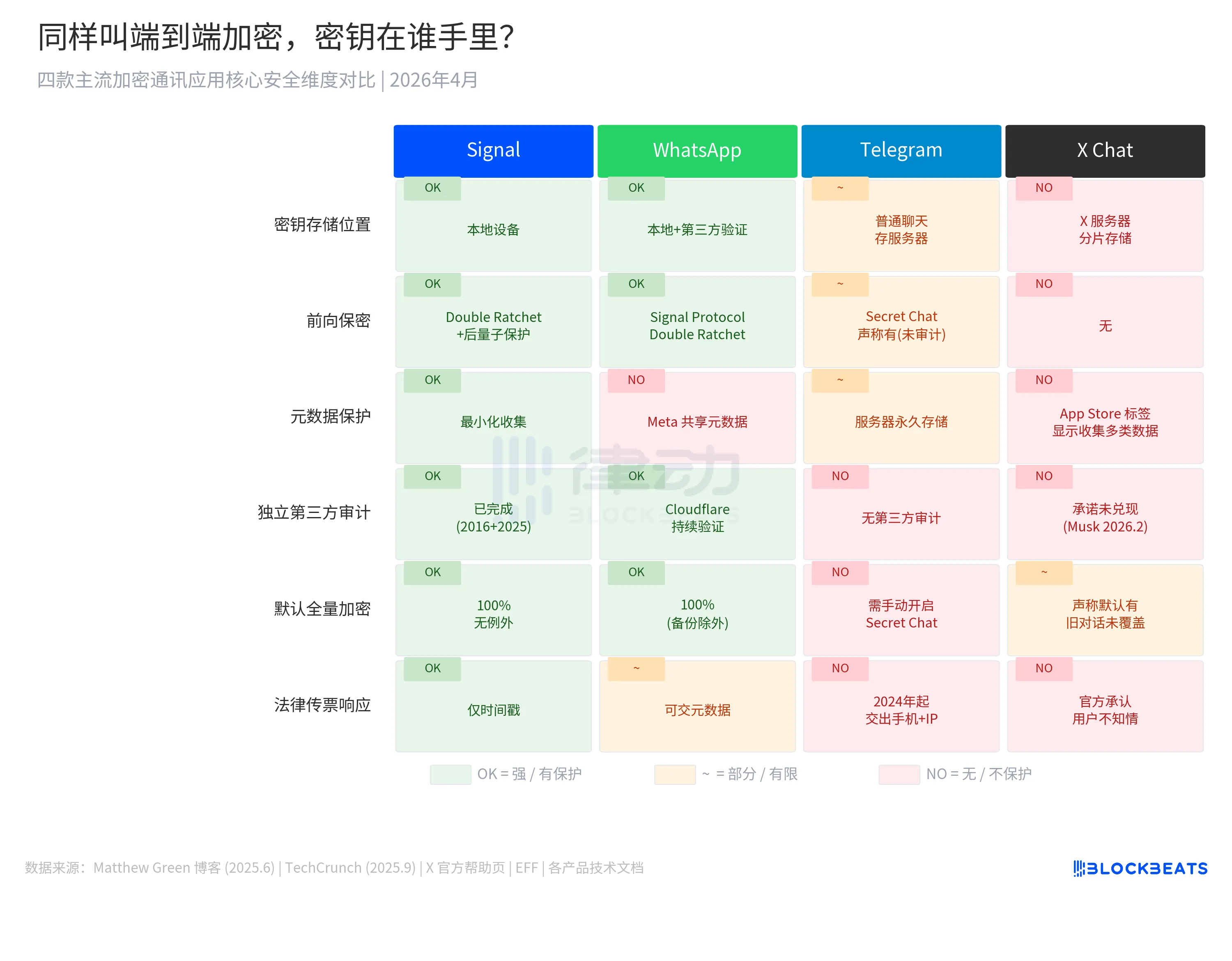
The diagram above compares the security mechanisms of Signal, WhatsApp, Telegram, and X Chat across six dimensions. X Chat is the only one of the four where the platform holds the key and is the only one without Forward Secrecy.
The significance of Forward Secrecy is that even if a key is compromised at a certain point in time, historical messages cannot be decrypted because each message has a unique key. Signal's Double Ratchet protocol automatically updates the key after each message, a mechanism lacking in X Chat.
After analyzing the X Chat architecture in June 2025, Johns Hopkins University cryptography professor Matthew Green stated, "If we judge X Chat as an end-to-end encryption scheme, this seems like a pretty game-over type of vulnerability." He later added, "I would not trust this any more than I trust current unencrypted DMs."
From a September 2025 TechCrunch report to its launch in April 2026, this architecture saw no changes.
On February 9, 2026, Musk tweeted a commitment to conduct rigorous security tests of X Chat before it goes live and to open source all the code.
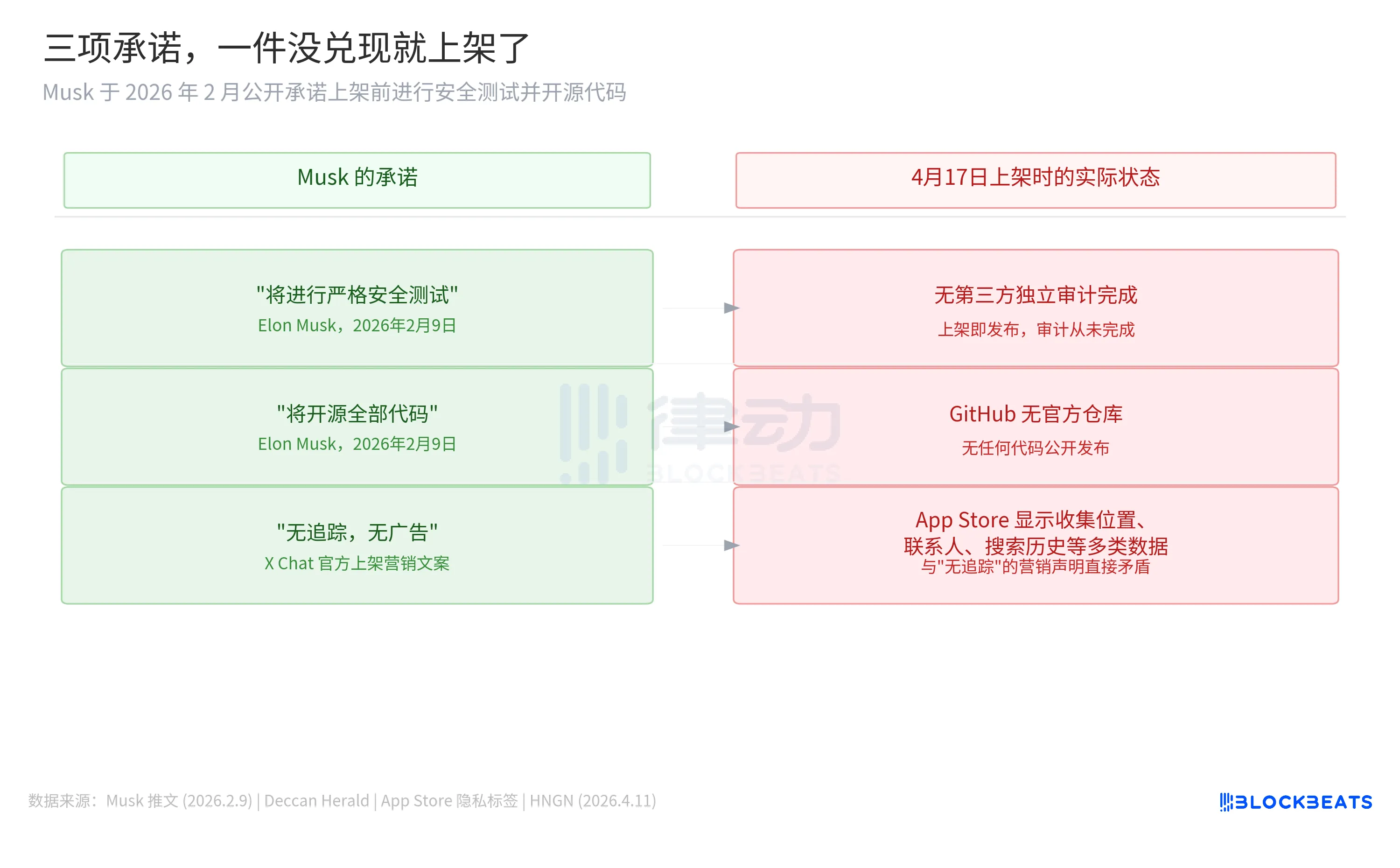
As of the launch on April 17, no independent third-party audit has been completed, there is no official code repository on GitHub, and the App Store's privacy label reveals that X Chat collects over five categories of data including location, contact information, and search history, directly contradicting the marketing claim of "No Ads, No Trackers."
Musk's "Super App": Is This It?
The "Super App" is the community's mainstream description of Musk's reshaping of his Twitter strategy. X Chat, along with X Money and Grok, forms a data loop parallel to the existing infrastructure, similar in logic to the WeChat ecosystem. This assessment is not new, but with the launch of X Chat, it's worth revisiting the diagram.
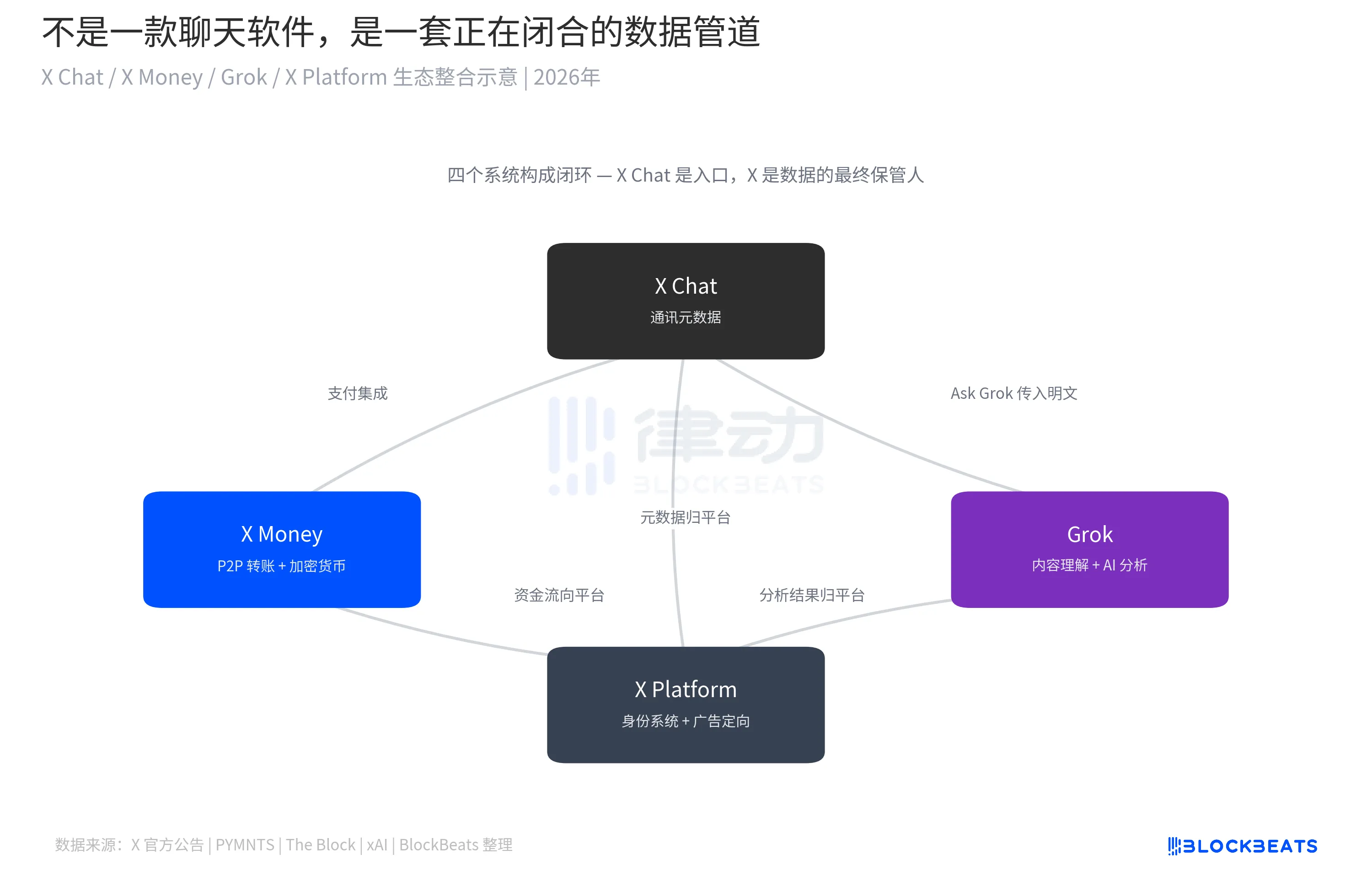
X Chat generates communication metadata, including who is talking to whom, for how long, and how frequently. This data feeds into the X platform's identity system. Part of the message content goes through the Ask Grok feature into Grok's processing chain. Fund flows are handled by X Money: external public testing was completed in March, it was opened to the public in April, fiat peer-to-peer transfers are facilitated through Visa Direct, a Fireblocks executive confirmed plans for crypto payments to go live by year-end, and X currently holds money transmission licenses in over 40 U.S. states.
However, for now, X Chat seems to have simply taken X's chat function and made it into a standalone app. Could it be that the future "Super App" will just break X apart?
Welcome to join the official BlockBeats community:
Telegram Subscription Group: https://t.me/theblockbeats
Telegram Discussion Group: https://t.me/BlockBeats_App
Official Twitter Account: https://twitter.com/BlockBeatsAsia