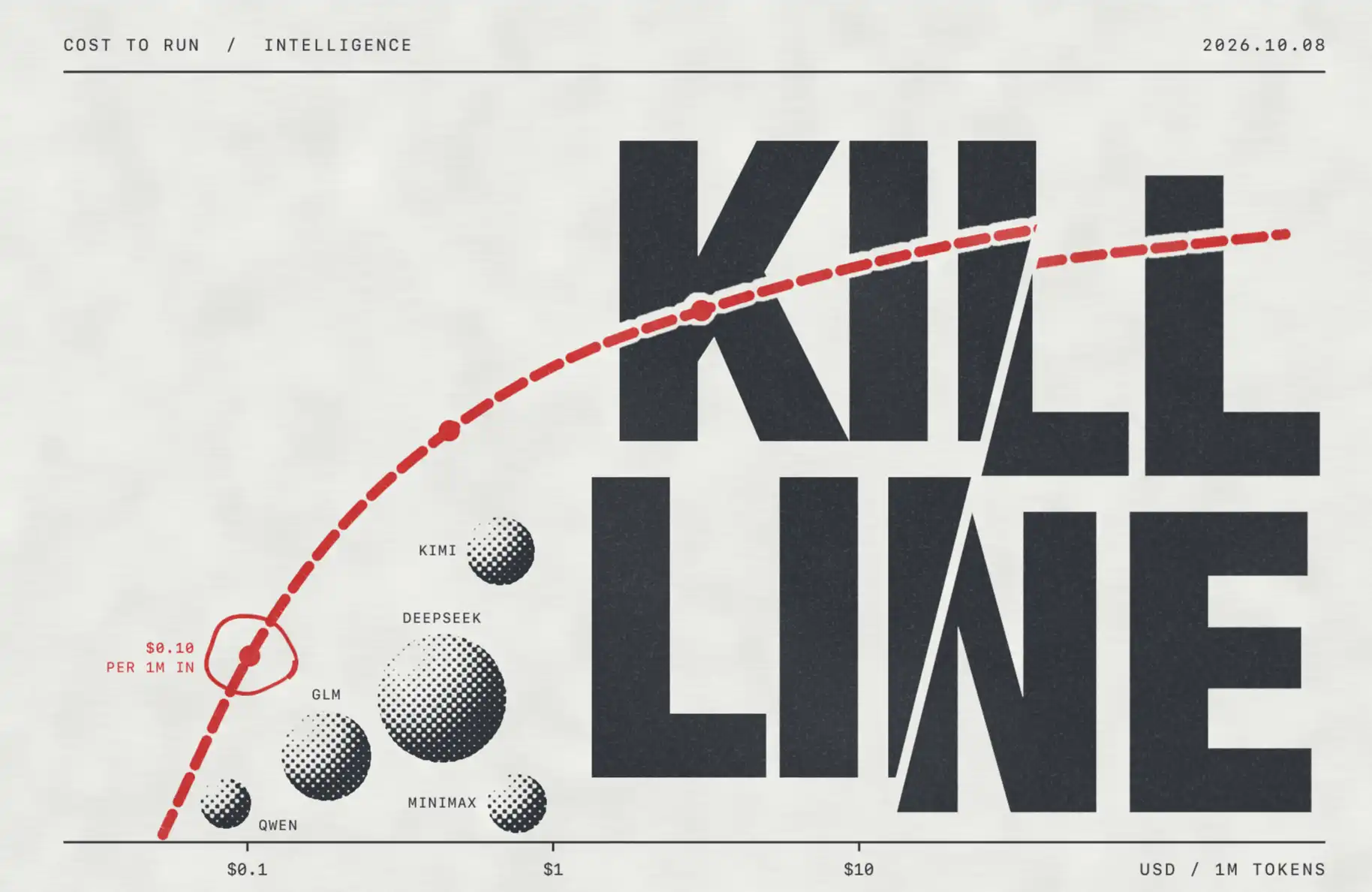
Claude put his $18 billion calculation skills to use and hit the Pro members with a price hike.

Anthropic is expected to earn $18 billion this year. Some analysts estimate that they have already surpassed this goal. However, apparently they are not satisfied.
Early this morning, a developer named George Pu revealed on X his finding: "Anthropic (Claude's parent company) has just removed Claude Code from the Pro package. Pro users who want to use this feature must now upgrade to the Max package, starting at a minimum monthly fee of $100."
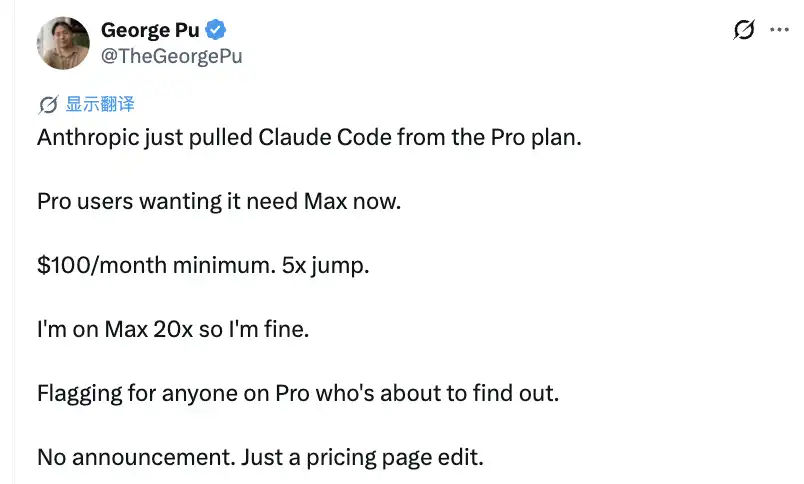
This means that to maintain the same level of access, the price has increased fivefold. With no blog post, no email, and no changelog, Anthropic quietly made a page update, attempting to raise prices.
This tweet quickly spread. Screenshots of the pricing page started circulating on Reddit, Hacker News, and developer groups. The community repeatedly checked their screens, and under the Pro column next to Claude Code, there was now a cross, with only Max 5x ($100/month) and Max 20x ($200/month) still checked. Previously, Anthropic's support documentation stated "Using Claude Code with your Pro or Max plan," but it now reads "Using Claude Code with your Max plan."
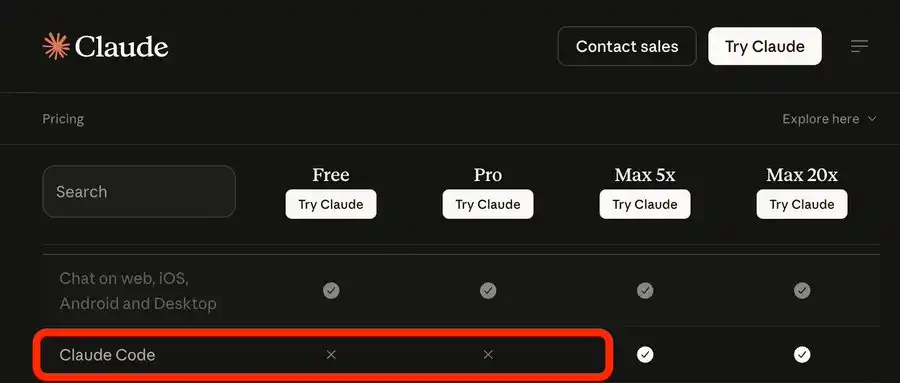
Naturally, the community was very dissatisfied. The public outcry reached a tipping point, forcing Anthropic's Head of Growth, Amol Avasare, to respond with a post on X. His explanation was that this was just a small-scale test for around 2% of new Pro users, and existing Pro and Max subscribers were not affected.
He then posted a longer explanation in the same thread, summarizing that when Max was launched a year ago, it did not include Claude Code at all, Cowork did not yet exist, and long-running agents were not part of everyday workflows. The initial design goal of Max was for heavy chat users, and that was all.
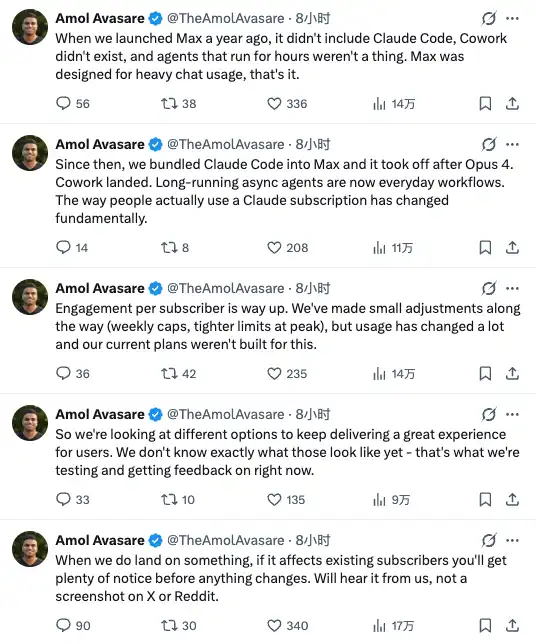
However, with the release of Opus 4, the usage of Claude Code exploded. Asynchronous agents became developers' daily tools. "Subscribers' average usage has significantly increased, and our existing pricing plans were not designed for this type of usage."
He finally assured: if the final plan affects existing subscribers, they will be notified well in advance, with the message coming from us, not from X or a screenshot on Reddit.
Over the past few months, a continuous tightening of computing power
Avasare's explanation sounds reasonable, but when pieced together, it points to a more fundamental issue: Anthropic may be under significant computing power stress.
Each coding session by Claude Code consumes a token amount far beyond a normal conversation, sometimes differing by an order of magnitude. When Opus 4 was released, users flocked in, when agents started running asynchronous tasks for hours, when Cowork brought more people into heavy-usage scenarios, the marginal cost of $20/month started spiraling out of control.
From a business standpoint, this is not a minor issue of "users overusing"; it is a fundamental misalignment of the pricing model after rapid product capability evolution. Originally designed for heavy chat, Max is now tasked with hosting continuous running coding agents. The computational costs of these two tasks are not even in the same ballpark.
Avasare used a phrase: "engagement per subscriber is way up." Translated into business language, it means: for the same amount of money, users are now consuming significantly more resources.
This is not the first time. Taking a longer timeline, Anthropic's "computing power tightening" actions in recent months have been numerous.
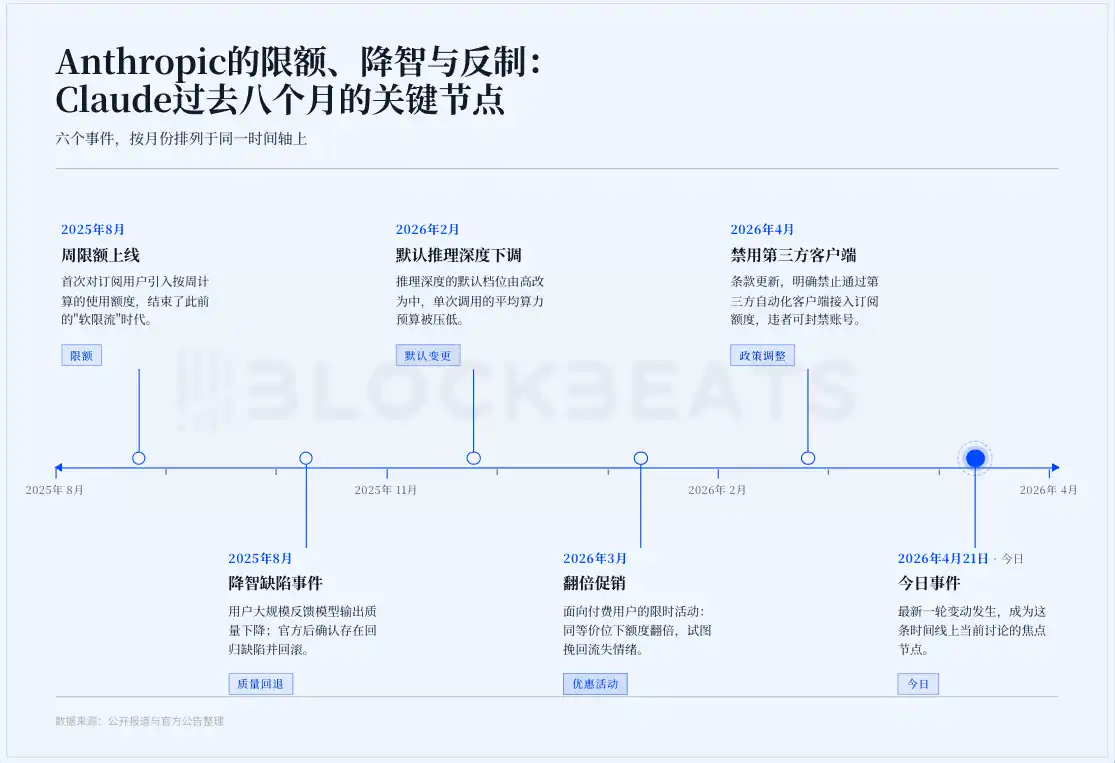
In August 2025, Anthropic announced a weekly usage cap for Pro and Max users, effective August 28. The official reason was that some users were violating the terms of use by sharing and reselling accounts to bypass restrictions. The statement claimed it would "only affect less than 5% of subscribers." A weekly cap, this was the first time a weekly hard limit was set for high-paying users.
In late August to early September of the same year, things got even more complicated. Many developers on Reddit and X reported a cliff-like drop in the quality of Claude's code generation, with models starting to ignore their own plans and randomly output gibberish, making Claude Code's task execution unreliable. Anthropic eventually acknowledged this as a technical bug that occurred during a reasoning stack upgrade, causing Claude Opus 4.1 to degrade continuously over about 56.5 hours, and released an official postmortem report.
This bug incident quickly overlapped with a larger controversy.
In early March 2026, Stella Laurenzo, a senior AI director at AMD, published a detailed analysis on GitHub. Based on 6,852 Claude Code session files, 17,871 thinking blocks, and over 230,000 tool calls, she concluded that:
Claude Code has experienced a decrease in intelligence. This analysis resonated strongly within the developer community.
Claude Code lead Boris Cherny later responded, refuting the core conclusion of "degraded model." He explained that Opus 4.6 switched to "adaptive thinking" mode on February 9 and then reverted the default effort level to medium (Level 85) on March 3, stating that this was considered the "optimal balance between intelligence, latency, and cost." However, he also acknowledged that about 7% of users would now encounter session limits that were previously not reached, with this adjustment primarily aimed at Pro users during peak hours, unaffected by Team and Enterprise users.
From March 13 to 27, 2026, Anthropic launched a "Off-Peak Doubling Usage" promotion: weekdays from 2 p.m. to 8 a.m. the following day (ET), and the entire weekend, where the usage cap would automatically double, covering all Free, Pro, Max, and Team packages.
While this appeared to be a welfare activity, when viewed in context, the reason for the doubling during off-peak hours was due to the peak hours themselves being in a state of computational strain. Doubling the quota was aimed at idle capacity, avoiding congestion periods, and creating conversion motivation for upgrading to higher-tier packages.
Then, on April 4, Anthropic announced the prohibition of third-party agent frameworks from running on the usage quotas subscribed to Pro and Max. If users wish to continue calling Claude via external frameworks like OpenClaw, they must pay an additional fee per call.
Lastly, there was the disappearance of Claude Code from the Pro pricing page.
Company A is certainly not the last to do this
Returning to Avasare's tweet. He stated that "Claude Code disappearing from the Pro pricing page was a small-scale test targeting only about 2% of newly registered Pro users," but this statement sparked considerable skepticism within the community.
The most direct question came from developer Simon Willison: "Everyone I know has seen the new pricing page, and the Internet Archive has also taken a screenshot." If it really only affects 2% of users, why was the entire public pricing grid changed? Why support document-wide updates?
Even more intriguing is: when asked by a reporter why the pricing page and support documents were completely overhauled, and how such a coverage scope for a test targeting only 2% of users cannot be explained, Avasare did not respond. An Anthropic company spokesperson similarly did not address this inquiry.
Another inconsistency was also noted: Claude Cowork was not removed from the Pro package, but from a product functionality perspective, Cowork is essentially Claude Code with a different brand name. In the words of one developer, "Cowork is Claude Code wearing less intimidating clothing."
The course of events unfolded as follows: after several hours of brewing public opinion, Anthropic quietly restored the website and support documents to their original state. No explanation, no announcement. Just like the changes themselves, it was done quietly.
When these actions are viewed together, we find that Anthropic now has the heart of Sima Yi, known to all:
Anthropic is tentatively moving towards testing higher computing power boundaries for subscription users. Doubling on weekends is guiding demand to off-peak times; default effort level reduction is saving computing power during peak hours; banning third-party agent frameworks is plugging the loophole of quota arbitrage; and the disappearance of Claude Code from the Pro page is testing user reactions to a more aggressive repricing scheme.
Amol himself admitted: "Our current setup is not designed for this kind of usage." This is a rare admission. It indicates that Anthropic has to some extent realized that the current pricing structure cannot sustain the computing power consumption brought by Claude Code.
What will happen next, we do not know.
But perhaps, as Ed Zitron wrote in his article: "I don't think this is the last time Anthropic will do something like this."
Welcome to join the official BlockBeats community:
Telegram Subscription Group: https://t.me/theblockbeats
Telegram Discussion Group: https://t.me/BlockBeats_App
Official Twitter Account: https://twitter.com/BlockBeatsAsia

 Related Articles