Elon Musk's $60 Billion Acquisition of Cursor's Stealth Bill: Evasion, Hash Power Rental, IPO Support

On April 21, 2026, when SpaceX announced its agreement with Cursor, Sam Altman was the quietest person in Silicon Valley. This news could have been the biggest tech M&A news of the year in any other year, but Altman remained silent.
He had good reasons to stay silent. Three years ago, he led a $8 million seed round investment in Anysphere, Cursor's parent company, on behalf of OpenAI, the company's first institutional funding. He later tried to acquire the company but was rejected. He then pivoted and acquired Windsurf, Cursor's competitor, for $30 billion. Then, on April 21, he watched Musk secure the asset he had once coveted at a price twenty times greater than his.
Six days later, he was set to meet Musk in a court in Oakland, California.
Most people saw this $600 billion deal at face value. However, beneath the surface, there were five layers of systematically obscured truths: Musk wasn't the stronger party, $100 billion wasn't a breakup fee, integration preceded the announcement, computing power rent came before the agreement, and the entire deal served a larger IPO agenda.
Pricey Defense
Let's start with the layer "Musk wasn't the stronger party."
xAI currently owns the world's largest AI computing cluster, the Colossus Supercomputer Center, with 100,000 NVIDIA H100 GPUs, set to expand to 200,000. This is the number most frequently cited in mainstream reports about the company and the one that most easily leads to the intuition that "Musk has already won the computing power war."
However, shortly after Colossus was built, an internal memo quietly made its way to the media. The memo was written by Michael Nicolls, who had just been appointed as xAI's CEO after serving as the Senior Vice President of Engineering for SpaceX's Starlink. In the memo, he made a harsh assessment, stating that xAI was "significantly behind" in the AI race, then provided specific numbers to support this claim: xAI's model float utilization (MFU) was about 11%, while the industry average ranged from 35% to 45%.
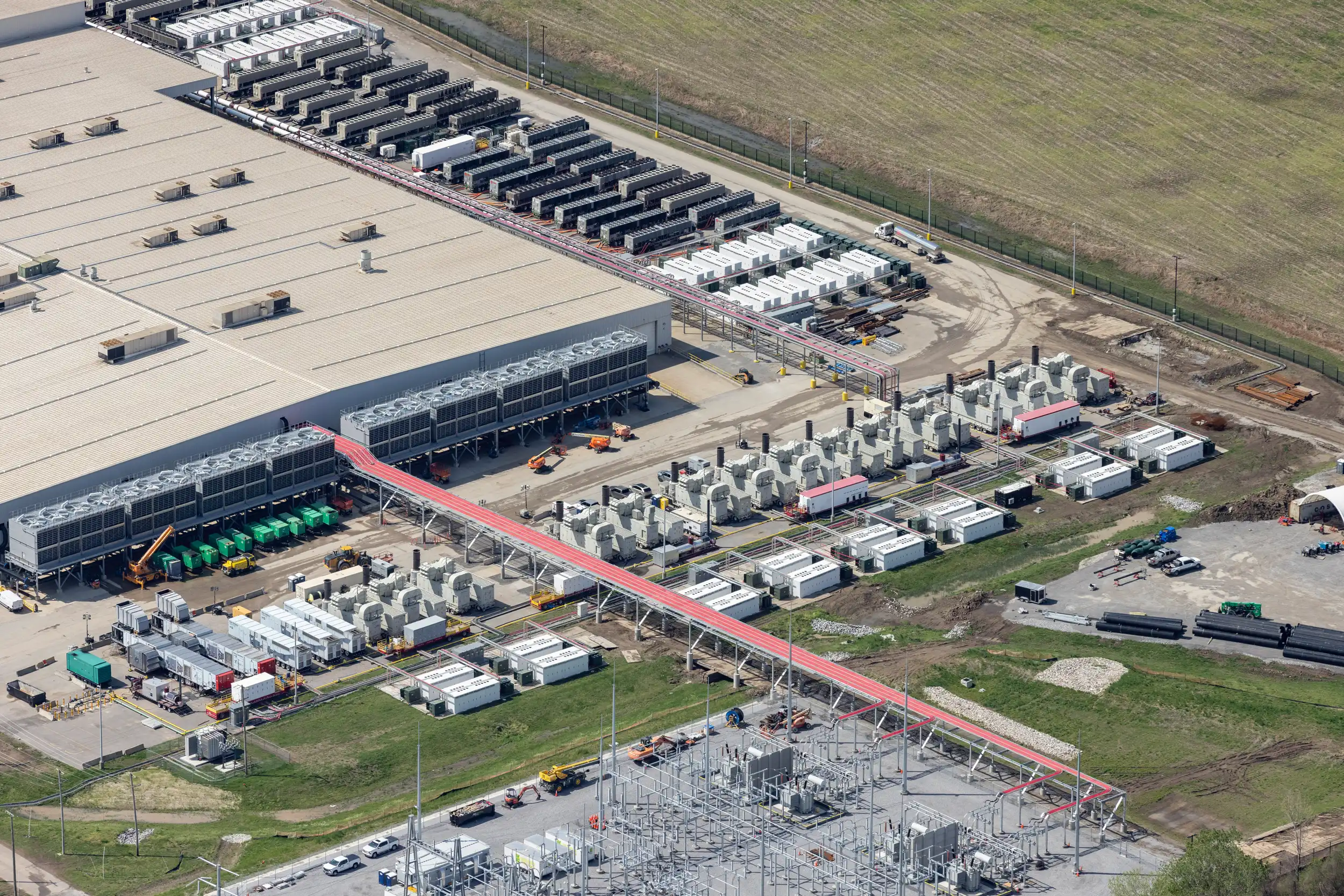
The Colossus Supercomputer Center in Memphis, Tennessee, USA
This means that out of those 100,000 H100 units, over 60% are idling. The world's largest computing power cluster is operating at less than one-third of the industry average efficiency.
The timing of this memorandum's delivery is even more embarrassing due to recent events. All 11 co-founders of xAI have departed, with Musk himself publicly admitting that xAI was "not built well the first time and is now being rebuilt from scratch." The company's most ambitious general AI agent project, "Macrohard," has stalled due to the core leader's departure. Nicolls was sent in to transplant SpaceX's ultra-efficient engineering culture to get that massive machine running at full speed again.
The $60 billion acquisition of Cursor was not a casual purchase by an expanding giant. It was made by an AI company that is technologically rebuilding and suffering from severely low computing power efficiency. They are buying time with money while also seeking a sufficiently large commercial workload for that idling machine. The groundwork for all of this had started 40 days before the official announcement.
Ginsberg and his partner Andrew Milich serve as Co-Heads of Product Engineering at Cursor, jointly responsible for the architecture and iteration of all core product features at Cursor. As Cursor grew from nothing to a $20 billion annual revenue, setting SaaS growth records, they were the two most critical individuals on the product side. On March 12, they both announced their move to xAI, reporting directly to Musk, with the task of rebuilding the Grok model's programming capabilities from scratch.
Upon announcing his move to xAI, Andrew Milich left with these words: "Nearly 10 years ago, I interned at SpaceX, working on the Dragon 2 spacecraft's cockpit display system." The significance of Ginsberg's return this time must be viewed within the context of his entire trajectory.
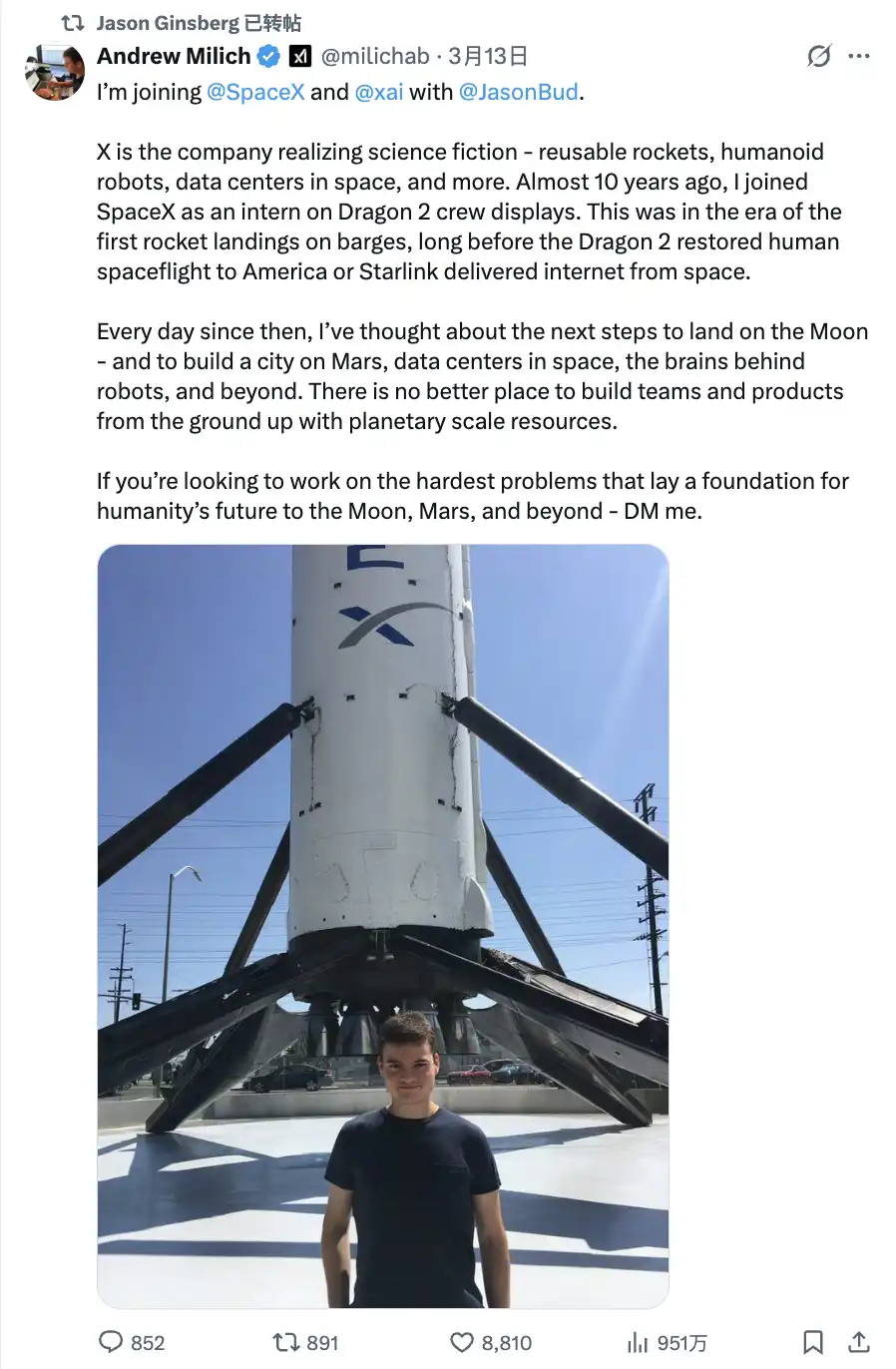
The cockpit display system of the Dragon 2 spacecraft was one of SpaceX's most critical human-machine interaction engineering projects at the time, and only a few interns could participate in it. After leaving SpaceX, he and Milich co-founded the end-to-end encrypted document collaboration platform Skiff, which was acquired by Notion in February 2024. Following this, both joined Cursor and together propelled it to the pinnacle of the AI programming market. Now, equipped with years of product judgment and technical architecture experience accumulated at Cursor, he is retracing his steps to the starting point of this journey.
When you zoom out on this timeline: Ginsberg's homecoming, Milich's joining, and the two being explicitly tasked with "rebuilding Grok programming capabilities." The essence of the acquisition was completed weeks before the official announcement. The contract was the endpoint, not the starting point.
A $100 Billion Reality Check, and a Surgical Strike in Court
The structure of the acquisition deal was as follows: at a later point this year, SpaceX must make a binary decision to either exercise the $600 billion acquisition option or pay $100 billion as a "collaboration fee." If the acquisition does not go through in the end, the $100 billion serves as a one-time settlement for this partnership.
Mainstream media commonly refers to this $100 billion as a "breakup fee," but this definition fundamentally obscures its true nature. To understand why Cursor accepted such an unusual structure, one must first understand the predicament it was in.
Cursor's inception relied on the underlying model provided by Anthropic. Claude was its most core technical foundation. Then Anthropic rolled out Claude Code, a programming AI tool directly competing with Cursor for the same set of users, turning a supplier into a competitor. And that's not even the worst part.
Analysis within Cursor revealed that Anthropic's Claude Code has a monthly subscription fee that tops out at $200, but Anthropic's actual cost in compute consumption per heavy user amounts to around $5,000. Last year, this figure was $2,000, a 1.5x increase within a year. This means Anthropic is bleeding about $4,800 per user per month to deliver this service to the market.
It's using venture capital ammunition to wage a pricing war that economically boxes out competitors. Any tool company continuing to rely on the Anthropic model to provide users with an equivalent experience cannot possibly cover the API costs with subscription fees.
Faced with this scenario, Cursor's CEO Michael Truell stated, "Our strategy is to mix the best technology provided by our partners with the technology we develop ourselves." This is the most sobering statement a founder can make in public. On the other side of it, Cursor must train its own models, which means it must find a compute source independent of the competition.
The xAI Colossus cluster is currently the largest independent computing power available to Cursor. The $10 billion "collaboration fee" encapsulates the prepaid value of this computing power leasing relationship. Cursor's situation has also become the most suitable piece in another larger game.
The relationship between OpenAI and Cursor follows a complete three-year arc, never fully spelled out in mainstream reports.
The story begins in October 2023. OpenAI led an $8 million seed round for Anysphere, becoming Cursor's first significant institutional investor. At that time, Cursor was just a fledgling AI programming tool company, and OpenAI's money was both funding and endorsement.
Two years later, the tables turned completely. In November 2025, Cursor completed a $23 billion Series D round, valuing the company at $293 billion. OpenAI began seriously discussing the possibility of acquiring Cursor, with the former investor wanting to buy back that initial seed. Cursor declined. OpenAI then turned around and acquired Windsurf, Cursor's competitor and the original Codeium, for $30 billion. The $300 billion unicorn refused, only to settle for the next best option at a tenth of the price.
Then came April 21. On the day SpaceX announced a $600 billion deal, six days before Altman and Musk officially faced off in Oakland Federal Court, a lawsuit stemming from Musk accusing Altman of betraying OpenAI's original non-profit mission—an openly aired grievance after years of simmering resentment.
There is no evidence that April 21 was a deliberately chosen date. But the dramatic timing of the event cannot be ignored: six days before Musk faced Altman in court, he publicly locked in the company that OpenAI had initially invested in and later unsuccessfully tried to acquire for $600 billion. The seed that was planted three years ago for $8 million is now worth $600 billion. Altman knew this calculation all too well.
And Musk's calculation was aimed not only at Altman.
The Ground Game of the IPO
On April 1, 2026, SpaceX secretly submitted an IPO application to the SEC, targeting a valuation of $1.75 trillion. The core narrative supporting this figure is SpaceX's grand plan to deploy as many as 1 million data center satellites in space, using solar power and natural space heat dissipation to replace the power and water cooling needs of ground data centers, providing a cheaper infrastructure for AI computation. Musk has stated on multiple occasions that "space will be the cheapest place to run AI."
However, according to S-1 filings disclosed by media outlets such as Reuters, SpaceX admitted in its legal submission to regulators that this plan involves "unproven technology," with uncertainty regarding its commercial viability. The company's official assessment of its largest AI bet remains a question mark.
This question mark explains the true rationale behind the acquisition of Cursor. The feasibility of SpaceX's space computing plan hinges on an unvalidated physical and engineering assumption. Cursor generates 150 million lines of code daily for global enterprises, representing a real and confirmed scale of demand happening now. If the future of the space computing plan is uncertain, the most crucial aspect is to find a sufficiently large and stable commercial workload for the ground-based Colossus cluster that is spinning in space.
With an annual revenue of $20 billion, Cursor is one of the fastest-growing SaaS products globally. By integrating it into SpaceX's ecosystem, the offering goes beyond just monetizing computing power; it provides a tangible case study to the capital markets that "AI infrastructure is already in place." This is more compelling in an IPO roadshow than any outlook on space data centers.
The acquisition of Cursor is SpaceX's way of leveraging a certain software asset to support an uncertain hardware vision.
Welcome to join the official BlockBeats community:
Telegram Subscription Group: https://t.me/theblockbeats
Telegram Discussion Group: https://t.me/BlockBeats_App
Official Twitter Account: https://twitter.com/BlockBeatsAsia