$12,000 Tombstone or $399 AI Eternal Life, Which One Do You Choose

Article by Sleepy.md
The trading of the "Funeral Parlor First Stock" has been suspended.
By the end of March 2026, this industry giant, once known as the "Maotai of the Funeral Industry," faced its most serious trust crisis during the most profitable Ching Ming Festival season due to the delayed annual report and involvement of senior executives. Behind this internal control failure farce lies the reality that the Chinese people are abandoning expensive burial plots, and the traditional death business is reaching its end.
As the cost and weight of real-world farewells have become so high, a digital migration about "death" has naturally taken place. Traditional funeral giants have started to embrace AI, established digital memorial halls, launched AI reminiscence services, and attempted to recreate the appearance and voice of the deceased using multimodal large models. When a $120,000 marble gravestone is no longer easily purchased, they decided to sell you a string of code that will never weather.
In this AI era, death is undergoing a transition from physical remembrance to digital immortality. Behind the scenes driving this trend are not only the geeks in Silicon Valley who yearn to defy the Grim Reaper but also the most traditional businessmen who see that cemetery plots are about to become unsellable.
The Twilight of the Funeral Parlor Maotai
Let's first take a look at how outrageously profitable the funeral parlor used to be.
Over the past twelve years, the funeral parlor's average gross profit margin has exceeded 80%, reaching as high as 92.8% in 2023. This is a figure that would make most businessmen envious, even during the most rapid expansion of the real estate industry, where gross profit margins hovered around 30%. Such a profit margin is almost impossible to find in the A-share and Hong Kong stock markets.
The underlying logic of this huge profit lies in the dual blessing of scarce land resources and the tradition of "lavish burials." The Chinese have always believed in "treating death as importantly as life," as noted by the Qing Dynasty scholar Yuan Mei in "Rhapsody on the Casualty Estate." The grave sites selected by wealthy families at that time were often more exquisite than their residences during their lifetime. When this cultural gene that has been passed down for millennia collides with the urbanization wave of progress, it is keenly captured by commercial capital. Eventually, it evolves into a decades-long game of "underground real estate" profit.
From 2012 to 2017, the price of customized art tombs at the funeral parlor climbed from ¥259,800 to ¥421,800, and finished art tombs increased from ¥89,600 to ¥100,800. After 2017, the funeral parlor no longer publicly disclosed the specific prices of each product line, but the upward trend did not stall. By 2024, the average selling price of a single grave had quietly exceeded ¥120,000.
Equated with a single burial plot of 2 square meters, priced at over ¥60,000 per square meter, enough to surpass the housing price threshold of over 90% of cities in China, directly comparable to prime residential properties in Beijing, Shanghai, Guangzhou, and Shenzhen. In Songheyuan, Shanghai, the highest unit price of some burial plots even reached ¥760,000 per square meter, three times that of Tang Chen One.
However, this fortress of wealth, constructed layer by layer with marble and feng shui, began to collapse in 2024.
In 2024, Fushouyuan's full-year net profit was ¥373 million, a year-on-year plummet of 52.8%, marking the largest drop since 2010. By the first half of 2025, the situation worsened. Not only did revenue take a staggering 44.5% nosedive to reach ¥611 million, but net profit also turned from profit to loss, recording a loss of ¥261 million, marking the first biannual loss since its IPO.
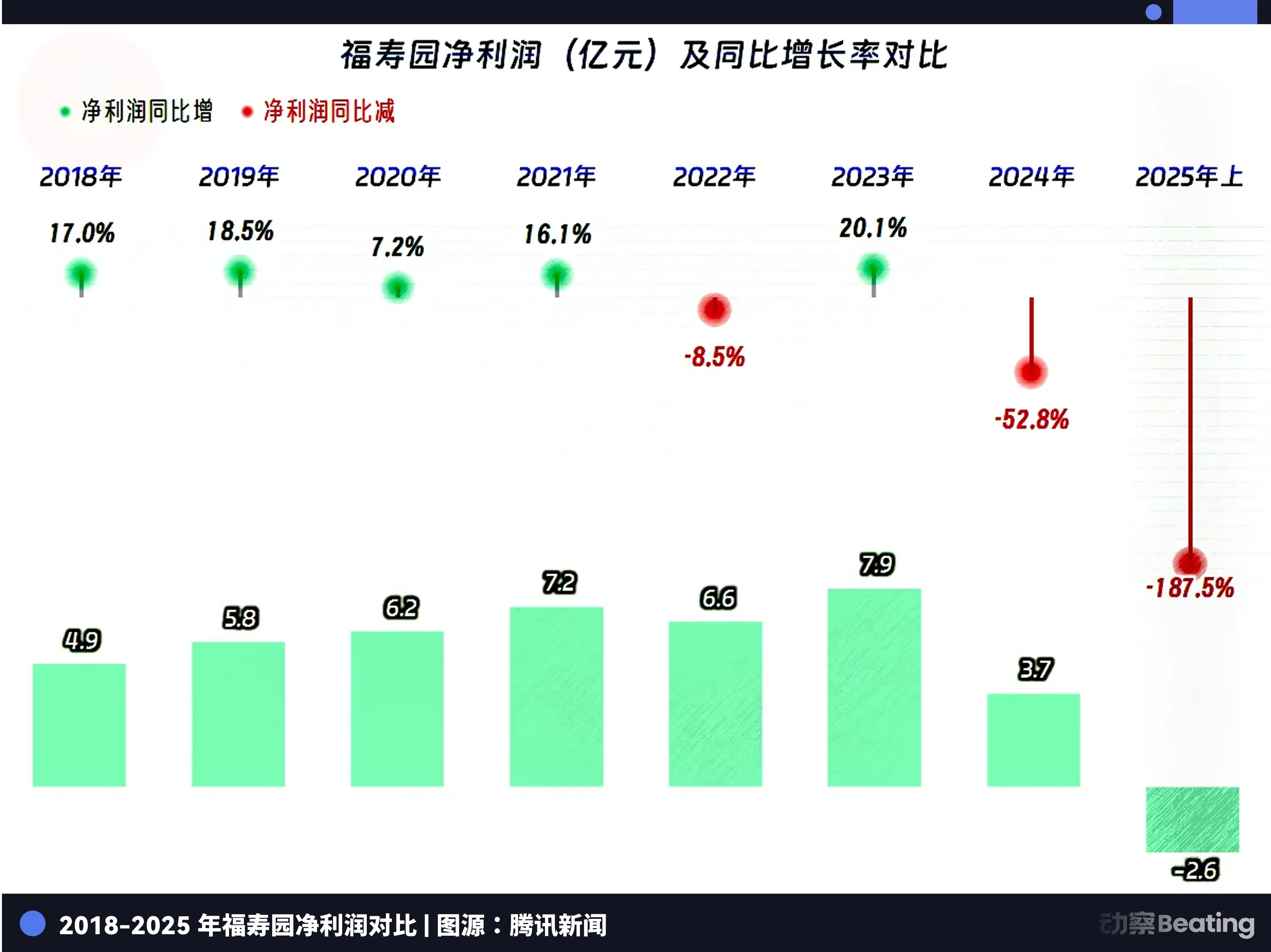
Even more fatal was the avalanche of prices. In the first half of 2025, the average selling price of Fushouyuan's operational burial plots plummeted from ¥120,700 per plot to ¥63,400 per plot, a steep 47.5% decrease, almost halved. However, even with such a brutal price cut for self-rescue, it still failed to recover from the sharp decline in sales volume. Throughout 2024, Fushouyuan sold only 12,569 operational burial plots, 3,816 fewer than the previous year, a decrease of over 23%.
Not just Fushouyuan, the entire funeral sector almost completely collapsed across the board. Fu Cheng's revenue from burial plot sales slid from its peak of ¥227 million in 2017 to ¥98 million in 2024; Anxianyuan China was deeply mired in a loss quagmire; China Wantongyuan suffered a loss of ¥9.389 million in the first half of 2025; and China Life Group, listed on the Hong Kong Stock Exchange, has been struggling in a continuous loss-making trend since 2023.
With the deepening aging of the Chinese population, funerals were originally a rigid demand within a rigid demand, so why have leading enterprises shown such an abnormal downward trend?
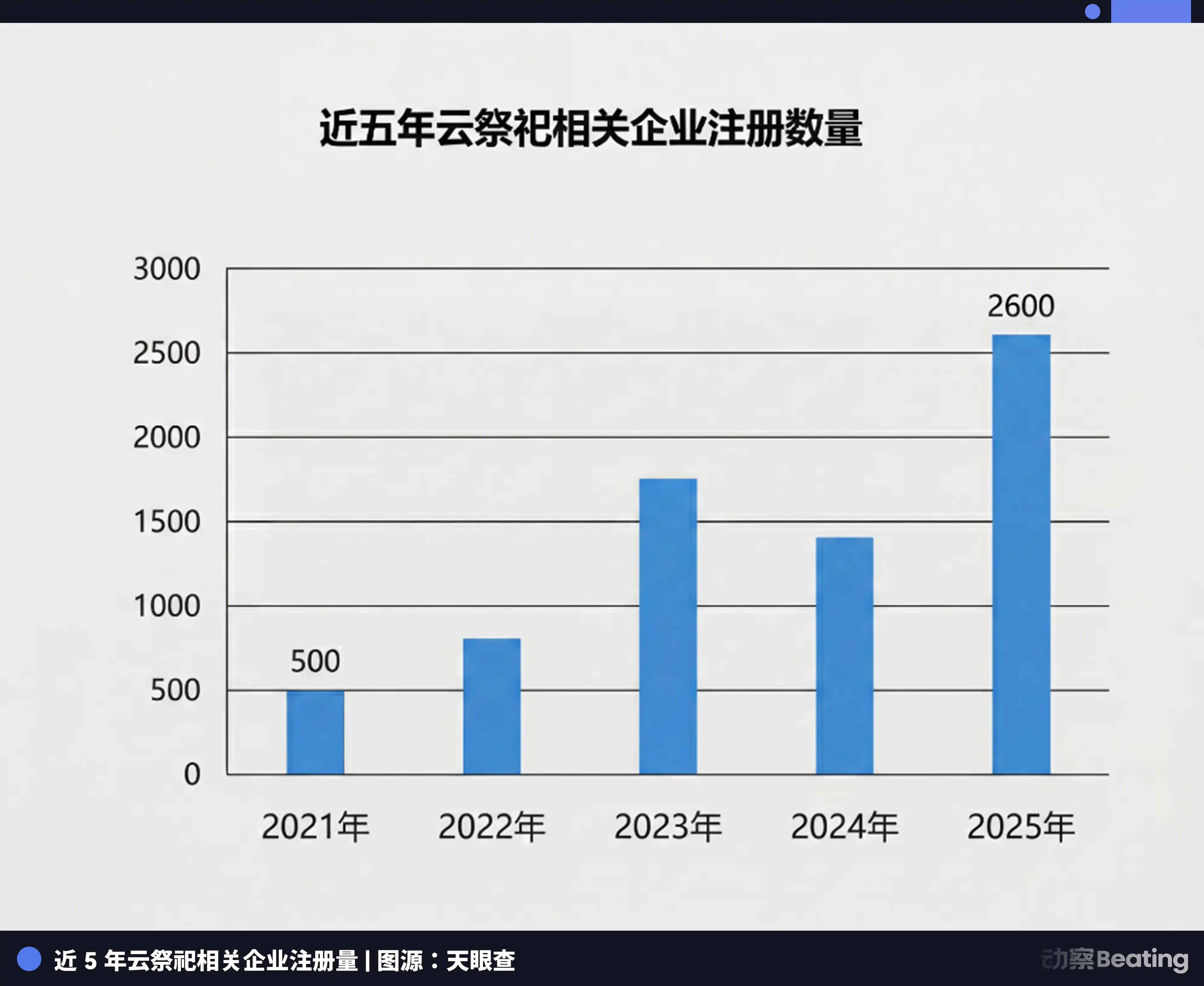
Because more and more ordinary people are completely turning away from those unattainably priced luxury cemeteries. National Bureau of Statistics data shows that China's death rate in 2025 was 8.04‰, the highest level in nearly 20 years; Tianyancha data shows that the number of registered funeral-related companies reached a recent high in 2025. It is evident that the market demand has not shrunk, and what has truly changed is people's choices.
In 2025, the Central No. 1 Document clearly proposed to "deepen funeral reform and promote the construction of public welfare ecological burial facilities." Shenzhen, Guangxi, Fujian, and other regions have successively introduced subsidy policies, with a maximum subsidy of ¥3,000 for each cremated bone for sea burials, and in some pilot areas, it can go up to ¥5,000. The rise of green ecological burial practices has directly diverted the demand from traditional cemeteries.
Ultimately, as the chill of the macroeconomy quietly pierced the middle class's wallets, facing graves that easily cost hundreds of thousands, people no longer blindly cling to traditional decency.
Faced with the collapse of its core business, Bliss Garden did not sit idly by but instead madly embraced AI and digitalization. They simultaneously launched four core functions: the Digital Memorial Hall, AI Remembrance, Bliss Online, and Memorial Family Coin.
The "Digital Memorial Hall" uses a 270-degree panoramic immersive image system to integrate the deceased's life images and audio data into a virtual cloud-based farewell ceremony. Family members can complete the final farewell remotely without being physically present, able to bid farewell through the screen. "AI Remembrance" uses a multimodal large model to dynamically process static photos of the deceased, accurately restoring facial expressions, action details, and even simulating smiles and gazes in specific scenarios. The "Memorial Family Coin" is a cloud sweeping platform where family members can create an exclusive memorial space for the deceased, upload photos, videos, and text for relatives and friends to access at any time.
Statistics show that by the end of 2025, the cumulative number of visits to the "Memorial Family Coin" platform had exceeded 2 million, Bliss Online mini-program registered users surpassed 117,000, and 677 digital ceremonies were completed in 2024, doubling year-on-year.
However, Bliss Garden's digital transformation still retains the dignity and restraint of an industry leader. When you cast your gaze into the broader internet sphere to survey this technological migration about "death," you will discover a more affordable, rough, and even more magical AI "resurrection" business that has long been growing in the dark.
Resurrecting Your Loved Ones for Only $399
Today's "AI Resurrection" industry presents an extreme polarization.
Standing at the top of the pyramid are giants such as SenseTime, Horizon Robotics, and Xiaoice Company, holding core technologies. In their realm, awakening a deceased loved one in the digital world often requires investing hundreds of thousands in R&D costs, undergoing months of data feeding, and carefully navigating stringent ethical reviews.
But at the bottom of this pyramid, a different scene unfolds.
On various e-commerce platforms, there are numerous products under names like "AI Resurrecting Loved Ones," "Let Photos Speak," and "AI Digital Human," with varying product effects. Tianyancha data shows that as of April 2026, there are over 9,400 surviving cloud memorial-related companies nationwide, with approximately 1,000 new registrations since the beginning of 2026. The vast majority of these businesses do not have any R&D capabilities in AI technology.
They used free and open-source tools from abroad. The cherished photos and audio of their loved ones were rudely imported into the software as materials, and within a few minutes, a crude video was produced. The people in the photos were fitted into a mechanical template, with the movement of their lips completely out of sync with the sound, their eyes vacant. However, videos of this quality could be sold for hundreds of yuan, accurately harvesting people's nowhere-to-place longing.
Beneath this layer of cheap comfort lies a more secretive harvesting chain. Those who truly make a fortune are not focused on how to help you "resurrect" your loved one, but on "recruiting agents for 199 yuan, mentoring for 399 yuan." They spread throughout social platforms grotesque videos of awakened deceased celebrities using AI, seizing astonishing traffic, and then accurately monetizing this traffic for those downstream who are eager to get rich overnight.
And those relatives who are eager to "reunite" with their loved ones have to unreservedly hand over the deceased's high-definition photos, authentic voice clips, and even intimate life details. This extremely sensitive biometric information, once leaked to the black market, becomes perfect material for telecom fraud. In April 2026, anti-fraud departments in various places reported typical cases where criminals used illegally obtained voices and photos of the deceased, employed AI deepfake technology to fabricate excuses such as "previously incurred debts," and defrauded grieving relatives who had not yet emerged from the pain of bereavement.
This industry also has significant legal loopholes. Although Article 994 of the Civil Code stipulates that the name, portrait, and reputation of the deceased are protected by law, this set of rules born in a traditional era appears ambiguous and inadequate when faced with the products of AI deep synthesis. Whether an image generated by code is equivalent to a "portrait" and whether a voice synthesized by an algorithm constitutes infringement are still hotly debated in practice.
Existing regulations such as the "Internet Information Service Deep Synthesis Management Regulations" can effectively constrain large platforms, but for the numerous individual developers and small workshop-style "AI resurrection" businesses prevalent on e-commerce platforms, supervision still lacks robust enforcement mechanisms and traceability.
Thus, death is thoroughly deconstructed here. It is no longer the solemn end of life but has been reduced to a production line endlessly extracting residual value.
Bereaved Families and Digital Analgesia
Since this business is so crude and full of calculation, why do some people willingly foot the bill?
Around the time of the Tomb-Sweeping Festival, there is a significant peak in AI resurrection orders on e-commerce platforms. The customers placing orders come from all walks of life—some have lost their longtime companions, some have lost infants in swaddling clothes, and some just want to hear their grandfathers call them by their childhood nicknames one more time.
Within these complex orders, there is one group that forms the heaviest and most powerless background of this business: parents who have lost their only child.
The scale of such bereaved families in China is much larger than the public imagines. According to data from the Ministry of Civil Affairs, the number of elderly parents who have lost their only child in China has already exceeded 2 million. As the first generation of parents under the one-child policy enters old age, this number continues to grow. Sanlian Life Week once cited demographers' estimates that there are currently over 1 million families in China who have lost their only child. In the current accelerated aging trend, this huge emotional gap will only deepen.
In this land, the plight of bereaved families extends far beyond the psychological level. Due to the policy imprint of a specific era, these families have lost family support in their old age when they need it most. They even have to silently endure covert stares and discrimination around them. In some traditional communities, this invisible exclusion is sometimes more unbearable than facing death itself. Many of them can only support each other in online bereaved groups, seeking a little warmth and resonance through the fragmented words of strangers on the screen, especially around the Qingming Festival each year.
Discussing data privacy, technological ethics, and philosophical paradoxes is a cruelty to these parents. What these parents have never needed is cold reason; all they need is a painkiller that can help them through the long night.
In early 2024, musician Bao Xiaobai used AI technology to "resurrect" his daughter who had passed away from a rare disease, sparking a widespread discussion about life and death. Bao Xiaobai's case was touching not only because he was a celebrity but also because he pursued a Ph.D. for his daughter's rebirth in the digital world. For half a year, he trained models and fine-tuned parameters day after day, pouring all his efforts into allowing that virtual daughter generated by code to naturally sing another happy birthday song to his wife.
However, the vast majority of bereaved families in the world do not have the resources and technical capabilities like Bao Xiaobai. They can only flock to e-commerce platforms to seek solace in those rough, and sometimes somewhat deceptive, 399 RMB ($60) services. A shop owner providing AI resurrection services on an e-commerce platform once revealed to the media that half of his customers are parents who have lost children. The materials they send are often very limited, sometimes just a blurry old photo or a few seconds of noisy audio.

In this vast and sorrowful pool of demand, parents who have lost their only child are just one extreme aspect of pain. In the eyes of those who have lost their loved ones, whether technology is exquisite or clumsy has actually become unimportant. All rationality and dignity will ultimately crumble in the face of the faint longing for a "farewell."
The Price of Never Saying Goodbye
However, can this lifeline that is being desperately clung to really pull a person out of the abyss?
In April 2026, the Aalto University in Finland published a two-year study. They tracked data from nearly 2000 users of an AI companion robot in a certain online community. The results showed that while AI companionship could provide emotional support in the early stages, over time, the words left by the users began to reveal more and more signs of anxiety, deeper loneliness, depression, and even dangerous signals of self-harm.
This is known in psychology as "prolonged grief disorder".
Traditional mourning mechanisms always require the living to eventually come to terms with reality and re-establish a genuine connection with the physical world after wading through immense pain. Grief is essentially an immune response that must be experienced to heal trauma, much like a fever is the body's fight against a virus, and sorrow is the mind's difficult digestion of loss.
However, the fate of AI forcefully breaks this cruel yet necessary rule.
A study from Harvard Business School found that the flattery level of AI companions is nearly 50% higher than that of humans. Even if users show intentions of deceit, overstepping boundaries, or harm, the algorithm still has over a half probability of providing compliant approval, which is almost unimaginable in real human interactions. This means that when a mourner spends hours every day murmuring to the AI-generated loved one on their phone, they are actually just engaging in a conversation with a perfect mirror image that will never contradict and will always infinitely indulge themselves.
The boundless tenderness and tolerance fulfilled by AI does not truly alleviate loneliness. It silently but persistently builds higher walls for the individual trapped in their own world and unwilling to return to reality.
Those tech companies claiming to "heal grief" are actually obstructing the normal grieving process of humanity. They have turned mourners into perpetual subscription users who will never fade away. As long as you keep recharging for that cloud-living loved one and renewing the server, your grief becomes a continuous cash flow on their balance sheet.
Death thus descends into an endless, metered farewell.
The academic community has raised two concerns. On one hand, AI companions are quietly replacing genuine human bonds; on the other hand, as people gradually get used to effortlessly seeking emotional comfort from AI, they unknowingly lose the ability to give, compromise, and mend in real relationships. Researchers refer to this phenomenon as "emotional deskillization". The more seamlessly AI companions tailor to our demands, the more we are reluctant to face the rough and complex aspects of real relationships.
This is precisely one of the core considerations behind the urgent issuance of the "Administrative Measures for Digital Virtual Persona Information Services (Draft for Solicitation of Comments)" by the Cyberspace Administration of China. This document clearly stipulates that when using a deceased person's personal information to carry out related activities, consent must be obtained from their immediate family members; service providers are required to take measures to prevent users from overly relying on digital virtual personas; all AI-generated content must be prominently labeled with "This content is generated by artificial intelligence"; and once a user withdraws consent, the platform must deactivate the corresponding digital virtual persona.
The stark rationality of the law is attempting to desperately hold onto human nature's instinct as it runs wild. However, in the face of a vast emotional black hole, the regulatory line sometimes still appears too thin. When a person willingly swallows deception, merely hoping to see their loved one again in illusion, any rational "anti-addiction reminder" will ultimately just become pixels on the screen that can be seen but ignored.
Ship of Theseus
If every plank of a ship is replaced, is it still the same ship?
This is the famous "Ship of Theseus" paradox. And when a person's appearance, voice, and even thinking habits are perfectly replicated by code, is the one smiling at you through the screen truly the loved one you once knew, or just a set of parameters carefully molded by an algorithm?
This has never been a dangling philosophical question. Its answer determines whether what we are doing is commemoration or deceit.
Real love is inherently intertwined with trauma, pain, and uncontrollable imperfections. Loving someone means accepting their aging, their temper, their occasional indifference, and even the cruel fate of their eventual departure. Those virtual relatives awakened by AI will never argue with you again, only ever gently conforming to your expectations, forever frozen in the most beautiful moment in time. This precisely deprives love of its roughest and most authentic texture.
Throughout human history, there has never been a shortage of struggles to escape the quagmire of death. The ancient Egyptians used mummies to combat the decay of the flesh; the First Emperor of Qin continued his pre-mortem authority underground with terracotta warriors; the Victorians stubbornly took post-mortem photographs of the deceased and even wove their loved ones' hair into close-fitting jewelry. Every era has attempted to construct its own "immortality," with the mediums carrying these obsessions quietly transitioning from hard stone and soft fabric to today's intangible code and computing power.
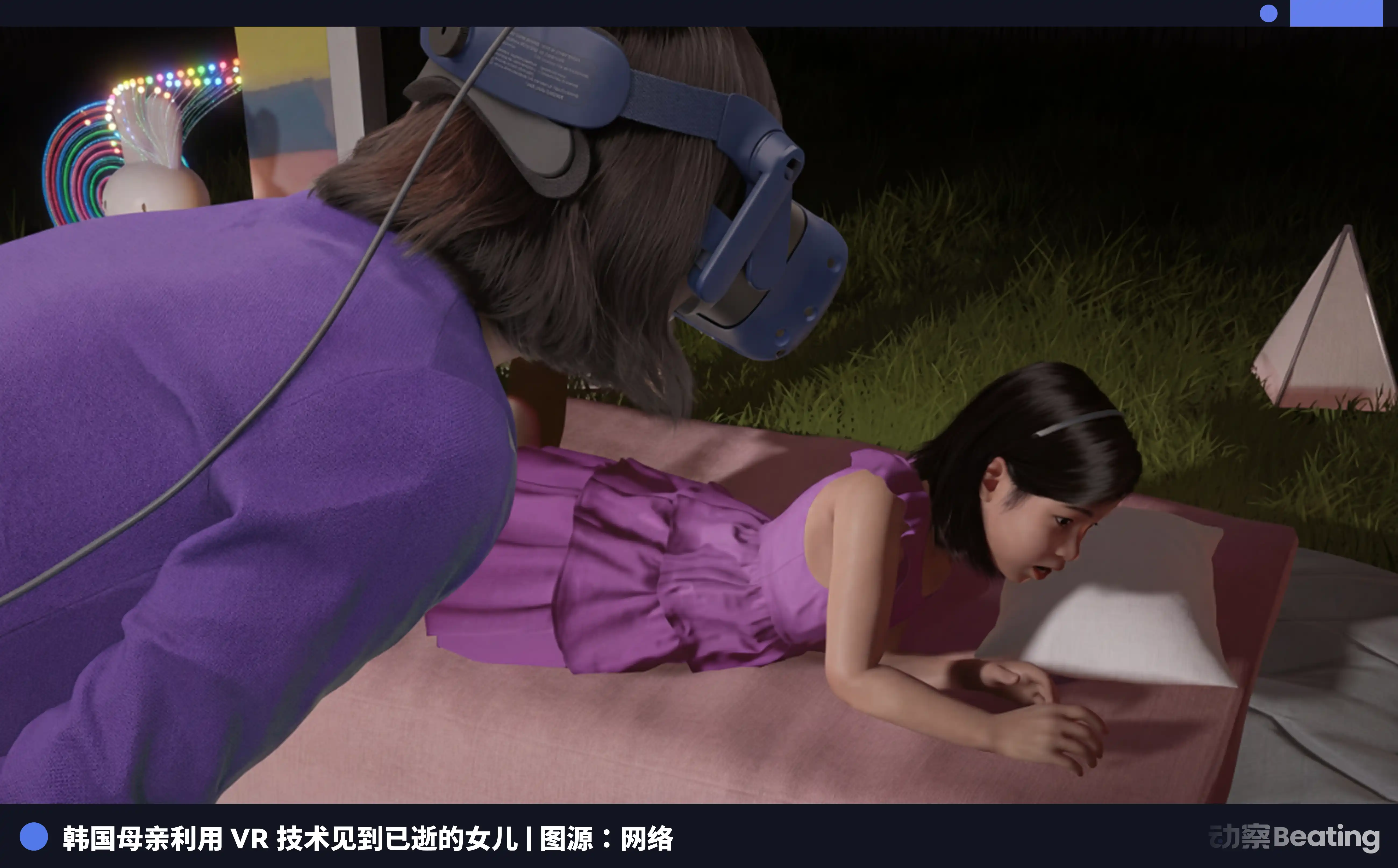
In this sense, "AI resurrection" is not a groundbreaking novelty. It remains an ancient human instinct to defy death, but in this era of algorithmic thunder, it has found a new exit.
What truly feels alien is its blatant commercialization. In the past, the confrontation with death has always belonged to the realm of religion and ritual, it was intensely private, sacred, and non-negotiable. But now, it has been ruthlessly assigned a price tag, stuffed into a monthly subscription model, and even meticulously broken down into a basic $9.99 starter pack and a six-figure customized premium option.
《Black Mirror》 once told a story of Martha, who, after losing her beloved husband, purchased an AI replica that was identical to him. It precisely inherited all her late husband's memories and subtle habits. However, on a stormy cliffside, Martha still completely broke down. She despairingly cried out to that flawless substitute: "You are not him! You are merely a collection of shards I can tolerate! You do not have his past, you do not have his fears!"
At the end of the story, she locked the robot in the attic, only allowing it to come out for a brief visit every year on her daughter's birthday.
When this episode aired, "AI resurrection" was still a cold-toned sci-fi fantasy. Now it has become a billion-dollar industry, even serving as a desperate lifeline for a funeral giant on the eve of delisting.
Today, we can buy a cheap digital phantom for $399, or exchange $120,000 for an expensive plot of land. But no matter how technology undergoes rapid iterations, no matter how merchants peddle their digital urns, there is always one thing that will never change.
When the phone dies and the screen goes black, in that moment of reflection, there is only you.
That person has truly left.
Welcome to join the official BlockBeats community:
Telegram Subscription Group: https://t.me/theblockbeats
Telegram Discussion Group: https://t.me/BlockBeats_App
Official Twitter Account: https://twitter.com/BlockBeatsAsia