Ant Group Proposes New Architecture for the Digital Economy, Covering Identity, Payment, Risk Control, and Compliance
On April 20, Ant Group proposed for the first time at the Hong Kong Web3 Festival the concept of an architecture for the Intelligent Entity Economy called the "4R Full-Stack Architecture," covering four levels: Agentic Runtime, Payment Rails, Agent Registry, and Root Infrastructure. This architecture aims to provide a technical infrastructure covering identity, payments, risk control, and compliance for AI intelligent entities.
Ant Group's CTO, Yan Ying, pointed out in her speech that the current foundation of the Intelligent Entity Economy has "four cracks": execution loss due to prompt logic flaws, a responsibility vacuum caused by AI lacking trusted identity, transaction barriers caused by human-centric payment gateways, and collaboration risks due to lack of trust in unfamiliar agents. She emphasized that "this cannot be solved by patching software; instead, it requires a redesign from the ground-level infrastructure."

According to Yan Ying, the core product of the Agentic Runtime layer is DTClaw, which incorporates the CARLI security model to impose mandatory constraints on intelligent entity behavior at the execution level. It supports multi-model compatibility and financial-grade compliance standards, aiming to make every AI operation controllable, auditable, and recoverable.
The Payment Rails layer builds native on-chain payment channels, integrating Agent intelligent decision-making and verifiable credential chain technology. It ensures precise identification of payment intent and end-to-end security while achieving transaction transparency and tamper resistance. For high-frequency micro-value transaction scenarios, the platform has built a native instant settlement network that supports cross-chain, multi-asset seamless circulation, and intelligent routing, significantly improving fund turnover efficiency. Additionally, by providing a standardized development toolchain and a seamless wallet integration experience, this solution significantly reduces development barriers and user costs, forming a payment closed-loop that balances financial-grade security and ultimate user experience.
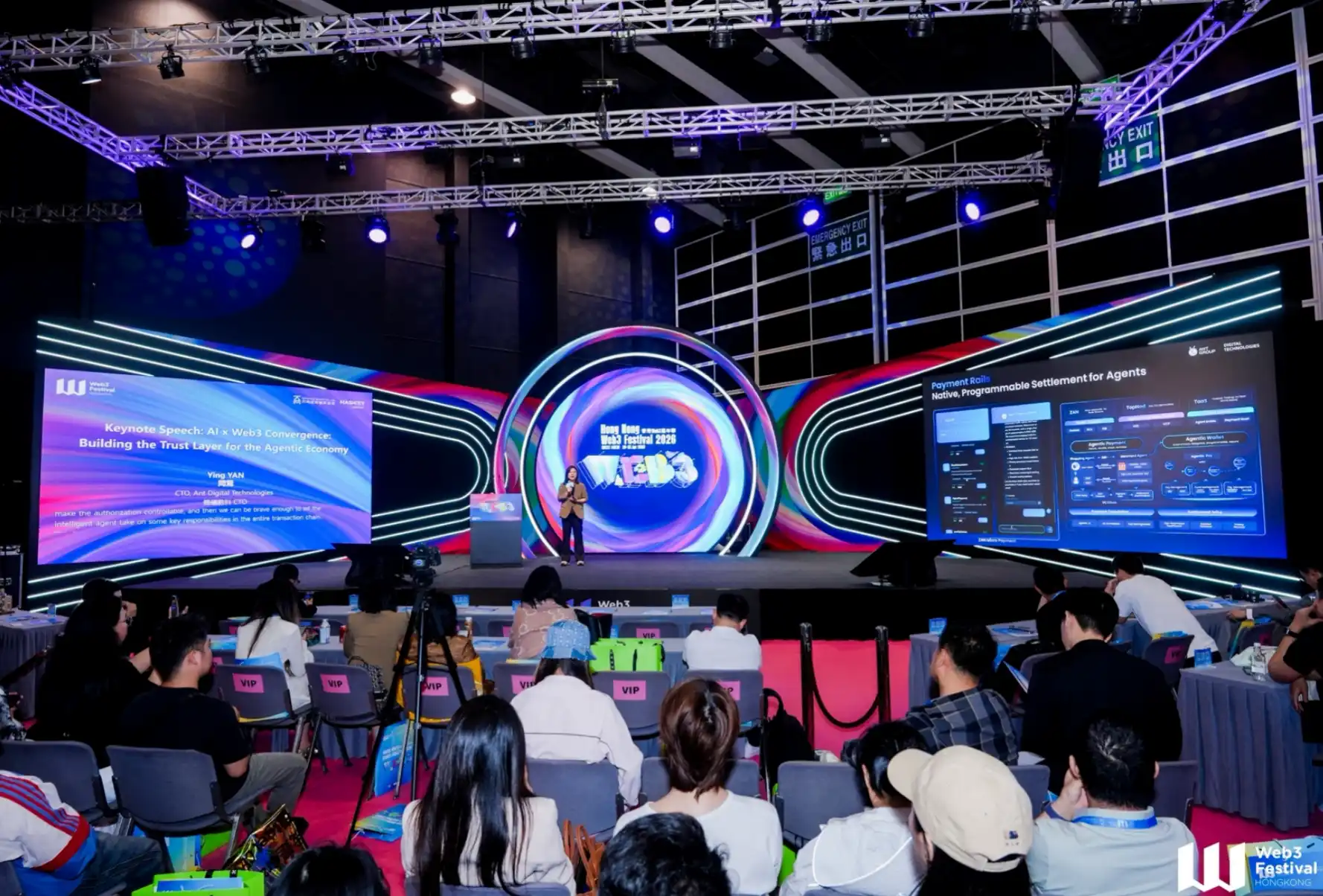
The Agent Registry layer issues on-chain identities to each intelligent entity based on the DID (Decentralized Identity) and ERC-8004 standards, enabling every collaboration between intelligent entities to be verifiable. As the foundation of the architecture, the Root Infrastructure layer utilizes Jovay Layer2 to achieve 120-millisecond confirmation for AI micropayments. It combines ZKVM technology to achieve off-chain computation and on-chain verification, addressing the trust issue in AI economies. Yan Ying stated, "The Root Infrastructure utilizes blockchain and privacy computing technologies to provide an immutable contract execution environment for intelligent entities. Even two unfamiliar AIs can establish trust based on code and transact with confidence."
Currently, AI is evolving from Chat and Action towards the era of Intelligent Entity. Yan Ying believes that the qualitative change in the third stage is not that AI becomes smarter, but that it begins to have assets and transaction rights. Yan Ying stated that in the past decade, Ant Group has accumulated a wealth of engineering practices in financial-grade security, privacy computing, blockchain, and compliance systems, upon which the 4R Architecture has undergone new research and design.
This article is contributed content and does not represent the views of BlockBeats.
Welcome to join the official BlockBeats community:
Telegram Subscription Group: https://t.me/theblockbeats
Telegram Discussion Group: https://t.me/BlockBeats_App
Official Twitter Account: https://twitter.com/BlockBeatsAsia