a16z New Post: Predicting the Market, Entering the Fast Forward Phase
Original Article Title: Prediction Markets: They Grow Up So Fast
Original Article Author: Alex Immerman, a16z
Translation: Peggy, BlockBeats
Editor's Note: Prediction markets have long been viewed as a "niche product": first as an academic experiment, then as a public opinion tool during election seasons, and later as an extension of sports betting. It always seemed to be attached to a high-profile event, but was rarely truly understood as financial infrastructure.
However, in the author's view, prediction markets are evolving from a niche "event trading tool" focused on elections and sports into a financial infrastructure that can price uncertainty.
The author points out that the key changes in the industry are evident on three levels: first, the application scenarios are expanding, with entertainment, macroeconomics, CPI, and other long-tail markets growing faster than sports, starting to meet institutional demand; second, prediction markets are now providing a tradable price benchmark for the "event itself" for the first time, allowing institutions to hedge political or macro risks directly, rather than through "second bets" on related assets; third, institutional adoption is progressing from data reference (looking at odds) to system integration, and then to actual trading, still in its early stages.
Prediction markets are undergoing a process similar to the early stages of the options market: professionalization, institutionalization, and infrastructure build-out. Once liquidity, leverage, and regulation are gradually improved in the future, it may become a core market tool connecting retail and institutional investors for hedging and pricing real-world uncertainty.
Finance is a highly "vertically layered" world, with almost every niche area having its own recognized "annual pilgrimage." Leaders in healthcare service providers, payment processors, and biotech companies gather in San Francisco every year for the J.P. Morgan Healthcare Conference. Heavyweights in global macroeconomics and dignitaries from various countries head to the Swiss Alps for the World Economic Forum Annual Meeting (Davos Forum). TMT, real estate, industry, financial services, and almost every industry you can think of all have their most representative flagship summits.
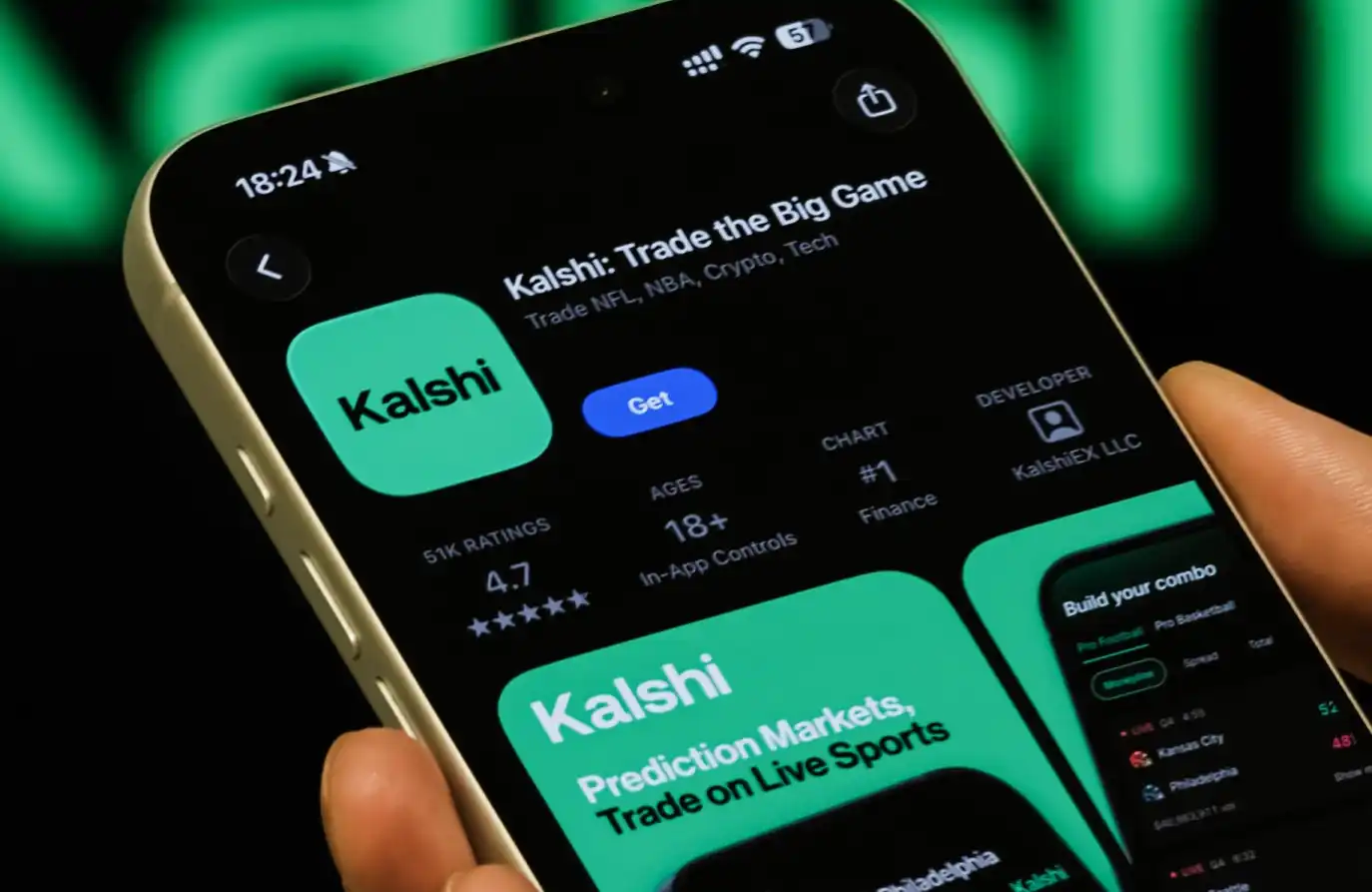
At the end of March this year, Kalshi's academic and institutional research division, Kalshi Research, held its inaugural research conference in New York, bringing together academics, Wall Street executives, former politicians, and traders who truly drive the market. A clear trend can be seen from the composition of attendees: this industry is "maturing."
The conference day kicked off with a conversation between Kalshi co-founder Tarek Mansour and Luana Lopes Lara with Katherine Doherty. Below are some industry insights distilled from this dialogue and subsequent roundtable discussions:
Markets and Life, Beyond Elections and Sports.
During significant news cycles, a common pattern often emerges: a major event (such as the 2024 election, the Super Bowl, or the more recent "March Madness" college basketball tournament) dominates the majority of headlines and subsequently drives the trading volume in prediction markets. This can easily create an impression that "the value of prediction markets is only reflected in these events."
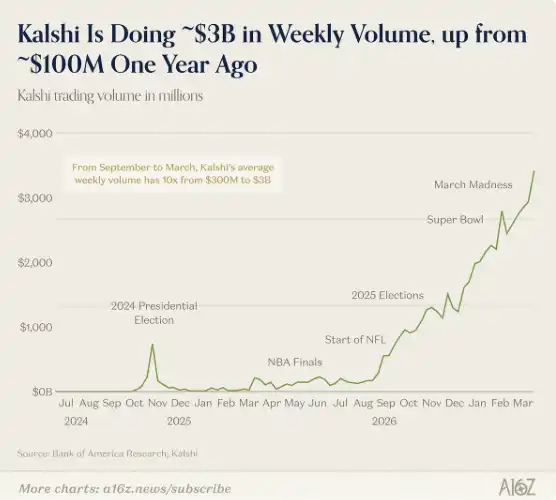
However, despite early narratives often portraying prediction markets as a tool "only meaningful during election cycles," Kalshi has seen significant growth in other domains as well.
At the time of the research conference, the weekly trading volume for sports-related trades had just reached nearly $3 billion, accounting for about 80% of Kalshi's total trading volume, primarily driven by "March Madness." Tarek and Luana viewed this high concentration as a phase-related phenomenon.
A more insightful data point is that although the absolute size of sports-related trades hit a historic high, their proportion in the total trading volume is at a historic low. This implies that the growth rates in all other categories are faster.
The two founders pointed out that categories such as entertainment, crypto, politics, and culture are showing stronger user growth and better trading retention structures than sports. Sports is more like a mass-market "igniter" — it possesses characteristics of high familiarity, clear timing, and strong emotional engagement, making it a typical entry product.
Meanwhile, the company has also observed significant growth in longer-tail markets. These markets currently account for over 20% of Kalshi's trading volume and will play a more critical role in future institutional hedging and information markets.
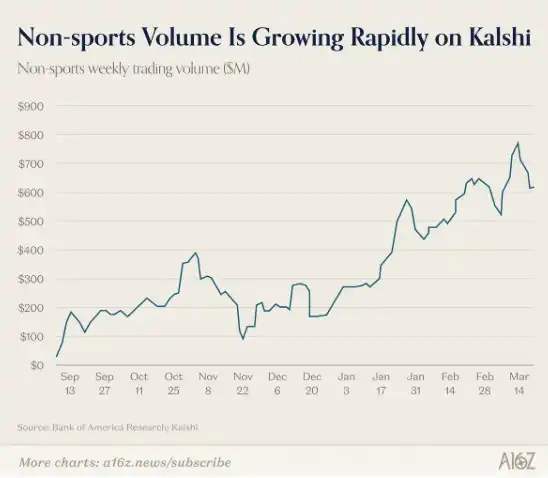
A subsequent institutional roundtable provided demand-side confirmation of this assessment.
Cyril Goddeeris, Co-Head of Global Equities at Goldman Sachs, stated that predictions related to macro events and CPI data are currently the most significant category of interest on Wall Street. Sally Shin, EVP of Growth at CNBC, mentioned that she has already used prediction markets related to the "Fed Chair's continuity" and "nonfarm payroll data" as content narrative tools. Troy Dixon, Co-Head of Global Markets at Tradeweb, further outlined a future scenario where major investment banks will establish dedicated prediction market trading desks with financial contracts as core products.
Why Kalshi Is Attracting Wall Street's Attention
One key reason why the traditional financial markets operate is that each core asset class has a recognized benchmark: the S&P 500 Index represents the overall performance of 500 stocks, while crude oil has benchmark price systems like ICE.
However, for political and macroeconomic events (such as election outcomes, tariff approvals, and Supreme Court rulings), there has been a long-standing lack of widely accepted and dynamically updated "pricing benchmarks." Prediction markets have changed this — now, almost any future event can have a real-time, liquid "price anchor."
Once an event (e.g., "Will a 30% tariff be approved?") has a reliable price, institutions can trade directly around this price. This can facilitate trading on the event itself and can also be used to hedge risks of other assets in a portfolio. As Troy Dixon from Tradeweb puts it: "Go back to Trump's first election, there was a lot of hedging in the stock market, the logic was to short the S&P because if Trump wins, the market will tank. But that trade was off. The question is: How do you price these events? Where's the benchmark?"
Tarek also mentioned that this was one of the motivations behind founding Kalshi. During his time at Goldman Sachs, the trading desk he was on recommended trades based on the 2024 election and Brexit. Without prediction markets, institutions hedging political or macro events through relevant assets are essentially betting on two things at once: whether the event happens and the correlation between that event and the traded asset. The second judgment can easily be wrong.
When the event itself has a direct price benchmark, these dual risks are compressed into one. As Tarek puts it: "Now, this market is starting to price everything."
The Three Phases of Institutional Adoption of Prediction Markets
It may be premature to say that Wall Street institutions are already trading at scale on Kalshi. Currently, most institutions are still at the "data source" stage rather than the "trading platform" stage.
However, Luana points out that the path of institutional adoption of this market is clear and can be divided into three phases:
The first phase is data access: integrating prediction prices into institutional daily workflows. For example, allowing Goldman Sachs' portfolio managers to routinely check Kalshi's odds data as they would the VIX Index. This phase has already to some extent occurred. John Hopkins University professor and former Fed official Jonathan Wright has stated, "For Fed decisions, unemployment rates, GDP, and other areas, Kalshi is almost the sole reference."
The second stage is system integration: including compliance and legal approval, technical integration, and internal education—essentially the process of introducing a new financial instrument.
The third stage is actual trading: institutions begin to directly hedge risks on the platform, and trading volume and market depth gradually accumulate. At this point, more hedging demand attracts speculators to enter, tighter spreads attract more hedgers, and the benchmark price formation becomes a self-reinforcing positive feedback loop.
Currently, most institutions are still in the first stage, some have entered the second stage, and very few have truly entered the third stage. An important barrier is that the current prediction market trading requires full margin. For example, a $100 position requires a $100 margin. While acceptable for individual investors, this mechanism is too costly for hedge funds or banks that rely on leverage and capital efficiency.
As Tarek put it: "If you want to hedge $100, you have to put up $100 at the clearinghouse. That's too expensive for institutions. Institutions like Citadel or Millennium wouldn't do this." Kalshi has now obtained a license from the National Futures Association (NFA) and is working with the Commodity Futures Trading Commission (CFTC) to introduce a margin trading mechanism.
What Will Happen Next?
Bloomberg's Head of Market Innovation, Michael McDonough, put it most directly: "The sign of success is when these things become boring." He likened the prediction market to the options market of the 1970s, which was similarly controversial with manipulation and regulatory uncertainties but eventually evolved into an infrastructure that is hardly thought about today.
AQR partner Toby Moskowitz said he is "willing to put real money on the line," predicting that the prediction market will become a viable institutional tool within five years, or perhaps even sooner.
Garrett Herren from Vote Hub described the end state: "The question is no longer whether to use the prediction market, but how to use it. Once the question becomes that, it signifies that it has become indispensable."
In fact, although the prediction market's current scale is still limited, the hedging market itself is a massive field.
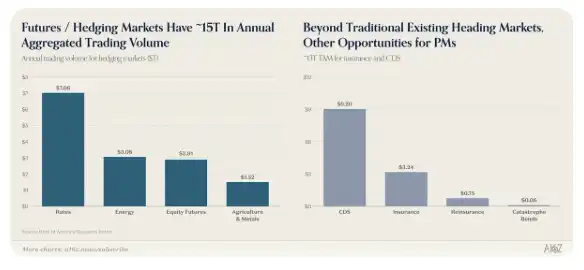
In fact, the "normalization" of the prediction market is already underway.
In a political-themed roundtable discussion, former Congressman Mondaire Jones mentioned that top leaders from both parties—including President Trump, House Minority Leader Jeffries, and Senate Minority Leader Schumer—have started citing Kalshi's odds data in public. DDHQ's Scott Tranter also confirmed that prediction market data has now become one of the standard inputs within party committees. Meanwhile, Vote Hub announced that they have directly integrated Kalshi's data into their midterm election prediction model.
All of this was completely nonexistent just two years ago. Back then, the most successful traders on Kalshi were still primarily considered "casual players." Today, this label is no longer even accurate.
During Kalshi's "The People Behind the Markets" roundtable, four traders shared their career paths—paths that sound nothing like traditional professional traders: someone spent 11 years studying the Billboard music charts, someone else has been honing their skills in prediction markets since 2006 when it was still "a somewhat geeky, almost unprofitable hobby." It is notable that none of these four guests come from the traditional financial industry; instead, they hail from the music, political, and poker fields. However, they unanimously agree that the platform truly rewards deep domain knowledge rather than a flashy resume.
The prediction market has come a long way. From initially being seen as an academic experiment to later becoming a "novelty tool" during elections, and then briefly classified as a "quasi-sports betting product," its positioning has continuously evolved. The clear signal conveyed by this conference is that the prediction market is evolving into an infrastructure—a tool for pricing uncertainty, serving a wide range of participants and diverse application scenarios, from retail traders to large institutions.
Welcome to join the official BlockBeats community:
Telegram Subscription Group: https://t.me/theblockbeats
Telegram Discussion Group: https://t.me/BlockBeats_App
Official Twitter Account: https://twitter.com/BlockBeatsAsia
 Related Articles