XChat Beta Testing Real Experience: Will It Reshape the Coin Community Social Landscape?
Original Title: "I Got Early Access to the First 1000 XChat Beta Testers — Here's Everything You Need to Know About XChat [With Web Version Link]"
Original Author: Punk (2898), AI Analyst
Let's Start with the Conclusion: The Experience Falls Short of Expectations, By a Large Margin. But the Impact of This Event on the Crypto Community Is Much Greater Than You Think
I was among the first batch to receive XChat's beta testing access and have been using it for quite some time. How do I feel about it? To be brutally honest — if you've used WeChat before, your initial reaction upon opening XChat will definitely be "Is this it?"
The app is set to launch on the 17th of April.
Web Version Link: https://chat.x.com
P.S.: The full article is nearly 6000 words long, so I suggest you bookmark it and read it slowly
Article Outline:
· What Is XChat, Exactly? A Real User's Beta Test Experience
· From Twitter DMs to a Standalone App: What Is Musk Really Up To?
· Horizontal Comparison: WeChat, Telegram, WhatsApp, OKX Chat
· Encryption Debate: Security Experts Are Criticizing, But I Have a Different View
· The Real Threat: Binance and OKX Should Be Nervous
· Grok + XChat: The Imaginary Space of AI Communication
· Conclusion: What Does This Have to Do with You?
Without further ado, let's dive in
1. What Is XChat, Exactly? A Real User's Beta Test Experience
Let me first give you some background
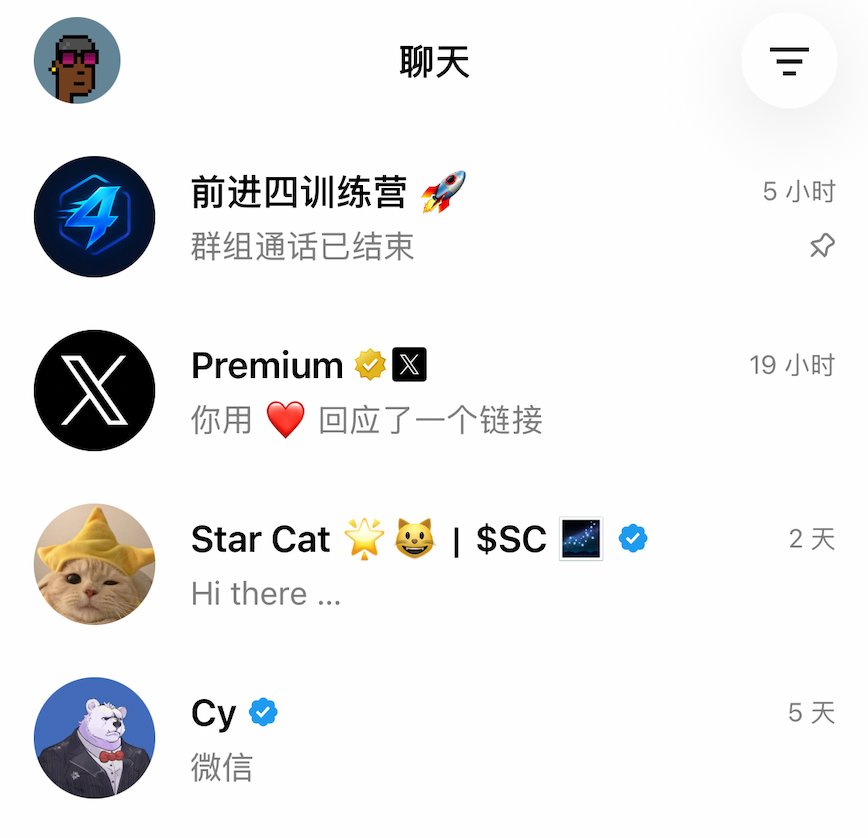
XChat is an independent communication app launched by X (formerly Twitter), set to go live on the App Store on April 17th (just three days away). I got early access through TestFlight and have been using it for a while
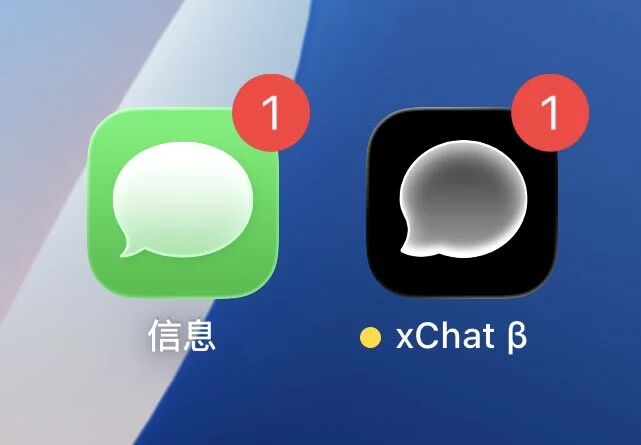
After trying it out, I only have one feeling: Everyone is definitely going to be disappointed
Why? Because we have all used WeChat. The product iterations in the Chinese internet space over the past decade have raised everyone's experience threshold to the ceiling. After getting used to the smooth, stable, feature-rich experience of WeChat, switching to XChat reveals a very noticeable gap in experience
In essence, the current features of XChat are almost identical to what Twitter's DM used to be
End-to-end encryption, ephemeral messages (auto-destroy in as fast as 5 minutes), screenshot prevention, voice and video calls, file transfer, group chat. These features were already in X's DMs before, just hidden deep within, and now they have been moved to a standalone app
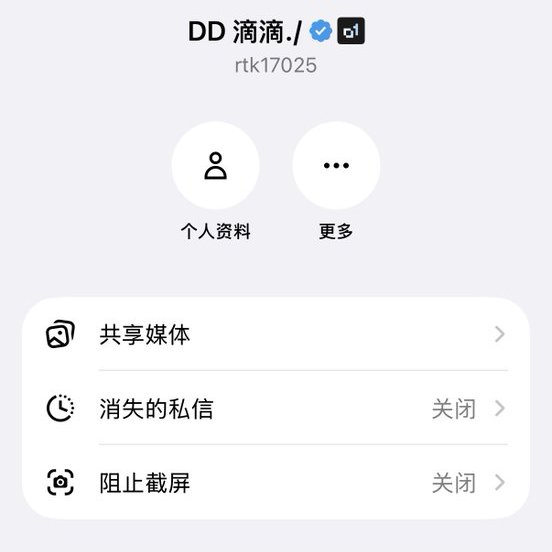
You could think of it as: No new features, just pure standalone
Then you might ask: What's the point of this?
Actually, it's quite significant
Previously, X's DM entry was too deep, requiring multiple taps to get in. Notification management was also a mess, with messages often getting lost in various notifications. By becoming standalone, all these issues have been resolved — when you open XChat, it's purely for chatting, without timeline distractions
There's actually a ready-made success story for this logic: Facebook's Messenger
When Messenger was separated from Facebook back then, many people also thought it was unnecessary. And the result? Messenger's user base soared to a billion after independence, which for Meta was like gaining an additional billion-user product out of thin air, skyrocketing their valuation
X is now doing the exact same thing
The first benefit of this separation is a focused experience. You can optimize the communication experience more effectively without being weighed down by the various functions of the main app
The second key benefit is that the target user base has expanded. As an internal DM at X, your ceiling is X's user count (roughly 5-6 billion monthly actives). But once you break out, your benchmark is Telegram, WhatsApp, or even WeChat, with a completely different valuation space.
II. From Twitter DMs to a Standalone App: What Is Musk Up To?
To understand how XChat came to be, we first need to understand what Musk was thinking the day he bought Twitter.
On October 27, 2022, Musk spent $44 billion to acquire Twitter. Walking into the company's headquarters, he held a sink in his hands, saying, "Let that sink in," a pun. While everyone took it as a joke, Musk had a very specific business blueprint in mind:
Transform Twitter into the Western world's WeChat
He has mentioned WeChat as a template on more than one public occasion. In 2023, at an all-hands meeting, he explicitly stated his hopes for X to become a "full-fledged" dating platform and digital bank. This ambition is not just talk; it is the fundamental driving force behind the XChat product line.
But before the transformation, Twitter's DM system was practically an ancient relic. No encryption, rudimentary interface, and barely functional features. To build a palace, you must first lay the foundation.
What followed was a long and winding process
1. 2023: Encryption Experiment, Failure
X began testing the first version of end-to-end encrypted DMs, open only to paid users. The experience was abysmal, with Musk himself later admitting that the version was "clumsy" and the encryption did not work properly.
2. 2024: Decision to Start Anew
The engineering team realized that the old codebase could not support Musk's vision of a super app. Patching up the old system was futile; they had to start afresh. The name "XChat" began circulating internally within the company.
3. May 2025: Pause of the Old System
X made an unusual move—proactively shutting down the existing DM encryption feature, citing "ongoing improvements." What happened behind the scenes was a complete rewrite of the entire messaging backend in the Rust language. It was akin to tearing down the old building's foundation and pouring new concrete, all while ensuring the upstairs residents were not affected.
4. June 2025: Musk Announces "New XChat"
His exact words were: "End-to-end encryption, ephemeral messages, support for sending any type of file, and audio/video calls... Built on Rust, utilizing Bitcoin-style cryptography, with a new architecture."
The term "Bitcoin-style cryptography" caused quite a stir. Cryptographers immediately pointed out that Bitcoin's blockchain does not rely on encryption in the traditional sense. This statement didn't hold up technically and seemed more like a signal to the Crypto community.
5. November 2025: Old DM Officially Exits the Stage of History
X automatically migrated all user chat histories to the new architecture. It shifted from being an "optional feature" to a "default experience." At the same time, Musk tweeted, "X just rolled out a brand-new communication stack... X Money is coming soon."
Linking communication and payments together was no coincidence.
6. December 2025: Independent App Emerges
Researcher Nima Owji discovered that chat.x.com had gone live with a minimalist interface, completely isolated from the main app. It could even be added to the desktop using PWA.
7. March 2026: TestFlight Beta Testing
Apple's TestFlight distribution, initially limited to 1000 slots, was fully taken within two hours. It was later expanded to 5000 slots. I was among the first batch of testers.
8. April 17, 2026: App Store Official Launch
This was nearly a year behind Musk's initial promise, but the product indeed underwent substantial evolution during this period.
There is a crucial background story here: In March 2025, xAI (Musk's AI company) acquired X through an all-stock transaction, valuing X at $33 billion (including $12 billion in debt) and xAI at a valuation of $80 billion. Following this merger, Grok (AI), X (social), and XChat (communication) truly came under the same umbrella organizationally.
So Musk's plan is to build a tripod structure: Communication (XChat) + Payment (X Money) + AI (Grok). If any leg is missing, the entire super app cannot be built
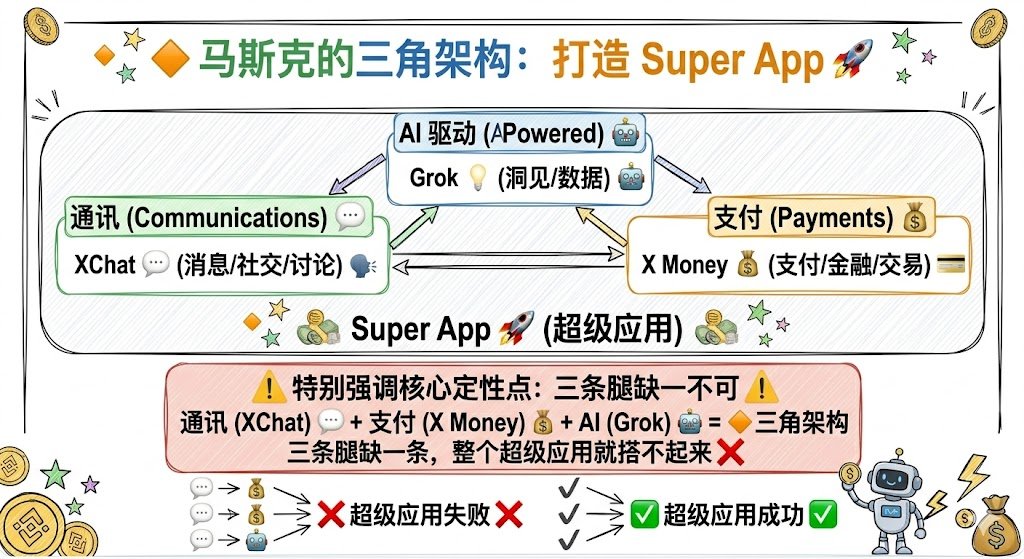
XChat is the first leg
III. Horizontal Benchmarking: Who is the true competitor of XChat?
From the perspective of crypto users, who are the competitors of XChat? I will go through them one by one
WeChat: Directly ruled out
The reason is too simple—account banning. Discussing encryption-related topics in WeChat often leads to an account ban. People simply dare not have in-depth discussions on WeChat, at most a few ambiguous words in a group chat. Crypto communities cannot survive in WeChat
Telegram: Too chaotic
We all know the advantages of Telegram: no KYC, openness, strong anonymity. But the problem is also because it is too open—account theft is rampant, scams are prevalent, and spam messages are everywhere. People around me who use Telegram basically receive several phishing links every month. Being too open actually makes it more insecure
WhatsApp: Unrivaled network effect, but unrelated to the crypto industry
WhatsApp has over 3.1 billion monthly active users globally. In the UK, 90% of online adults use it, and 74% open it every day. This level of penetration means it is not just an app but a social infrastructure
WhatsApp uses the Signal protocol for encryption, making message content invisible to Meta. However, Meta collects metadata—whom you chat with, how frequently you chat, and when you are active. The content is secure, but the metadata is transparent
For crypto users, the issue with WhatsApp is: it requires a phone number for registration and is completely unrelated to the encrypted community ecosystem. You won't find Alpha group chats on WhatsApp
OKX Chat: Good user experience but lacks independence
Now, let's talk about this separately. The in-app chat feature launched by OKX actually provides a decent user experience compared to similar products in the crypto space. Although it lacks many features compared to WeChat, it covers the basics of messaging, groups, and notifications, which is sufficient.
The only issue is that it is not a standalone app; you have to open the OKX App to use it. This limitation has restricted its user base to the active users of OKX.
What sets XChat apart?
Firstly, no need for a phone number; you can log in directly with your X account. This is extremely convenient for crypto users—your friends are already on X, with avatars, follow relationships, and social graphs all there. Plus, you can directly jump to a contact's Twitter profile, making the experience seamless.
Secondly, if XChat is developed, users can create encrypted-related communities using this standalone app. Private messaging will also be very convenient due to single sign-on. This is the most direct benefit for crypto users.
Thirdly, XChat emphasizes "no ads, no tracking, encrypted communication." Although I have some doubts about this claim, at least in terms of marketing, it is attractive to privacy-conscious crypto users.
In simple terms, XChat's current differentiation lies not in its features but in its social graph. Your X friends are already on the platform, making the switching cost extremely low.
Section Four: Crypto Debate: Security Experts Are Criticizing, But I Have a Different View
This section is the most critical part of the whole article. I will first explain what the experts are criticizing, and then provide my own assessment.
What are the experts criticizing?
After XChat was launched, security researchers collectively criticized it. The core issues of the criticism are threefold:
1. Four-Digit PIN + Key Stored on Server = Essentially Useless
When activating XChat, you are required to set a four-digit PIN. Your private key, encrypted with this PIN, is stored on X's server—not on your phone.
A four-digit PIN only has ten thousand possible combinations. Security researcher Mysk directly pointed out: anyone with server access can enumerate and crack it within minutes, thus decrypting all your message history.
Cryptographer and professor at Johns Hopkins University, Matthew Green, provided a judgment: "If judged by the standard of end-to-end encryption, this is a completely failed design."
Contrast this with Signal: the private key never leaves the user's device. No one can see your messages, not even Signal itself.
2. No Forward Secrecy
In simple terms: if your key is compromised in the future, the attacker can retroactively decrypt all your previous messages. Signal solved this problem ten years ago.
3. X Admitted to a "Backdoor" Themselves
On X's official help page, there is a line that remains there to this day:
"If malicious insiders or X itself expose encrypted conversations through lawful processes, the sender and receiver will be completely unaware."
While this statement is honest in itself, it also exposes the underbelly of the "privacy-first" marketing slogan.
Even more awkwardly, the Privacy Label on the App Store shows that XChat collects data including: location, contacts, search history, and more, directly contradicting the "no tracking" promotion.
Alright, the experts have finished criticizing. Now, let me share my perspective — which differs from theirs.
Many people, upon seeing these security issues, immediately start to criticize: "Garbage! Deception! Encryption is fake!"
But let me ask you a question: Why do you think they are incapable rather than intentionally doing this?
Four-digit PIN codes, key storage on servers, lack of forward secrecy — do these things have technical barriers?
No. Signal did all of this ten years ago. With X's engineering capabilities, achieving encryption at Signal's level is entirely possible.
So, this is not an issue of capability; it is a strategic issue.
They are intentionally doing this to lay the groundwork for future business expansion.
Just think about it:
If XChat really achieves Signal-level full encryption — where X itself can't see any user data, any message content — then how would X Money, digital banking, payment systems behind it work?
If you don't even know user information, how do you do KYC? How do you do AML? How do you do risk control? How do you do personalized recommendations? How do you do advertising?
If everything is fully encrypted, forget about business expansion
Musk's strategy is actually very shrewd:
Sacrifice some encryption, but advertise encryption. Very few people truly understand cryptography; they are not X's core users. X's core users are the few billion ordinary people on Twitter. For them, just hearing the four words "end-to-end encryption" is enough
The benefits of this approach are:
1. Occupy the advantage of the "encryption" publicity point and steal users from Telegram and WhatsApp
2. Did not truly achieve full encryption, leaving room for X Money, digital banking, AI analysis later on
3. In case of regulatory demands for cooperation in investigations, they won't be stuck due to "we can't even decrypt it ourselves"
From a purely business perspective, this strategy is spot on
Think about it, Musk acquired Twitter for 44 billion, xAI acquired X valued at 33 billion including 12 billion in debt. With such a large investment, it's impossible to actually create a product where "you can't even see your own data". How would you cash out your investment?
So, the encryption in XChat is essentially a marketing tool, not a technical commitment
This is not me criticizing it: In the business world, this approach is extremely rational
Five, The Real Threat: Binance and OKX Should Be Nervous
After discussing so many product-level things, let's now talk about what I think is the most crucial part — the impact of XChat on the cryptocurrency world
My assessment is: with this move by XChat, the biggest threat is not WhatsApp, not Telegram, but Binance and OKX
Why?
If XChat is developed, it will occupy not just a communication niche, but a community relationship
Think about the current social scene in the crypto world:
You see an Alpha on X and want to have a deeper conversation. Previously, you had to jump to Telegram to create a group, or chat one-on-one in X's DMs (with an excessively deep entry path). Now, with XChat, you can simply create an XChat group and that's it
Group chats, private chats, communities, all kept within X's ecosystem
What does this mean?
For OKX: Your group chat feature may become obsolete
OKX's on-platform chat experience is indeed good in the crypto world, but if everyone is creating XChat groups, your group chat will become redundant. Who would maintain a community in two different places? Everyone will gather where the crowd is
For Binance: The problem is even bigger
Binance Square currently has 10 million monthly active users. What does this number mean? It means Binance completely has the ability to create an encrypted communication software
You have the traffic (3 billion registered users), the use cases (trading discussions, Alpha sharing, community operations), the infrastructure (KYC completed, payment channels established). If you were to create a communication tool, it would be a natural progression
But you didn't
By the time XChat grows, it will be too late to think about it. Because once community relationships are formed, the cost of migration is extremely high. Look at how long WeChat has been around—it's fundamentally because all your relationships are on it, and you can't escape
Encrypted socializing is a massive gateway. This gateway is currently empty—WeChat accounts get blocked and can't be used, Telegram is too chaotic for people to trust, WhatsApp is not aligned with the crypto community. If XChat seizes this window of opportunity to capture community relationships, it will be very difficult to disrupt later on
Another point: Chinese team product iteration speed is top-notch worldwide. And now with AI, development efficiency has increased several times. If Binance or OKX starts now, it might only take a few months from conception to launch
The truth is, you don't really need to consider marketing costs — you have 300 million users on Binance, OKX has the best wallet ecosystem; as long as the product is developed and the user experience is acceptable, why wouldn't users use yours?
So my suggestion is: Both Binance and OKX should quickly launch independent encrypted communication products as a defensive move
This window of opportunity won't stay open forever
Six, Grok + XChat: The Imagination Space of AI Communication
XChat has something that no other communication tool has: Grok
After xAI acquired X, Grok and XChat are now products of the same company in terms of organizational structure. The resistance to data flow has been significantly reduced
The functionality that has been implemented so far is Ask Grok: You long-press a message in the chat, select "Ask Grok," and it will perform real-time analysis on the message content. It can parse PDFs, generate itineraries, translate, summarize — all directly within the chat interface
The imagination space for this feature is vast
Just imagine: You're in a crypto community, someone posts a project whitepaper. Previously, you would have had to copy the link → open the browser → find a translation tool → slowly read. Now, simply long-press → Ask Grok → within seconds, you get a structured analysis. This experience is revolutionary
But there is a significant privacy contradiction here:
The message you select is sent in plain text to Grok for processing. In other words, while your overall conversation is encrypted, once you invoke AI, that message is no longer a secret
The hybrid architecture of "encrypted conversation + AI plaintext transmission" opens up a gray area in terms of privacy
But to be honest — for most crypto users, this issue is not even within their scope of consideration. It's not like you're discussing state secrets; you just want AI to help you quickly go through a whitepaper
Back to XChat itself. If Grok's AI capabilities continue to improve, the combination of XChat + Grok may potentially create a differential experience that others don't have in specific scenarios:
Real-time translation (multilingual group chats), intelligent summaries (summarizing hundreds of messages in one click), content generation (directly generating analysis reports in the group), on-chain data queries (asking Grok about the holdings of a specific address)
If these features are really well implemented, XChat's use case in the crypto world will be much richer than Telegram's
AI communication may be XChat's true differentiator, rather than anything related to "end-to-end encryption"
7. Summary: How does this matter to you?
After all this talk, you might be most concerned about: How does this matter to me?
If you are an average crypto user:
XChat is worth downloading and trying out. The experience is indeed not as good as WeChat, but the benefit is that your X friends are all on it, group creation is convenient, and login is unified. Especially if you often look for Alphas on X, or chat privately with KOLs, XChat will be much more useful than previous DMs.
The experience will get better and better. People like Musk—products are definitely rough in the early stages, but the iteration speed is very fast. Tesla had a lot of problems in the early days, but now?
If you are an investor:
Pay attention to two things:
1. When will X Money go live. If XChat + X Money form a closed loop, X's valuation will undergo a significant reassessment. This time point may be in the second half of 2026 to 2027
2. Whether Binance and OKX will launch defensive communication products. If they do, it indicates that they believe XChat's threat is real. You can judge the popularity of the encrypted social track from this (Of course, I think they have no reaction at all)
If you are an entrepreneur: Encrypted social is an extremely large entry point, and currently, no product has truly dominated this entry point. XChat is working on it, but the experience is still rough. TG is too chaotic, WeChat bans accounts, WhatsApp doesn't fit in. Is there an opportunity here?
The answer is yes. But you have to run faster than Musk
Finally, a few more words: Can XChat become the Western WeChat?
Most likely not. WeChat's success is built on a specific Chinese soil—a single-language market, regulatory blocking of foreign competitors, simultaneous development of digital payments. None of these conditions exist in the West
But "Not being WeChat" does not mean "No value". The most realistic path to success for XChat is to become the glue within the X ecosystem — allowing 600 million X users to keep more and more of their private interactions within the X system, rather than going out to use TG or WhatsApp.
For the crypto circle, its greatest value is providing a "WeChat cannot be used, not trusting TG" third option, and its threat to Binance and OKX is just beginning.
Original Article Link
Welcome to join the official BlockBeats community:
Telegram Subscription Group: https://t.me/theblockbeats
Telegram Discussion Group: https://t.me/BlockBeats_App
Official Twitter Account: https://twitter.com/BlockBeatsAsia