AI Agent Can't Kill SaaS

Article | Sleepy.md
After the AI Agent took off, many people have already started to write eulogies for SaaS. But I think it's too early for that.
Investors are indeed in a panic. In early 2026, the doomsday panic of SaaS swept through the entire tech industry. By the end of January, just after Anthropic released a feature update that allowed Claude to invoke plugins, the market capitalization of the US software sector evaporated by hundreds of billions of dollars in the following three weeks.
Their panic logic is simple. They believe that since AI can already write code on its own, find vulnerabilities, and even dynamically generate tools, the cost of writing code is rapidly approaching zero. Once the Agent can create all kinds of customized tools for businesses anytime, anywhere, those software companies that charge monthly rent will naturally see their hard-earned moats vanish.
So, from CrowdStrike to IBM, from Salesforce to ServiceNow, regardless of how bright their financial reports are, they are all experiencing brutal sell-offs.
At the same time, countless AI entrepreneurs are holding their business plans, telling VCs that they want to "build the middleware of the Agent era" and "start a business for the Agent."
They are all betting on one thing: building tools is the sexiest business of this era.
But if we take our eyes off those PowerPoint slides and look at the real aspects of how enterprises operate, we will find that it's not actually like that.
Selling Software Has Never Been About Code
There is a classic and repeatedly verified theory in economics called "factor scarcity transfer." Every productivity revolution makes a previously scarce factor abundant, while making another previously overlooked factor extremely scarce, leading wealth to concentrate on the latter.
Before the Industrial Revolution, labor was scarce; the steam engine made mechanical labor abundant, and scarcity transferred to capital and factories, making factory owners the richest people of that era.
The Internet revolution made the cost of information dissemination zero, and scarcity transferred to users' "attention," making traffic a big business.
Today, the AI revolution is making the ability to write code and build tools extremely abundant. In the Agent era where code is no longer scarce, where has the scarcity shifted to?
Actually, in the decades of development in the software industry, the code itself has never truly been a moat.
Every line of code in the Linux system is free, but that didn't stop Red Hat from being acquired by IBM for a whopping $34 billion; MySQL is free, yet Oracle acquired it and still manages to sell pricey service contracts. Anyone can download PostgreSQL's code, but AWS's Aurora database service still manages to rake in billions of dollars from enterprise customers every year.
The code is free, yet the business is still here, and thriving.
What truly matters are these three things: solidified business processes, years of accumulated customer data, and the resulting high switching costs.
When you purchase Salesforce, you are not buying the source code of that CRM system; you are buying access to over 50 trillion enterprise customer records managed by it, along with the seamless process experience of how it integrates sales, customer service, marketing, and other aspects. This data is not just lines of cold code; it's the living time and history of the company.
A company that has been using Salesforce for ten years has every communication record, every transaction history, every follow-up point of each sales opportunity within it. Moving away is not just a software switch; it's akin to relocating the entire memory of the company. This is why Salesforce can still generate $41 billion in annual revenue and aims for $63 billion by 2030.
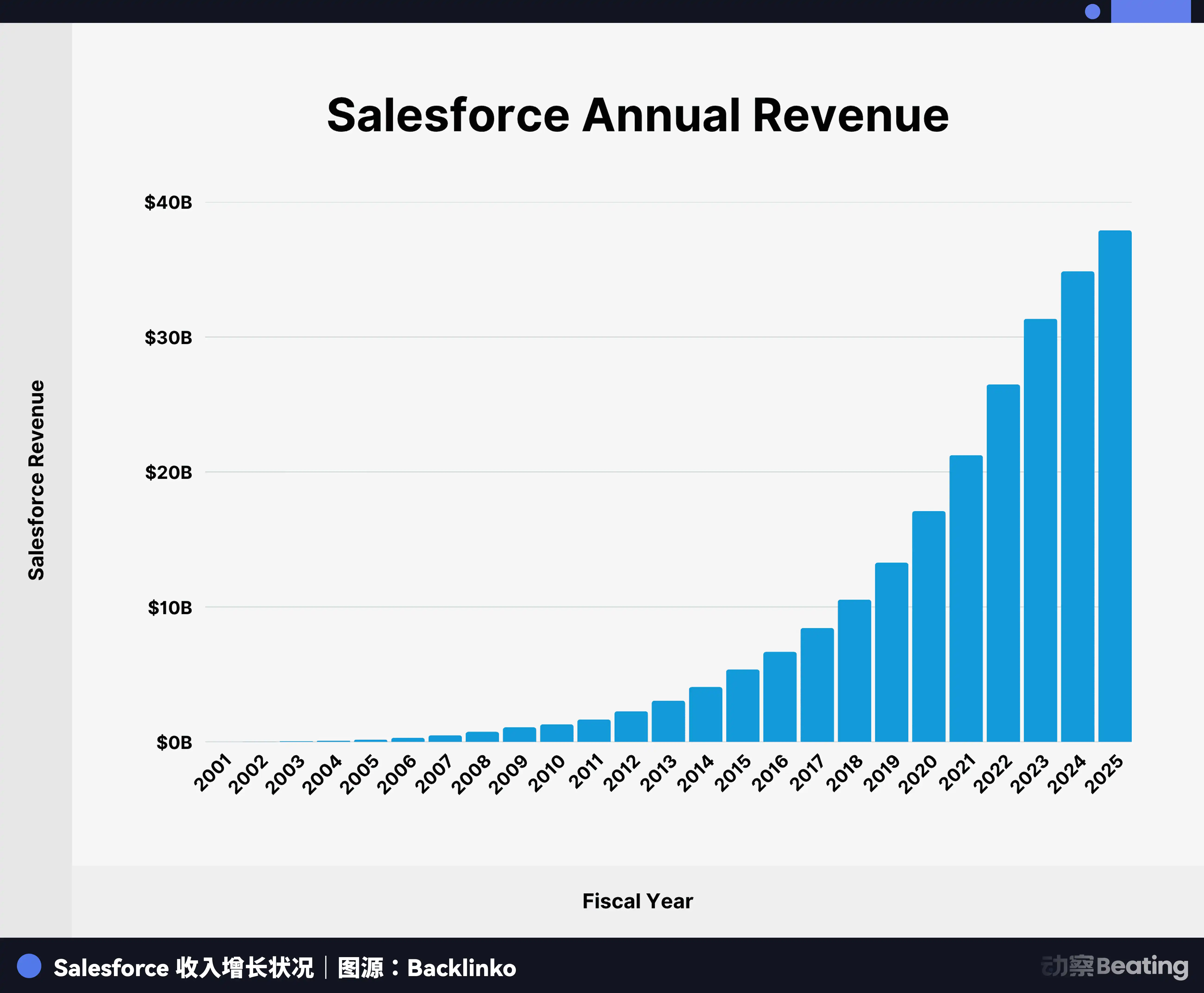
Let’s return to the framework of the scarcity shift. Since the Agent can create tools on its own and the cost of coding has dropped to zero, what is truly the scarcest element in the enterprise service scenario?
Choking the Agent
What truly chokes the Agent is not its lack of hands, but its lack of "context" in its brain.
A super Agent with all the tools is like a high-performance juicer. It spins rapidly, blades sharp, but if no one puts fruit in it, it surely won't produce a glass of juice for you.
McKinsey pointed out in its annual report that 88% of enterprises are using AI, but only 23% have truly achieved scalable deployment of Agent systems in some part of the enterprise. What's holding them back is not the lack of intelligence in big models, but that the enterprise's data architecture is not ready.
In an interview with MIT Technology Review, SAP's President of Data and Analytics, Irfan Khan, mentioned: "Businesses cannot simply throw away their entire ledger system and replace it with an agent because an agent cannot do anything without business context."
Here, "business context" refers to: where this company draws the line on financial compliance, what regulatory requirements exist in this industry, the past decade of this customer's preferences and history, this supplier's payment terms and default records, this employee's performance history and career path... These things are neither publicly available on the internet nor accessible through web scraping, and AI cannot generate them through text prediction.
Ashu Garg, Partner at Foundation Capital, shares the same view. He said that what an agent needs is not just data but a "context graph," a layer of reasoning that can capture not only what the enterprise has done but also how the enterprise thinks. This kind of thing can only be precipitated from real business operations and cannot be manufactured out of thin air.
Following this logic, scarcity has shifted from "the ability to create tools" to "possessing irreplaceable business context data."
Since an agent cannot even squeeze a glass of juice itself, then who holds the fruits?
The Golden Age of Data Landlords
The answer points to those old folks who were once thought to be disrupted by AI.
On February 23, 2026, Bloomberg unveiled an Agentic AI interface called "ASKB." The Bloomberg Terminal is one of the most iconic entities in the software industry. Although there are only 325,000 subscription users globally, with each account charged $32,000 annually, this means that Bloomberg collects over $10 billion in revenue per year from these 325,000 accounts alone, accounting for over 85% of Bloomberg LP's total revenue.
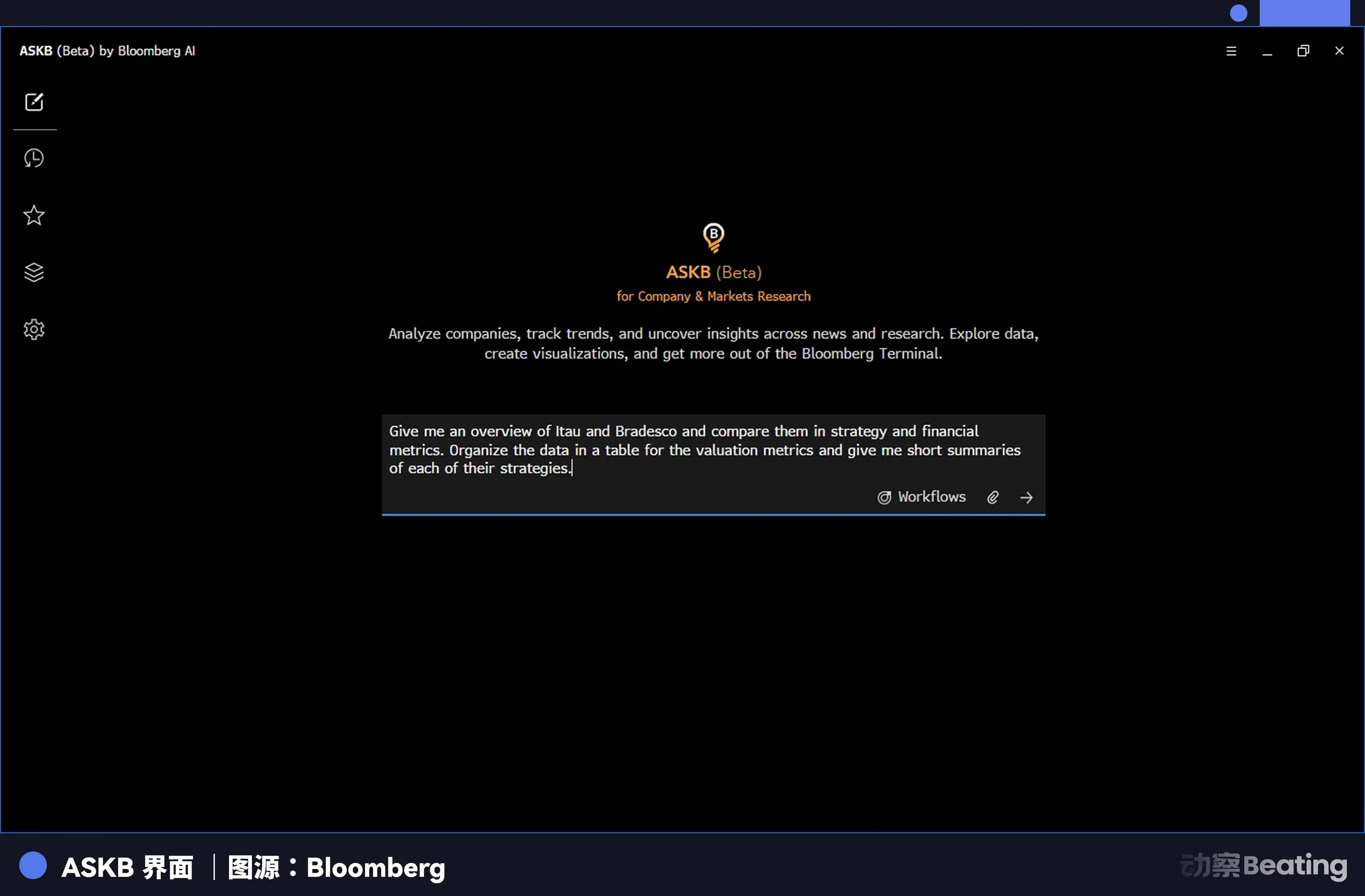
For the internet industry, which typically follows the "more users, the better" mantra, this is actually counterintuitive; Bloomberg has built a strong business fortress relying on a tiny number of paying users.
There is only one reason it can achieve this: Bloomberg holds the most comprehensive, real-time, and in-depth structured financial data globally. This data is the result of decades of continuous investment, including real-time quotes, historical archives, news corpus, analyst reports, company financial data... Any institution wishing to make serious decisions in the financial field has no way to avoid using it.
For the newly launched ASKB, AI is the engine, and Bloomberg's proprietary data is the sole fuel. Any Agent looking to make an impact in the financial field cannot fabricate this data out of thin air; it must obediently tap into Bloomberg's API.
WatersTechnology provided a very astute observation: Bloomberg's Agentic layout demonstrates how "those who possess data have turned AI into their personal ATM."
This logic applies across various verticals. Veeva holds the compliance and R&D data for the global pharmaceutical industry; any pharmaceutical company's Agent handling clinical trials or regulatory submissions must access this data. Epic holds the medical records of over 250 million patients in the U.S.; every diagnostic suggestion by a healthcare Agent requires these authentic medical records as a foundation. LexisNexis monopolizes vast legal document archives; legal Agents conducting case searches and compliance analysis cannot circumvent it.
These data are the crystallization of decades of business operations in the real world, the sediment of time, and a history that cannot be replicated. This is also the ultimate manifestation of "scarcity transfer": when everyone possesses top-tier AI engines, the true determinant of success is whether you can find that oil field that belongs uniquely to you.
In the past, these subscription-based data services were sold to human analysts. A large institution might need to purchase 100 Bloomberg terminal accounts. However, in the future, as machines become the consumers of data, it might be an institution running tens of thousands of Agents, frantically calling these proprietary data interfaces in milliseconds.
This is a leap in scale. The number of queries a human analyst can handle in a day is limited, but an Agent's call frequency can far exceed that of a human. The demand for continuous, real-time, high-value data will experience an exponential surge. The subscription-based business logic has not been overturned; instead, it has been infinitely magnified by the insatiable appetite of machines.
Code goes back to zero, and data starts collecting rent.
However, does this mean that all SaaS and data companies can rest easy?
Not All SaaS Hold This Card
If this article is seen as indiscriminately bullish on the SaaS industry, then that would be a grave mistake. What AI has brought to SaaS is a ruthless great divide.
In early March 2026, TechCrunch interviewed several top VCs to ask them what they least want to invest in right now.
VCs in Silicon Valley have already voted with their feet. Simple workflow encapsulation, horizontally applicable tools across any industry, lightweight project management — these stories that used to be enough to secure a round of funding all share the same fate now: a direct pass. The reason is simple: these are tasks that agents can now handle effortlessly. Software companies without exclusive data are quickly losing their eligibility to enter the capital spotlight.
This assessment has effectively split the SaaS world in half.
One half consists of those that offer only thinly packaged tool-type products, wrapping public data in a nice interface or merely optimizing a specific single-point operation flow within SaaS. The moat for these products fundamentally lies in user habits and interface stickiness.
However, as Jake Saper from Emergence Capital puts it: "In the past, getting humans accustomed to your software was a powerful moat. But if agents are doing this work now, who cares about human workflows?"
Such SaaS products do indeed face significant threats. The GTM tool stack is a typical example. Companies like Gainsight, Zendesk, Outreach, Clari, Gong each occupy adjacent functions such as customer success, customer support, sales outreach, revenue forecasting, call analysis, each requiring separate budgets, separate operations, and separate integrations. Native AI companies can now use one agent to connect all these aspects, significantly devaluing the existence worth of these point solutions.
On the other hand, the other half of SaaS deeply embeds within enterprise core business processes, holding irreplaceable proprietary data. These companies will not only be replaced by agents but will actually become more valuable due to the presence of agents.
Take Salesforce, for example. In February 2026, Salesforce's financial report showed that Agentforce's annual recurring revenue reached $800 million, a 169% year-over-year growth; they have delivered a total of 24 billion "Agentic work units," handled nearly 200 trillion tokens; signed over 29,000 Agentforce customers, with a 50% quarterly growth rate. More importantly, Agentforce and Data 360's merged ARR exceeded $2.9 billion, with a growth rate of over 200% year-over-year.
Marc Benioff said in the earnings call, "We have rebuilt Salesforce into the operating system of the Agentic Enterprise. The more AI can replace work, the more valuable Salesforce becomes."
Instead of being replaced by Agents, Salesforce has become the soil in which Agents operate. Its value comes precisely from the business data and process context that Agents cannot bypass.
ServiceNow's CEO Bill McDermott publicly announced in February 2026, "We are not a SaaS company."
He is not denying what ServiceNow is but rather proactively defining its boundaries. His argument is that SaaS is a concept about the "software delivery method," whereas ServiceNow aims to be the orchestration and execution layer of enterprise AI Agents. While AI can identify issues and provide recommendations, it is ServiceNow, deeply integrated into workflows, that executes actions within enterprise systems.
On March 17, 2026, Workday released "Sana," a conversational AI suite that deeply integrates HR and finance data. The core idea of this product is not to replace Workday with AI but to feed AI with Workday's data.
Workday holds the compensation, performance, organizational structure, and financial budget data of thousands of enterprises. The depth and uniqueness of this data are something that any AI-native startup cannot replicate in the short term.
Therefore, the real moat is not whether you have data but whether the data you possess is inaccessible, unpurchasable, and inimitable.
The Next Decade: Who Collects the Rent
In every technological revolution, the ones who ultimately capture the most profits are usually not the inventors of the groundbreaking new technology but those who quietly control the scarce elements on which the new technology relies. In this era of rapid AI advancement, the capabilities of large models will grow stronger, and Agents' ability to code and create tools will become more widespread.
When these once-considered cutting-edge capabilities become infrastructure, the logic of "elemental scarcity transfer" leads to only one conclusion: those fervently creating tools for Agents are unlikely to be the ultimate winners of this era.
In its February 2026 analysis, Foundation Capital said that the overall market value of the software industry is set to expand tenfold over the next decade. However, this tenfold growth will not be evenly distributed among all software companies; it will be highly concentrated in those players who can truly harness the Agent era.
The real winners are those who hold data assets that Agents cannot bypass.
For today's entrepreneurs and investors, there are only two destinies in this era: either desperately building a pickaxe for the Agent or claiming the land first. You should know what you are doing right now.
Don't focus on the Agent's hand; go for the Agent's throat.
Welcome to join the official BlockBeats community:
Telegram Subscription Group: https://t.me/theblockbeats
Telegram Discussion Group: https://t.me/BlockBeats_App
Official Twitter Account: https://twitter.com/BlockBeatsAsia