This viral high school teacher from Beijing, Jiang Xueqin, predicted America's downfall in advance


On March 21, prominent American media figure Tucker Carlson released his latest interview program.
The guest was not a former senator or retired general, nor a prestigious scholar from a Washington think tank. Instead, it was a Chinese man named Jiang Xueqin. His day job involves teaching history and philosophy at a private high school called the "Moon Exploration School" in Beijing's Chaoyang District.
The program lasted over an hour, covering topics ranging from the trajectory of the Iran War to the possibility of Japan's nuclearization, Israel's strategic calculations, the actual combat capabilities of the U.S. ground forces, and the role played by Trump in all of this.
To truly understand this episode, we must start with Tucker Carlson. (Full interview translation: "Jiang Xueqin's Latest Interview: How to View the Current Global Changes")
The Disoriented Tucker Carlson
If someone were to ask who is the political journalist most representative of the core soul of America in this era, Tucker Carlson is an unavoidable name.
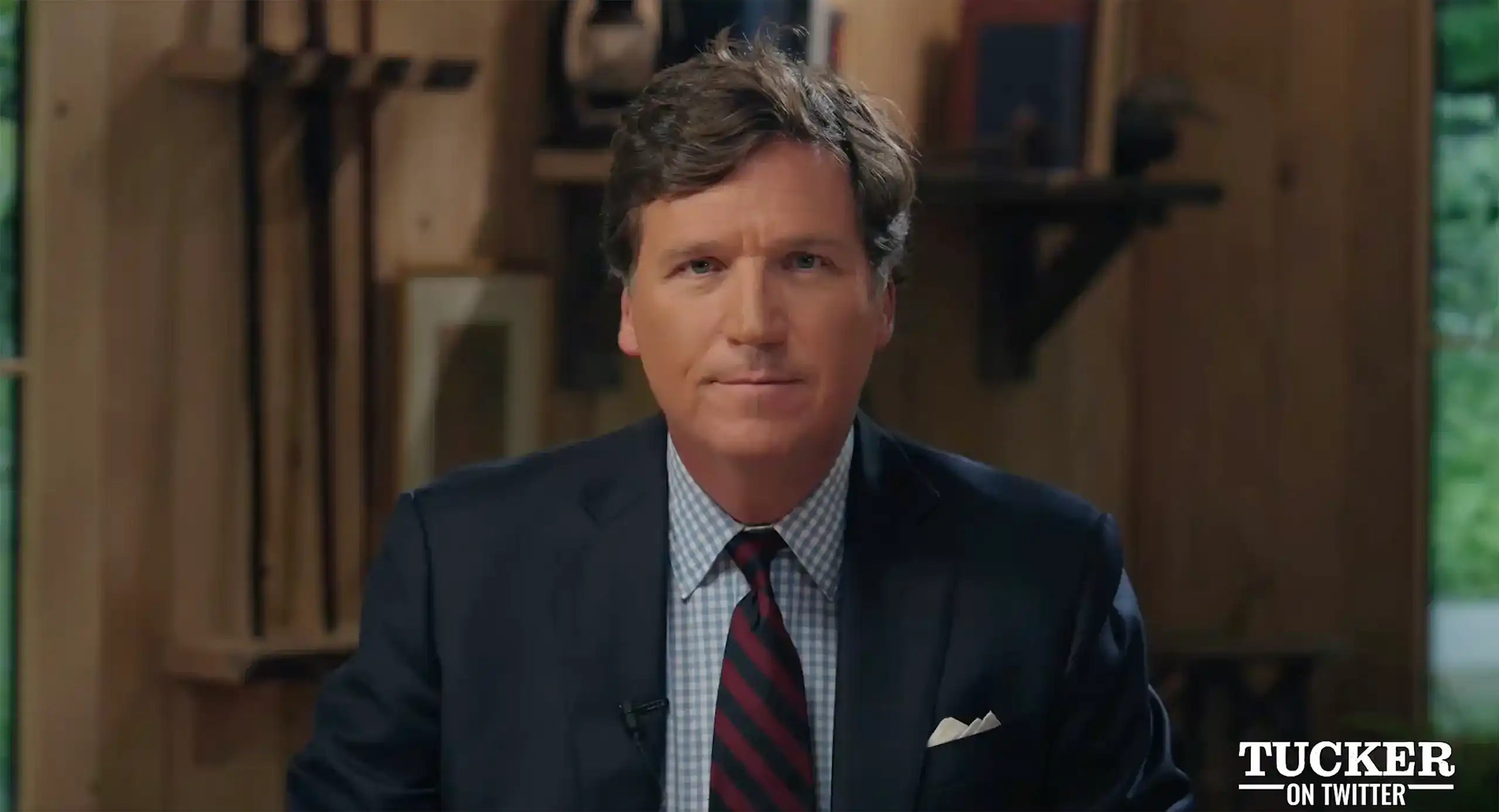
Tucker Carlson
He is a top American political commentator. His program, Tucker Carlson Tonight, has long held the top spot in U.S. political program viewership ratings and is the most important platform for conservative discourse.
More importantly, he is also one of the most important media allies of the MAGA movement. Trump sees him as "one of his own," and during the 2024 election, the two appeared together on stage multiple times. Carlson is almost the loudest trumpet for the MAGA movement in the media arena.
However, everything changed after the U.S.-Israel joint military strike on Iran in February.
Carlson publicly denounced the war, calling the joint strike operation "disgusting and extremely evil" and stating clearly, "This is Israel's war, not America's war." Trump promptly kicked him out of MAGA: "Tucker has lost his way; he is not MAGA. MAGA is about making America great again, putting America first, and Tucker is none of these."
Following this, Carlson publicly claimed that the CIA was preparing to sue him under the charge of "undisclosed foreign agent," solely because he had exchanged text messages with the Iranian side before the outbreak of the war.
This war has also evolved into a rift between the MAGA camp and the establishment: The establishment tried to reverse its decline through the war, while some, represented by Carlson, believed this was digging their own grave. Trump kicking Carlson out of MAGA is a microcosm of this internal split.
The irony of Carlson's current situation is striking: he had predicted numerous times on his show that the "deep state" would use legal means to suppress dissenters. But now he has become a dissenter himself.
At this crucial moment, he invited Jiang Xueqin—a Beijing high school teacher who had predicted two years ago that America would lose this war—onto his show.
Three Predictions that Catapulted Him to Fame
In May 2024, with Biden still in the White House and Trump yet to experience the two assassination attempts that summer, the election outcome far from certain. In what seemed like an ordinary class, Jiang Xueqin made three predictions to his students:
1. Trump would win the election in November.
2. The US would be involved in a war with Iran.
3. The US would lose this war, altering the global order forever.
Looking back now, the first two predictions have both come true:
On November 5, 2024, Trump emerged victorious in the US election, defeating his opponent Harris.
On February 28, 2026, the US and Israel jointly launched a military strike against Iran.
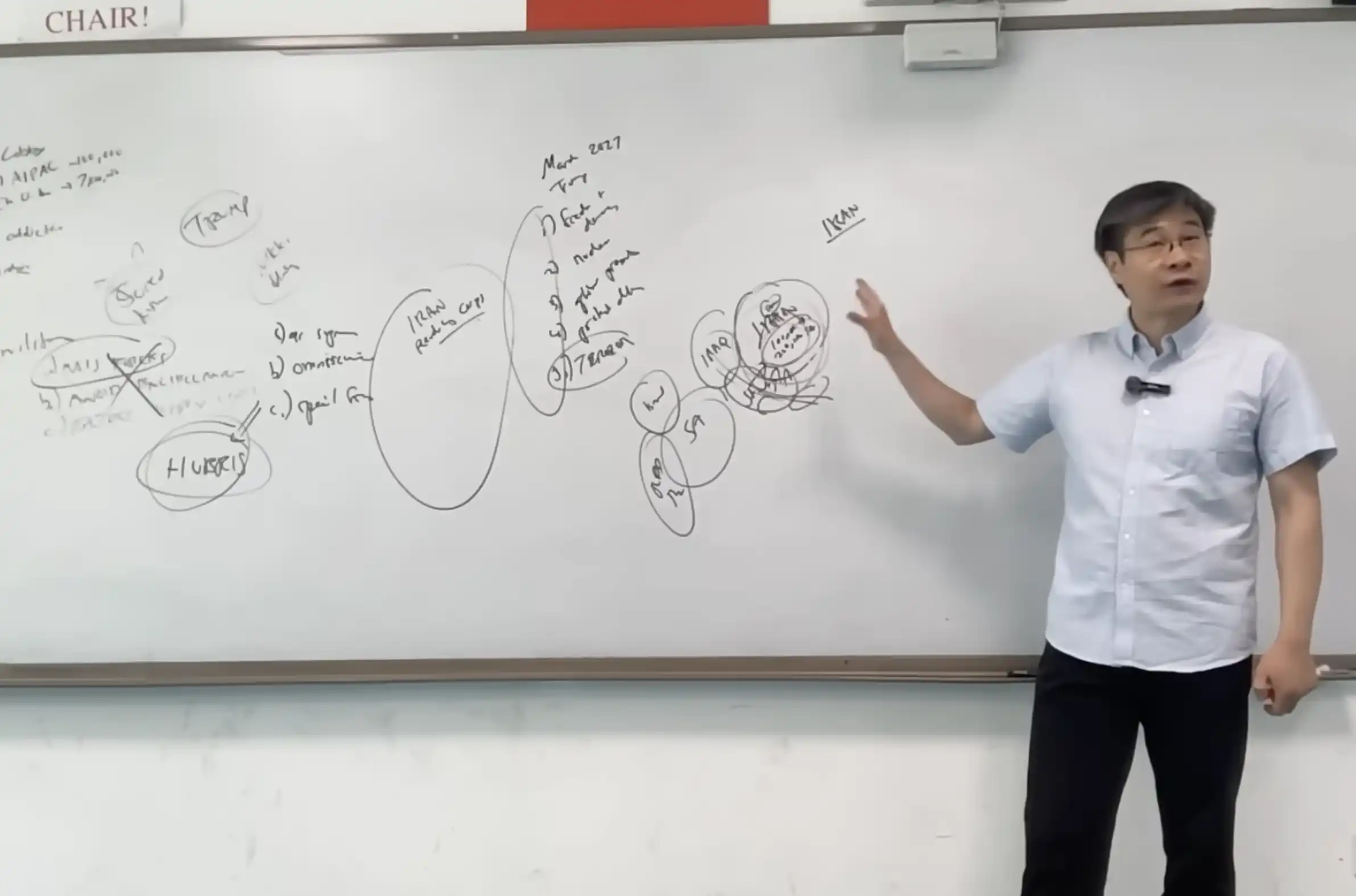
Predictive History Video Screenshot
As for the third prediction, it is still unfolding.
All these classroom discussions were posted on his YouTube channel "Predictive History." No subtitles, no editing, just a well-dressed Mr. Jiang and a blackboard. According to himself, the channel was inspired by the concept of "psychohistory" in the works of science fiction writer Isaac Asimov: believing in the structural laws of history, future trends can be deduced through mathematical models and analysis of group psychology.
After the US-Iran War broke out, this old video from 2024 went viral across the web, with the comment section filled with Americans' astonishment. This also propelled Jiang Xueqin to fame, with the video surpassing 4 million views in a single day and the channel gaining over 2 million subscriptions.
Will the US Lose This Middle East War?
In 415 BC, immersed in the illusion of empire at its peak, Athens rashly treated Sicily as a ripe fig. They deployed the most luxurious expeditionary fleet in history but, due to a broken supply line and collapse of local support, they buried an entire generation of their finest youth and almost all their savings on that distant land.
This was Jiang Xueqin's historical analogy for the potential fate of the "US involvement in Iran".
His core argument is that the US military is essentially a Cold War-era "muscle-flexing" system, costly, seeking technological awe, rather than the resilience of a prolonged attrition war. This misalignment manifests in reality as a ludicrous asymmetry, such as using a missile defense system worth millions of dollars to counter a $50,000 drone.
Even after the war began, Jiang Xueqin still believed that Iran had the upper hand over the US. He pointed out a sinister trump card Iran held: by targeting desalination plants in the Gulf region, they could paralyze the entire petrodollar system within weeks, as he mentioned in an interview on the US independent news commentary show "Breaking Points" on March 3.
90% of Kuwait's drinking water comes from desalination, while Saudi Arabia relies on it for 70%. Once these facilities suffer systemic damage, it will deepen regional instability, further triggering a humanitarian crisis and an immigration emergency in the Gulf region.
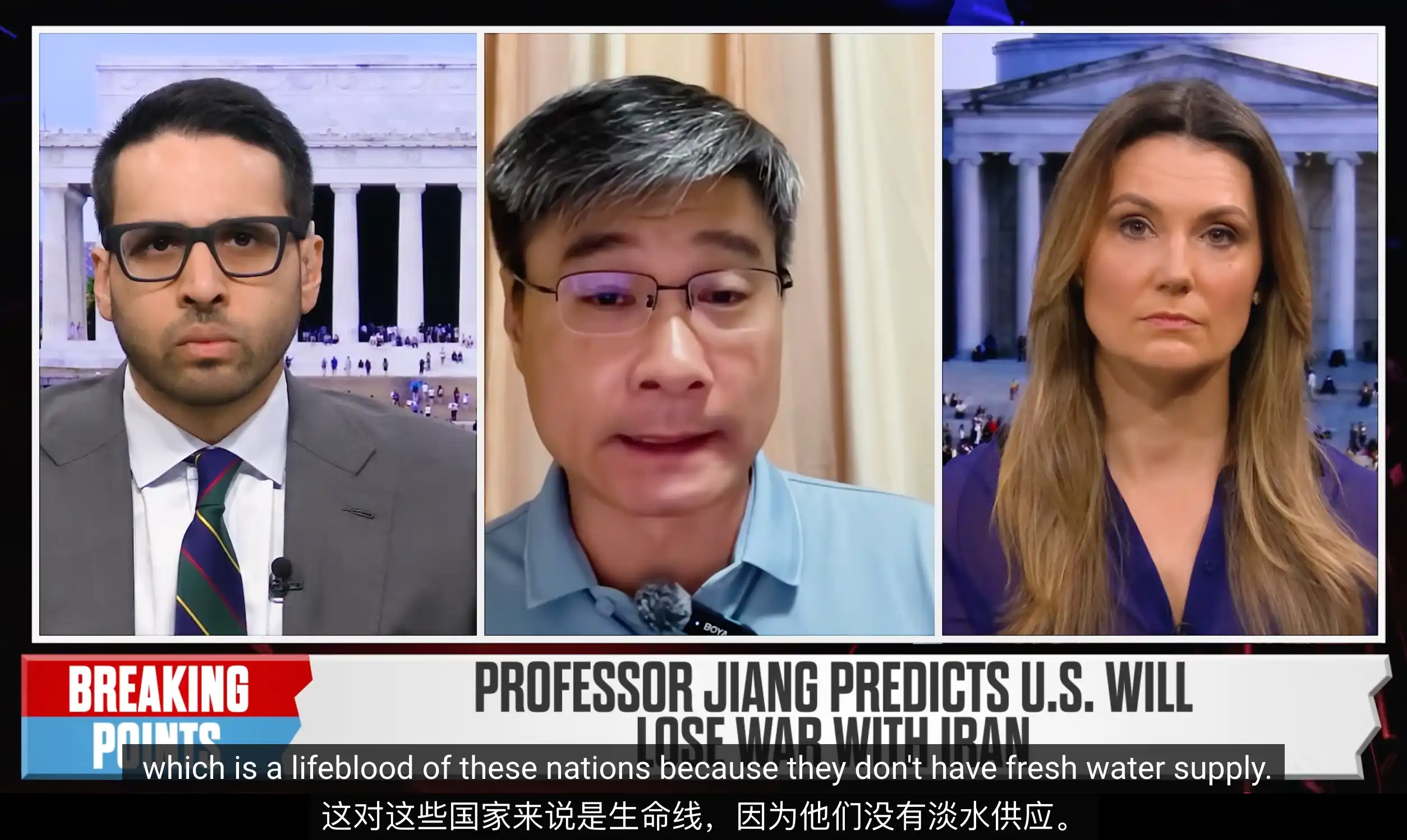
Jiang Xueqin on Breaking Points
And just five days after the show aired, on March 8, Iran attacked a desalination plant in Bahrain.
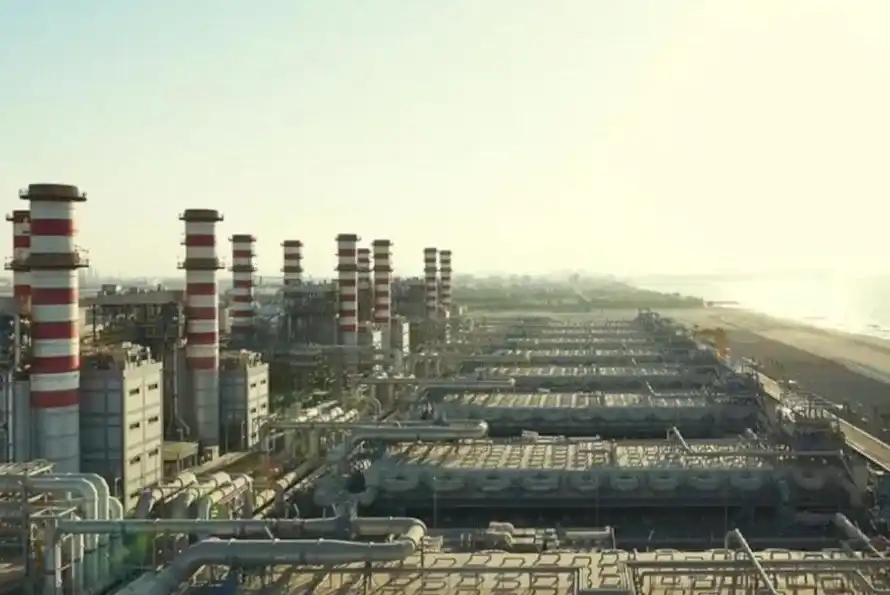
Desalination Plants in the Middle East
On Tucker Carlson's show, Jiang Xueqin's predictions are even more profound and unsettling:
The modern global economy is built on one premise: energy is cheap and readily available. Now, that premise is crumbling.
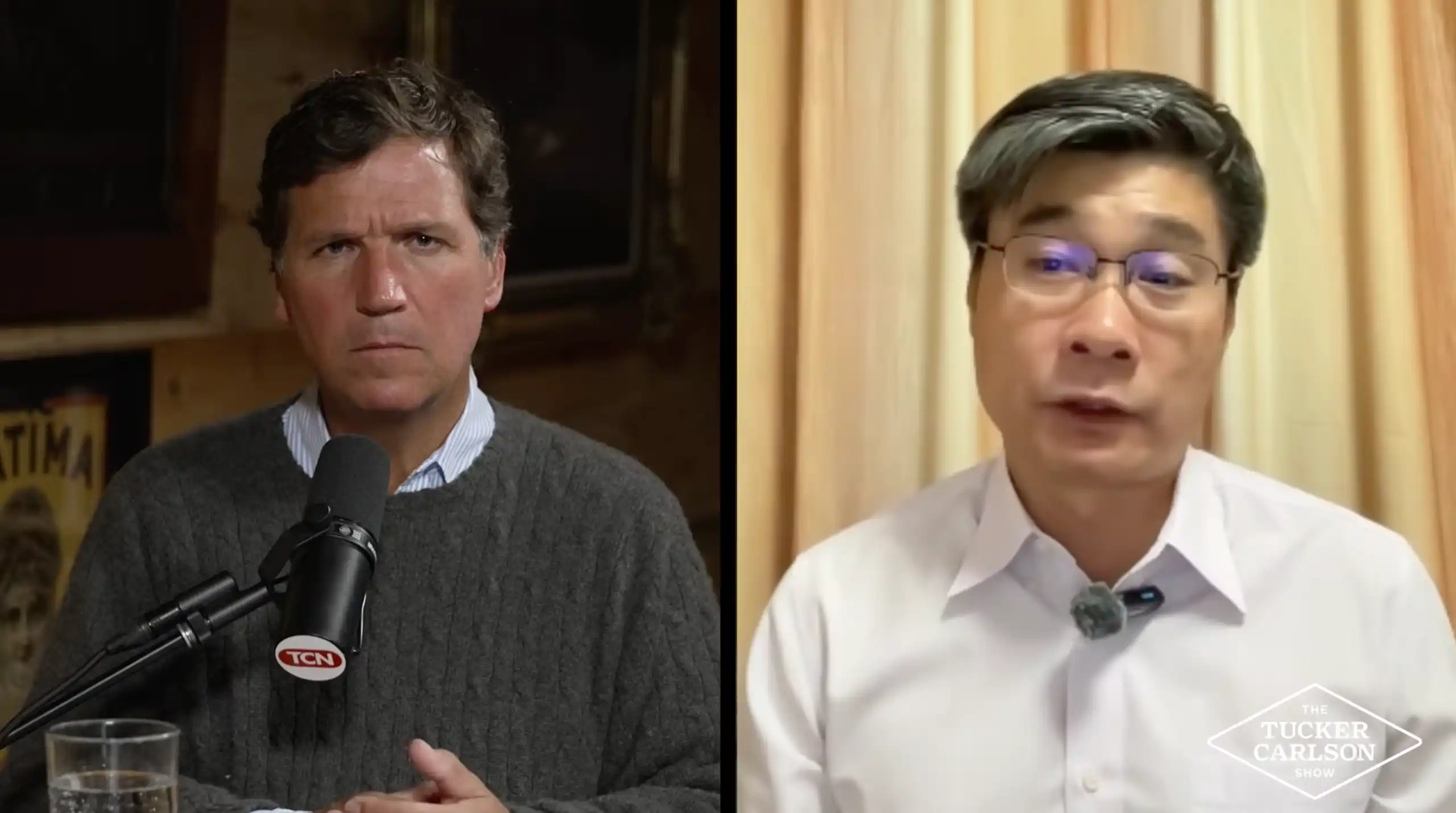
Tucker Carlson Interviews Jiang Xueqin
Jiang Xueqin believes that the Iran war will be highly similar to the Ukraine war: dragging on and turning into a war of attrition. The U.S. cannot withdraw because once it does, the only regional power that can fill the security vacuum is Iran. Around one-fifth of the world's oil passes through the Strait of Hormuz every day, and if the Gulf countries lean towards Iran, the petrodollar system will collapse.
His statement is very straightforward: "The current U.S. economy is essentially a Ponzi scheme, relying on foreign countries continuously buying dollars to keep it running." The U.S. is currently saddled with nearly $39 trillion in debt, relying for decades on oil-producing countries settling oil in dollars and then recycling the money back into the U.S. economy. Once this cycle is interrupted, the consequences will be devastating.
Building on this assessment, he outlined three major trends that he believes will occur regardless of the outcome: deindustrialization due to expensive energy, countries forced to rearm, and a return to mercantilism after the collapse of the global supply chain.
He also predicted that to maintain the front, Trump is highly likely to order a national draft, leading to street riots, followed by the deployment of the National Guard. "So, unfortunately, the U.S. will likely experience years of factional violence," he said on the show.
In this logic, this year's Oscar-winning film "World War Redux" may no longer be some kind of screen assumption but the final prelude to systemic collapse.
Basis of His Prediction
Jiang Xueqin's trajectory of growth is itself a history of boundary-crossing practice. At the age of 6, he immigrated to Canada with his family and then grew up in Toronto. With a scholarship, he enrolled at Yale to major in English literature. After graduation, he returned to China. For nearly twenty years, he has worked as a journalist, documentary filmmaker, UN project officer, and deeply engaged in China's educational reform practice.
In 2022, he returned to Beijing and joined Moonshot Academy. Its founder, Wang Xiqiao, born in the 1990s, is also an active education innovator.
Moonshot's educational logic is inherently consistent with the direction Jiang Xueqin has been deeply cultivating for twenty years: abandoning the evaluation of students based on subject scores and emphasizing solving real-world problems.

Jiang Xueqin on the Moon Exploration School Website
Jiang Xueqin teaches a year-long Western philosophy course here, guiding students to read the Epic of Gilgamesh, Plato's Republic, and Descartes' Meditations. But what he truly wants to teach students is: to examine themselves and the world from a higher, critical, and objective perspective.
This is the underlying ability on which he based those three predictions, not a mere accumulation of knowledge in a specific field, but a way of thinking that pierces through appearances and identifies structural patterns.
Those Who Master Patterns Are Rare in Any Era
In class, Jiang Xueqin once said that a correct historical framework should achieve three things at the same time: connect the past, explain the present, and predict the future. Only by achieving these three points can one possibly approach the truth.
The glow of the desalination plant, the cracks in the petrodollar — these are all inevitable manifestations of structural forces reaching a certain point. Asimov's "psychohistory" is fascinating because it believes that beneath the surface chaos, history has its own grammar. His three predictions are a real-world validation of this framework.
However, the framework itself does not provide answers. Perhaps this is why Jiang Xueqin chooses to stay in the classroom, not because the classroom is safe enough, but because there are still people there willing to ask questions earnestly.
Welcome to join the official BlockBeats community:
Telegram Subscription Group: https://t.me/theblockbeats
Telegram Discussion Group: https://t.me/BlockBeats_App
Official Twitter Account: https://twitter.com/BlockBeatsAsia