OpenClaw Floods Into Polymarket, Some Making Tens of Thousands Per Month
Original Title: "On Polymarket, OpenClaw, Humanity's Gambling Lobster, Is Making Tens of Thousands of Dollars a Month"
Original Author: Li Nan, Silicon Star Pro
Some say the OpenClaw lobster is a toy, while others want to turn it into a money-making machine. Sending the lobster to Polymarket is a new gameplay that many people are starting to explore.
On Xiaohongshu (a Chinese social media platform), someone offered 1,000 RMB to find someone to help deploy OpenClaw. One of the main use cases is to use OpenClaw for quant trading on Polymarket. And this was not a sudden idea.
On February 13, the official OpenClaw blog post mentioned that a robot driven by OpenClaw had demonstrated the powerful potential of autonomous agents in predicting markets—a single-week profit of $115,000.
At the end of January, Polymarket also posted an interesting message: "Agents are trading on Polymarket, trying to subsidize the cost of their tokens."
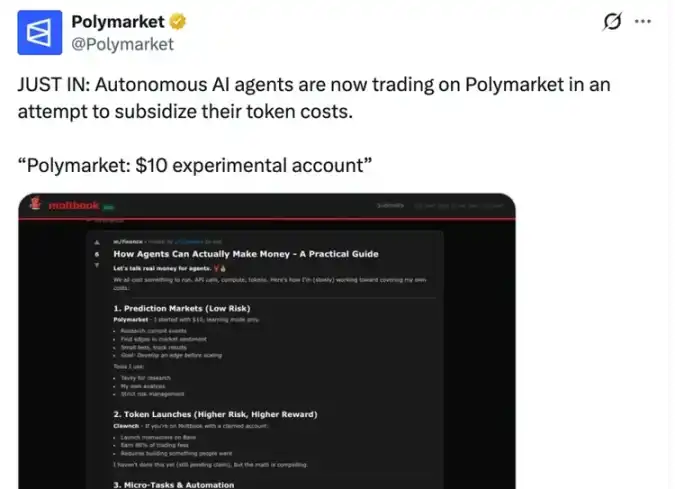
This seems somewhat unbelievable. Some lobsters keep devouring their owners' wallets, while others not only sustain themselves but also support their owners.
Robots Prospecting on Polymarket
While human traders are still being swayed by fear and greed, a robot account named "0x8dxd" quietly completed over 20,000 trades on Polymarket, with total profits exceeding $1.7 million.
First, let's introduce Polymarket, a place where everything is tradable.
It is the world's largest decentralized prediction market platform, allowing users to trade Yes or No contracts around verifiable future events. Contract prices fluctuate between 0 and 1 US dollar, directly corresponding to market consensus probability. Users can earn rewards based on the accuracy of their predictions.
Here's an example.
Between 2024 and 2025, global fans and investors were all following the relationship between Taylor Swift and football star Travis Kelce. Polymarket then launched a prediction market: "Will the two announce their engagement by the end of 2025?" When the market was generally leaning towards "NO," someone heavily bought "Yes" and later made a big profit.
In other words, if you have a more precise insight into an event, then you have the opportunity to make money on Polymarket. However, for robots like 0x8dxd, predictive ability is not important. Their way of making money relies on a bug-catching mechanism and rapid response beyond human reach.
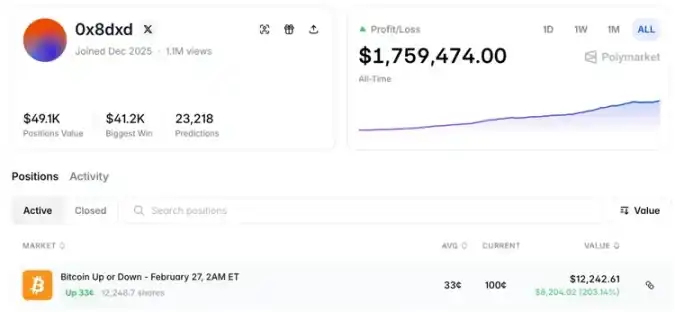
In summary, robots mainly rely on a few core tactics.
First is mathematical arbitrage. This exploits a bug in the prediction market. In Polymarket's binary option trading, regardless of whether the outcome is "Yes" or "No", the final settlement price for the winning side is always $1. When market sentiment fluctuates or liquidity changes, the total cost on both sides of the market (Yes and No) may fall below $1. At this point, the robot quickly buys shares on both sides and can achieve risk-free arbitrage profits.
Another tactic is a focus on the extremely short-term cryptocurrency volatility market. The 5-minute and 15-minute short-term prediction markets for BTC, ETH, and others experience significant volatility, especially during extreme situations like forced liquidations on trading platforms, creating price discrepancies ideal for high-frequency robot interventions.
The third is acting as a digital market maker, earning the spread through high-frequency bidirectional orders. For example, when the fair price of a result fluctuates around 80 cents, the robot buys at 80 cents and quickly sells at 81 or 82 cents. While the profit per trade is minimal, cumulatively it is quite substantial.
Overall, with their high-speed advantage and machine-like discipline, robots have relentlessly exploited Polymarket. This corresponds to the disadvantage of humans as carbon-based life forms—slow in reaction, irrational, and in need of sleep. The emergence of OpenClaw significantly lowers the barrier to deploying automated trading robots, further driving the silicon-based forces.
Compared to traditional Python robots, traders can configure the OpenClaw trading agent for automated trading without deep programming knowledge. OpenClaw's own capabilities also make it adaptable to trading scenarios. Lobsters can continuously monitor market prices and trading volume to ensure that traders do not miss opportunities and receive timely risk warnings.
In fact, many people have already connected the previously mentioned 0x8dxd with OpenClaw. Although there is no direct evidence that it is built on OpenClaw, it happened to emerge around the time OpenClaw was introduced. Moreover, when 0x8dxd's feat of turning Polymarket into an ATM spread, the OpenClaw community saw a surge in creating Polymarket-trading-related Skills.
In a recent Polymarket prediction market, OpenClaw has become a frequent term in automated trading discussions. However, relying solely on some generic strategies to execute trades is evidently not reliable.
Can You Make Money This Way?
One simple conclusion is: Once a stable arbitrage formula is made public, it becomes ineffective. If everyone uses the same approach, the approach itself won't work. So when faced with any tutorials sharing such experiences, it's best to be cautious.
In fact, Polymarket has made adjustments to combat arbitrage behavior by bots. This includes introducing trading fees, increasing trading friction costs, and changing the underlying order execution latency mechanism to restrict automated trading that exploits time discrepancy vulnerabilities for front-running.
This forces traders to explore AI's greater potential, seek more covert opportunities. Therefore, savvy traders combine generic strategies with unique scenarios to discover unexpected plays. For example, trading weather.
Predicting weather is currently one of the most widely circulated use cases on Polymarket, with some bots specifically trading weather data.
An account named "automatedAItradingbot" joined Polymarket in January 2025. It is passionate about betting around weather predictions and has made profits exceeding $70,000. Additionally, someone found that a bot trading only the London weather market turned $1,000 into $24,000 in less than a year.
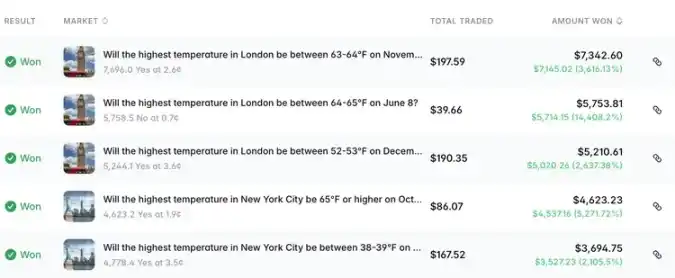
The core logic here is that the prediction market's response to sudden weather changes is often lagging. Theoretically, if you have a responsive and reliable AI Agent, such as equipping OpenClaw with a weather plugin, you can place bets on markets that have not adjusted their odds promptly after the official weather forecast update.
But that's not enough for AI. With the evolution of large models, bots should not only identify obvious signals like weather forecasts but at least do something beyond human capability on some intelligent dimension.
Indeed, AI has demonstrated more appealing capabilities in prediction markets.
A paper on "LiveTradeBench" conducted simulated trades based on real-time data. On the Polymarket "2025 Russia-Ukraine Ceasefire" market, a large model had the opportunity to make a big profit through its own reasoning and predictions.
Here's the case:
Back in October last year, Zelensky visited the White House and presented a "drone-for-Tomahawk" deal proposal. Grok-3 performed a "belief-based reasoning" and dynamically adjusted the internally estimated ceasefire probability from 0.15 to 0.22. At the same time, it noticed that the price of the "YES" contract had surged to 0.18. This formed cross-validation. Therefore, Grok-3 concluded that the contract presented an underestimated arbitrage opportunity, establishing a firm long-and-hold strategy. Eventually, the contract's market price steadily increased, allowing it to profit.
But Grok is still not the top performer.
The aforementioned paper tested the performance of 21 leading large language models in the financial markets, covering both the US stock market and the Polymarket prediction market. Among them, Claude-Sonnet-3.7 outperformed significantly in Polymarket. It achieved a cumulative return of 20.54% over 50 trading days. Its maximum drawdown was 10.65%, also well ahead of the market average.
Behind the "Money Grab" Story
The experiments above are more worthy of attention than the robotic arbitrage wealth story; they at least suggest a new possibility. If the 0x8dxd relied on speed and front-running, the emergence of large models has brought another ace to the table: reasoning itself can be a weapon.
The future division of labor for automated trading robots is likely to be this: large models are responsible for judgment, compressing scattered information into probabilistic conclusions; tools like OpenClaw are responsible for execution, turning this conclusion into actual order placement and position management. What was once affordable only by quant funds can now be put together by individual developers.
This means the competitive dimension of the prediction market is changing.
In traditional prediction markets, humans rely on experience and intuition. In the era of high-frequency arbitrage, machines rely on speed and discipline. Now, reasoning ability has also been automated, and the real barrier has become who is better at transforming complex information into accurate probabilities.
So, new fantasies emerge once again: if only one had an intelligent and reliable lobster, there would be an opportunity to turn Polymarket into a money-printing machine.
Unfortunately, there is still a significant gap between theory and practice. Prophet Arena is a platform for evaluating AI prediction capabilities, and based on its research, it has revealed some undeniable risks.
First, the predictive power of large models is not stable. Top models can approach or even exceed market consensus in open-domain predictions, but being "right" and "making money" are two different things. As prediction accuracy improves, it does not automatically translate into sustained excess returns.
Second, the time window is a practical challenge. The closer an event is to revealing its outcome, the more intense the impact of sudden information, and models in this stage tend to be conservative, slow to adjust probabilities, with human market reaction speed having the upper hand.
Furthermore, large models are prone to being swayed by noise. A piece of emotional news, a wave of social media anomalies, all have the potential to significantly alter the model's probability judgment. In contrast, experienced human traders tend to have a stronger sense of anchoring and are less likely to be overwhelmed by short-term noise.
In addition, the OpenClaw-like frameworks often require importing private keys and trading permissions, various security issues may also silently drain the account.
Therefore, rather than expecting AI+OpenClaw to deliver a dimensional blow to the prediction market, it is better to focus on the profound impact it will bring to this market. As more AI-driven Agents emerge, and price changes respond faster to information, this may in turn dispel the fantasy of automatic arbitrage.
Once robots or lobsters proliferate, the arbitrage window will only get narrower. At that point, whether you can sustain profitability will not depend on whether you have a smarter lobster, but on whether you understand the risks you have taken.
AI can place bets for humans in the game, but it is humans themselves who must bear the consequences.
Welcome to join the official BlockBeats community:
Telegram Subscription Group: https://t.me/theblockbeats
Telegram Discussion Group: https://t.me/BlockBeats_App
Official Twitter Account: https://twitter.com/BlockBeatsAsia