Arthur Hayes: Is Every Middle Eastern Skirmish a Long Bitcoin Opportunity?
Original Article Title: iOS Warfare
Original Author: Arthur Hayes
Translation: Peggy, BlockBeats
Editor's Note: From the Gulf War to the Global War on Terror, and to the Afghanistan "Surge," U.S. military actions in the Middle East have almost spanned the international political cycle of the past few decades. Accompanying these wars is not only geopolitical conflicts and massive fiscal spending but also a frequently overlooked variable: monetary policy.
This article, by reviewing several key war junctures since 1990, elucidates the intricate relationship between war, fiscal pressures, and Fed policy: following multiple Middle East conflicts, the Fed often stabilizes the economy and financial markets through rate cuts or accommodative policies. Building on this, Arthur Hayes (Co-founder of BitMEX) presents a market-oriented observation: as geopolitical conflicts escalate and fiscal spending expands, a loose monetary environment often ensues, which could also have a significant impact on risk assets including Bitcoin.
Below is the original article:
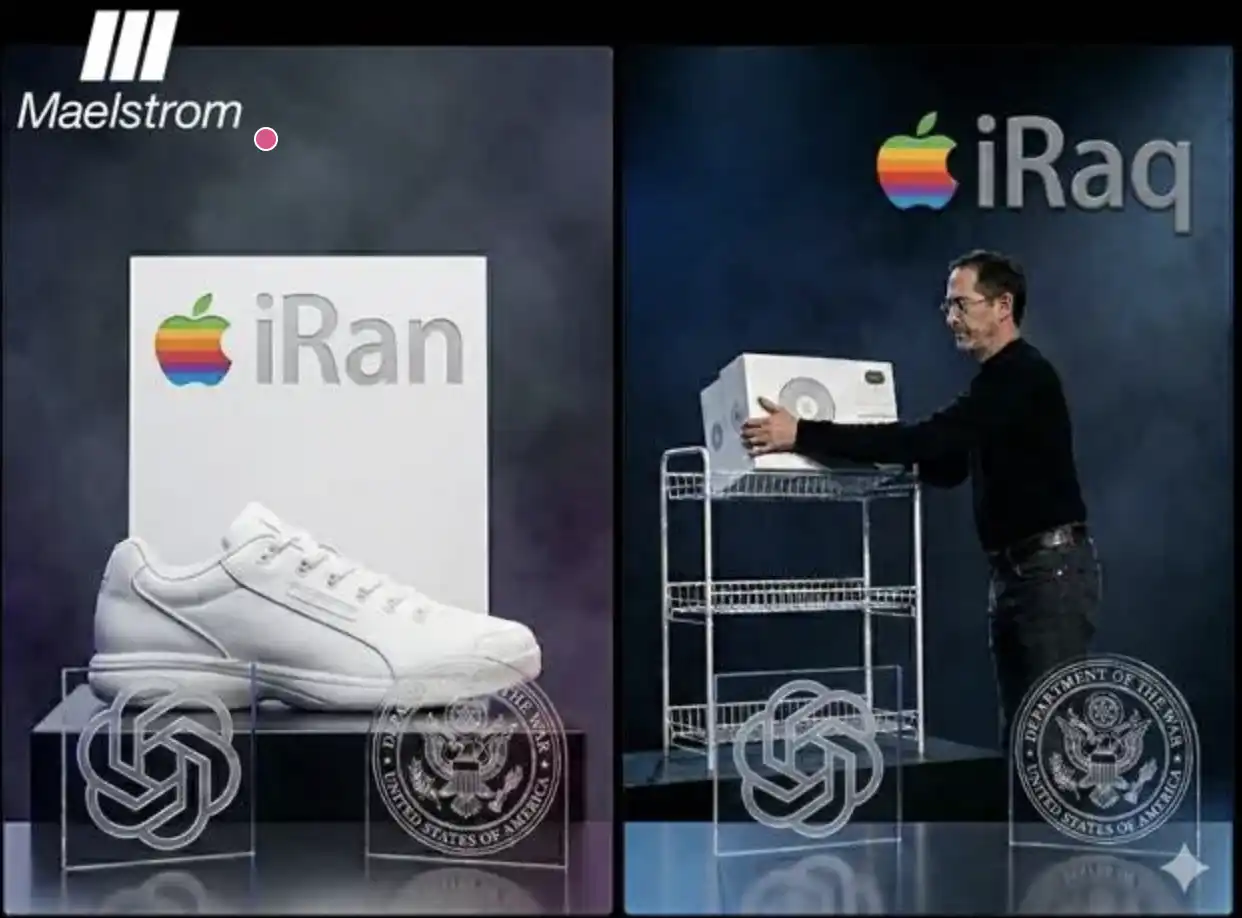
Under the direction of Donald J. Trump, the "most peace-loving president" in U.S. history, the U.S. "Department of War" collaborated with OpenAI to launch an offensive autonomous AI weapon: a set of a lethal new Apple iOS. Once this operating system is implanted in a country's network infrastructure, it will attempt to instigate a "regime change." Such regime changes often entail indiscriminate bombing of both military and civilian infrastructure, resulting in massive casualties, costing hundreds of billions, if not trillions, of dollars.
Upon the obliteration of local political resistance forces, a U.S.-backed new political elite emerges. They not only extract funds from U.S. taxpayers but also exploit local resources, depositing these funds into their asset pool in private wealth accounts at JPMorgan. Over time, public discontent accumulates against the rule of this "Vichy-style regime" propped up by the U.S. in the Middle East, often culminating in violent overthrow, replaced by a more localized, and often more reactionary, oppressive, or even bloodthirsty political structure.
Thus, this entire "sales cycle" is completed, and OpenAI can smoothly unveil the next generation of products. Are you eagerly anticipating an OpenAI IPO priced based on an "infinite forward P/E ratio"?
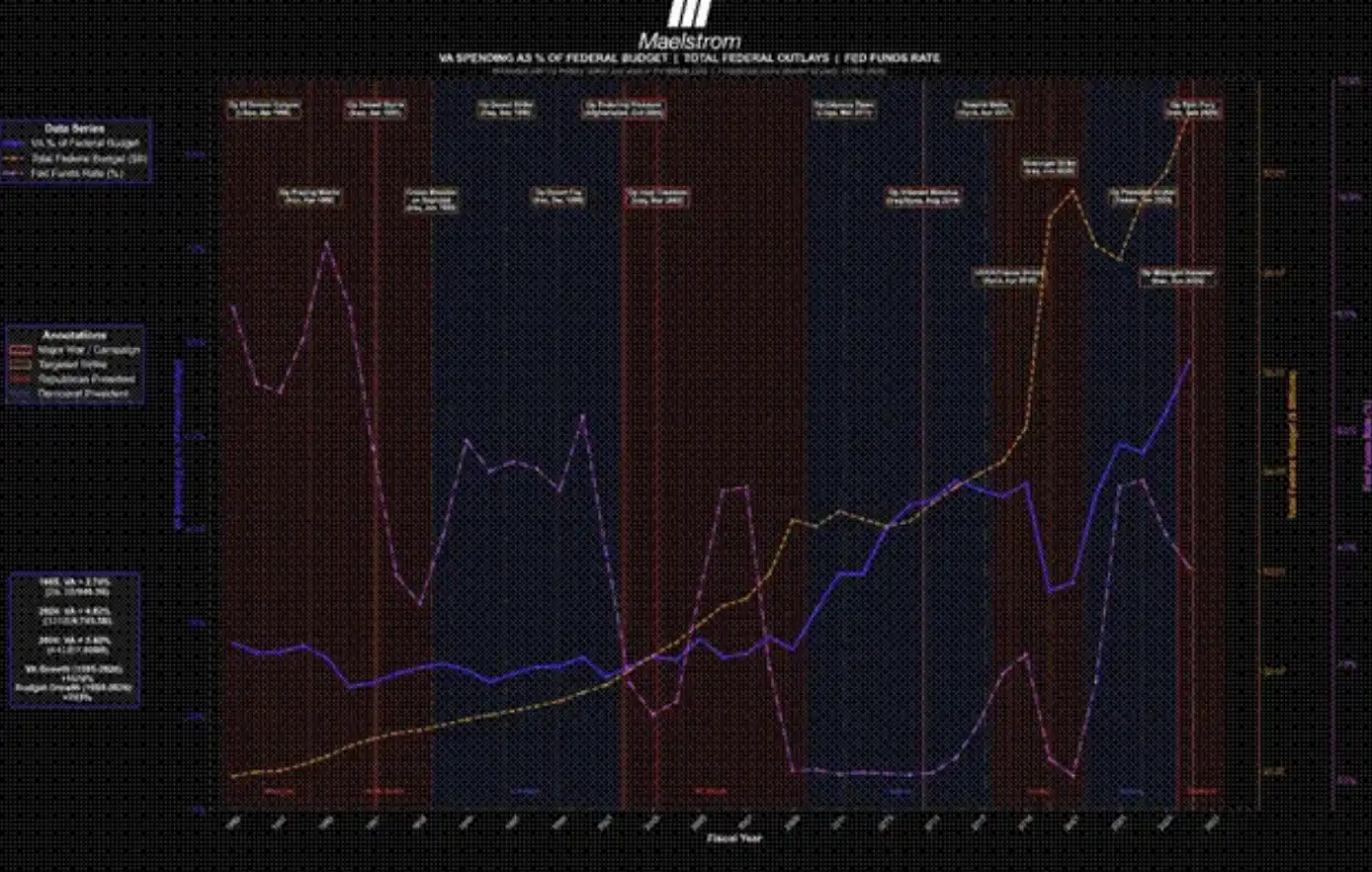
Since 1985, the year when my consciousness began recording human experience in this so-called 'quantum continuum,' the 'Pax Americana,' in the name of 'justice,' has launched almost uninterrupted Crusade-style operations against Middle Eastern oil-producing countries and key geopolitical nodes of oil and gas pipelines. Take a look at this chart generated by the latest Perplexity Computer model to feel its 'splendor'.
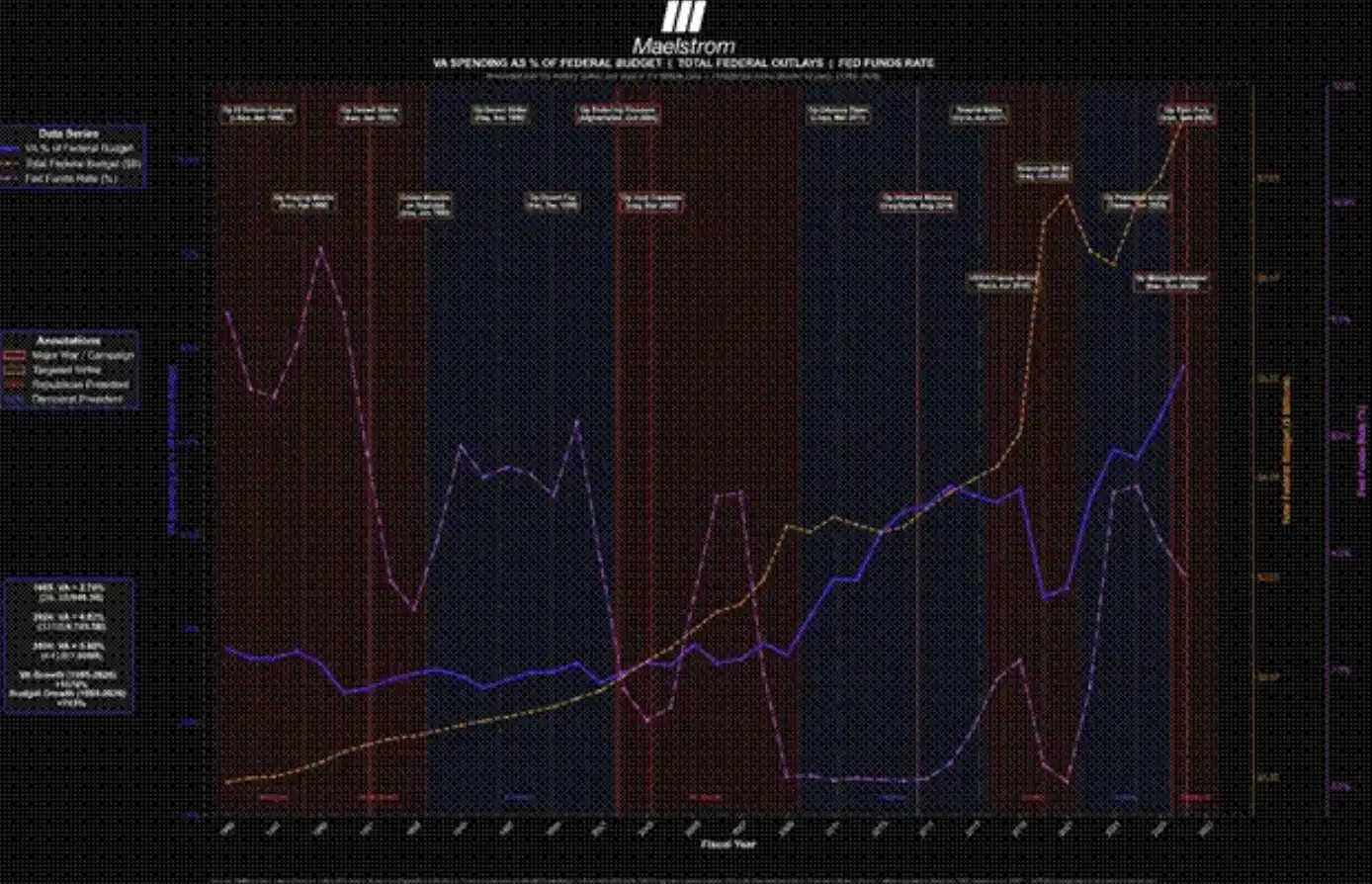
From a macro perspective, this chart attempts to present the human cost of war. The chart focuses on three core indicators: the percentage of the U.S. federal budget allocated to the Department of Veterans Affairs (VA), the total size of the federal government's nominal spending, and the effective federal funds rate. Additionally, the chart annotates a series of representative (but not exhaustive) U.S. missile strikes or full-scale war events launched against Middle Eastern countries.
From the data, the spending on caring for veterans has grown at almost twice the rate of the overall federal budget. More importantly, and the focus of this article, almost every time the 'Pax Americana' launches a major 'selective war' in the Middle East, the Fed tends to quickly cut interest rates. Despite every U.S. president in my lifetime attempting to persuade the public that the seemingly video game-like Middle East wars on the evening news do not bring real pain to the only 'significant humans' in the universe, American soldiers, the data clearly shows that America's obsession with military adventures in the Middle East is consuming American lives in an extremely costly manner.
The so-called 'ovarian lottery' led me to be born on this continent delineated by squiggly lines by humans, called the 'United States.' In my four decades of life, whether it's a 'Red Team' Republican president or a 'Blue Team' Democratic president, both have launched missiles at a certain 'deserving' country in the Middle East or even initiated full-scale war. It's as if once elected president, senior bureaucrats take you into some top-secret room, clamp your testicles with a pair of pliers, and make you swear: during your term, you must make at least one Middle Eastern country feel the 'fiery warmth of democracy,' or face the consequences.
Regardless of whether you believe in various popular conspiracy theories today to explain why America bombs a certain Middle Eastern country, this chart presents a rather clear fact in my lifetime: since 1985, every U.S. president has been involved in military conflicts with one or more Middle Eastern countries. Therefore, as President Trump now talks about possibly 'assassinating' Iran's Supreme Leader Khamenei and openly supporting the 'People's Revolution' to overthrow Iran's theocratic regime, we as investors have to consider: what impact will our investment portfolios face as Trump travels the 'rite of passage' that all former U.S. presidents have experienced?
Considering that I am just a simple-minded, slightly "toxic male" crypto bro, I find the logic behind Bitcoin's price movement to be quite straightforward.
The longer Trump spends on expensive actions like "nation-building" in Iran, the more likely the Fed is to support a new round of "American peace" military adventures in the Middle East by reducing interest rates and increasing the money supply.
To validate this hypothesis, let's review the Fed's policy actions after every major military conflict in the Middle East since 1985.
1990 Gulf War: "Father" (President George H. W. Bush)
At the first post-war FOMC meeting, the Fed chose to keep interest rates steady but hinted that if the war dragged on, they might need to pursue a policy of monetary loosening.
The following is a direct quote from the FOMC statement, retrieved and compiled by Perplexity.
August 21, 1990: "The increased uncertainty arising from events in the Middle East and the possible resulting weaker-than-desired economic performance have made the formulation of effective monetary policy extraordinarily difficult." "Several members indicated that the evolving situation would most likely point toward a need at some point for an easing to counter incipient economic weakness that had become apparent even before the run-up in oil prices."
Subsequently, in the November and December 1990 meetings, the Fed cut interest rates consecutively, subtly describing the war as a key uncertainty affecting their decisions. The Gulf War eventually ended in March 1991.
In other words, the Fed chose to ease policy even amid escalating oil prices and inflationary pressures.
2001 Global War on Terror (GWOT): "Son" (President George W. Bush)
The "Global War on Terror" swiftly unfolded after the collapse of the Twin Towers in New York. Shortly after, Iraq and Afghanistan became targets of cruise missile interrogations. To stabilize economic confidence, the Fed almost immediately accelerated its rate-cutting pace.
At an emergency meeting following the attack, then-Federal Reserve Chair, nicknamed "The Maestro," Alan Greenspan, stated: "Clearly, last week's events have brought at least a higher degree of fear and uncertainty, which has exerted significant downward pressure on asset prices and increased the likelihood of asset price deflation, with obvious implications for the economy. Therefore, I propose lowering the federal funds rate target by 50 basis points."
Essentially, if confidence in the economic "Pax Americana" is shaken, leading to asset price declines, the Fed must act swiftly. And the usual "prescription" is cheaper and more abundant money.
Another part of the Fed's statement also reveals a fact: when necessary, the Fed will fulfill its duty to assist the government in financing the war machine.
November 6, 2001: FOMC Statement
"Although the reallocation of resources for security may limit productivity gains for a time, in the long term, productivity growth and the overall economic outlook remain positive."
2009 "The Surge": "The Messiah" (President Barack Obama)
The ordinary people of Iraq, Syria, and Afghanistan may have once believed that a Nobel Peace Prize laureate president would not rain hellfire on their countries. But reality proved this expectation to be an illusion, and false hope is often the most lethal.
While Obama did not launch new large-scale Middle Eastern wars, he did expand the troop presence in the Afghanistan War (the so-called "surge") because he viewed it as a "just war."
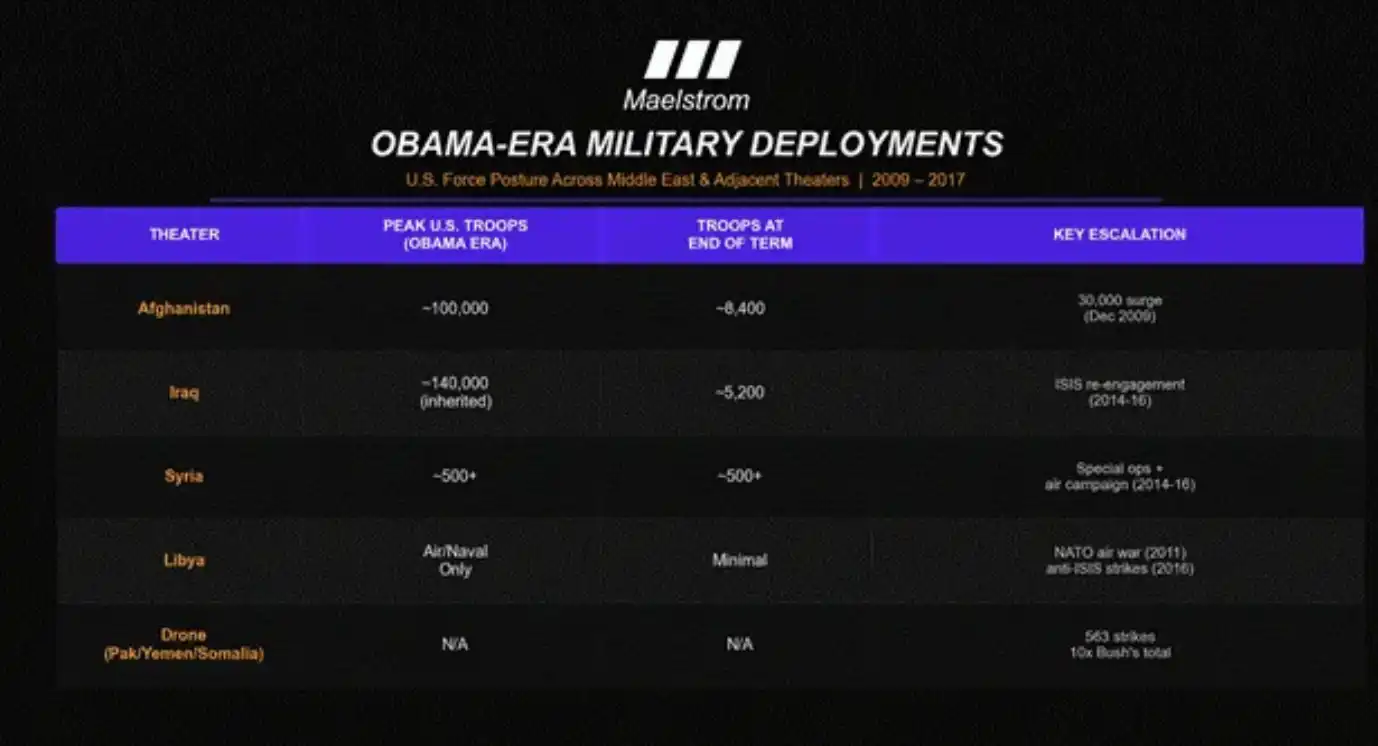
Given that the Fed had already lowered rates to zero by the end of 2008 and had started massive "money printing" through Quantitative Easing (QE), there was hardly any more monetary policy action to take when Obama expanded troop deployments to the Middle East. The cost of funds was close to zero, and liquidity was nearly infinite. The U.S. war machine and its contractors naturally feasted on this.
2026 Iran: "The Messiah" (President Donald Trump)
Fate seemed to play a rather ironic joke: after surviving an assassination attempt during the 2024 presidential campaign, Trump appeared almost like a "resurrection." Just as Kanye sang: "Jesus walks." Now I can probably talk about Kanye, right? After all, he has already "bowed down," hasn't he?
Trump's performance in office, as well as the reelection prospects of his "Red Team" Republican lawmakers in the November election, will depend largely on whether the financial asset markets are rising or falling, and whether oil prices are falling or rising. Since the overthrow of the Shah of Iran in 1979, driving regime change in Iran has been a long-standing obsession of America's bipartisan elite political class. In this context, the Fed has full political "cover" to significantly ease monetary policy. If the Fed fails to act, to finance the "reconstruction of Iran as an American client state" through cheaper, more abundant money, that would be seen as "unpatriotic."
Trading Strategy
At this point, we don't yet know how long Trump will maintain interest in reshaping the Iranian political structure — a project that could cost hundreds of billions, if not trillions of dollars. Nor do we know how much political pain he is willing to endure before giving up in the face of geopolitical and market pressures.
Therefore, a more cautious approach would be to wait and see how the situation unfolds.
The real "all-in" moment would be after the Fed has cut rates or resumed money printing to align with the government's policy goals in Iran. That would be the time to heavily buy into Bitcoin and quality "shitcoins" like $HYPE.
Take care, friends.
Welcome to join the official BlockBeats community:
Telegram Subscription Group: https://t.me/theblockbeats
Telegram Discussion Group: https://t.me/BlockBeats_App
Official Twitter Account: https://twitter.com/BlockBeatsAsia
 Related Articles