Payment Public Blockchain Stablecoin: Leading Player in the Counter-trend Growth Race
Market Cold Thoughts: Market Down, Who's "Bucking the Trend"?
The recent market situation has been witnessed by everyone. Bitcoin has been fluctuating around $70,000, causing panic among investors, with some even expecting it to drop to $60,000. However, during this "bull retreat," a project called Stable quietly hit a new all-time high, rising more than 40% this week.
Why? Because everyone has finally realized that while hype may fade, as long as someone is alive, they will have to use stablecoins for payments.
The current market is actually undergoing "deleveraging and squeezing out excess," with funds flowing from those elusive "shitcoins" to projects with real demand in the "money-printing machine" sector, namely the Stablecoin-exclusive public chain—Stablechain.
The Current Center of Attention: Stablecoin Infrastructure
Over the past few years, stablecoins have been more of a "liquidity tool" rather than a "native application layer." The volumes of USDT and USDC have approached or even exceeded the circulation of many national currencies (USDT circulation has surpassed $190 billion, covering over 350 million users), but the underlying settlement still heavily relies on general-purpose blockchains like Ethereum.
The issues are:
· Gas fees priced in ETH naturally mismatch with stablecoin payment logic;
· Severe fluctuations in fees during peak times, unsuitable for high-frequency, small-value settlements;
· High cross-chain friction, increasing enterprise operational costs;
· Difficulty in balancing the needs of financial institutions for privacy, compliance, and auditability.
Therefore, a new sub-track has emerged recently— "Stablechain / Stablecoin-specific public chain," aiming to upgrade stablecoins from an "asset" to a "native payment rail." Key players include:
· Stable (emphasizing USDT native settlement and payment infrastructure);
· Plasma (more of a stablecoin settlement network);
· And several customized chains/Layer-2 solutions around USDC, PYUSD, etc;
Overall, the key variables in this track are not "whose TPS is higher," but:
1) Is there a real payment demand;
2) Is there any institutional collaboration;
3) Whether the network economy is aligned with the stablecoin itself.
Why is Stablecoin Worth a Closer Look?
Among the various stablecoin infrastructures, the recent market performance of Stable has been quite remarkable. On the eve of the mainnet v1.2.0 upgrade on February 4, its native token once hit an all-time high, with a weekly gain of about 43%, reaching a peak of $0.03. The current market value is about $420 million, with a FDV over $2.4 billion, significantly ahead of most competitors in the same field.
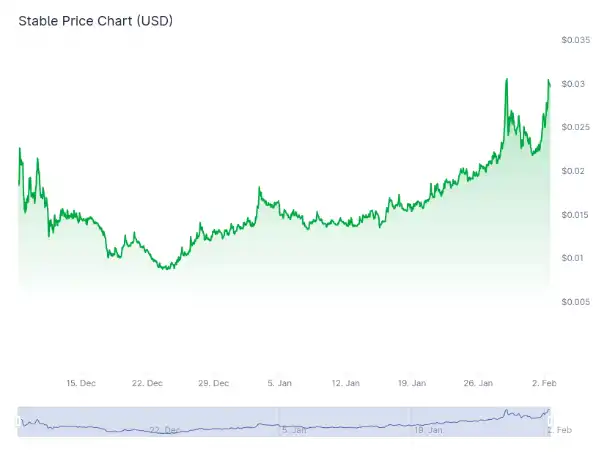
But what's more interesting is that this trend is not a typical "event hype" but more like a reflection of the gradual realization of fundamentals.
(1) Product Positioning: From "Transaction Chain" to "Settlement Chain"
Stable's core positioning is not to attract DeFi speculative traffic, but to target real payments, forex settlements, salary payments, and corporate fund management. This is in stark contrast to "general-purpose smart contract platforms" such as Ethereum and Solana.
The key differences are:
1. Stable uses USDT as the native Gas asset (v1.2.0 completely eliminates gUSDT, switching fully to USDT0);
2. This means that user fees, enterprise settlements, and the network economic model all revolve around the stablecoin;
3. It essentially reduces the structural friction of "paying fees with volatile assets";
From a payment perspective, this is a more meaningful design choice than simply increasing TPS.
(2) v1.2.0 Upgrade: A Key Step Towards a "Production-Ready Network"
The focus of this upgrade is not on showmanship, but on making the network more usable, reliable, and easy to integrate:
Consensus and Execution:
· Currently using customized StableBFT, emphasizing stability;
· Future plans to evolve to a DAG architecture, with internal testing achieving 200,000 TPS, sufficient to support enterprise-level batch payments, exchange clearing, and other scenarios.
Financial Institution-Friendly Design:
· Reserve "Institution-specific Block Space" to prioritize critical transactions during peak times;
· Support for private transfers to protect business privacy while meeting audit requirements;
· Decoupling of state storage and memory mapping optimization to balance efficiency and security.
Five Key Technical Improvements (More Engineering-oriented):
1) Native Stablecoin Gas: USDT0 becomes the sole Gas asset, reducing wallet and enterprise integration costs.
2) Observable Staking/Unstaking: Addition of on-chain signals to avoid application-layer "state guessing."
3) STABLE Token Compatibility Fix: Enhanced reliability of old version Solidity contract migration.
4) Gas Exemption Mechanism: Support for controlled zero Gas transactions, benefiting payment scenarios, with set limits and rate protection.
5) Infrastructure Stability Upgrade: Improved production environment resilience.
Overall, this upgrade is essentially a move from a "usable testnet" to a "scalable commercial network."
(3) Capital and Ecosystem: The True Strength of Stable
While many public chains rely on incentive subsidies to attract users, Stable takes a different path: first focusing on payment scenarios, then on-chain activities.
1) Native Cryptocurrency Support
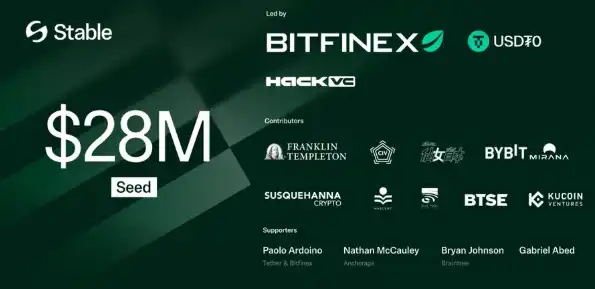
Stable is deeply integrated with Bitfinex, which provides liquidity, market resources, and ecosystem synergy; it is also supported by institutions such as Morpho, Paxos, Anchorage, covering DeFi, compliant stablecoin issuance, and custody areas.
2) Traditional Financial Access
The most significant signal is: PayPal's PYUSD has been launched on Stable.
This is not just a technical integration but also an "endorsement." If PayPal is willing to operate PYUSD on Stable, it indicates that its infrastructure meets institutional standards.
Additionally:
PXP Financial (processing €300 billion in payments annually)
Chipper Cash (a leading African cross-border payment service)
have both integrated into the ecosystem, indicating that Stable is not only serving Web3 but is also attempting to build a cross-border payment corridor.
3) Real Demand-Driven, Not Token-Incentivized
Some key data points:
50+ PSPs are currently integrating into the pipeline, with more coming online subsequently;
Covering scenarios such as corporate fund distribution, payroll, merchant payments, and more;
Partner network reach:
· 1M+ corporates (including Walmart, Amazon Business ecosystem);
· 80M+ merchants supporting USDT payments;
Over $2B in pre-deposits were completed before the public release, demonstrating genuine enterprise interest.
Moreover, Stable is advancing regulatory communication and collaborating with teams participating in regulated pilots such as Basal Pay, Holdstation, to mitigate policy risks.
Stable Project Investment Research Summary
In essence, projects like Stable earn "tolls on the highway." Even in a bear market, the essential needs of cross-border trade, payroll, and merchant payments continue unabated. As long as transactions are still happening, the network's value will grow.
Short-term Progress: Implementation of v1.2.0, new partnership announcements, these are tangible catalysts.
Long-term Ecosystem: If it can really capture payroll services for those 1 million corporates, its current market cap is just the beginning.
Operational Advice: Stable is not the kind of "meme coin get-rich-quick scheme" based on probability speculation; it is a dark horse infrastructure project with long-term predictability. In today's market, which values fundamentals and verifiable data, instead of gambling on meme hype with no cash flow support, it's better to focus more energy on Stable, a leader in the race that has both real settlement transactions and recognition from top institutions. From a risk-reward perspective, projects focused on long-term stable growth offer more cost-effectiveness and investment value.
Welcome to join the official BlockBeats community:
Telegram Subscription Group: https://t.me/theblockbeats
Telegram Discussion Group: https://t.me/BlockBeats_App
Official Twitter Account: https://twitter.com/BlockBeatsAsia