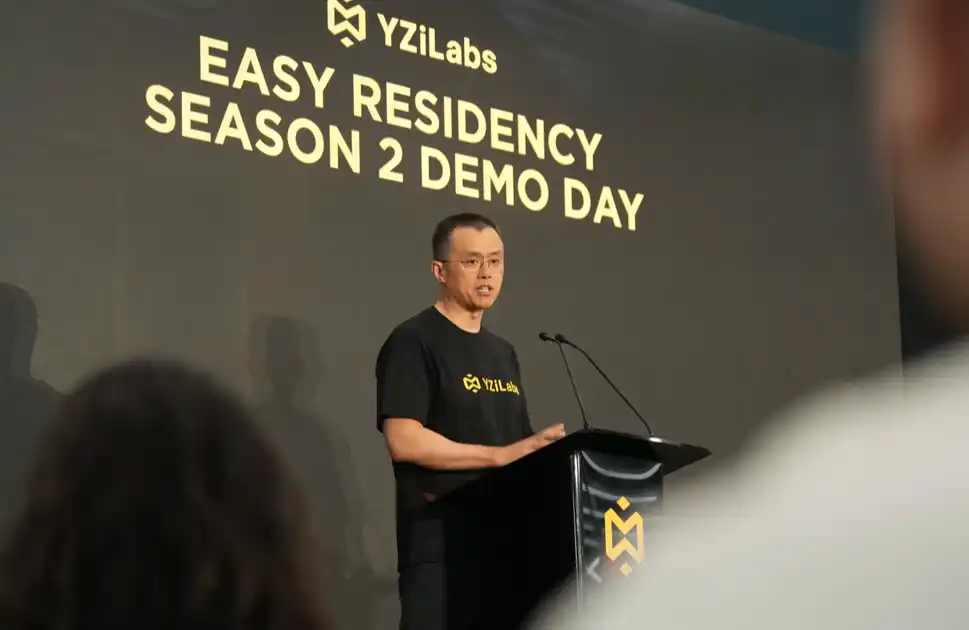
Full Text of CZ's New Interview: From Ordinary Programmer to the Richest Chinese, involving FTX, Going to Jail, Doing Charity, Publishing a Book, What is CZ Focused on Now?
Original Title: Binance CEO: 4 Months in Prison, $4 Billion Fine, and What Comes Next
Original Author: All-In Podcast, YouTube
Translation: Peggy, BlockBeats
Editor's Note: This interview records the complete and highly influential yet controversial journey of CZ (Changpeng Zhao), one of the most prominent figures in the global cryptocurrency industry, from his peak, imprisonment, to rebirth.
Breaking the myth of the billionaire giant in the eyes of the public, it reveals an extremely real and minimalist ordinary person: he flipped burgers at McDonald's, coded at Bloomberg, and even post-financial freedom, he still prefers to fly economy class. Apart from Binance's rise, the most shocking revelation is his detailed account of the power play with the government's Department of Justice, how he maintained absolute emotional stability during weeks of psychological warfare, ransom risks fueled by media sensationalism, and the intricate racial gang rules inside the Seattle prison.
CZ candidly revisited the ins and outs of his conflicts with SBF and the tearful departure from Binance's management forced upon him. Now, he has turned to engage in a tokenless, purely philanthropic global educational initiative. This is not just a chronicle of the crypto industry but also a profound introspection into power, money, and the boundaries of freedom.
Key Points
· Early experiences from China to Canada
· CZ's early career experiences: surprisingly "ordinary"
· Founding the first company in Shanghai
· Connection with Bitcoin
· Going all-in on the crypto industry
· Why create Binance?
· The FTX event: Relationship with SBF and its aftermath
· Confronting the Biden administration's "anti-crypto" Justice Department
· What is life like inside federal prison?
· Life after leaving Binance and the new venture
Below is the complete podcast transcript:
Early Experiences from China to Canada
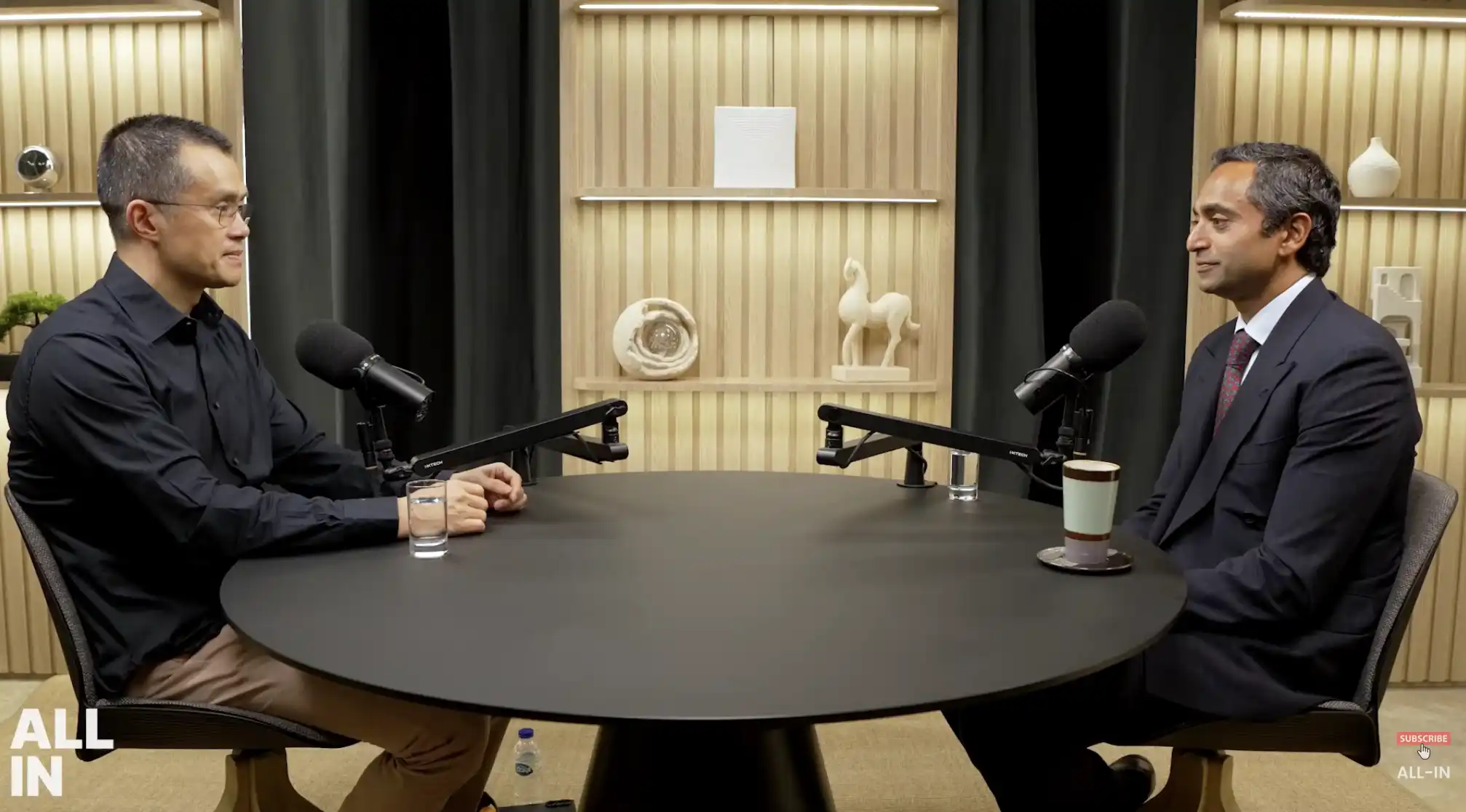
Chamath: CZ, welcome to the "All-In" podcast. I want to rewind the timeline back to the beginning because I feel like many people don't fully understand your background, at least not as much as they should. Your early experience in Canada is something I'm particularly interested in. You worked at McDonald's, and I worked at Burger King.
CZ: My father went to Canada to study in 1984.
Chamath: How did he get that opportunity back then? Did he stay in Canada after he went there?
CZ: He would come back to see us, maybe once or twice a year, but most of the time he was in Canada.
Chamath: Was he a teacher in China?
CZ: He was a teacher, a professor. He first went to the University of Toronto for an exchange program, then after a few years, he went to the University of British Columbia in Vancouver. Later, we also started to apply to go there. At that time, getting a passport was actually very difficult, it took three to four years to get it. We started applying around 1985, and it took about two to three years to get the passport.
Chamath: Are you saying you got a Chinese passport?
CZ: Yes, a Chinese passport. And then we had to wait for several more years to get the visa, the process was just that slow back then.
Chamath: How did it feel to move to Vancouver?
CZ: Completely different, it was like arriving in a whole new country. I had studied English in school in China for one or two years, but I wasn't fluent at all. But Vancouver was great, Canada, you know, with good greenery, open spaces, everything was pretty, the standard of living was high, things were all very clean. The fruits were also bigger. The overall environment was very comfortable.
Chamath: After the family reunited, did your parents both work?
CZ: My dad was an assistant professor at the university, making about 1000 Canadian dollars a month. The school also provided very cheap teacher housing, so we lived on campus.
On our third day in Canada, my mom went to work at a garment factory, sewing and stitching clothes. She used to teach math and history in China, but her English wasn't that good, so she couldn't find a job at the same level, she could only work in the lowest-paid factory job. She worked there for seven to ten years, just doing that.
Chamath: When my mom was in Sri Lanka, she was a nurse. Later, after we immigrated and got refugee status, my father couldn't find work. So, my mom went to work as a housekeeper to make ends meet. Then later, she went back to a job similar to a nursing assistant. I think when I was around 14, I got my first paying job.
CZ's Early Career: Surprisingly "Ordinary"
CZ: Yes, that's right, I also worked at McDonald's for my first job when I was around 14 or 15.
Chamath: We are the same age, so I guess that would make us both 14. Do you remember what the minimum wage was in British Columbia back then?
CZ: I do. At that time, the minimum wage was $6 CAD.
Chamath: That's incredible. In Ontario, it was $4.55 CAD at that time.
CZ: But at McDonald's, they only paid $4.5 CAD. That was even lower than the statutory minimum wage because McDonald's seemed to have a special exemption back then, considering they hired a lot of young people. I remember applying there on my 14th birthday, and a week later, I was flipping burgers there, marking my first-ever income.
Chamath: So, would you consider yourself one of those precocious "tech prodigies"? You know, the kind that spends 24 hours a day coding and delving into computer science as a kid?
CZ: No, I don't think I fit that description. I was a tech enthusiast, studied computer science in college, got interested in programming during high school and self-taught myself, but I definitely wasn't some coding genius. I was a decent programmer, wrote some good code throughout my career. However, around the ages of 28 to 30, I started moving away from the codebase to focus more on business development and sales.
Chamath: Did you have many friends back then?
CZ: I had quite a few.
Chamath: Were they all Asian friends, or did you have friends from various backgrounds?
CZ: I had friends from both groups. In fact, I had both Asian and non-Asian friends, but in our school, most Asian kids stuck with other Asian kids. I was an exception as I had many white friends and belonged to various friend circles. My teenage years in Canada were amazing, some of the best years of my life. I think that period shaped my optimistic personality, and I'm generally a pretty happy person.
Chamath: How did you feel when you didn't get into my alma mater, the University of Waterloo, and had to settle for McGill University? Did you feel dumb about it?
CZ: Well, I was actually torn between Waterloo, McGill, and the University of Toronto at that time. But I knew I definitely wasn't going to the University of British Columbia because I wanted a change of city. UBC had actually accepted me, but I just didn't want to go. At that time, a very respected elder advised me to become a doctor because it's a respectable profession with high pay. I took her advice and chose biology. However, Waterloo wasn't known for biology, right? So, I went to McGill. But after a semester, I told myself, "No more biology; I have to switch to computer science."
Chamath: Is that a typical college experience? Did you find an amazing internship during the summer break? Or did you have to work like a regular college student to pay for tuition?
CZ: I worked every summer, and I also had part-time jobs during the academic year.
Chamath: So no debt? Were you thinking back then, "I have to graduate without any debt"?
CZ: Yes, I didn't apply for a student loan in my first year. Actually, I borrowed 6,000 Canadian dollars from my dad. In the second year, I still didn't have enough money, and my sister gave me 3,000 Canadian dollars. Since then, I have never asked my family for money again and have been entirely self-sufficient. So, I was very lucky not to have any student debt, but it was all thanks to working tirelessly every summer.
Chamath: Do you know what the best and most life-saving part of the University of Waterloo was for me? It was their co-op program. I found some incredible internships at that time. Even so, I graduated with about 30,000 Canadian dollars in debt, but I was quite active in stock trading at that time.
Later, my boss, a person named Mike Fisher, did an extremely generous thing for me. I was working as a derivative trader at a bank, which was my main job, but I also traded stocks privately and helped him make a lot of money. He asked, "How much debt do you have?" I said about 30,000, to be precise, 32,000. He said, "Go downstairs to the Canadian Imperial Bank of Commerce now and pay off your debt. I'll write you a check."
CZ: Wow.
Chamath: He immediately wrote me a check for 32,000 Canadian dollars.
CZ: You should have told him you had a debt of 33,000 or even 300,000.
Chamath: That's the amazing thing about Canada. You can receive a fantastic education and not be crushed by the kind of debt that keeps you down, which is already impossible for many people in the United States.
CZ: Even at McGill, there are many people who come from the U.S. to study, paying international student fees, only to find that it is still cheaper than studying in the U.S. I thought that was insane at the time. So we are really fortunate; Canadian tuition is still reasonable.
Chamath: So what did you do after graduating from McGill's Computer Science department?
CZ: Oh, I didn't actually graduate from McGill. I was there for four years, found an internship in my third year, extended it in my fourth year, and didn't return to McGill. So I don't have a degree from McGill.
Later on, I found out that I needed a bachelor's degree to apply for a work visa in Japan. It was around the year 2000, during the peak of the dot-com bubble, so I joined an online education program called the "American School of Computer Science" and obtained a degree from there.
Chamath: Oh my god! So, in name, you're a graduate of that school?
CZ: In name, yes.
Chamath: Okay, so what internship did you have at that time that made you decide to stay there?
CZ: It was an internship in Tokyo. I had been working on programming-related tasks since my freshman year. I wrote simulation software for a company called Original SIM. In my junior year, I joined a company in Tokyo called Fusion Systems Japan. They were developing an order execution system for brokerages on the Tokyo Stock Exchange.
Chamath: Was that a Japanese company with offices in Montreal or Canada?
CZ: No, I flew directly to Tokyo.
Chamath: You went to Tokyo?
CZ: Yes, it was actually a company founded by several Americans in Tokyo.
Chamath: So, you felt like it was an adventure at that time, like you were going to Tokyo for a summer vacation.
CZ: Just think, I was just a college student back then. Being able to live in Tokyo was like a dream come true.
Chamath: What kind of software development were you mainly responsible for at that time?
CZ: Primarily order execution software. Simply put, it was a system responsible for processing and transmitting trade instructions.
Chamath: Similar to the kind of underlying logic that now supports Binance's operations?
CZ: That's a fair way to look at it, the architectural style is very similar. However, all the software I was involved in developing did not involve decision-making algorithms; they were only responsible for efficiently executing instructions.
Chamath: When you first entered this field, was your reaction "Wow, I love this so much," or just "Since I've been given a coding task, I understand the logic, so I'll complete it"? Were you attracted to the business itself, or was it just a job to you?
CZ: Initially, it was purely seen as a job. I was too young at the time and lacked a macro view of various industries. When I first joined the company, I was assigned to develop a digital image storage system, not as simple as an iPhone photo gallery but a professional system used for medical images.
However, not long after, the company's core business shifted to the order execution system, and I became involved in that transition. This became the focus of my career. What I enjoyed about it was the high level of technical expertise required. The core of this field is efficiency: ultra-fast response times and ultra-low latency. This pursuit of efficiency subconsciously resonated well with my personality.
Chamath: Going deeper, with high-frequency trading firms like Jump, they optimize for efficiency and minimal latency at almost any cost, even developing custom circuit breakers and physical fiber infrastructure to save mere milliseconds. How is this extreme optimization reflected in software? How do you handle these boundary conditions when writing code?
CZ: This can be divided into multiple levels. First is the optimization of software architecture, where you must ensure that the system is absolutely efficient. For example, to eliminate latency, we would eliminate all database queries and move all operations to memory. At the same time, you need to streamline the computational logic, especially for risk checks before orders and trades. A more advanced stage would involve hardware, such as using Field-Programmable Gate Arrays, which are programmable chips integrated into network cards.
Chamath: This way, data doesn't have to shuttle back and forth between memory and the processor, further enhancing speed.
CZ: Exactly. About ten years ago when I was still coding, a round trip of data would take about 100 microseconds; through hardware optimization, we were able to reduce this latency to 20 microseconds. Then comes the optimization of physical infrastructure, like seeking server hosting to minimize physical distances.
Chamath: This reminds me of Groq in the AI field. When we started a decade ago, we had a similar insight that shuttling data between the GPU and HBM (High Bandwidth Memory) was very inefficient. So we decided to use SRAM and keep all data on the chip.
This approach is very effective in the decoding stage of inference. Since high-frequency trading involves such massive amounts of capital, why haven't these institutions tried developing custom Application-Specific Integrated Circuits (ASICs)? I understand the use of FPGAs, but it seems no one has ventured into self-designed ASICs, or have they done so but kept it under wraps?
CZ: I believe custom chips at this scale are not common, mainly due to the rapid iteration of algorithms. While chip design is highly efficient, once logic needs to be modified, the development cycle is too long. In comparison, FPGAs strike the best balance between performance and reconfigurability. Still, the programming cycle for FPGAs is about ten times longer than pure software.
Chamath: Did the company you worked for in Japan succeed in the end?
CZ: Quite successful. Just on the eve of the burst of the 2000 internet bubble, that company was acquired by a Nasdaq-listed company.
Chamath: Was the acquisition amount substantial?
CZ: At that time, it was about $52 million. In that era, that was considered a huge amount.
Chamath: Was that when you noticed the business opportunity, decided to dive into entrepreneurship, or was there another hidden motive?
CZ: No, I was just in my early twenties at that time, still too young. In the company, I was just an ordinary programmer, a salaryman as they say in Japanese.
Chamath: I see. What happened after that?
CZ: After the company was acquired, a serious cultural clash occurred between the parent company and the original team. That was the first time I realized the challenges that corporate mergers could face. The management did not align, so the original partners decided to part ways and founded another company.
Although I didn't get any money from that acquisition, the partners made quite a bit. They rented an extremely luxurious office space, yet the new company only lasted a year. This proved that past success does not guarantee the future and can even be misleading. They spent money extravagantly but had no revenue, and the company folded in 2001. In early 2001, I started looking for new opportunities, and Bloomberg happened to be recruiting. That was before the "9/11" incident, and I received the job offer but hadn't officially started yet.
Chamath: Was the position in New York?
CZ: I was still in Tokyo at that time, but the position was in New York. After "9/11," I called Bloomberg to ask if the position was still available, if they still wanted me to come. They asked me back, "Are you still willing to come?" I said, "No problem." So, I arrived in New York in November 2001.
Chamath: What was the atmosphere like back then?
CZ: The streets were eerily empty, but I adapted quite well. Although New York was silent for a few months, it quickly regained its vitality. It didn't bother me much, and I worked at Bloomberg for four years.
Chamath: During that time, were you still playing the role of an employee? Working in a large corporation, receiving a salary, bonuses, and maybe some stock options.
CZ: Yes, at that time, I joined as a senior developer and was assigned to the Tradebook Futures team. It was their newly established department aimed at integrating and developing the futures trading system on the Bloomberg terminal.
Chamath: At that time, did you have any thoughts of starting your own business?
CZ: Not at all.
Chamath: What were you pursuing back then? Stability? Why did you choose to work at Bloomberg in New York?
CZ: I was only 24 or 25 at the time, just a young person looking for a good job, exploring different worlds, and seeking direction in life. I knew I lacked the experience to start a business independently at that time. In Tokyo, the company had only about 200 people, while Bloomberg had around 3,000 employees at the time.
For me, that was already a behemoth: the office was extremely luxurious, with a fish tank and free food. After joining, I had a great boss and was promoted three times within two years. Eventually, I started leading a team that grew from 60 to 80 people. That was a turning point in my career. I stopped coding and transitioned to a management position. For me, that was the most difficult transformation in my career.
Founding the First Company in Shanghai
Chamath: Did you then resign and go to China? How did that happen?
CZ: In early 2005, my former colleagues from my time in Japan planned to start a new fintech company. They were all in Asia at the time, hesitating between Tokyo, Shanghai, and Hong Kong. Because we believed Shanghai had the most potential for future fintech development, we chose Shanghai, although later it turned out that there were more business opportunities in Hong Kong at that time. In 2005, I moved to Shanghai. The founding team consisted of six people: four Caucasians, one Japanese, and myself. I was the only one who could speak Chinese, although my Chinese was a bit rusty at the time.
Chamath: So, you guys parachuted into Shanghai like that. What was the business idea at the time?
CZ: We believed we had the most cutting-edge Wall Street trading technology experience.
Chamath: Did your friends later go to New York? Or did they stay in Japan?
CZ: Two of them were with me in New York at the time, and the other three stayed in Japan. The six of us came together with the intention of bringing Wall Street trading technology to China and providing services to Chinese brokers and trading platforms. So, the team rented a very luxurious office space...
Chamath: Wait a minute, this was your first real venture. Did you know to ask about equity allocation or cap tables at that time? Or were you just blindly participating?
CZ: The allocation was not entirely equal. The core leader held about 39% to 40%, and the remaining five of us split the remaining shares evenly, with me holding about 11%. I only knew this ratio at the time, but I was clueless about legal details such as shareholder rights, preferred stock vs. common stock differences.
Chamath: So you moved to Shanghai with this 11% stake.
CZ: Yes, I had no idea about it, just pure enthusiasm. As a junior partner, because I could speak Chinese, I was responsible for communicating with potential clients once we moved to Shanghai. After contacting domestic brokers, I discovered a fatal issue: we had registered as a wholly foreign-owned enterprise, but at the time, the policy did not allow domestic brokerages or financial institutions to cooperate with this type of company. It wasn't until after the company was established that we realized this. So we had to pivot. To survive, we started taking on various IT outsourcing projects.
Chamath: Did you become a consulting firm like Deloitte?
CZ: Even worse than Deloitte. We took on all kinds of jobs: fixing printers, implementing SAP systems, and so on, a wide range of business activities. We persevered like this for several years. Surprisingly, we really survived on these jobs and accumulated a large number of clients in the automotive industry, such as SAIC Motors, Volkswagen Group China, and FAW Group. About three to four years later, we opened an office in Hong Kong and started dealing with international giants like Morgan Stanley, Deutsche Bank, and Credit Suisse.
Chamath: So eventually the business took off.
CZ: Yes, that company still exists to this day. I stayed there for eight years until I left in 2013.
Chamath: Were you in Shanghai all those eight years?
CZ: Mainly in Shanghai. But I also spent a lot of effort setting up the Hong Kong office and often went to Tokyo to serve clients there.
Chamath: How did the company grow later on?
CZ: As far as I know, the company grew to about 200 people and maintained that size for a long time.
Chamath: As a junior partner, were you directly involved in profit sharing?
CZ: In fact, we didn't receive too much profit share. I reinvested most of my savings back into the company and never cashed out a cent. However, a few years later, the company's revenue was enough to support high salaries for partners. By then, I had a family, my children were attending international schools, and my annual salary had reached six figures.
Chamath: Were you married at that time?
CZ: Yes, I got married while working in New York.
Chamath: How did you meet your ex-wife?
CZ: I met her for the first time when I was interning in Tokyo. It was around 1999. Later, she came to New York to find me, and we got married and had children. Although we are now separated, during our time in Shanghai, the salary was enough to allow our child to receive a good education at an international school, which was already very satisfying for me.
Chamath: Looking back on your previous experiences, there was still no sign that you were about to establish Binance.
CZ: Absolutely not, at that time, I had no idea about it.
Chamath: That was between 2013 and 2014, how old were you then? Around 36 years old?
CZ: In 2013, I was exactly 36 years old.
Encountering Bitcoin
Chamath: The prime of life. You were still an employee receiving a salary at that time, a junior partner at that company, successful in your career, and your children were attending private schools. So, what happened next?
CZ: I came into contact with Bitcoin. At first, a friend recommended it to me, asked me to pay attention to this thing called Bitcoin. It took me about six months to truly understand its essence, starting around July 2013.
Chamath: Was it because you read that whitepaper and found that you needed to read it repeatedly to grasp it?
CZ: Basically. And at that time, the main communication platform was the BitcoinTalk.org forum, where I read almost all the content.
Chamath: Have you read the article I published in Bloomberg in 2012? Did it have an impact on you?
CZ: To be honest, I don't remember. I read a massive amount of information at that time, and it's really hard to recall specific sources.
Chamath: Just kidding, but I did write it. Interestingly, I had a good relationship with Michael Bloomberg at that time. Although he was much senior to me and not exactly my mentor, he highly appreciated me. Around 2012, his team invited me to write a column. In the article, I suggested that everyone should allocate 1% of their net worth to Bitcoin as a form of insurance.
After the article was published on the Bloomberg Terminal, I had an awakening awareness of Bitcoin. It was the most fascinating technological product I had ever seen. The most impressive thing — I don't know if you feel the same — it was the only piece that I read from start to finish and marveled at its elegant prose. Unlike those obscure documents written only for PhDs, you could hand it to anyone who doesn't understand technology, and they could still read and comprehend it.
CZ: And the entire document is only a measly nine pages.
Chamath: Exactly. To condense such complex logic into such a concise form requires a high level of intellect.
CZ: Brevity is much harder to achieve than long-windedness. If someone else were to rewrite this whitepaper, it would probably end up being 90 pages long.
Chamath: Who was the friend who introduced you to Bitcoin? Was it a colleague at the time or a friend you met in Shanghai?
CZ: It was a friend of mine named Ron Cao. We didn't have any business dealings. He was the Managing Director of Light Speed Ventures China at the time. We used to play poker together, at those small stakes private games where the players were either entrepreneurs hustling or venture capitalists.
During one of those games, Ron suggested I look into Bitcoin. We had a deep conversation, and Bobby Lee, who was then working at Walmart, was about to resign to become the CEO of BTC China.
As part of the deal, Ron invested in BTC China on behalf of Light Speed Ventures. That was in July 2013. Seeing how serious they both were, I had lunch with Bobby the next day. Bobby suggested I allocate 10% of my net worth to Bitcoin, his reasoning being: even if it goes to zero, you only lose 10%; but if it goes up tenfold, your net worth doubles. That argument was very convincing. So, I started researching, and by the end of 2013, I was completely convinced of its value. However, it was awkward because Bitcoin surged from $70 to $1000 within six months in 2013.
Chamath: Seeing it increase by 15 times, how did you feel at that time?
CZ: I felt like I missed the best opportunity. Because in the Bitcoin industry, no matter when you enter, you always feel like you're late to the party, as everyone you meet seems to have been in it before you.
Chamath: During your research, was there a community you could engage with?
CZ: There was a very small community in Shanghai at that time. I spoke with almost anyone in the world willing to talk about Bitcoin. I also had a few friends in Taiwan working at TSMC who were quitting their jobs to try to develop Bitcoin mining chips. There were also some miners, like the industry figure known as "Rainbow Minnow" (Mao Shihang), who was the founder of the F2Pool mining pool.
They were in Hangzhou at the time, and we would meet up in Shanghai to exchange ideas. The most crucial turning point was the Bitcoin conference held in Las Vegas in December 2013. I flew over to meet everyone in the industry.
It was a small conference with only 200 people in attendance, where giants like Vitalik (Ethereum founder) and Charlie Lee (Litecoin founder) were present. At that time, the "Silk Road" website was being shut down, and the media was portraying Bitcoin as a tool for drug lords. However, what I saw at the conference was a group of very polite tech geeks and young people. When you interacted with Vitalik, you would find that he was a very innocent and kind person.
Chamath: Were you still working at your original company when you were doing these things? Did you just tell your partners directly that you were going to Las Vegas to play for a few days?
CZ: Yes. When I came back, I suggested to my partners that the company should develop a Bitcoin payment system. At that time, Bitpay had just raised $4 million, leading the industry.
Chamath: Speaking of Bitpay, I have a very interesting personal experience. I was eager to prove the transaction capabilities of Bitcoin. In 2012 or 2013, I bought a Land Rover through Bitpay with Bitcoin. At today's exchange rate, the car was probably worth $90 million. Even more outlandish, I also bought a piece of land at Lake Tahoe with Bitcoin just to prove the feasibility of real estate transactions. Looking back now, that piece of land would be worth around $1 billion.
CZ: You can't count it that way. Even if you didn't use Bitcoin at that time, you would have used an equivalent amount of cash to buy. And that cash could have been used to buy more Bitcoin. It's essentially a mental accounting issue.
Chamath: Back to the point, when you proposed to your partners to create Bitpay's competitor, they obviously couldn't understand. Did you buy Bitcoin at that time?
CZ: At that time, I only bought one coin to try it out.
Going All-in on the Crypto Industry
Chamath: What happened next?
CZ: I told my partners that this was the biggest opportunity I had ever seen in my life. In my lifetime, I have witnessed three fundamental technological changes: the internet (I was too young to deeply participate at that time), Bitcoin, and later, AI. I was 36 years old at the time, and I didn't want to miss out on Bitcoin. I decided to resign and dedicate myself fully to this industry.
To raise funds, I decided to sell my property in Shanghai. It took a few months to sell the house, and I eventually sold it for about $900,000. My whole family moved into a rental house in Tokyo, while I frequently commuted between Shanghai and Tokyo. The house payment was received in installments. When the first payment arrived, the price of the coin was $800, and then it kept falling. I continued to buy more at $600, $400, and my average holding price ended up around $600.
Chamath: You converted all your savings into Bitcoin, but you were not working at that time.
CZ: I was actively looking for a job with a very clear goal of only considering opportunities in the Bitcoin industry. From the moment I decided to resign until I secured a new job, it took less than three weeks.
Chamath: Who hired you?
CZ: Initially, I had a conversation with Bobby from BTCZ, who was interested in recruiting me. However, Roger Ver from Blockchain.info (now Blockchain.com) then reached out to me. At that time, their team consisted of only three people: founder Ben Reeves, newly appointed CEO Nicholas Cary, and myself as the third member.
I joined as Vice President of Engineering. I flew to work in York, north of London, for a while. However, the experience was not smooth. After the team expanded to 18 people, the newly appointed CFO Peter Smith restructured the management to secure funding, which led to a dramatic shift in company culture. Many developers, including myself, chose to leave. I only stayed there for about six to seven months, and although the time was short, the experience was invaluable.
Chamath: What did you learn not to do?
CZ: Quite a few things. When I joined Blockchain.info, Ben Reeves said, "Look, we have no company, no office; everyone works remotely; we pay everyone in Bitcoin." These practices taught me a lot. Even today, this philosophy is still widely adopted within Binance.
Another lesson I learned was that at that time, Blockchain.info was one of the largest user platforms in the industry, with around 2 million wallets, even surpassing Coinbase at one point.
However, they had hardly any traditional marketing strategies; their entire marketing strategy relied mainly on a single post on BitcoinTalk.org. The post spanned 150 pages, with Ben Reeves continuously replying and engaging with users, leading to the platform's user base growing to 2 million. This made me realize that with the right approach, even very "guerrilla" marketing can achieve scale. I learned a lot from that company, but later, when the corporate culture shifted, it was no longer the right fit for me, so I moved on. That's when Haipo Yang recruited me to OKCoin.
Chamath: Doing development?
CZ: Becoming CTO. During this process, I felt that BTC China helped me again. Because after I left and was looking for a job again, He Yi happened to be discussing this with me, and Bobby Lee also contacted me after hearing about it. At that time, OKCoin's offer was 5% equity; then BTC China came in and directly offered 10%. As a result, OKCoin matched the offer within three hours.
I was hesitating between Shanghai and Beijing at the time, and finally decided to go to Beijing to join OKCoin. At that time, He Yi himself only had 1% equity, he recruited me in, in a sense, hoping that I would become a more important partner—taking on greater business responsibilities. I stayed at OKCoin for about eight months, but also did not persist for too long.
Chamath: Why?
CZ: Mainly because of cultural and values misalignment, there were some practices that I could not agree with. For example: when they did events, or fee discount promotions, the advertisements were written as if everyone could enjoy them, but in reality, you had to actively apply to get them, they did not take effect automatically, details like this made me uncomfortable. So, in early 2015, I decided to leave. That's about it, mainly in those months of 2014, extending into early 2015.
Why create Binance?
Chamath: So how did you end up creating Binance later on?
CZ: In 2015, I and several former colleagues decided to create a Bitcoin exchange platform in Tokyo, Japan. Because it was one year after the Mt. Gox incident, there was a noticeable vacuum in the Japanese market.
On the same day I decided to leave OKCoin, two developers found me, and they happened to have just resigned as well. I said, why don't the three of us do something together. We agreed that I would be the CEO, get more equity, be in charge of fundraising; I used my savings to pay the salaries of the two developers, and I did not take a salary myself.
We quickly created a demo version, downloaded an open-source trading platform system, and slightly improved the interface to make it look better.
Chamath: So Binance started from forking an open-source project?
CZ: Not exactly (laughs). That was before Binance, and we didn't say this publicly. I was very honest at the time, this demo was just a concept validation we rushed out in two to three days to show the direction, not the final product.
In addition, we wrote a script to fetch Bitfinex's market data. Bitfinex was one of the large exchange platforms at the time, we essentially replicated its order book, made the interface constantly flash with transactions, look very active, so that when investors saw it, they would think the technology was strong.
But more importantly, when they asked questions, I was able to dive deep into the details, such as how to optimize matching engine performance, how to build an in-memory matching engine, how to design the database schema, and so on. These were all things I had accumulated knowledge about previously.
Chamath: So you basically laid out all the knowledge you had gained about in-memory matching and databases.
CZ: Yes. I could provide in-depth answers to their technical questions, so they believed this was not just a superficial demo. However, they also pointed out that running a trading platform in Japan might not be successful because you don't speak Japanese. So they suggested, why not sell this trading system to another platform instead? Because many Japanese trading platforms lack strong technology.
I thought it was feasible, so I approached a few companies. About two weeks later, we signed a contract with one of them, who bought this system for $360,000, paying an initial installment of $180,000. That money was enough to stop me from using personal funds to pay salaries, so of course, I was relieved. That's when we shifted from building our own trading platform to becoming a trading system provider.
Chamath: So you started selling software.
CZ: Yes, selling software. By July 2015, a group of Chinese companies also approached us, saying they wanted to buy the system.
Chamath: Apologies for the interruption, but this experience is amazing. In many startup stories, when people ask "How is your company doing? What's it worth?" everyone tends to think of that kind of "eureka moment, destined for greatness" legend.
For example, Binance is now worth around $200 billion, and many people believe that such a company must have had an explosive start. But your experience is more like real entrepreneurship: all the way through trial and error, learning, iterating, the path was not straightforward, until a certain moment acted as a catalyst. Even then, what you were doing at the time was not a final form but rather providing solutions, providing services. Many people misunderstand the essence of entrepreneurship; it's more about resilience, enduring the hard work and exhaustion over and over again.
CZ: I completely agree. Many people romanticize entrepreneurship and think that inspiration strikes right from the beginning.
Chamath: Like the story of Facebook, scribbled together in college, suddenly a million users.
CZ: Yes, Facebook, Microsoft, Google, these kinds of stories are the most easily spread, starting from a garage, dorm room, going from zero to one in an instant.
Chamath: But in reality, especially in finance, or companies like Tesla, it's more about a long, hard battle.
CZ: Yes, it's indeed an ongoing struggle. You have to try repeatedly in many directions, and at the beginning, you can't see which path will lead you to success. Those three are more like rare exceptions that got it right from day one, but they shaped the public's imagination of entrepreneurship. In fact, 99% or even 99.9% of successful companies are not on that path.
So going back to our situation at the time, the software licensing business was doing well, and we served a total of about 30 exchange platform clients.
Chamath: Wait, really?
CZ: Yes, really, it lasted for about two years. During those two years, we onboarded many clients, and it was actually a multi-million-dollar licensing business. It could also be considered SaaS; we called it 'Exchange as a Service,' charging a fixed monthly service fee. The business was very stable, and with each new client, the revenue took a step-like increase. It was actually a very good business model.
But by March 2017, the Chinese government had shut down most of our clients. By May, we realized we needed to pivot.
Chamath: But they didn't directly impact you because you were just a software provider.
CZ: Right, we were just a software provider, not operating the exchange platforms, not involved in the business itself. But the problem was that without clients, the business ceased to exist. So in April and May, we were constantly thinking about how to pivot.
During that time, there were many attempts, such as three colleagues who worked with me wanted to create a Poloniex clone, as Poloniex was one of the largest exchanges back then. I said we had cash on hand to invest, but three days later, they wanted to do something like an on-chain chat room, on-chain trading software, and I felt it wasn't worth investing anymore.
Finally, I said, since we already have a trading system, why not build our own exchange platform dedicated to spot trading? The system needed some customization, but the foundation was there. So at the end of May, we made the decision to rebuild the exchange platform, focusing on spot trading only.
Chamath: How big was the team back then?
CZ: Around 20 people, mostly technical staff, but almost no marketing team because we were originally B2B, mainly relying on sales. We only had two salespeople plus myself. After deciding to pivot, we said let's just run it ourselves: build a spot trading exchange.
Then from June 1st to June 10th, Vinnik, co-founder of BTC-e, did an ICO in China and raised $15 million in 10 days. I was very shocked to see that; he only had a whitepaper and a website, no product, nothing, and still managed to raise $15 million. Then I thought if he could do it, maybe I could too.
Chamath: What you need is venture capital. You're thinking that if you get $15 million, you can expand the team, invest in marketing, put the company on a growth trajectory, and not be so anxious about cash flow pressure.
CZ: Yes. Initially, we did plan to go for VC funding, but after seeing that thing, I realized how efficient an ICO is. Around mid-June 2017, I attended a conference where everyone was talking about ICOs, and they all told me, "CZ, you must do an ICO."
Around June 14th, I made up my mind to gather the team and do an ICO, immediately starting to write the whitepaper.
Chamath: Were you already well-known in the Bitcoin or crypto community back then? Whether in China, Japan, or elsewhere?
CZ: A little bit. I was already known by quite a few people during my time at Blockchain.info. Blockchain.info was the most popular platform at that time; I was also the CTO at OKCoin, quite active on social media, and in charge of their international markets, mainly non-Chinese markets because hardly anyone in the team spoke English better than me, even though my English wasn't that great. So, I had some level of recognition in the community, and people somewhat knew who I was.
Chamath: Because you were going to do an ICO, you needed some level of fame or endorsement, right?
CZ: Yes. It was also an advantage of entering the industry early. At that time, attending a few conferences with maybe two hundred participants. The first time, no one knew you; the second time, some people started to remember you; the third time, others would consider you an insider, even think of you as an expert. During that time, I did build some reputation.
I also noticed that the person in China who did that ICO, Vinnik, was well-known domestically but not internationally; whereas I had some exposure both domestically and internationally. So, I figured I probably had a good chance to conduct an ICO and raise a similar scale. In the end, we did achieve that.
Chamath: I've always been puzzled, and it remains so today, about who the buyers of your ICO were.
CZ: To be honest, even today, it's challenging for me to provide a completely accurate picture.
Chamath: Were they Chinese? Japanese? Or people from around the world who already knew you? Or was it because your whitepaper was exceptionally well-written?
CZ: In terms of investor composition, maybe 80% to 90% were Chinese, with some international investors participating as well. The data roughly indicates that around 20,000 people subscribed to that ICO.
Chamath: 20,000 people?
CZ: Yes, about 20,000 people. For a brand new project, the real endorsement actually comes down to two points: a few people know me, and we have articulated our proposition clearly.
Chamath: So even though China had cleared out exchanges at that time, IC0 was still allowed?
CZ: Let's clarify, IC0 had not been explicitly prohibited at that time.
Chamath: Right, it wasn't banned at the time, but it wasn't exactly allowed either.
CZ: Strictly speaking, it was not approved, it was in a gray area. Adding one key point, the exchange platform we were serving clients on at that time was mainly a "fiat-to-crypto exchange," not a pure crypto exchange. Crypto exchanges were not shut down in March but faced regulatory scrutiny after we launched and faced a heavy crackdown around September. The timeframe we are talking about is roughly June or July of 2017.
Chamath: You were essentially navigating in the regulatory gap at that time.
CZ: Indeed. But we didn't know how policies would unfold later, we were just making decisions based on the reality at that time.
Chamath: How much of the company's equity did you sell off at that time?
CZ: We didn't sell equity. We issued tokens, with no equity arrangements involved. We issued a new token, BNB, which still exists today. Our plan was to sell 60% of the tokens to raise around $15 million. Of course, the fundraising was conducted in terms of and settled in cryptocurrencies like Bitcoin.
Chamath: What was the tokenomics model you initially designed for BNB?
CZ: We proposed several use cases, but the most core and quickly implementable one was that users holding BNB would receive a 50% trading fee discount when trading on the future exchange platform, which was the most direct value proposition. We also mentioned that it would evolve into its own chain in the future, forming a more complete ecosystem, roughly in three to four major directions.
Chamath: You must have been very excited at that time, raising $15 million and being able to launch the exchange right away. But in September, the policy came, and the exchange itself was banned in China. What did you do?
CZ: On September 4, 2017, the Chinese government issued a joint statement from multiple departments: first, virtual currency exchange platforms were no longer allowed to operate in China; second, IC0s were also no longer allowed; third, mining was similarly banned. We had only one choice: to move out of China.
At that time, China was still an important market, contributing roughly around 30% of our users, but we had about 70% of users from other global regions. We believed that even if we lost that 30%, the business could still survive, and there was still room for decent growth. So, I proposed moving the team to Tokyo.
Chamath: You really like Tokyo.
CZ: I am not unfamiliar with Japan, at least not my first time adapting to a new culture.
Chamath: And you would speak Japanese by then too.
CZ: A little bit, at a taxi level: I could say thank you, good job, understand some restaurant menu items; I could mostly name sushi types. That's roughly the level. But the key was that Tokyo was not a completely unfamiliar city to me. At that time, we were about 30 people, so we decided to relocate as a whole.
Chamath: Everyone moved?
CZ: Practically everyone. That was eight years ago, only one or two people in the team were already married, hardly anyone had kids, so the relocation costs were relatively low. Everyone packed up and left. I remember a product manager cried because her boyfriend was still in China. But she eventually followed the team to Tokyo, later married that boyfriend, which still seems incredible when I think back on it.
In any case, after we moved to Tokyo, the platform continued to grow.
Chamath: When you initially launched Binance, did it instantly become successful, or did it require a lot of effort to find PMF? How did early viral adoption occur? And how was liquidity established?
CZ: I would say the product grew well, but the token price once fell below the ICO price, dropping by around 30% to 40%, and it took roughly three weeks to recover. As for PMF, the crypto market was still very hot at the time, and we were doing a spot exchange, which was not a completely new concept, so the demand already existed.
Chamath: In that case, the ICO was crucial, everyone held the token, could enjoy trading fee discounts, so they would prefer Binance, right? But was your system architecture also significantly better? Faster, more stable?
CZ: Yes, the system performance was indeed significantly better. At that time, even without a complex comparison, you could tell just by intuitive experience that placing orders and matching on Binance were much faster than competitors, highlighting a significant performance advantage of the entire trading system.
Chamath: In 2017, who were you mainly competing with?
CZ: At that time, Poloniex and Bittrex were the two biggest ones. In the Chinese market, there were also exchanges like Huobi and OKCoin, while in the Western market, there was Coinbase. Gemini hadn't emerged yet at that time. Bitstamp and Bitfinex were also around, but they are relatively smaller now.
Chamath: At that time, you were close to 40 years old, and things really took off. How did you digest this success? Did you ever say to yourself, what is happening here? Is this real?
CZ: There were indeed some very unreal moments. For example, a finance colleague told me that our revenue for a certain period was approximately several hundred bitcoins. My initial reaction was disbelief—how could this be possible? Did we really earn this much? Are you sure? The person said yes. So we double-checked, triple-checked, and still arrived at the same result. It was a very shocking feeling.
There was also a time during the three weeks when BNB was recovering its price. The ICO price of BNB was around $0.10, dropped to around $0.06, and then started to rebound. During that period, it was almost like waking up to a 20% increase after sleeping, another 20% increase after a meeting, and even coming back from the restroom, it felt like it had increased again. Of course, this is an exaggeration, but the pace was indeed dizzying.
Chamath: At that time, you quickly realized, wait a minute, I seem to have become very wealthy.
CZ: The impact of wealth came a bit later. Probably in early 2018, after six or seven months, Forbes put me on the cover. That was the moment when I really began to realize that things might be completely different now.
Chamath: How did they contact you at that time to do the cover?
CZ: I'm actually not very clear about the specific process. Forbes was doing a crypto-themed issue at the time, featuring many industry insiders. They contacted us through our PR team, which consisted of about four or five people, saying they wanted to interview me and do a photoshoot.
Initially, I didn't want to go, but the team believed that for a new brand, Forbes' exposure could significantly increase awareness, so I agreed. That photoshoot was also the first time I wore makeup and did that kind of formal studio shoot.
Chamath: What does money mean to you? Don't get me wrong, but you became wealthy later in life. In your forties, is money still important?
CZ: Money is certainly important, but not everything. For me, a few things have played a role:
First, I am indeed not young anymore. People in their forties are less likely to chase after luxury cars, parties, or ostentatious consumption like people in their twenties. I am not interested in those things.
Second, my personality is relatively stable, not easily swayed by external changes.
Third, wealth accumulation has not been a gradual process for me. I went almost directly from just achieving some financial comfort to suddenly being on magazine covers, with others saying you might be a billionaire. But when I opened my wallet, life beyond the numbers didn't change immediately. Someone would tell me, "You might already be a billionaire," and I would actually think, Really? Why do I not feel that way at all?
Even during the time we moved from China to Japan, I was still booking red-eye economy flights. Later, someone reminded me that I should upgrade to business class so I could lie down to sleep, and that's when I realized that habits don't automatically change drastically due to a sudden increase in wealth.
If someone goes through a step-by-step process of becoming wealthy, from 1 million to 10 million, they might buy a car; at 200 million, they might buy a yacht, gradually forming a set of spending and identity habits. But I didn't go through that kind of step-by-step process, so many habits of the wealthy didn't develop in me.
Chamath: And now? Sometimes you're a billionaire, sometimes even at the "hundred-billion level." What do these numbers really mean?
CZ: For me, they don't mean much. I think money has roughly two levels of meaning:
First, ensuring basic living needs: food, shelter, security. Honestly, the amount needed to achieve this is not high. People often complicate life, but basic needs are not expensive. In that sense, of course, I achieved this a long time ago. I live very comfortably, but not extravagantly.
Second, the changes brought by being wealthier are not as significant as imagined. For example, the house I live in now, the living room still leaks every once in a while because the house is very old. The outside world might think I live extremely luxuriously, but the reality is different: I live in a house that is a suitable size, conveniently located, and meets my family's needs. It's not new, not extravagant, just functionally suitable. When things break, they get fixed, that's all. The leak happened just a month ago.
Chamath: Does that mean you are practical? Or is it that you are not easily impressed by these things?
CZ: I value functionality more. If it can solve problems, if it can operate normally, I am satisfied. I am not concerned about decoration, style, color, or flashy gold or similar symbolic things. As long as it works well, it's enough.
Chamath: Do you ever feel a strong sense of insecurity?
CZ: Not really. I am aware of my weaknesses and have also learned how to deal with them. I hope I am not an overly arrogant person.
Chamath: It may sound somewhat arrogant to say this, but I truly only started to understand you in the past two years. I watched your videos from the end of the 2010s to the beginning of the 2020s, and my most direct reaction, because it has also been my eternal struggle, is the tug-of-war between inferiority and arrogance. I thought at the time: Wow, this person is extremely calm. It seems that you have very strong emotional regulation and a deep sense of self-awareness.
CZ: Other people's emotions can fluctuate greatly, manifesting as extreme joy or sadness. I also experience happiness or worry, but my range of fluctuation is narrower.
Chamath: This trait allows you to handle many things with ease. This means that when you are buried in solving a difficult problem, the so-called "success" is somewhat illusory, because outsiders do not know the hardships you have endured, and no one really cares about those tedious labors.
People tend to judge things in a blunt and simplistic way, such as pointing at something and exclaiming, "Wow, look at all you have." Indeed. If you have been working hard all along without time to enjoy, nobody can truly understand that state.
CZ: That's right, it is indeed like that.
Chamath: Alright, let's talk about Binance's early days. You launched this platform, which grew extremely rapidly, but also went through some setbacks. Do you feel that at some point you were overly obsessed with this growth?
CZ: I wouldn't say I was obsessed with growth, but I was indeed obsessed with work. In fact, work itself brought me great satisfaction and a sense of accomplishment.
Chamath: What was a typical day like for you back then? What were you mainly busy with?
CZ: I basically had to handle over 20 meetings every day, including scheduled conference calls or formal meetings, as well as various miscellaneous tasks, and also replying to users on Twitter, and so on. But this made me feel very meaningful because it contained an indescribable sense of achievement. This feeling did not come from money or scaling.
Chamath: What was it then? During your tenure at Binance, how did you measure it? Some people are fixated on lagging indicators, such as revenue, but revenue and profit are actually lagging reflections of work done six months or even a year ago. What was your most valued leading indicator? What was your true north star that reflected the health of the system?
CZ: I believe the core metric is daily active users, not trading volume, not revenue.
Chamath: Why daily active, why not another metric?
CZ: That's the core. I believe as long as you continue to serve more users, you are creating value for them. I firmly believe that a product is only valuable when people are willing to use it. Therefore, the more people use it, even if the revenue is zero, the product still holds value.
That's true for any product; the broader the audience, the higher the value. That's my philosophy. In contrast, you could optimize for revenue or profit for short-term gains, but that might sacrifice long-term growth potential. I always believe that in the long run, if the platform has a large user base, that is where the value lies — it's not just creating value for yourself but also for the users.
People choose to use your platform because it brings value to them. So, that's my guiding star metric. Besides, realizing that billions of people are using our service and benefiting from it is meaningful in itself. My view is, if users are willing to pay fees, it's because we are providing corresponding value.
Chamath: But daily active is a double-edged sword because these active users may include bad actors. When was the first time you realized this could be a serious issue that needed to be addressed seriously?
CZ: In fact, there was a very clear time point, that was New Year's Day 2018. Binance was only about five months old at the time, and we had grown significantly to become the world's top-ranking exchange. An official from the U.S. Department of Homeland Security contacted me back then. He emailed me requesting our assistance in tracking some hackers who may have moved the funds from the Ether Delta hack.
Ether Delta was a decentralized exchange that suffered a hack in 2017 and eventually shut down. That was the first time a U.S. government official reached out to us, and I had no clue how to handle it. No one on our team had experience dealing with law enforcement. So, I gathered a few partners to discuss, 'How do we help him?'
Subsequently, after verifying his identity, we provided the information he needed. He later thanked us for our help. I asked him at the time, 'Joseph, could you recommend some people with experience in dealing with law enforcement so that we could hire them in the future?' He did recommend someone, but that person was in the U.S. at the time, and we didn't have a U.S. entity to employ staff locally, so it didn't work out. But it was on that New Year's Day that I realized this kind of situation would happen more frequently in the future.
Chamath: That's when you realize, as the user base grows, this kind of thing is inevitable.
CZ: Yes, it's inevitable.
Chamath: Even in the case of a surge in the user count.
CZ: It was on that day that I realized we needed to hire professionals with law enforcement backgrounds.
Chamath: So what did you do next?
CZ: We ultimately did hire more professionals in that area.
Chamath: Obviously, you can't personally monitor every transaction, so you can't catch all the details. But if we fast forward, the core of the charges brought against you by the Biden administration is that organizations like Hamas were using Binance for transactions, and your compliance measures were inadequate.
CZ: On this point, due to legal agreements and litigation factors, I have strict legal constraints on what I can and cannot say. While I'm not a lawyer, I will try to avoid touching on these sensitive topics. However, from a macro perspective, I would say the Biden administration is overall quite hostile towards the cryptocurrency industry, openly declaring war on cryptocurrencies. Therefore, seeing a 180-degree shift in attitude by the new administration, I think it's a good thing for the United States and the world. I don't want to just blame the previous administration, but I think they indeed failed to understand this industry at that time.
Chamath: Why do you think they were so hostile?
CZ: It's simply rooted in fear of the unknown. I think in their perception, to some extent, they wanted to protect the existing financial system, banks, and related stakeholders from impact. In addition, these traditional industries may have engaged in a lot of lobbying activities, brainwashing or influencing the minds of decision-makers. It's human nature, not ideal, but understandable.
Chamath: You run a trading platform and business is booming. From 2018 to 2020, you steadily climbed to the top. Eventually, you decided to establish a U.S. entity.
CZ: Yes, we launched Binance.US in 2019.
Chamath: Why did you feel the need to do that at the time?
CZ: In 2019, there was some news, in my layman's terms, that the U.S. government was going after BitMEX. Negative news about BitMEX and Bitfinex was frequent back then. I remember the Polish government froze about $600-800 million of their assets, and their market cap was only around $4 billion at the time, which was a huge amount.
Subsequently, the U.S. government sued them for insufficient reserves. Upon seeing this news, we realized that the U.S. government was beginning to pay attention to this industry, so we had better get registered. Similarly, I consulted many friends with legal backgrounds, and the general consensus was that we should operate in the U.S. in a compliant manner. So in 2019, we registered Binance.US, which is a completely separate entity with its own deployment system, matching engine, and liquidity pool. From day one, Binance.US has been under regulatory scrutiny.
Chamath: Between 2019 and 2021, everything was running smoothly for the most part.
CZ: Overall, yes.
FTX Event Timeline: Relationship with SBF and Its Downfall
Chamath: Then you started to see other competitors rise, such as SBF and his FTX, with very strong momentum. Tell me about that experience, how did you get to know him?
CZ: At one point, we held a 20% stake in them, but we exited a year later, so it wasn't a long-term hold.
I remember meeting him for the first time in January 2019 at a conference organized by Binance in Singapore. I remember that FTX hadn't even been established at that time. Sam Bankman-Fried (SBF) was still running Alameda Research. They hosted a party at the Singapore Aquarium in Sentosa, and they even had divers holding up signs in the fish tanks.
At that time, they were VIP clients of Binance with very large trading volumes. So, our relationship with them was very friendly, and that was in January 2019. A few months later, they approached us, saying they wanted to build a futures platform. They proposed a joint venture, and I don't remember the specific details, but I remember their proposed profit split was 60/40, with us holding the larger share.
At that time, I had thought about negotiating because, after all, the users were all in our hands, and they had nothing at that time. I even considered proposing a profit split of 95/5, but I felt that wouldn't be very polite. After all, they were still our significant traders and VIP clients, so we declined that proposal.
Chamath: Because they were a crucial part of the liquidity pool at the time.
CZ: Socially, we didn't have much interaction. They were platform whales at the time. But you have to understand that Binance at the time was also very young, not a long-established institution that had been around for years; it had probably only been in operation for six months to a year. Later in the summer, they came back with a better proposal, but I turned them down. By November, they attempted cooperation for the third time. By then, FTX was already live and had some trading volume, and they proposed that we could transfer 20% of the shares to you at that price.
」 That transaction involved a token exchange, specifically swapping BNB for FTT, through which we also acquired some early FTT holdings. At the time, BNB's liquidity was much higher than that of FTT. However, shortly after the transaction was completed, I began hearing from friends about SBF spreading negative comments about us in Washington D.C. and across the United States. I found it incredibly unbelievable at the time.
Additionally, they did some frustrating things, such as offering 5x higher salaries, and poached two client managers from us who had access to the VIP database. When one of the employees left, I thought, if we were to give her a raise to retain her, it would mean giving everyone a 5x raise, which was evidently not feasible, so she ended up joining FTX. However, on her second day at FTX, our VIP clients started receiving calls from them claiming that trading on FTX offered more favorable rates.
So I called SBF and said, "Can you stop this behavior? We are still your shareholders." At the same time, on the surface, he would politely ask, "CZ, can we participate in a cryptocurrency event roundtable together?" As an investor, I originally wanted to help promote them. In fact, I sincerely hoped that there would be multiple successful exchanges in the industry so we wouldn't always be the target of attacks. However, things went against my wishes, and I kept hearing rumors of him badmouthing us behind our backs.
By early 2021, due to their claim of a $32 billion valuation for fundraising, we decided to exit. According to the investment terms, we had veto power over future funding rounds, so if we wanted to obstruct them, we could have easily used that right. But I didn't want to make things difficult for them in that way. I thought, in that case, it was better to just exit and let everyone compete fairly in the market.
If I remember correctly, the transaction was finally settled and the transfer completed in July 2021, a full year and a half before their eventual crisis erupted. At that time, no one could have predicted the subsequent collapse.
Chamath: Exactly. There were rumors at the time that many of their problems started after you sold your shares, and there was some connection between the two, and your current remarks powerfully refute that notion.
CZ: That notion is completely baseless. Due to our business competition relationship, even though we were shareholders, I never requested to review their financial statements, never asked about them. I am a very passive investor, and after investing, I never interfere with the other party's operations. Moreover, we compete on futures platforms, so I deliberately kept my distance to let them develop on their own.
Chamath: After FTX's collapse, the most discussed points were that the compensation scheme was not optimal for some of the cash-holding creditors and the later-stage asset valuation issues. Looking back on all of this, what do you think this reflects about the industry's current situation?
CZ: To be honest, I don't understand the specific process of bankruptcy liquidation, nor am I clear whether it is fair. I just read some statements online. Also, to maintain transparency, I must disclose that FTX's bankruptcy trustees are currently in litigation with us, trying to recover the funds we withdrew when we left the company a year and a half ago. Therefore, the extent to which I can comment publicly at this time is very limited.
I did hear some Chinese users complain about not being able to receive compensation, among other issues. But as far as I know, due to the rise in cryptocurrency prices, if calculated in US dollars, they now have enough assets for compensation. However, if users held cryptocurrency at the time, they should have received more, and I am not sure about the specific transaction details.
Confronting the Biden Administration's "Anti-Encryption" Justice Department
Chamath: When did Binance's situation start to become complicated? I mean in terms of its relationship with the US government.
CZ: It started between 2021 and 2022 when they began requesting information from us, and we always cooperated. But by the end of 2022, the situation became increasingly dire. It wasn't until early 2023 that things started to clarify, where we either reached some form of settlement agreement or faced prosecution. This led to lengthy behind-the-scenes negotiations.
Chamath: As someone directly involved, how do you deal with this kind of pressure? When you're sitting in a meeting room and hear the lawyer say, "CZ, I think you might face criminal charges," what does that feel like?
CZ: First and foremost, I don't have a legal background, so I heavily rely on professional advice. That was the most challenging period for me because I had no experience. Anyone who has been through something like this wouldn't want to experience it a second time. I hired a group of top lawyers, but managing these lawyers was actually tricky. While they are professional, each has different expertise and opinions, and each wants to appear as the one with the most decision-making power. Moreover, lawyers work in an extremely detailed and time-consuming manner, considering they bill by the hour.
I'm not saying they're unethical; they do want to do a good job, but they often get caught up in all sorts of minutiae, making you feel pulled in countless directions, and that's where my frustration lies. What I needed at the time was someone to tell me: "These are the three things you need to focus on, this is the strategy we need to take." Since our legal team at the time was still quite young and lacked experience in handling such significant cases, it made the situation even more complex.
Chamath: Where was your team at that time?
CZ: We are now scattered around the world. By 2023, most of my time was spent in Dubai. Those days were extremely stressful. My way of coping with stress is to analyze the "best" and "worst" case scenarios. The best scenario: pay a fine, sign a deferred prosecution agreement, and close the matter. The worst scenario: the other party tries to put you in jail.
Chamath: Is that really the worst-case scenario? Because at the time, similar cases often just resulted in probation.
CZ: This is indeed an extreme risk. While no one has gone to jail for this before, they have the right to make such a request. There is actually another "worst-case scenario": if you choose to tough it out, refuse the agreement, and stay in the UAE (the UAE has an extradition agreement with the US). Even though the likelihood of me being extradited is extremely low due to my citizenship, my freedom to travel would be restricted. Every time I cross a border, even if that country does not have an extradition agreement, there could still be some kind of political deal. That would be a life lived in fear.
Chamath: And if the two countries are allies, it would further complicate government relations.
CZ: Exactly, this would put tremendous pressure on the UAE government. I do not want to cause trouble for the country that granted me citizenship. Even worse, if you do not cooperate, they sue you and issue a red notice, that kind of life is unimaginable.
Chamath: How did you resolve it?
CZ: The negotiation process was extremely difficult. For over a year, I had to meet almost every day with 12 to 20 lawyers on standby, as we were in a game with the Biden administration's Department of Justice. The most common phrase my lawyer said to me was, "We have never seen them behave so hostilely in dealing with such cases."
Chamath: At some point, do you become numb to it? Or do you constantly reflect and think, "Why is this happening to me"?
CZ: It's a gradual process, with several stages that are very difficult to overcome. In negotiations, when the other party proposes terms that are absolutely unacceptable to us, you must refuse, even if they do not budge an inch. This is followed by a weeks-long "stalemate." During those weeks, you have no idea what will happen, and it feels like being in "purgatory." You could be sued at any time because you have rejected their proposal. During that time, you have to mentally prepare for the worst: like spending the rest of your life in one country, being extremely cautious. Interestingly, two weeks later, they will come back and ask, "Can we restart negotiations?"
Chamath: What do you think happened during those two weeks?
CZ: Looking back, I think it was a very clever negotiation tactic on their part, maintaining silence. For someone like me experiencing this kind of thing for the first time, it felt like risking my life in a game, but for them, it was just another day at work. They are very smart, knowing that two weeks is a perfect breaking point. If the silence lasts too long, you will get used to living under that extreme pressure and become fearless, still saying "no" when they come back. They are very good at this psychological warfare. This kind of pressure is not something you can get used to; it presents a great mental challenge.
Chamath: How did you ultimately convince yourself to accept these final agreement terms?
CZ: After multiple rounds of tough negotiations, we finally reached a consensus. I accepted a single charge related to violating the Bank Secrecy Act, which was essentially a failure to meet registration obligations. While this is a federal offense and of a serious nature, no one has ever been imprisoned for this in history.
Chamath: This charge sounds more technical. In the perception of the U.S. media, it is widely believed to involve money laundering, aiding and abetting crimes, and failure to enforce KYC and AML. Is there a connection between the public perception and the actual legal charge? Are they equivalent or independent?
CZ: I can try to explain my understanding. First, I need to state that I am not a legal professional, and this only represents my layman's understanding, so there may be deviations. My understanding is as follows: Layer 1: Violation of the Bank Secrecy Act. This is the most basic layer, which is a failure to meet registration obligations. Binance provided services to U.S. users without registering with relevant U.S. regulatory authorities as a financial services company.
Layer 2: Inadequate KYC and AML procedures. Even if the company is unregistered, it should have robust anti-money laundering procedures. People often think compliance is black and white, but in reality, it involves the strength of enforcement, the systems used, and the human resources dedicated to it.
Layer 3: Knowingly and assisting in illegal transactions. This is a higher-level charge. If the AML procedures are not rigorous, it may miss bad actors, but that does not mean the company is intentionally aiding.
Layer 4: Individuals directly involved in illegal transactions. For example, the case of Charlie Shrem handling transactions for the Silk Road. I personally have never been directly involved in any transactions; it is entirely outside my scope of duties.
The final consensus reached was that Binance failed to register as required and had weak points in their KYC/AML procedures. For these two points, we were willing to accept fines and reach a settlement. From a legal standpoint, based solely on these two charges without any additional charges, and with no precedent in U.S. history of imprisonment, the government at the time tried to add two so-called "aggravated penalty charges" (Layer 3 and Layer 4), alleging that I personally facilitated illegal transactions.
Chamath: Can they pinpoint specific transaction records or evidence?
CZ: No, they cannot. They attempted to attribute certain company-level oversights to me personally. The court unequivocally dismissed these two aggravated charges. But before I traveled to the U.S., we agreed to argue this in court. Based on legal advice, at that time, I believed the worst-case scenario would be something like BitMEX's Arthur Hayes, who received a six-month home detention sentence, despite his involvement (direct customer interaction) being obviously more severe than mine. Therefore, at that time, I was confident that going to the U.S. to resolve the issue was the best choice.
Chamath: So your strategy was to admit to the base charge and refute the 3rd and 4th layer charges in court. You arrived in the US, went to court, and then what happened?
CZ: The details are very extensive. The first day was for the plea hearing, and the terms had long been scrutinized and polished by both extensive legal teams.
Chamath: By the way, where were you staying at the time? Did your family accompany you?
CZ: I was staying in a hotel in downtown Seattle. My sister and mother were with me, but I didn't bring my children as they had school. My business partner also had a company to run, and I was no longer in charge of Binance operations at that point, so I didn't want to distract him. After the plea hearing, the lawyers started debating the terms of bail. My lawyer argued that I should be allowed to return to the UAE and wait for the sentencing in three months. The government, however, argued that I might flee and requested that I remain in the US but promised not to restrict my movements within the US.
Initially, the magistrate approved my return to the UAE, but the government immediately filed an appeal. My lawyer said that in his 40-year career, he had never seen the government appeal bail conditions. He thought this aggressive move might antagonize the court, which could work in our favor. However, the outcome was unexpected. Two weeks later, the court ruled in favor of the government, and I was compelled to stay in the US for three months. After the three months were up, the government applied for a three-month extension.
Chamath: During those six months, did you get to see your kids?
CZ: No, I didn't want them to see that situation. During that time, I traveled within the US or stayed at my sister's place, trying to keep a calm mindset.
Chamath: Your sentencing date is April 30, 2024.
CZ: Yes. A week before the sentencing, the government submitted a sentencing recommendation, requesting 36 months of imprisonment, which was twice the upper limit of all legal guidelines. Meanwhile, Senator Elizabeth Warren once again declared war on cryptocurrency on TV and wrote to the Department of Justice, showing clear bias against the industry in her letter.
On the day of the sentencing, the judge first acknowledged my contributions and character, but then uttered that pivotal word—however. It was the vigorous defense put forth by the lawyers in court that led to the complete rejection of the two core charges the government sought to impose on me. The judge confirmed I had no involvement in those transactions and no knowledge of them.
What is life like inside a federal prison?
Chamath: So the final sentence was four months of imprisonment. How did you react at that time?
CZ: Initially, it was very difficult to accept. My concern was not the four-month duration, but my personal safety. After the verdict, major media outlets reported that I was the "richest person ever to enter a U.S. prison."
Chamath: Such media coverage would make you a target of public outrage.
CZ: Absolutely right. My lawyers and prison consultants warned me that such high visibility would make me the prime target for extortion in prison.
Chamath: What is a prison consultant?
CZ: It's a specialized industry, usually consisting of former prison guards or wardens. They will teach you the rules of survival in prison: how to live, how to face challenges. They told me that if someone is unusually friendly on the first day, never accept anything from them because it usually means you will have to pay tenfold in the future. I also consulted with some people who had served time in prison. The U.S. prison system is very vast, incarcerating 2 million people, with government spending on prisons even surpassing education annually. Each prison has its own unwritten rules. I eventually realized that no matter how much advice I received, I would ultimately have to face it all alone.
Chamath: You mentioned you were sentenced on April 30. When did you start serving your sentence?
CZ: Generally, after being sentenced, the parties involved do not immediately know where they will be sent or which prison they will enter. The court usually provides two recommendations, and then you receive a notification letter.
Chamath: So, you might have still been in a hotel or elsewhere at that time, waiting to be informed of a date when you must report and enter prison as required.
CZ: Yes. But my situation was somewhat unique. The judge ruled that I did not need to undergo any form of supervision, which is quite rare in cases like mine. Therefore, I did not need to report on schedule; I just needed to wait for a letter to be sent to my sister's house—that was the contact address I registered with the court.
In fact, the Department of Justice requested in its application to subject me to "pretrial detention," meaning they would control and take me away in Hong Kong; I guess they wanted to get that "perp walk" photo for PR purposes.
But the judge made it clear: I was not a flight risk, did not pose a risk of escape, and would not harm society, so there was no need to take that approach. The judge also specifically added: I do not need supervision. Later, I found out that this was crucial in a legal sense. This also explains why I did not have probation, parole, or require any supervision after serving my sentence. For me, there were indeed some unexpected legal details in this experience.
Chamath: How did you spend that time? Were you afraid? Did anything serious happen?
CZ: Fortunately, there were no particularly bad incidents. The overall experience was certainly very painful, but there was no physical harm, no involvement in fights, and no real ransom situation. Before going to prison, my prison advisor kept reminding me: do not join any gang inside, try to keep a low profile, be solitary, speak less, avoid getting into conflicts. But in the first minute I walked through the prison gates, a guard told me, "You need some protection. The Pacific Islanders are recruiting, you might want to join them." That's the first thing I heard right after crossing the threshold.
Chamath: Did he say that to you?
CZ: Yes, I had no idea what that meant at the time. The process on the first day of going to prison was extremely cumbersome: a series of procedures, strip search... then you would be taken to your assigned cell block. There were around 200 inmates: three rows of cells, about 20 in each row, facing each other, three stories high, with a common area at the bottom. The moment you walk in, you can almost feel everyone's eyes on you.
Later, I realized that prisons group inmates by race and ethnicity: Chinese with Chinese, White with White, Black with Black; Hispanic, Mexican, Spanish-speaking groups also form a group. This actually reduces conflicts significantly, as similar cultures and lifestyles tend to get along better.
For example, Muslim inmates have fixed prayer and rest times and would be placed in a more coordinated group. The prison authorities actually tacitly approve and encourage this grouping because it reduces the probability of violence. And if there is friction between groups, it is first resolved within the group hierarchy: if you have an issue with someone from another group, it is no longer a personal conflict but a group-to-group issue, and representatives from each side will negotiate.
Chamath: Sounds like a union representative.
CZ: To some extent, yes. They sit down to coordinate and say, "You take a step back first, let's resolve the issue." There is a whole set of operating mechanisms and hierarchical structures behind this. I had no idea about any of this before going in.
I remember when I just arrived in the cell block, a person who looked half Chinese, half Asian came up to me and said, "I'm Chino, welcome to join us." He used the term "car." I was stunned on the spot: Should I shake hands? Would there be a problem if I didn't? Does this count as being "pulled into a gang"? My mind was a mess at that moment. That person was actually of Filipino and German descent. Since the number of Asians is small, prisons often group anyone who "looks Asian" into the same group, and even indigenous people, Pacific Islanders, including Hawaiians, are also included in the same group.
Among those 200 people, our Asian group only had 6 people. I was placed in a low-security prison, which, based on the nature of my case, should have been an even lower level minimum-security prison, typically where white-collar criminals go. But because I am not a U.S. citizen, they put me in a low-security prison, where the primary type of inmate is drug-related offenders. This experience was very intense and surreal, and I will detail this part in my upcoming book.
Chamath: What was the first thing you did after being released from prison?
CZ: Take a good shower and have a decent meal. The shower in prison is very small, about the size of a box. The door is like those saloon doors you see in Western movies, only covering the middle part, leaving your legs and head exposed. What's worse is that it's very hard to shower without touching the walls. The most obvious luxury of the first shower after release was finally not having to lean against the wall and make do in a cramped space.
In terms of food, fruits were very rare, quality protein was scarce; there were plenty of carbohydrates — lots of bread, flour products, fried foods, very few vegetables, very little protein, and almost no fresh whole fruits to be seen. I might not have seen a whole piece of fruit for several months. When I saw a plate of fruit after my release, my immediate reaction was that this was truly a long-lost luxury.
Chamath: Did you immediately leave the U.S. after being released from prison?
CZ: It took me about 26 minutes from walking out of the prison gate to boarding a plane to leave.
Chamath: What were you thinking at that moment? Did you feel like you could understand why they did certain things, perhaps some parts were reasonable, but there were also clear cases of over-enforcement that made you feel wronged? Or did you feel this was entirely a politically motivated setup, extremely unjust, and why me? What was your inner monologue at that time?
CZ: I have some speech restrictions regarding details like plea agreements, legal terms, etc., which I cannot elaborate on.
Chamath: I'm just asking about your emotional response.
CZ: Emotionally, I just wished for all of this to end soon. And when I had just been released, it was still during the Biden administration, the election had not yet taken place, the outcome was unknown, and the direction of American policy was still unclear.
Chamath: You went to prison on May 30, 2024, right?
CZ: Yes. I went to prison on May 30, 2024, and four months later, on September 27, I was completely released. The election was in November.
Chamath: By the way, at that time you had already been in the United States for a year and hadn't seen your child for a year.
CZ: So my only thought at the time was to end all of this. I was also mentally prepared that if the policy continued in its original direction, the crypto industry would continue to face sustained pressure, and we could only continue to survive in that environment.
Life After Leaving Binance and New Ventures
Chamath: After you returned outside, did you gradually come to terms with the fact that you could no longer continue to manage Binance, which was also part of the plea deal?
CZ: Yes, I eventually accepted that. Stepping down was very difficult, and I did cry about it. The last time I cried so hard was when my father passed away a few years ago.
But after returning to normal life for a while, I actually felt a certain degree of relief about "no longer managing Binance": I had more free time. If I had voluntarily stepped down, the outside world might have said, "he couldn't handle it anymore"; but the current situation is "I can't continue," which isn't entirely a personal choice, at least not a narrative of "lack of energy."
And after some time, I also realized that there are many valuable and meaningful things in life to invest in. Overall, I am in a very fortunate position, with resources and enough funds to support the projects and ventures I want to drive, such as Giggle Academy, free education, and more.
Chamath: I also want to discuss AI and these new projects. But before that, let's clarify the pardon part: how did you start applying for a pardon and how did you receive it? What did you specifically do?
CZ: To be honest, I feel like almost no one really knows what the pardon process is because it doesn't seem to have a fixed process. My understanding is that you need to find a lawyer to write a petition, clearly articulate the arguments, why you should be pardoned, why you were subjected to overprosecution, your conduct and past, and so on.
Chamath: What is the essence of a pardon? Is it admitting to overprosecution?
CZ: The effect of a pardon is to restore you to a regular legal status, essentially wiping out the previous burden. As for "why a pardon is considered," the reasons can be many.
Chamath: Ultimately, is it the President exercising executive clemency after reading the petition?
CZ: That's probably how it works. The U.S. Constitution grants the President the power to pardon, and the text of the provision itself is not very detailed. As for how it specifically operates, it depends more on the political and social environment at the time, as well as the President's personal judgment.
Chamath: In other words, it more reflects the current social norms and political climate, as well as how the president interprets these factors.
CZ: I think so. Historically, many presidents have concentrated pardons on the last day of their term. Biden, on the other hand, began pardoning in the middle of his term, and even introduced the concept of "pre-emptive pardons."
Chamath: Pre-emptive pardons are indeed very innovative, probably widely discussed since the time of the pandemic.
CZ: He even granted his son a pre-emptive pardon for a period of time, during a rarely discussed period. In any case, in my view, there is no clear, fixed, transparent process. The president can theoretically exercise the power of pardon at will.
All I know is, after submitting a petition, you can only wait. There is a person in the White House responsible for pardon affairs, I remember her name is Alice Johnson, she has spent many years in prison, and has written a very good book which I have read.
Lawyers constantly ask, "Is there any progress? Any feedback?" but often do not receive any updates. Then one day, things happen. That's all I can say about the pardon process, and I doubt many outside truly understand how it works.
Chamath: Many people instinctively think that you must have done something to get a pardon, I hope you can clarify this.
CZ: I haven't done anything, nor have I carried out any operations. But I believe, from a practical perspective, without a pardon, it would be very difficult for Binance to enter the U.S. and operate in a compliant manner. Because I am the ultimate beneficiary of Binance and Binance US, without a pardon, business in the U.S. would be greatly restricted.
If the U.S. wants to become the global capital of crypto, it will be difficult to exclude the industry's largest liquidity pool, and it is impossible to prevent American users from accessing the largest market and ecosystem. Binance is both one of the largest liquidity centers and one of the largest crypto ecosystems. Therefore, my guess is that the new president himself is a pro-crypto president, who has also experienced de-banking and being targeted.
Chamath: He has talked about his experience with de-banking, what it feels like to be systematically targeted.
CZ: Not only de-banking, he has also faced 34 criminal charges. I saw this news on TV while in prison, and one of the details of the accusation was that he took files into the bathroom to read, which sounds absurd. I think he has personally experienced the toughness and radicalism of the Biden Justice Department, an experience that may make him more empathetic. To some extent, this may have helped me obtain a pardon.
Chamath: How do you currently manage your time?
CZ: I am still quite busy. I am working on Giggle Academy, a free education platform; I also provide consultation to some countries to help them develop more rational cryptocurrency regulatory policies; I am also involved in investments, focusing on blockchain, AI, and other areas. We have a very active investment team.
Chamath: Are these activities conducted within Binance or externally?
CZ: Externally to Binance, under YZi Labs. Additionally, I also mentor and support some entrepreneurs within the BNB Chain ecosystem. Overall, I have quite a few things going on.
Chamath: Tell me about Giggle Academy, what is it exactly?
CZ: My vision is that educational content can be completely digitized and delivered entirely through mobile devices.
Chamath: Why is this important?
CZ: Because there is a harsh reality where globally around 700 million to 800 million adults are illiterate, two-thirds of whom are women; in addition, there are approximately 500 million children out of school. Together, that's about 1.2 billion people outside the education system.
Chamath: That's roughly 12% to 13% of the global population.
CZ: And most of these people live in extreme poverty areas, either with no nearby schools or unable to afford tuition. Even if there are schools, the quality is often subpar. The mechanism of the traditional education system is to "pull students up to the average": with so many students in a class, the teaching pace can only cater to the "median."
Chamath: So what is the form of your software?
CZ: It's an app on a mobile phone or tablet. My belief is that with gamified design, human psychological mechanisms, and AI capabilities, an app can freely provide the necessary educational content.
Chamath: Have you seen a model similar to Alpha School? What are your thoughts?
CZ: I think Alpha School is very good and well-executed. However, it is high-cost and challenging to reach the most vulnerable population.
Chamath: Have you seen Timeback?
CZ: I haven't used it extensively, but I have met their founder and some core team members. They are addressing the issue of "improving the existing education system"; I am addressing the issue on the other end, "making education accessible," with two different directions.
Chamath: So your goal is to spread as widely as possible, do you envision having schools?
CZ: No, I don't want to build schools, I want everyone to learn through the same app.
Chamath: I noticed that your software emphasizes a reward mechanism, like badges. My gut feeling at the time was: this feels like a series of "breadcrumbs," easily leading to tokenization, earning incentives, a payment system... Am I overthinking this?
CZ: No, your thoughts are very natural. In fact, I have seriously considered for a long time and deliberately resisted giving Giggle Academy a token. Indeed, issuing a token has many benefits, such as enabling learn-to-earn, incentivizing teachers, and rewarding content production. But the issue is, with my background, once a token is issued, external attention is likely to quickly shift from "education" to "speculation": everyone will focus on buying coins, trading coins, and completing tasks for coins. It will become difficult to distinguish whether real children are learning on the platform or just chasing incentives.
I hope Giggle Academy is a truly free education platform, not a token project disguised as education. As soon as you introduce a token, everyone's focus shifts to the token.
Chamath: Honestly, Giggle sounds great, but I also admit that my initial instinct was to lean in that direction.
CZ: Almost everyone thinks this way, which also indicates that this path is too obvious, but I hope it will ultimately be understood as an education project, not a crypto speculation project.
Chamath: So is your plan to continue funding it personally to expand and popularize it?
CZ: That was the original plan. But then something unexpected happened, a community project donated around $12 million to us through a memecoin approach. Frankly, so far, I have only spent between $3 million and $4 million on the entire project. It has turned into a situation where "spending money is difficult": spending money to have a positive impact is much harder than imagined.
Chamath: Yes, spending money to bring about a positive impact is fundamentally a completely different thing.
CZ: It's indeed very difficult. But my plan is still that as long as it's needed, I will continue to fund it until the goal is achieved, fully digitizing educational content and delivering it in a gamified, sufficiently sticky way to those who need it most.
Chamath: I want to insert an AI question. You mentioned that AI is the third pillar in your life, and you see it as a massive wave-like cyclical change. The most interesting thing about AI is that when you delve beneath the surface into English, entering embedding and the embedding layer, you will find it is a machine-readable language, not English itself. It has a high information density, making it very suitable for intelligent agents. They can navigate within it, encrypt queries, perform tasks, and bring about a significant leap in productivity. This also means that intelligent agents will become participants in economic activities and will require a payment system. You also mentioned that in the near future, AI could become the largest user of cryptocurrency. Can you describe this vision for us?
CZ: I think the logic is quite straightforward. Very soon, behind each one of us, there will be hundreds, if not thousands, or even more intelligent agents working in the background for us. They will conduct transactions, manage funds. For example, if you want to listen to this podcast episode, your team can charge a few cents under some business model, and of course, you can design more complex models as well.
Chamath: Don't just charge a few cents, CZ.
CZ: Of course (laughs). What I mean is, no matter which model is adopted, there will be a significant need for automated micropayments and settlements. We have discussed before about intelligent agents buying tickets, ordering meals, booking hotels for us. It's not fully realized today, but it will definitely be in the future. More importantly, the transaction frequency of intelligent agents may be a million times that of humans. They cannot possibly accomplish all this through the traditional banking system. The compliance process of banks simply cannot handle this scale and speed. You can't perform KYC on "intelligent agents"; it's not logically feasible.
Chamath: And the transaction volume and frequency of intelligent agents will overwhelm traditional network systems.
CZ: Exactly, the traditional system cannot support it at all. For example, in terms of investment and trading, when you open a trading app today, look at the candlestick chart, click on the price, enter a value, click the red or green button, this should not be the end form at all. A more reasonable interface should be "Convert 10% of your stablecoin assets to BNB." As for how to execute, for large positions, it should be done in batches and over time, for small positions, it should be done at market price directly. All of these should be automatically completed in the background, and intelligent agents can perform these operations for us.
Chamath: So, what is the most feasible and realistic intelligent agent payment system today?
CZ: I'm not sure; there is currently no significantly mature system.
Chamath: Are you talking about specific crypto projects? Which one could intelligent agents theoretically use?
CZ: It's still very early, and I don't want to name any specific projects to avoid unnecessary price fluctuations. But indeed, many teams are working on it, especially after the recent surge in concepts like AI-powered social networks. This direction has become even hotter, and I believe we will gradually get there.
Chamath: Asking a more macro question, when you see a lot of discussions about free speech, in the crypto world, what role does privacy play? One of my biggest concerns about Bitcoin is its lack of fungibility, which could hinder its widespread adoption; at the same time, it lacks privacy. Many people think this could be the most significant obstacle to Bitcoin becoming ubiquitous. How do you see the importance of privacy?
CZ: I believe privacy holds a fundamental position in society. As you said, Bitcoin and most cryptocurrencies lack privacy capabilities. Bitcoin was originally designed to be pseudonymous, but the reality is that every on-chain transaction is traceable, especially when you introduce KYC from centralized exchanges, making tracking even more manageable. People
often simplify the privacy issue as "some people will use it for illegal activities," but in reality, privacy has many legitimate and necessary use cases. For example, if you pay a hotel using an on-chain address, outsiders only need to know the hotel's receiving address to potentially infer your location, directly threatening personal safety.
This is also why people do not publicly disclose their home addresses online; in some countries, revealing another person's address may even be illegal. Of course, it is a legitimate requirement for law enforcement to investigate crimes, and I do not oppose that. However, the foundational value of privacy still exists. The industry must seriously advance the evolution of privacy capabilities in the future, a direction that currently few people are truly investing in. There are indeed some privacy coins, but they have limited scale and influence.
Chamath: Let's talk about your book.
CZ: Progress is okay, but writing a book always takes more time than I expected. I started drafting the book in prison just to give myself something to do, so I wouldn't be idle all the time. I typed it using a very rudimentary terminal and sent the manuscript to my assistant. After I was released from prison, I found that the content was enough to support a book, so I decided to continue refining it.
But editing is extremely time-consuming; each round of edits could take two to three weeks. The entire book is now about 95,000 words, roughly 300 pages, and I am simultaneously editing the English and Chinese versions, further extending the timeline. The purpose of this book is, first and foremost, to tell the story clearly. There are too many misunderstandings about me, Binance, and the entire industry from the outside world, as well as many negative reports. Some of the politically related narratives are also very complex and will not be the focus of my book. I hope readers can understand who I am, what I have been through, and from my perspective, what this company is in a sense.
Chamath: Is this book also important to your children?
CZ: I think it's important. Of course, children are more inclined to stand by my side, and they also know that the media narrative is not entirely accurate. But I haven't had the opportunity to explain the whole story to them in such detail. The book can carry more details, helping them understand parts that I cannot explain clearly in daily conversations. Although the book cannot cover everything, I will write to the best of my ability.
Chamath: What kind of person do you hope your children will become?
CZ: I hope they are healthy, happy, and define life in their own way. If they are content with being an ordinary person, I fully accept that; if they want to start a business, that's great too; if they want to be artists, or dedicate themselves to humanitarian and charitable work, that's also great. Whatever they choose, I hope to be a supportive figure in their lives.
Chamath: Does this match your parents' expectations of you?
CZ: It does. My parents never forced me to follow a certain path; they didn't even demand that I become a doctor, lawyer, engineer, or the like as some typical Chinese parents do. Their requirements for me were very simple: don't harm yourself, don't harm others; don't do drugs, don't commit crimes, don't do things that hurt others, that's all.
Chamath: I think many people, after listening to this, will have a thought — this is actually highly commendable, and in a different environment, "that person could also be me." We often mythologize success as if it is invincible, unattainable, a kind of miraculous gift from the heavens. But it's not like that. Because after spending time with you, I believe the audience can also feel that you are actually a very ordinary person.
CZ: Yes, I am indeed an ordinary person, many people say that.
Chamath: This, in turn, has a kind of value. When you are doing what you love, time naturally passes. You keep learning, keep trying, and when you look up, there are new problems, new directions. Can you say a few words to those who are thinking, "that could maybe be me"?
CZ: Of course. First, I am just an ordinary person. I don't consider myself particularly smart, but success does not require extraordinary talent. Of course, you can't be too mediocre, but you don't have to be extremely intelligent either. What's more important are principles, values, emotional management, and so on.
Additionally, luck is also crucial. For most people, many external circumstances are not immediately changeable by you; what you can often do is change yourself. If you push yourself a little bit every day, you don't need to exert excessive force. Pushing too hard will lead to fatigue, burnout, and not getting far. The better rhythm is a long-term sustainable effort slightly above your comfort zone, such as an intensity of effort from 110% to 130%, as long as you can endure. If you can persist for 30 years, add a bit of luck, you are highly likely to live a good life - you may not become a billionaire, but you will usually have a decent life.
Chamath: Do you think it's necessary to debunk a myth that becoming a billionaire is not as people imagine?
CZ: Yes, it's very necessary. Money is just one axis on the spider web of life, and once you reach a certain level, more money won't make you happier. There are many other dimensions that truly influence happiness: health, family, values, sense of contribution, positive impact, and these intrinsic rewards are often more important.
Once you have enough money, the marginal benefit of more money is very low; but how about your health? Are your family members well? Can you freely manage your time? Are you investing your time in things you truly want to do? Are you living with people you want to be with? These are more crucial. If your family is healthy, that's already a huge gift.
Mental health is equally important: how to deal with stress, how to stay stable. I am also very fortunate to have a relatively stable mindset. Instead of being obsessed with money, it's better to continuously improve yourself in these dimensions. Many people only chase money but sacrifice everything else: work tirelessly, lose free time, neglect family, and see a significant decline in health after ten or twenty years. What's more ironic is that they don't even enjoy the pursuit; they exhaust their lives to get something that "they wouldn't need so much after getting it."
Chamath: They are not even happy in the process of striving for their goals, just mechanically enduring it.
CZ: So I'm actually very grateful that I no longer need to manage Binance. I finally have more time. In the past, of course, I enjoyed entrepreneurship and management, but I wasn't doing well in other aspects of life. Now I can reallocate my energy.
Chamath: CZ, thank you for coming on the "All-In" podcast.
CZ: Thank you for the invitation, I'm glad to participate.
Welcome to join the official BlockBeats community:
Telegram Subscription Group: https://t.me/theblockbeats
Telegram Discussion Group: https://t.me/BlockBeats_App
Official Twitter Account: https://twitter.com/BlockBeatsAsia
 Related Articles