Rollup Scheme Empowered by Boundless: Bringing Minute-Finality to Layer 1
Source: Boundless
· Boundless is enabling OP Rollup to achieve true fast finality
· This is the first ZK-proof-driven, non-interactive dispute game
· The Rollup only needs one set of smart contracts to flexibly switch between ZK Fault Proof and Validity Proof modes
· Leveraging the Boundless Network, Rollup can access a proofing power of 4 quadrillion cycles per day, with a median cost of less than $0.04 per billion cycles.
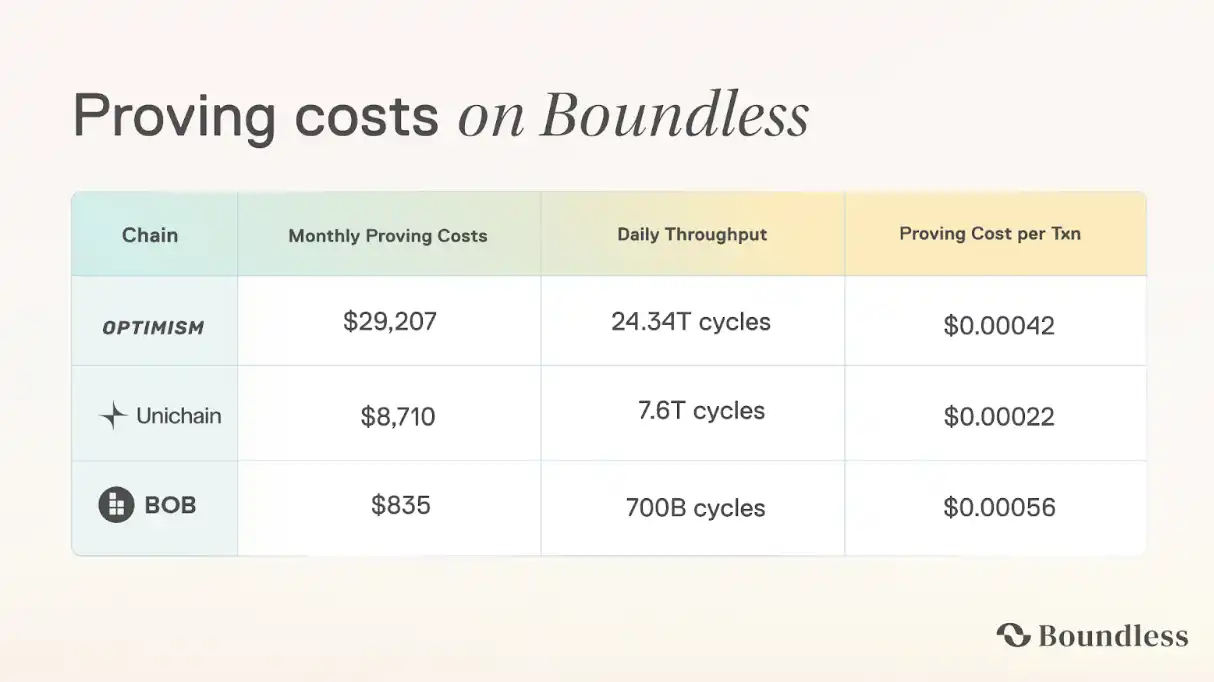
· Based on current throughput, Boundless can provide proof services for OP Mainnet of about $29,000 per month (24.34T cycles/day), for Unichain about $8,700 (7.26 trillion cycles/day), and for BOB about $835 (700 billion cycles/day); as further optimizations are rolled out, costs will decrease significantly.
· Currently, Rollups such as BOB, SOON, MegaETH, etc., are using Boundless on the mainnet.
Rollups have brought true scalability to Ethereum and the broader blockchain ecosystem. They have repeatedly demonstrated that detaching execution from the Ethereum main chain is feasible, and user experience can continue to improve without sacrificing decentralization.
However, as more and more chains come online, the value carried by Rollup continues to grow, raising an unavoidable question:
Who is ultimately responsible for the security of Rollup itself?
For a long time, Optimistic Rollup has been built on the same core assumption:
State submissions are considered valid by default and are only overturned when successfully challenged.
This design is simple and elegant, but the costs are equally clear:
A challenge period of up to 7 days, a complex and fragile interactive dispute process, and high capital lock-up costs.
These issues have slowed down capital movement, increased the risk for the counterparty, and forced users to turn to more centralized bridging solutions in exchange for faster asset turnover.
As the ecosystem matures, the direction is clear.
The next step is not to abandon Optimistic Rollup, but to upgrade them.
Rollups Solution Endorsed by Boundless
Boundless's Rollup solution provides an upgrade path for OP-based Rollups that leads directly to fast finality and Stage 2 readiness.
It is a direct upgrade on the Optimistic model, replacing the original interactive dispute process with ZK. This is the first ZK-based non-interactive dispute resolution solution to land in the OP chain system.
Within the same unified framework, Boundless supports both ZK Fault Proof and Validity Proof.
A Rollup can initially run in ZK Fault Proof mode, ensuring efficiency while significantly shortening finality. When faster confirmation speeds are required, the full Validity Proof can be enabled. Moreover, it can smoothly switch between the two modes as needed.
All of this is supported by the Boundless Network. As the world's largest proof network, Boundless provides massive proof power for Rollups while inheriting the decentralization and liveness guarantees of the selected settlement chain.
Flexible Security Model
Boundless offers a configurable security system that can be adjusted based on the actual needs of different OP Rollups:
ZK Fault Proof Mode
Adopting a non-interactive ZK dispute mechanism, disputes only require a single ZK proof to reach a decision, completely eliminating the binary game process and shortening finality from 7 days to about 24 hours.
Validity Proof Mode
Before final block confirmation, every block is verified, no longer relying on a dispute process, thus achieving minute-level finality.
Teams can start from a hybrid mode at almost zero cost, upgrade to Validity Proof when conditions are right, and even freely switch between the two modes as cost structures or business requirements change. This flexibility allows Rollup to maintain full control between performance and cost while preparing in advance to meet the proof standards required for Stage 2.
Core Advantages of Boundless Network
The Boundless Network enables proof generation that truly embodies scalability and predictability.
Unprecedented Proof Capacity
Boundless is currently the only network that utilizes a permissionless proof-of-stake incentive mechanism, ensuring continuous and available compute power. The current network can deliver 4 trillion cycles of proof per day, a scale 46 times larger than other proof networks.
Highly Competitive Proof Cost
By aggregating idle and highly optimized hardware resources, Boundless significantly reduces the marginal cost of a single proof. Developers can achieve near dedicated system performance without the need to self-host or maintain infrastructure.
On Boundless, the median cost per billion cycles is only $0.04.
No Introduction of New Trust Assumptions
Boundless adopts a smart contract-centric design, directly inheriting the security of the developers' chosen settlement layer (such as Ethereum, Base), rather than imposing additional trust assumptions.
Natively Anti-Fragile Design
Boundless is composed of independent provers and validators from multiple chains, without relying on any centralized nodes. Even in network congestion or attack scenarios, the system can maintain stable operation. The functioning of the entire market also does not depend on the core team running any critical infrastructure.
It is these characteristics that make Boundless the only network currently capable of meeting the comprehensive requirements of high-performance Rollups for proof capacity, cost, and stability, a performance that self-hosted solutions or more centralized proof networks find challenging to achieve.
Median cost per billion cycles on Boundless: $0.04
Enabling True ZK Rollup Implementation
For a long time, the high cost of ZK Proof has been a core bottleneck limiting its large-scale application, and Boundless is changing this status quo.
By integrating Rollup into the Boundless Network, the proof cost has been significantly reduced, making continuous large-scale Validity Proof on the mainnet a feasible option.
At the current throughput level, Boundless can provide proof services of approximately $29,000 per month for OP mainnet (24.34 trillion cycles/day), approximately $8,700 for Unichain (7.26 trillion cycles/day), and approximately $835 for BOB (700 billion cycles/day). These data demonstrate that Boundless can achieve efficient and stable scalability across Rollups of different scales.
Currently, the median proof cost per billion cycles on Boundless is $0.04.
Verified on Real Network
Boundless's Rollup solution is not a concept-stage solution but has already started operating on a real network.
· BOB is building a hybrid Rollup, bringing programmability to the Bitcoin ecosystem, allowing developers to inherit Bitcoin's security while enjoying the flexibility of Ethereum smart contracts.
· MegaETH is a next-generation high-performance Rollup designed for real-time applications, constantly challenging the limits of throughput and latency. SOON is an SVM-based Rollup system aimed at bringing Solana-level performance to more ecosystems.
These projects all rely on Boundless, using ZK mechanisms to replace the original interactive dispute process, significantly reducing withdrawal waiting times.
"Interactive proof is costly, structurally fragile, and easily abused. [Boundless] eliminates the risk of malicious blocking and ensures that dispute resolution is both efficient and scalable." — MegaETH Team
Build the Future of Your Rollup in Advance
Whether it's an OP architecture or a customized Rollup design, Boundless provides a universal foundation for scalable proof-based infrastructure.
Boundless's Rollup solution enables every team to use ZK proofs to secure their own chain, drive Rollup from "optimistic proof" to "verifiable security," achieve faster finality, gain stronger security, and smoother cross-ecosystem collaboration.
This article is a contribution and does not represent the views of BlockBeats.
Welcome to join the official BlockBeats community:
Telegram Subscription Group: https://t.me/theblockbeats
Telegram Discussion Group: https://t.me/BlockBeats_App
Official Twitter Account: https://twitter.com/BlockBeatsAsia