Trump Waved His Hand, Stirring the Venezuelan Game Hurricane
You never know what impact a butterfly flapping its wings may have, causing a hurricane halfway around the world.
On the 9th day after the United States raided Venezuela and arrested its president Maduro, a game called RuneScape once again made history. On this day, the peak concurrent player count of RuneScape exceeded 258,000, the highest in the game's 25-year history.
Two seemingly unrelated events magically intertwined.
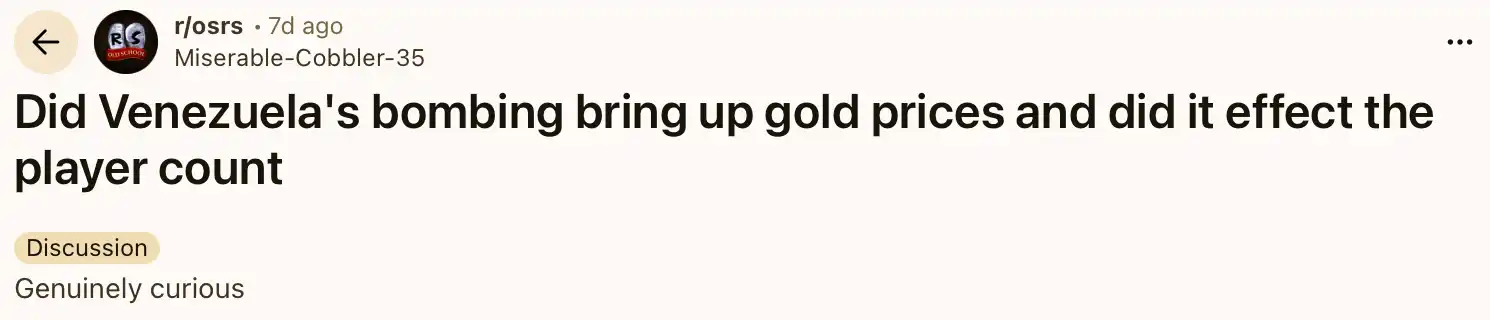
"Will the U.S. attack on Venezuela cause a rise in RuneScape's gold price and player count?"
While the world focused on the international oil price or the Venezuelan stock market due to the turmoil in Venezuela, RuneScape players were watching the in-game gold prices, item values, and the fluctuation of RuneScape's player base.
If Maduro "leaving" Venezuela marked the end of an era, then Venezuelan players "leaving" RuneScape also marked the end of an era.
The end of an era only signifies that history moves forward eternally and ruthlessly, not necessarily equating to new hope. Venezuelans, RuneScape, and cryptocurrency—the intense interplay of these three elements told a story of survival and escapism.
Survival
Due to oil, Venezuela was once one of the wealthiest countries in South America, but starting in 2013, the country's economy began to collapse.
The collapse was like a snowball rolling down from the mountaintop, continuously growing and accelerating. Between 2013 and 2021, Venezuela's GDP had plummeted by around 75% - 80%, making it the most severe economic collapse globally in the past 45 years for non-war reasons, surpassing the scale of the Great Depression in the U.S. and the collapse of the Soviet Union. By 2021, 95% of Venezuelans lived below the poverty line, with 77% in extreme poverty.
In August 2018, on the eve of the Venezuelan currency "Bolívar" revaluation, the annual inflation rate in this country had already exceeded 48,000%. In just four months, the black-market exchange rate of the Bolívar to the U.S. dollar plummeted from 1 million:1 to about 7 million:1, rendering banknotes practically worthless.
In this crumbling existence, Venezuelans found RuneScape. At this time, the exchange rate of the in-game currency "gold" to the US dollar in Old School RuneScape (hereinafter referred to as OSRS) was approximately 100-125 million:1, much more valuable and stable than the bolívar.
Although OSRS was launched in 2013, it is actually a fork of the August 2007 version of RuneScape. The company behind the game, Jagex, made an attempt to bring back the old version to the modern age to reverse player churn and negative reactions to updates.
This attempt unexpectedly succeeded, and OSRS has since continued to grow, keeping the RuneScape IP thriving. This attempt also unexpectedly had a sense of destiny because it is an old version that can be played through a web browser with low computer hardware requirements, allowing a large influx of Venezuelan players to work in this virtual game world to address real-world survival challenges.
On YouTube, there is an old video published in February 2018 showing gameplay of OSRS on a Canaima laptop with only 2GB of RAM. In the 2010s, the Venezuelan government distributed millions of free Canaima laptops to students to aid in their education.
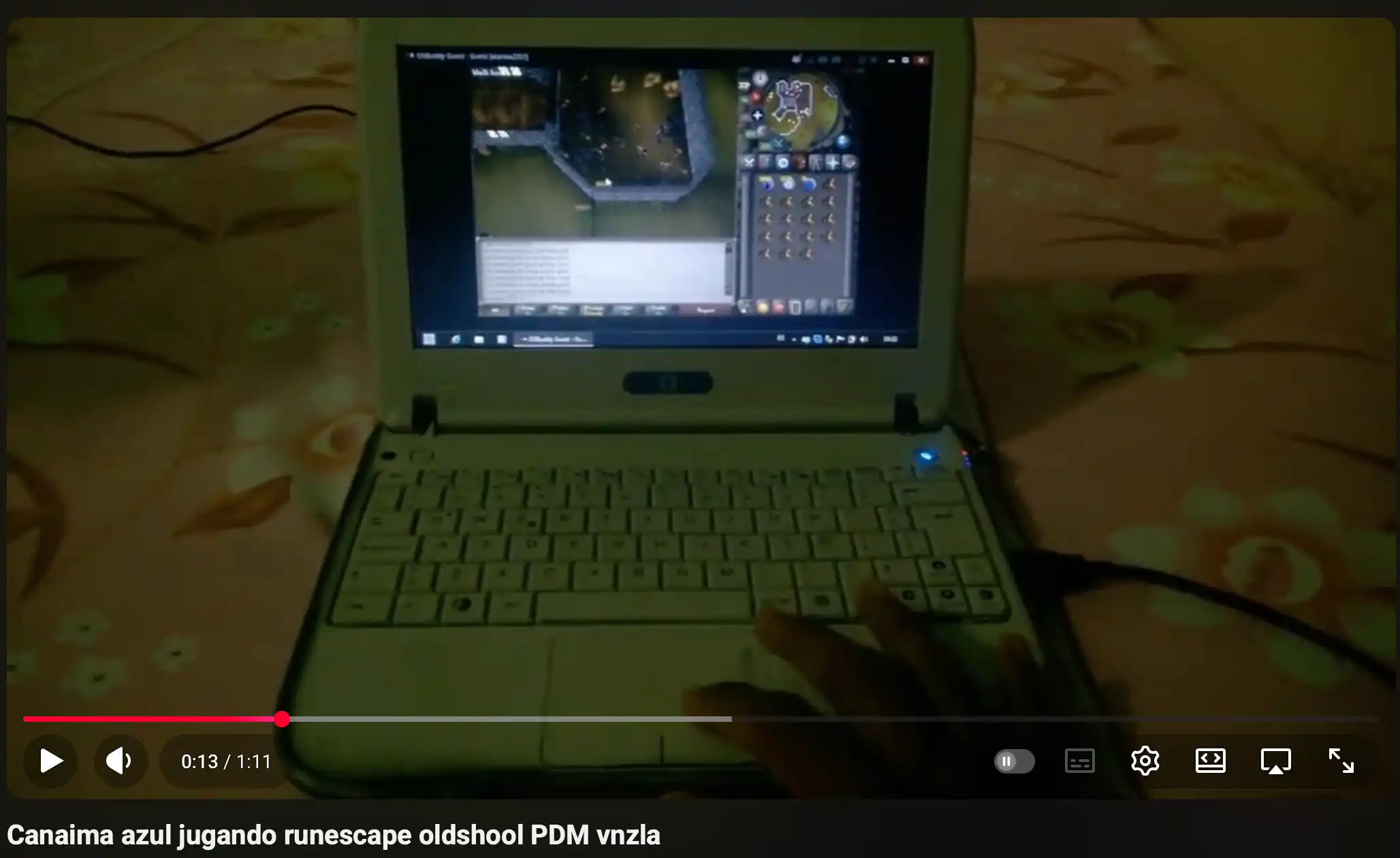
Who would have thought that knowledge could not help these children change their destiny in the face of the country's decline, but this computer, with very limited capabilities, helped these children breathe in the face of survival difficulties.
Venezuelan players started using OSRS to address livelihood issues at least as early as 2017 because in September 2017, a Reddit post teaching OSRS players how to kill Venezuelan players in the game's "East Dragons" area went viral and later became an important part of OSRS meme culture:
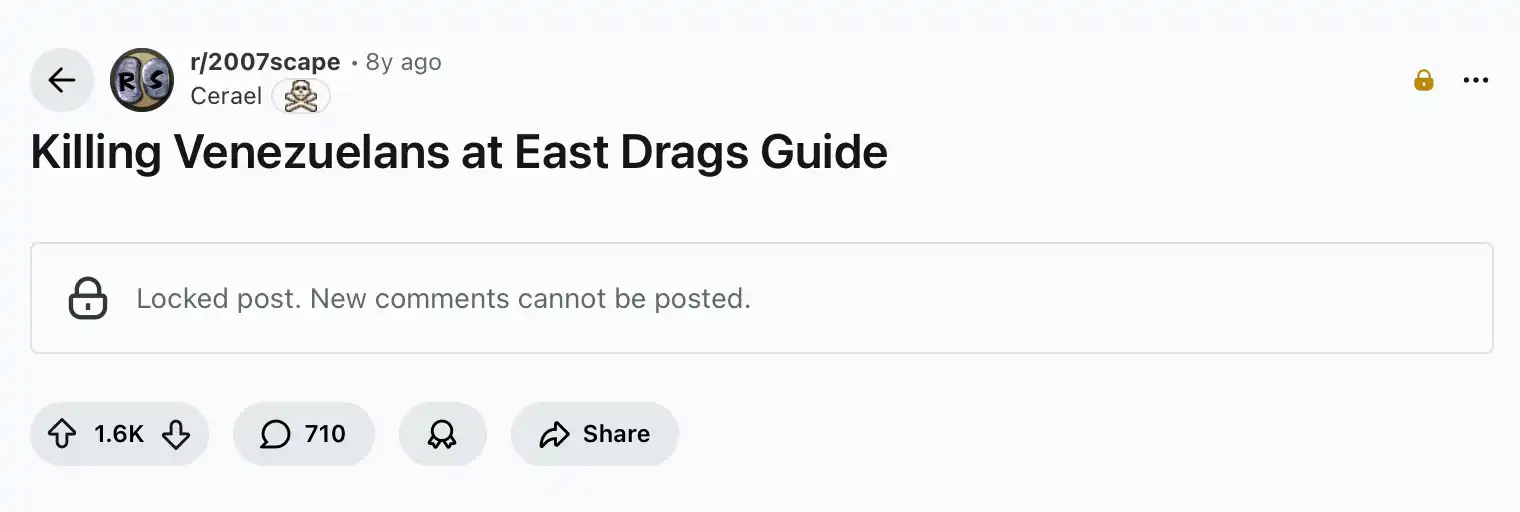
The "East Dragons" refer to the eastern part of the "dragon killing area" in OSRS where a monster called "green dragon" spawns, and Venezuelan players once crowded there from 2017 to 2019. They intensely continuously killed dragons, took the dragon bones and hides dropped by green dragons to sell on the RuneScape Grand Exchange for gold coins, and then converted the OSRS gold coins into bitcoin or other cryptocurrencies for cashing out.
According to a post by the user "fisherman" on Steemit in August 2017, farming Green Dragons for an hour can earn 500,000 OSRS coins, which is roughly 0.5 USD. This lucrative method even made it to a national newspaper in Venezuela:
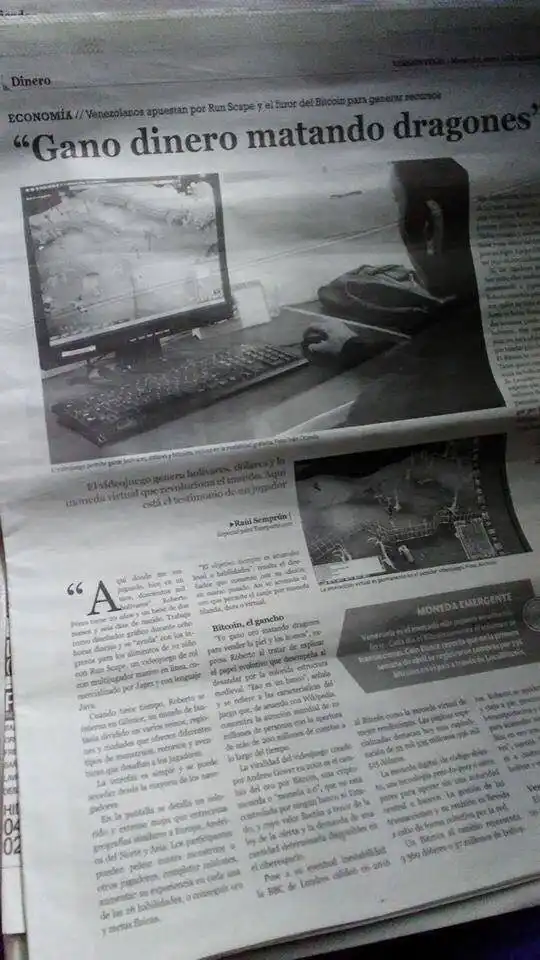
High-level players, on the other hand, would farm another winged giant snake boss named "Zulrah," increasing their hourly income to 2-3 USD. This hourly rate is already higher than what most college-educated individuals in Venezuela earn.
A few years ago, Venezuelan players engaging in OSRS gold farming were at their peak, and several English media outlets interviewed them. Those interviewed commonly reported earning over $100 per month from OSRS, while their parents earned only around $10 a month. In their view, OSRS was highly popular among Venezuelans, considered a mainstream way of earning money that could help support their families and shield their hard work from the impacts of Bolivar devaluation.
Similar to how we see many domestic helpers in Hong Kong fulfilling household tasks, Venezuelan players in the world of OSRS filled the labor-intensive, monotonous process of monster grinding and leveling/collecting. Besides farming dragons, snakes, and deer and collecting various materials, Venezuelan players also engaged in power-leveling skills and crafting items for others. However, unlike domestic helpers in Hong Kong who can leisurely gather for coffee on the streets, Venezuelan players, due to Jagex's crackdown on real-world trading of in-game items, operated multiple burner accounts to mitigate the risks of being banned.
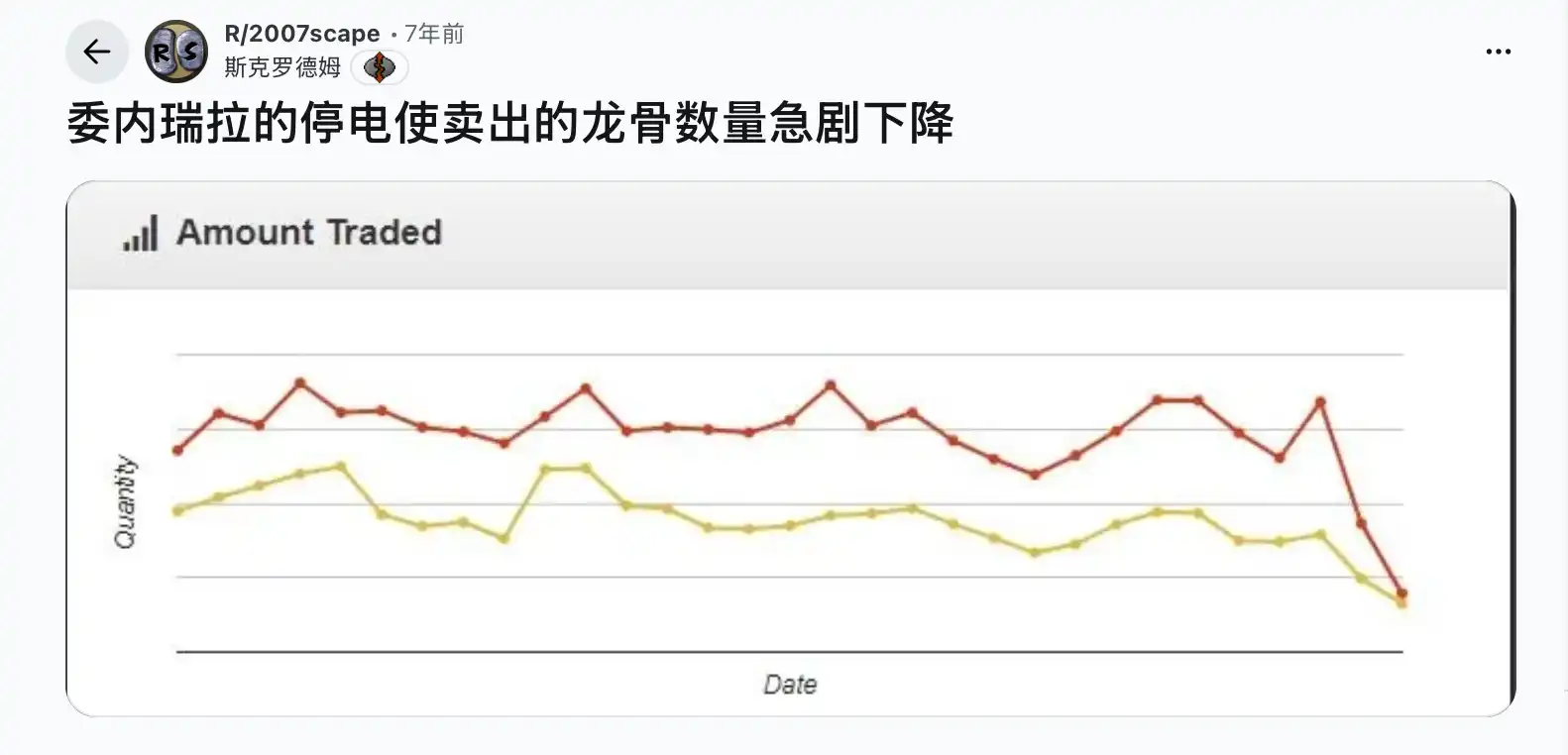
In March 2019, Venezuela experienced a nationwide blackout. During those days, Green Dragons lost their most loyal slayers, causing a drastic drop in dragon bone supply in the market, leading to price hikes.
Players' attitudes toward these Venezuelan gold farmers can be described as complex. On one hand, Venezuelan players are generally known for their manual grinding efforts. Unlike players from other countries or regions who may scale up through studio-based work, they genuinely earn gold by playing fairly and manually like other players but solely for survival. Sometimes, more casual players even think that the presence of Venezuelan players actually enhances their gaming experience as they, not willing to grind too hard, can enjoy the game more affordably.
On the other hand, this kind of profit-seeking behavior will definitely affect the normal player's gaming experience and the game's economy. Venezuelan players, acting in the world of OSRS for real-life survival, will also affect the survival of the OSRS world. Over the years, the perception of Venezuelan players on Reddit has always been a topic of debate, with anonymous malice and, at the same time, anonymous warmth.
Until the Venezuelan players left.
Escape
In today's OSRS world, only the legend of Venezuela can be heard, and the former gold farmers are nowhere to be seen.
Starting in 2023, Venezuelan players began to gradually leave OSRS. While Venezuela's economy continued to crumble, the price of gold in OSRS also experienced a decline. Those tireless bots, free from the need for rest, began to compete with the manual Venezuelan players, causing a surge in OSRS gold production, accompanied by a corresponding plummet in gold prices. Currently, the price of OSRS gold against the US dollar is approximately 1 million gold: $0.16 - $0.2.
For Venezuelan players, gold farming did not stop; it just moved to a more cost-effective place — they turned to games like Tibia, Albion Online, World of Warcraft, continuing to seek a livelihood in the virtual world for the real world.
But there will always be someone asking, "Is this kind of life right?" So, some players resolutely left these virtual game worlds, and even left their countries in the real world.
According to the latest data from early this year, about 7.9 million Venezuelans have fled the country, making it one of the largest refugee crises in Latin America and globally. In English-language media, we can see some interviews with Venezuelans who escaped from Venezuela by earning money through OSRS.
José Ricardo, an OSRS gold middleman, earned profits by buying OSRS gold and reselling it to buyers. When interviewed a few years ago, his monthly income ranged from $800 to $1200. He invested these profits in cryptocurrency and had the money needed for vacations in Brazil, Colombia, and Trinidad and Tobago. He still lives in Venezuela, but that is just one option; he is unwilling to let his life stay in one place forever and on one thing.
Victor Alexander Rodriguez, who, since early 2017, decided to play OSRS for 14 hours a day with his sister to earn money to help with household expenses. At the beginning of gold farming, he had discussed with his sister, "One day, we will leave." They worked together to raise $500 through OSRS and went to Peru in 2018. Later, he became a security guard, earning a higher salary than gold farming in OSRS. During his downtime, he occasionally returns to the OSRS world on his phone, only this time, he is truly an enjoying player.
But not every escape story is so rosy. Bran Castillo once described the experience of a friend of a friend who earned enough money to escape to Peru thanks to OSRS, continued playing OSRS in Peru, but the income level that was sufficient in Venezuela was no longer enough in Peru. Venezuelan players on Reddit have answered questions in this regard, noting that while their public services have quality issues (most notably, the first time they logged into OSRS was using mobile data because the broadband copper wires had been stolen), they hardly need to spend money, and the money they earn mainly solves food and shelter needs.
There are even darker rumors circulating, suggesting that some Venezuelan female OSRS players, after escaping the country, didn't know how to sustain themselves and turned to...
OSRS players have a belief-like saying, "This game never ends; you are not leaving, you are just taking a break."
And the most touching blessing I've seen is, "Hopefully, one day, we all have nothing to worry about beyond the joy of the game."
Conclusion
The relationship between Venezuela and the cryptocurrency industry is so numerous and so deep. Now, we eagerly discuss the potential 600,000-bitcoin reserve of the Maduro regime; we deeply analyze why Venezuela's once-issued "oil-pegged coin" failed; we delve into the economic and daily life changes after USDT became widely adopted as the local currency...
But this time, as we try to find the "human" stories instead of starting from the "industry macro" phenomenon and perspective, we see how cryptocurrency and a 25-year-old game have helped Venezuelans solve livelihood problems. In the virtual world's entanglement, emotional conveyance and battles, all for real-world survival or to escape that damn destiny.
If it weren't for cryptocurrency overcoming geographical, linguistic, and cultural barriers, converging on a significant global value consensus, providing a solid foundation of world-class trust at the settlement level, the story of OSRS and Venezuela might not have unfolded.
Whether struggling to maintain a crumbling life in the virtual world or double escaping the virtual and real worlds to chase new hope, these seemingly individual mundane choices have actually driven industry advancement.
Their stories slowly fade away in OSRS and merely pass by and quietly leave in the cryptocurrency industry, but they represent the real bitterness behind the industry's progress.
Welcome to join the official BlockBeats community:
Telegram Subscription Group: https://t.me/theblockbeats
Telegram Discussion Group: https://t.me/BlockBeats_App
Official Twitter Account: https://twitter.com/BlockBeatsAsia